Pentecost 12—August 31, 2025
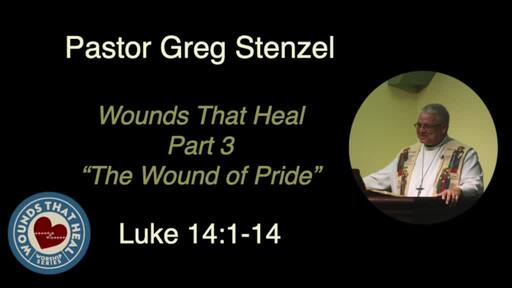

Notes
Transcript
Wounds That Heal, Part 3 –
Wounds That Heal, Part 3 –
The Wound of Pride
The Wound of Pride
Text: Luke 14:1, 7–14
Date: August 31, 2025
In the name of Jesus. Amen.
In the name of Jesus. Amen.
There are some moments in life that are simply unforgettable because of the embarrassment involved.
Imagine this: A wedding reception is underway. Guests are milling around, waiting to be seated. You walk into the hall and see the beautifully decorated head table. Without thinking—or maybe with too much thinking—you march right up and sit yourself down next to the bride and groom. Everyone watches. People whisper. Then the best man arrives, and the maid of honor, and suddenly you realize: you don’t belong there. And to your horror, the bride leans over and gently says, “I’m sorry, but those seats are reserved. You’ll need to move.” And now, with everyone watching, you shuffle down to the last seat in the hall.
The shame burns. The humiliation is unforgettable.
That’s exactly the picture Jesus paints in our Gospel lesson today. He is at a Sabbath banquet in the home of a Pharisee. All around Him, the invited guests are scrambling for the best seats, the seats of honor, the places where people will notice them. It is pride on display in its rawest form.
And Jesus uses that moment to teach a hard truth: “Everyone who exalts himself will be humbled, and he who humbles himself will be exalted.”
This morning, we come face to face with the wound of pride. And as we’ve been seeing throughout this series, Jesus takes our wounds—even the wounds we inflict on ourselves—and He turns them into places of healing.
Here is our theme:
Christ heals the wound of pride by humbling Himself to lift us up.
I. Pride Disfigures Us (vv. 1–6)
I. Pride Disfigures Us (vv. 1–6)
The scene begins with Jesus entering the home of a Pharisee for a Sabbath meal. But Luke tells us, “they were watching Him closely.” This was not a friendly dinner invitation. It was a setup.
Right there before Jesus is a man suffering from dropsy—what today we would call severe edema, swelling from fluid retention. His body is puffed up, disfigured, grotesque to look at. And the Pharisees placed him there as bait, to see if Jesus would heal on the Sabbath.
But the man’s condition is a vivid parable of pride. Just as his body was swollen with fluid, so the Pharisees were swollen with self-importance. Pride puffs us up. It distorts our true condition.
Pride deceives us. It whispers, “You are superior, more deserving.” It insists, “Promote yourself.” Pride swells the heart, blinding it to its sickness.
And isn’t that us? We may not jostle for literal seats of honor at a banquet, but how often do we angle for recognition? How often do we measure our worth by comparison with others? How often do we withhold kindness from those who cannot benefit us, while showing favoritism to those who might advance us?
James addresses this head-on in our Epistle: “My brothers, show no partiality as you hold the faith in our Lord Jesus Christ.” But the church to whom he wrote was tempted to give the best seats to the rich man in fine clothes, while pushing the poor man to the side. Why? Because of pride—because they thought their status could rise if they were seen with the powerful.
The truth is, pride disfigures us. Like dropsy, it makes us sick. Like a cancer, it eats away at the soul. And worst of all, pride separates us from God, because pride leaves no room for grace.
II. Pride is Humbled by God (vv. 7–11)
II. Pride is Humbled by God (vv. 7–11)
Jesus tells His parable about the wedding feast not to give us etiquette lessons, but to confront us with reality: pride ends in humiliation.
“Everyone who exalts himself will be humbled.” That’s not just a possibility—it’s a certainty. God Himself will see to it. Pride before others eventually leads to shame. Pride before God leads to judgment.
Proverbs says it well: “Do not put yourself forward in the king’s presence, or stand in the place of the great, for it is better to be told, ‘Come up here,’ than to be put lower in the presence of a noble.”
Pride always overreaches, and sooner or later it is cut down.
And if we’re honest, we know this from experience. We’ve seen how pride damages friendships. We’ve seen how arrogance destroys families. We’ve seen how conceit poisons workplaces. And spiritually, we know how pride cuts us off from God, because pride refuses to repent. Pride says, “I don’t need forgiveness. I’m right; everyone else is wrong.”
The Law exposes us here.
Pride is rebellion.
Pride is idolatry of the self.
Pride makes us believe that we deserve exaltation.
And God says, “No. I oppose the proud, but I give grace to the humble.”
That is the wound of pride laid bare. We need more than advice. We need rescue.
III. Christ’s Humility Heals Our Pride (vv. 12–14)
III. Christ’s Humility Heals Our Pride (vv. 12–14)
Jesus doesn’t simply warn us of pride’s dangers; He points us to Himself as the remedy. None of us naturally give without expecting something in return. Yet Christ came for those who are 'poor, crippled, blind, and lame'—spiritually destitute and unable to repay.
He, who deserved the highest honor, chose the lowest place. “Though He was in the form of God,” He became a servant, humbling Himself to death on a cross (Philippians 2). He didn't answer humanity's pride with wrath but with the humility of bearing our sin.
Can you picture it? The eternal Son of God—robed in majesty, worshiped by angels, enthroned from all eternity—willingly takes the lowest place.
When He is born He is placed in a manger instead of a palace.
He works at a carpenter’s bench instead of a throne.
He chooses the cross instead of a crown.
On the cross, Jesus endured humiliation to the point of death, but God exalted Him above all. Through Him, our pride is put to death. In Christ, we receive exaltation by grace, not through our merit.
And here’s the miracle: He shares that glory with you. He says to every sinner humbled at the foot of the cross, “Friend, move up higher.”
That’s the promise tucked inside His parable: “You will be repaid at the resurrection of the righteous.” Not because you earned it. Not because you climbed to it. But because He descended to raise you up.
Therefore, when Jesus invites the marginalized, He illustrates His own redemptive work for us. Christ was humbled for you, and in Him, our exaltation is secured.
This is the heart of the Gospel:
Christ heals the wound of pride by humbling Himself to lift us up.
IV. Freed for Humble Service
IV. Freed for Humble Service
But notice how Jesus ends His teaching. He turns to the host and says, “When you give a banquet, don’t invite your friends and rich neighbors who can pay you back. Invite the poor, the crippled, the lame, the blind. And you will be blessed, because they cannot repay you. You will be repaid at the resurrection of the righteous.”
Think about it: Who are the “poor, crippled, lame, and blind” in your life? They may not be physically impaired, but perhaps they are the people who can’t give you anything in return—the overlooked, the lonely, the difficult, the ones society ignores. Jesus says: serve them. Love them. Invite them.
And why? Because that’s exactly what He did for you. We are the poor, the crippled, the blind in sin—and yet Christ has welcomed us to His table. Now we, in turn, are freed to welcome others.
This is why Christian love is different from the world’s love. The world gives in order to receive. The world serves in order to gain. But Christians give because Christ has already given us everything. We serve not to be noticed, but because we are noticed—noticed by God, claimed as His own in Christ.
Conclusion
Conclusion
Friends, pride runs deep—it disfigures and condemns. But in Christ, our wounds are healed. Though pride leaves us empty, Christ fills us with forgiveness and lifts us into His kingdom.
So today, hear again His promise:
“Everyone who exalts himself will be humbled, and he who humbles himself will be exalted.”
That is not just a proverb for polite living.
It is the very Gospel of Jesus Christ.
It is the pattern of His life, death, and resurrection.
It is the promise given to you in Baptism, and
it will be fulfilled completely on the Last Day.
Until then, we live in the freedom of His humility. We serve in the joy of His exaltation. We love because He first loved us.
So walk humbly with your God, confident that in Christ your wound of pride is healed, your shame is lifted, and your place in His kingdom is secure.
In the name of Jesus. Amen.
In the name of Jesus. Amen.
Prayers of the Church – August 31, 2025
Prayers of the Church – August 31, 2025
The Wound of Pride – Luke 14:1, 7–14
P: Let us pray for the whole Church of God in Christ Jesus, and for all people according to their needs.
For the Church
For the Church
P: Almighty God, You have called Your Church to live in humility, following the way of Christ who took the lowest place to save us. Guard Your Church from pride, arrogance, and self-exaltation. Grant to pastors, teachers, and all servants of Your Word faithfulness and humility, that they may proclaim Christ crucified as the only hope of the proud and the humble alike.
C: Lord, in Your mercy, hear our prayer.
For Our Nation and Communities
For Our Nation and Communities
P: Gracious Lord, You order all things for the good of those who love You. Bless our leaders with wisdom and humility, that they may serve with justice and compassion. Guard our communities from division, prejudice, and violence. Establish peace where there is strife, and restore dignity where pride has caused harm.
C: Lord, in Your mercy, hear our prayer.
For Annunciation Catholic Church & School, Minneapolis
For Annunciation Catholic Church & School, Minneapolis
P: Merciful Father, we grieve the tragic shooting at Annunciation Catholic Church and School in Minneapolis. We commend to Your care the two children who were killed, asking You to comfort their families with the hope of the resurrection. Be with those who were injured; grant them healing of body and spirit. Surround the entire Annunciation community—students, families, teachers, staff, and clergy—with Your steadfast love. Protect them from fear and despair, and use even this wound to draw them closer to Christ, who bore the wounds of all.
C: Lord, in Your mercy, hear our prayer.
For the Sick, the Grieving, and Those in Need
For the Sick, the Grieving, and Those in Need
P: Compassionate Lord, You drew near to the suffering and the broken. Be with all who are sick, hospitalized, or recovering, especially Mike Hafele, Cal Bauer, and Dorothy Polson who is under hospice care. Comfort and encourage our brothers and sisters who are resident at Bethel Home: Brian Cole, Myrtle Erdman, Kathy Haugjorde, Marie Poole, and Alma May Price, and especially all whom we name before You in our hearts… [pause]. Strengthen them in faith, grant them healing as You will, and remind them of the honor that awaits all who are united with Christ in His death and resurrection.
Comfort those who grieve, especially Kevin Beard and his family at the death of his sister, Cindy, and Leslyan and Lester Ronholdt family as they mourn the death of her dad, Ken Moen. Remind all the sorrowing that nothing can separate us from the love of Christ Jesus our Lord.
C: Lord, in Your mercy, hear our prayer.
For Humble Service
For Humble Service
P: Lord Jesus, You welcomed the poor, the lame, the blind, and those who could not repay You. Give us hearts of humility to love and serve those who are overlooked, neglected, or despised. Teach us to see others as You see them—precious and beloved—and to invite them into the joy of Your kingdom.
C: Lord, in Your mercy, hear our prayer.
Closing Collect
Closing Collect
P: Into Your hands, O Lord, we commend all for whom we pray, trusting in Your mercy, through Jesus Christ our Lord Who taught us to pray…
C: Our Father….
