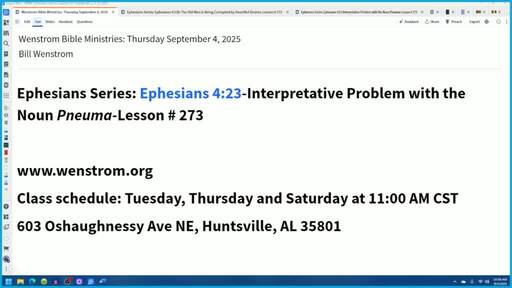
Ephesians 4.23-Interpretative Problem with the Noun Pneuma

Wenstrom Bible Ministries
Pastor-Teacher Bill Wenstrom
Thursday September 4, 2025
Ephesians Series: Ephesians 4:23-Interpretative Problem with the Noun Pneuma
Lesson # 273
Ephesians 4:23 Each and every one of you as a corporate unit were taught to make it your habit of replenishing your human spirit, that is, your regenerate mind. (Lecturer’s translation)
There is an interpretative problem, which is very difficult with regards to the noun pneuma (πνεῦμα) since some exegetes argue for the Holy Spirit as the referent of this word while others argue for the church age believer’s human spirit.
There is also a problem with identifying the syntactical relationship of this word in relation to the verb ananeoō (ἀνανεόω) and the noun nous (νοῦς), which modifies it.
Those who interpret the referent of the noun pneuma (πνεῦμα) as the Holy Spirit view it as functioning as a dative of personal agency while those who interpret the referent of this word as the human spirit view it as either a dative of reference or dative of sphere or location.
Those who argue for the Holy Spirit as the referent support their view by pointing out that up to this point in the epistle, the Holy Spirit is always the referent of this word (Eph. 1:13, 17; 2:2, 18, 22; 3:5, 16; 4:3 and 4).
The only exception is Ephesians 2:2 where the referent is the devil.
Furthermore, this interpretation would make the Holy Spirit as the expressed agency of the passive form of the verb ananeoō (ἀνανεόω) with the noun nous (νοῦς) functioning as a genitive of reference indicating that this replenishing is “with reference to” the believer’s regenerate mind.
I interpret the noun pneuma (πνεῦμα) as referring to the church age believer’s human spirit, which is the nature and mind of Christ, which they received at the moment of justification through the regeneration performed by the Holy Spirit.
The noun nous (νοῦς) pertains to the particular manner or way of thinking and denotes an attitude, practical reasoning or intellect that enables a person to arrive at a conclusion regarding a matter.
The referent of this word is the church age believer’s regenerate mind, which is in fact the mind of Jesus Christ, which they received at justification through the regenerate performed by the Holy Spirit.
The noun pneuma (πνεῦμα) functions as a dative direct object, which indicates that the believer’s human spirit receives the action of being replenished when they exercise faith in the Spirit inspired Scriptures, which produces obedience to the various commands and prohibitions in the Spirit inspired Scriptures.
Paul put this word in the dative case rather than the accusative case because he wants to emphasize the personal relations between their volition and their human spirit, which he identifies as their regenerate mind, which itself is the mind of Christ (cf. 1 Cor. 2:16).
Therefore, Paul put this word pneuma (πνεῦμα) in the dative case rather than the accusative case because he wants to emphasize the personal relationship between the church age believer and Jesus Christ.
He wants the mind of Christ who is the last Adam to gain greater dominance over their souls than their unregenerate mind, which received at the moment of physical birth through the imputation of Adam’s original since in the Garden of Eden.
The noun nous (νοῦς) is functioning as a genitive of apposition or epexegetical genitive, which which means that it specifies what Paul means when he uses the articular form of the noun pneuma (πνεῦμα).
Therefore, the noun nous (νοῦς) is identifying or describing the believer’s human spirit as being their regenerate mind, which is the mind of Christ.
As has been the case throughout this epistle, the referent of the genitive second personal plural form of the personal pronoun su (σύ) is the recipients of this epistle who Paul describes here in Ephesians 2:11 as Gentile Christians.
The word means “each and every one of you as a corporate unit” or “all of you without exception” because it not only refers to these Gentile Christians as a corporate unit but is also used in a distributive sense emphasizing no exceptions.
In other words, it not only refers to them as a corporate unit but also as individuals.
The articular construction of the noun nous (νοῦς) is employed with the genitive second personal plural form of the personal pronoun su (σύ), which indicates that this regenerate mind “belongs to” or is “the possession of” the members of the Gentile Christian community in the Roman province of Asia who are the recipients of this epistle.
Therefore, to summarize, the noun pneuma (πνεῦμα) is a reference to the believer’s human spirit and as the direct object of the verb ananeoō (ἀνανεόω).
The noun nous (νοῦς) identifying the believer’s human spirit as being the mind of Christ, which they received through the regeneration performed by the Holy Spirit at their justification.
The Holy Spirit is the unexpressed but implied agency from Ephesians 3:16 who replenishes the believer’s human spirit or regenerate mind when they exercise faith in the Spirit inspired Scriptures, which appropriates the Spirit’s omnipotence to obey the various commands and prohibitions in the Spirit inspired Scriptures.
Therefore, the interpretation of the expression tō pneumati tou noos hymōn (τῷ πνεύματι τοῦ νοὸς ὑμῶν) as a reference to the Holy Spirit is tenuous at best for several reasons.
First, the genitive modifier nous (νοῦς) is very difficult reconciling with the referent of the noun pneuma (πνεῦμα) since it would require the former to function as a genitive of reference and the latter to function as a dative of sphere or reference.
This would leave the verb ananeoō (ἀνανεόω) with no explicit object.
It would also express the idea that the recipients of this epistle were taught to replenish “in the sphere of” or “with reference to” the Holy Spirit “with reference to” the believer’s regenerate mind.
It is hard to believe that Paul would express a very important point with his readers with such weak language.
Therefore, my interpretation of the expression tō pneumati tou noos hymōn (τῷ πνεύματι τοῦ νοὸς ὑμῶν) as being a reference to the believer’s human spirit makes the most sense because it would have Paul saying that the recipients of this epistle were taught to replenish their human spirit, that is, their regenerate mind.
With this interpretation, both the nouns pneuma (πνεῦμα) and nous (νοῦς) have the same referent with the former receiving the action of the verb ananeoō (ἀνανεόω) and the latter defining further the former.
The noun pneuma (πνεῦμα) receives the action of this verb and the noun nous (νοῦς) modifies it giving a different description.
Thus, there is a lot less exegetical gymnastics involved with this interpretation.
