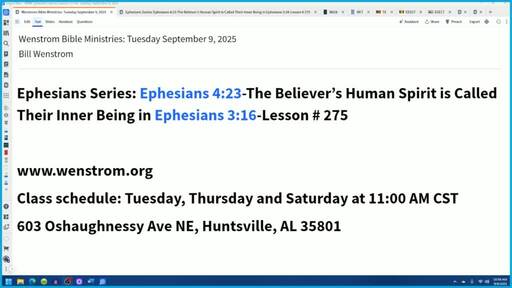
Ephesians 4.23-The Believer's Human Spirit is Called Their Inner Being in Ephesians 3.16

Wenstrom Bible Ministries
Pastor-Teacher Bill Wenstrom
Tuesday September 9, 2025
Ephesians Series: Ephesians 4:23-The Believer’s Human Spirit is Called Their Inner Being in Ephesians 3:16
Lesson # 275
Ephesians 4:23 Each and every one of you as a corporate unit were taught to make it your habit of replenishing your human spirit, that is, your regenerate mind. (Lecturer’s translation)
The believer’s human spirit or in other words, the new nature of Christ is identified in Ephesians 3:16 by the expression ton esō anthrōpon (τὸν ἔσω ἄνθρωπον), “your inner being.”
In this verse, the noun anthrōpos (ἄνθρωπος) speaks of the unique person of history, Jesus Christ, who is the head of the new creation in contrast to the head of the old humanity whose head is the first human being, Adam.
The articular construction of this noun functions as a possessive personal pronoun referring to the recipients of this letter who Paul identifies in Ephesians 2:11 as Gentile church age believers in the Roman province of Asia.
This expresses the idea that this inner human being is “the possession of” these Gentile church age believers.
This word is modified by the adverb of location esō (ἔσω) which identifies the location of this new humanity or the new head of the human race is located, namely, within the human body and soul of the church age believer.
The noun anthrōpos (ἄνθρωπος) is the object of the preposition eis (εἰς), which functions as a marker of benefaction, which indicates that it is “for the benefit of” the inner new humanity of these church age believers that they are strengthened by means of power through the post-justification work of the Holy Spirit.
This expression ton esō anthrōpon (τὸν ἔσω ἄνθρωπον), which appears in Ephesians 3:16 also appears in Roman 7:22 with the same referent.
Romans 7:22 For you see, I habitually and joyfully agree with God’s Law with respect to my inner man. (Lecturer’s translation)
In 2 Corinthians 4:16, Paul employs a similar expression ho exō hēmōn anthrōpos (ὁ ἔξω ἡμῶν ἄνθρωπος), “our inner person” to refer to the new indwelling nature of Christ.
2 Corinthians 4:16 Therefore we do not despair, but even if our physical body is wearing away, our inner person is being renewed day by day. (NET)
Therefore, these expressions in these three verses all refer to the new Christ nature that the church age believer received through regeneration the moment they were declared justified through faith in Jesus Christ as their Savior.
At the moment a sinner is declared justified by God through faith in Jesus Christ as their Savior, the Holy Spirit creates a human spirit for the imputation of eternal life by God the Father, which makes the believer a new spiritual species meaning they now possess the divine nature.
This is called in theology “regeneration.”
Some expositors argue that this “inner human being” or “man” or “inner person” is not the nature of Jesus Christ, which every church age believer receives at the moment of justification through regeneration by the Holy Spirit.
Many of these expositors believe the inner man or person is speaking of the heart, mind or soul of a person, which are in fact are affected by the temptations of the sin nature.
However, Romans 7:22 makes clear that it is in fact this indwelling nature of Jesus Christ because if you notice, Paul asserts in this verse that he delights in the law of God in this inner man or inner person.
An unregenerate person cannot delight in God’s law but only a regenerate person can delight in it because they are a new creation or new spiritual species because they received the nature of Jesus Christ at justification through regeneration by the Holy Spirit.
Also, notice in Romans 7:23, Paul asserts that the members of his physical body which contain the old Adamic sin nature are waging war against his mind and making him captive to this sin nature, which resides in the genetic structure of the physical body according to Romans 6:6.
Lastly, in 2 Corinthians 4:16 Paul contrasts the physical body, which is corrupted by the sin nature and decaying, with the new nature, which is being renewed day by day.
Therefore, it is better to view this inner person or inner man or inner being as the indwelling nature of Jesus Christ, which gives the church age believer the capacity to love and obey God and His law.
Paul’s Spirit inspired desire that the Father would cause each one of the recipients of this epistle, who were Gentile church age believers, to be given strength by means of power through the personal intermediate agency of the Holy Spirit, would result in this new nature of Christ gaining more and more control over the hearts of these Christians.
Consequently, the indwelling old Adamic sin nature would have less control over their hearts.
Therefore, this is why Paul asserts in Ephesians 3:17 that as a result of the Father answering this prayer request he makes in Ephesians 3:16, Christ will dwell in their hearts through faith.
The apostle Paul mentions the believer’s human spirit in 1 Thessalonians 5:23 in relation to the sanctification of the believer.
1 Thessalonians 5:23 Now, may the one and only God Himself, who produces a peace which is divine in quality and character, cause each and every one of you to be sanctified completely. Correspondingly, may your entire spirit, soul and body be kept blameless at our Lord Jesus Christ’s arrival. (Lecturer’s translation)
So therefore, the human spirit is received at regeneration and enables the justified sinner to understand the grace of God.
The Holy Spirit through the communication of the Word of God reveals the grace of God.
The human spirit is in effect the new nature or Christ nature which enables the believer to understand the things of God.
However, the non-Christian cannot understand the things of God because they only have a soul (cf. 1 Cor. 2:9-16).
Philippians 4:23 May the grace which originates from the Lord Jesus Christ be communicated to your human spirit. Amen. (Lecturer’s translation)
Second Timothy 4:22 May the grace originating from the Lord become united with your spirit. May His grace cause itself to be manifested among each and every one of you. (Lecturer’s translation)
Philemon 25 May the grace originating from the Lord, namely Jesus, who is the Christ become united with the spirit of each and every one of you. (Lecturer’s translation)
