Ephesians 4.24 Completes the Protasis of a First Class Condition
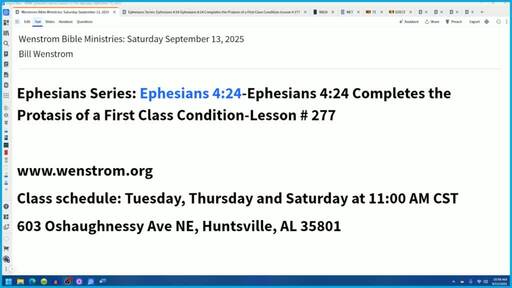

Wenstrom Bible Ministries
Pastor-Teacher Bill Wenstrom
Saturday September 13, 2025
Ephesians Series: Ephesians 4:24-Ephesians 4:24 Completes the Protasis of a First Class Condition
Lesson # 277
Ephesians 4:24 Specifically, each and every one of you as a corporate unit were taught to clothe yourselves with the new man, which has been created in conformity with God’s image by the exemplification of righteousness, yes the exemplification of a holy righteousness as well by means of the one and only truth. (Lecturer’s translation)
Ephesians 4:24 is composed of the following: (1) infinitival clause endysasthai ton kainon anthrōpon (ἐνδύσασθαι τὸν καινὸν ἄνθρωπον), “each and every one of you as a corporate unit were taught to clothe yourselves with the new man. (Author’s translation) (2) attributive participial clause ton kata theon ktisthenta (τὸν κατὰ θεὸν κτισθέντα), “which has been created in conformity with God’s image. (Author’s translation) (3) prepositional phrase en dikaiosynē kai hosiotēti tēs alētheias (ἐν δικαιοσύνῃ καὶ ὁσιότητι τῆς ἀληθείας), “by the one and only truth exemplifying righteousness, indeed by exemplifying a holy righteousness.” (Author’s translation)
Syntactically, the infinitival clause completes the protasis of a first class condition, which began in Ephesians 4:21 and whose apodosis appears in Ephesians 4:20.
This infinitival clause also defines what Paul means when he asserts in Ephesians 4:23 that the recipients of this epistle were taught to replenish their human spirit, which is their regenerate mind or mind of Christ.
It reminds them that they were to replenish their human spirit or regenerate mind by clothing themselves with the new man, which is the new identity because of their union and identification with Jesus Christ.
This infinitival clause is modified by a participial clause, which serves to describe the new man as being created in conformity with God the Father’s image.
The prepositional phrase modifies this participial clause by presenting the means by which the Father created the new man in conformity with His image and it also presents the agency through whom the Father did this.
Namely, the Father created this new man in conformity with His image by perfectly exemplifying His holy righteousness by means of the one and only truth, who is His Son, Jesus Christ.
Therefore, Paul is reminding the recipients of this epistle that the new man was created by the Father through the person and work of His Son, Jesus Christ in the sense that His Son became the head and prototype of the new creation as a result of His crucifixion, death, burial, resurrection and session at His Father’s right hand.
Like Ephesians 4:22 and 23, Ephesians 4:24 contains an infinitival clause, which identifies how the believer is to replenish their human spirit, i.e., their regenerate minds and it asserts that it is by clothing themselves with the new man, which is the nature of Christ who is the head and prototype of the new humanity.
Ephesians 4:24 completes the protasis of a first class condition that indicates the assumption of truth for the sake of argument and which protasis began Ephesians 4:21 and the contents of Ephesians 4:22-24 explain the contents of Ephesians 4:21.
Therefore, the contents of Ephesians 4:21-24 constitute the protasis of this first class condition.
In Ephesians 4:22, Paul asserts that the recipients of this epistle were taught with reference to their pre-justification lifestyle to lay aside their indwelling old Adamic sin nature which is being corrupted in accordance its deceitful desires.
Then, in Ephesians 4:23, he reminds them that they were also taught to replenish their human spirit, which is their regenerate mind.
Lastly, in Ephesians 4:24, Paul reminds the recipients of this epistle that they were also taught to clothe themselves with the new man, which is their new nature.
Therefore, the contents of Ephesians 4:22-24 are describing the recipients living in their new indwelling Christ nature that every church age believer receives at the moment of justification through regeneration by the Holy Spirit.
The apodosis of this first class condition appears in Ephesians 4:20, which we noted presents a contrast with the statements in Ephesians 4:17-19, which describe the ungodly mind-set and resultant ungodly lifestyle of unregenerate Gentile humanity.
In Ephesians 4:20, Paul emphatically asserts that the recipients of this epistle by no means whatsoever learned about the person of Christ through experience in the manner described in Ephesians 4:17-19, which describes the ungodly thinking and lifestyle unregenerate Gentile humanity.
When Paul speaks of these Gentile Christians learning about the person of Jesus Christ, he is speaking of learning about Christ in an experiential sense or in other words, they possessed an experiential knowledge of Jesus Christ by obeying Paul’s Spirit inspired teaching.
Thus, he is speaking of them learning through experience about the person of Christ and to experience the person of Christ is to live the Christian way of life.
As we noted, the statement in verse 20 contains the figure of speech called “litotes,” which is a statement negated in order to emphasize a positive notion.
Therefore, this figure expresses the idea that it is an utter impossibility that the recipients of this epistle learned about Christ through experience so as to possess the ungodly mindset and resultant ungodly lifestyle of unregenerate Gentile humanity as described in Ephesians 4:17-19.
In other words, their experiential knowledge of Christ through obedience to the Word of God emphatically did not result in them thinking and living like unregenerate Gentile humanity think and live their lives.
So therefore, this figure emphatically affirms that the Gentile Christian community in the Roman province of Asia by no means whatsoever learned about the person of Christ experientially so as to think and live like the members of the unregenerate Gentile community.
Therefore, the contents of Ephesians 4:20 presents a contrast between the experience of these Gentile Christians in the Roman province of Asia and the experience of unregenerate Gentile humanity.
Specifically, it marks a contrast between these Gentile Christians learning about the person of Christ through their life experience with that of the life experience of unregenerate Gentile humanity.
In Ephesians 4:21, Paul employs the protasis of a first class condition as a tool of persuasion in order to persuade the recipients of this letter to come to his conclusion in the apodosis.
This is also a responsive first class condition which indicates that the audience would totally agree with the assertion in the protasis.
Therefore, the protasis in Ephesians 4:21-24 is designed not only to persuade the recipients of this letter to this course of action but to remind them of it as well.
The idea of the protasis in Ephesians 4:21 is “if and let assume that it is true for the sake argument that each and every one of you as a corporate unit conformed to an experiential knowledge of Christ or in other words, each and every one of you as a corporate unit were taught about Him through experience because obedience to the truth corresponds to an experiential knowledge of Jesus and we all agree each one of you did.”
The apodosis asserts that “by no means whatsoever in this manner did each and every one of you as a corporate unit learn about Christ through experience.”
Therefore, by means of this first class conditional statement in Ephesians 4:20-24, Paul is persuading as well as reminding these Gentile church age believers that by no means whatsoever did living like unregenerate Gentile humanity cause each and every one of them as a corporate unit to learn about Christ through experience.
Specifically, it is persuading them and thus reminding them that they learned about Christ through personal experience as a result of appropriating by faith their union and identification with Christ in His crucifixion, death, burial, resurrection and session at the right hand of the Father.
Simultaneously, they were appropriating by faith their new indwelling Christ nature because the nature of Christ is utilized by the believer who is experiencing the presence of Christ in their life, which is accomplished by appropriating faith their union and identification with Christ.
Therefore, this post-justification faith enabled them to learn through personal experience Christ’s crucifixion, death, resurrection and session at the right hand of the Father and thus to experience their new indwelling Christ nature.
The relationship between the protasis and the apodosis is evidence-inference, which means that the relation the protasis has to the apodosis is that of ground, or evidence with the apodosis presenting the inference and here the speaker infers something (the apodosis) from some evidence.
That is, he makes an induction about the implications that a piece of evidence suggests to him.
So therefore, the protasis in Ephesians 4:21-24 presents the evidence and the apodosis in Ephesians 4:20 presents the inference from the evidence presented in the protasis.
In Ephesians 4:21, the evidence is that the recipients of this epistle who were Gentile Christians conformed to an experiential knowledge of Jesus Christ in the sense in the sense of that they obeyed Paul’s Spirit inspired apostolic teaching as a result of appropriating by faith their union and identification with Christ.
This enabled them to experience their new indwelling Christ nature, which enabled them to manifest the character of Christ in their lives.
In Ephesians 4:22, Paul builds on the evidence presented in Ephesians 4:21 by reminding the recipients of this letter that they were taught with reference to their former lifestyle to lay aside the old man’s sinful desires, which are being corrupted in accordance with deceitful lust patterns.
Then, in Ephesians 4:23, Paul builds upon the evidence presented in Ephesians 4:22 by reminding the recipients of this letter that they were taught to make it their habit of replenishing their human spirit, that is, their regenerate mind.
Lastly, in Ephesians 4:24, Paul defines for the recipients of this epistle what replenishing their human spirit or regenerate mind entails.
He reminds them that they were taught to clothe themselves with the new man, which has been created in conformity with God’s image by exemplifying a holy righteousness by means of the one and only truth, who is Jesus Christ.
