Covenant & Covering – Session 11
Notes
Transcript
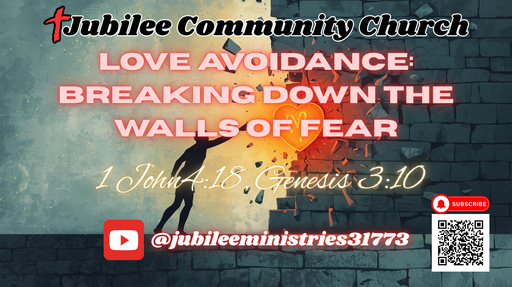
Love Avoidance: Breaking Down the Walls of Fear
Love Avoidance: Breaking Down the Walls of Fear
Opening Scripture
18 There is no fear in love; but perfect love casteth out fear: because fear hath torment. He that feareth is not made perfect in love.
10 And he said, I heard thy voice in the garden, and I was afraid, because I was naked; and I hid myself.
I. Introduction: Love and Fear at War
I. Introduction: Love and Fear at War
The covenant of marriage is designed to mirror Christ’s covenant with His church (Eph. 5:25–32).
Yet many couples struggle because fear blocks true intimacy.
Love avoidance is when one partner fears closeness, intimacy, or emotional exposure. They build walls, withdraw, or control to protect themselves.
Spiritually, this is the same response Adam and Eve had in the garden—hiding from God out of fear, not because God was unsafe, but because they felt unsafe.
II. The Two Types of Love Avoidance
II. The Two Types of Love Avoidance
1. Type 1: Dismissive Avoidant
1. Type 1: Dismissive Avoidant
Definition: Avoids intimacy, values independence, views emotions as weakness.
Strong’s Insight: The Greek word for “cold” in Matthew 24:12 (“the love of many shall wax cold”) is psuchō (ψύχω, Strong’s 5594) – meaning “to breathe cold, to chill.” Their love grows distant and detached.
Characteristics:
Keeps people at arm’s length.
Avoids deep conversations.
Sees closeness as “too much.”
May come across as emotionally cold or indifferent.
Scenarios:
A spouse who keeps busy with work, hobbies, or ministry to avoid connection.
Refuses to talk about feelings, saying, “It doesn’t matter,” or “I’m fine.”
Struggles to comfort or empathize.
2. Type 2: Fearful (Ambivalent) Avoidant
2. Type 2: Fearful (Ambivalent) Avoidant
Definition: Wants closeness but fears rejection. Swings between intimacy and withdrawal.
Scripture Parallel: Israel’s relationship with God—sometimes near, sometimes far (Hosea 2, Jeremiah 3).
Strong’s Insight: The Hebrew word pachad (פָּחַד, Strong’s 6343) means “dread, fear, terror.” It often describes Israel’s trembling before God when they should have trusted Him (Ex. 20:18–19).
Characteristics:
Desire for love but sabotages closeness.
Tests the partner’s love through control or withdrawal.
Builds emotional walls as protection.
Uses silence, suspicion, or avoidance when triggered.
Scenarios:
A spouse who expresses love one day but pulls away the next.
Deep conversations quickly turn into defensiveness or blame-shifting.
Jealousy or mistrust arises, even without evidence.
III. Biblical Examples of Avoidance
III. Biblical Examples of Avoidance
Adam & Eve (Gen. 3:10): Hid from God because of fear and shame.
Israel (Ex. 20:18–19): Refused intimacy with God at Sinai, asking Moses to speak instead.
Hosea’s wife (Hosea 2): Ran from covenant love out of fear and brokenness.
Each example shows that avoidance is a fear-based response that resists the safety of covenant love.
IV. Why Avoidance Destroys Covenant
IV. Why Avoidance Destroys Covenant
Prevents Transparency – covenant requires openness (Gen. 2:25 – naked and not ashamed).
Breeds Mistrust – silence or withdrawal communicates rejection.
Blocks Healing – fear-driven walls prevent love from casting out fear.
Distorts Covering – instead of safety, the relationship feels like control vs. withdrawal.
V. Overcoming Love Avoidance
V. Overcoming Love Avoidance
1. Recognize the Root
1. Recognize the Root
Avoidance is not about rejecting love—it’s about fearing pain.
The battle is not flesh and blood but rooted in fear, trauma, and spiritual bondage (2 Tim. 1:7).
2. Practice Covenant Patience
2. Practice Covenant Patience
1 Corinthians 13:4 – Love suffereth long, and is kind.
Steadfast consistency slowly dismantles walls.
3. Communicate in Truth and Grace
3. Communicate in Truth and Grace
Ephesians 4:15 – Speaking the truth in love.
Silence and secrecy feed avoidance. Safe, honest conversations break it down.
4. Model Christlike Covering
4. Model Christlike Covering
Ephesians 5:25 – Husbands, love your wives, even as Christ loved the church.
Covering is not control—it is protection and sacrificial love.
5. Allow God’s Perfect Love to Heal
5. Allow God’s Perfect Love to Heal
1 John 4:18 – Perfect love casteth out fear.
Healing requires both partners inviting God’s presence into the relationship.
VI. Practical Scenarios & Responses
VI. Practical Scenarios & Responses
Scenario 1: Withdrawal During Conflict
Avoidant spouse shuts down.
Response: Give space but reassure love. Return to the issue with patience.
Scenario 2: Fear of Betrayal
Avoidant spouse questions loyalty.
Response: Consistent truth, reassurance, and transparency.
Scenario 3: Silent Walls
Avoidant spouse refuses conversation.
Response: Gently pursue with openness, not accusation. Pray together if possible.
VII. Closing Reflection
VII. Closing Reflection
Covenant love is God’s design for tearing down fear. The love-avoidant heart is not hopeless—it mirrors humanity’s own avoidance of God. Yet Christ patiently pursues, covers, and heals.
19 And I will betroth thee unto me for ever; Yea, I will betroth thee unto me in righteousness, and in judgment, And in lovingkindness, and in mercies. 20 I will even betroth thee unto me in faithfulness: And thou shalt know the Lord.
This is how covenant love overcomes fear.
Discussion Questions
Discussion Questions
Which type of avoidance do you recognize more—dismissive or fearful?
How have you seen avoidance play out in your marriage or family?
What steps can you take to build covenant safety and break down fear-driven walls?
“Love is not blind to fear, but it is steadfast enough to cast it out.” – Robert Young
“Love is not blind to fear, but it is steadfast enough to cast it out.” – Robert Young
