Ephesians 4.24a-Believers Must Clothe Themselves with the New Man
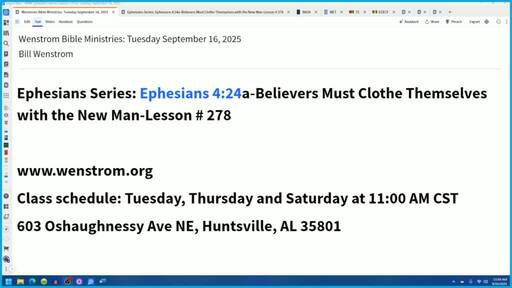

Wenstrom Bible Ministries
Pastor-Teacher Bill Wenstrom
Tuesday September 16, 2025
Ephesians Series: Ephesians 4:24a-Believers Must Clothe Themselves with the New Man
Lesson # 278
Ephesians 4:24 Specifically, each and every one of you as a corporate unit were taught to clothe yourselves with the new man, which has been created in conformity with God’s image by the exemplification of righteousness, yes the exemplification of a holy righteousness as well by means of the one and only truth. (Lecturer’s translation)
Ephesians 4:24 is composed of the following: (1) infinitival clause endysasthai ton kainon anthrōpon (ἐνδύσασθαι τὸν καινὸν ἄνθρωπον), “each and every one of you as a corporate unit were taught to clothe yourselves with the new man. (Author’s translation) (2) attributive participial clause ton kata theon ktisthenta (τὸν κατὰ θεὸν κτισθέντα), “which has been created in conformity with God’s image. (Author’s translation) (3) prepositional phrase en dikaiosynē kai hosiotēti tēs alētheias (ἐν δικαιοσύνῃ καὶ ὁσιότητι τῆς ἀληθείας), “by the one and only truth exemplifying righteousness, indeed by exemplifying a holy righteousness.” (Author’s translation)
Now, the infinitival clause in Ephesians 4:24 is epexegetical, which means that it explains Paul’s previous assertion in Ephesians 4:23, which reminds the recipients of this epistle that they were taught to make it their habit of replenishing their human spirit, that is, their regenerate mind.
In verse 24, he reminds them that they were taught to make it their habit of clothing themselves with the new man, i.e., their new Christ nature they received through regeneration at the moment of justification.
Therefore, this indicates that the assertion in verse 24 is “defining” the assertion in Ephesians 4:23 or in other words, Paul is defining the church age believer replenishing their human spirit, or regenerate mind as clothing themselves with the new man, which is the mind and nature of Christ.
Now, as was the case in Colossians 3:10, the verb enduō (ἐνδύω) here in Ephesians 4:24 is used in a figurative of sense and means “clothe oneself, to put on oneself, to dress oneself with” since it pertains to putting on clothes without implying any particular article of clothing.
However, unlike Colossians 3:10, the verb here in Ephesians 4:24 is not used of the believer clothing themselves with the new man the moment they were declared justified by the Father through faith in His Son Jesus Christ.
Rather, it used here in Ephesians 4:24 is used of an act that takes place after justification and speaks of the believer clothing themselves with the new nature of Christ by appropriating by faith their union and identification with Christ in His crucifixion, death, burial, resurrection and session at the right hand of the Father.
This post-justification faith would enable them to obey the various commands and prohibitions in the gospel.
This post-justification use of the verb enduō (ἐνδύω) also appears in Romans 13:12 and 14, Ephesians 6:11, 14, Colossians 3:12 and 1 Thessalonians 5:8.
As was the case in Ephesians 2:15, the noun anthrōpos (ἄνθρωπος) in Ephesians 4:24 is a generic term denoting a “person, a human being, humanity” without any indication of the race or gender of that person which must be determined by the context.
In Ephesians 2:15, the noun speaks of a new corporate human entity and specifically, it is used with reference to the church, the body of Christ composed of both Jewish and Gentile Christian communities but unlike Ephesians 2:15, the referent of the noun anthrōpos (ἄνθρωπος) in Ephesians 4:24 is Jesus Christ.
Specifically, it refers to His nature, which every church age believer received at the moment of justification through regeneration performed by the Holy Spirit.
Also, as was the case in Ephesians 2:15, the accusative masculine singular form of the adjective kainos (καινός) in Ephesians 4:24 means “new” in the sense of being original and of a kind not seen before since the word pertains to that which is recent in contrast to something that is old.
In Ephesians 2:15, it is used to describe both Jewish and Gentile Christian communities as the “new” humanity, which was accomplished at justification through the baptism of the Spirit and regeneration.
However, in Ephesians 4:24, the adjective kainos (καινός) is ascribing to the person of Jesus Christ the attribute of being new in contrast to the head of the old creation who was the first Adam.
It is used to describe the head of this humanity composed of both Jewish and Gentile church age believers, namely Jesus Christ who is the “new” human being in contrast to the first human being, namely Adam and specifically, it describes Jesus Christ’s nature as new in that it serves as head or prototype of the new creation.
As was the case in Ephesians 2:15, this word kainos (καινός) in Ephesians 4:24 is modifying the accusative masculine singular form of the noun anthrōpos (ἄνθρωπος).
In Ephesians 4:24, the word is in the first attributive position (article-adjective-noun), which indicates that this adjective receives greater emphasis than the noun anthrōpos (ἄνθρωπος), which means that it is ascribing the attribute of being new to this human being or person who we noted is Jesus Christ.
Therefore, the first attributive position of the adjective kainos (καινός) emphasizes an attribute of Jesus Christ, namely, that He is “the new” human being and head of the new creation replacing the old creation under the headship of Adam.
As we noted in our study of Ephesians 3:16 and 4:23, the believer’s human spirit or in other words, the new nature of Christ is identified in Ephesians 3:16 by the expression ton esō anthrōpon (τὸν ἔσω ἄνθρωπον), “your inner being.”
As was the case in Ephesians 2:15 and 4:24, the noun anthrōpos (ἄνθρωπος) in Ephesians 3:16 speaks of the unique person of history, Jesus Christ, who is the head and prototype of the new creation in contrast to the head of the old humanity whose head is the first human being, Adam.
Now, this post-justification use of the verb enduō (ἐνδύω) here in Ephesians 4:24 is supported by the context.
Like Ephesians 4:22 and 23, Ephesians 4:24 is composed of an infinitival clause, which presents a contrast with the previous infinitival clause in Ephesians 4:22.
Ephesians 4:22 remind the recipients of this epistle were taught with reference to their lifestyle as unregenerate people to lay aside the old man’s sinful desires.
Ephesians 4:23 reminds them that they were also taught to make it their habit of replenishing their human spirit, which is their regenerate mind, which is the mind of Christ, which they received at justification through the regeneration performed by the Holy Spirit.
Therefore, the contrast is between the church age believer living according to the sinful desires of their old indwelling Adamic sin nature as unregenerate people and that of living according to their new indwelling Christ nature by replenishing their human spirit, namely their regenerate minds.
In Ephesians 4:24, Paul defines this replenishing of their regenerate minds as clothing oneself with the new man, which is the nature of Christ who is the head and prototype of the new humanity.
Therefore, the verb enduō (ἐνδύω) here in Ephesians 4:24 is used of a post-justification action on the part of the believer because Paul is reminding these Gentile Christians who are the recipients of this epistle of what they were taught after justification in order that they might experience fellowship with the triune God.
Corresponding, they would also experience their sanctification, and salvation.
Like the aorist tense of the verb apotithemai (ἀποτίθεμαι) in Ephesians 4:22, the aorist tense of the verb enduō (ἐνδύω) in Ephesians 4:24 is a constative aorist.
In verse 22, it describes in summary fashion the recipients of this epistle benefiting themselves by laying aside the sinful desires of their indwelling old Adamic sin nature and the context suggests the aorist tense is speaking of the experiential aspect of the church age believer’s sanctification.
This interpretation is supported by verses 17-21, which are concerned about the church age believer’s lifestyle.
The aorist tense of the enduō (ἐνδύω) in Ephesians 4:24 describes in summary fashion the recipients of this letter being taught in the past after justification to clothe themselves with the new nature of Christ.
Now, like the infinitive conjugation of the verbs apotithemai (ἀποτίθεμαι) in Ephesians 4:22 and ananeoō (ἀνανεόω) in Ephesians 4:23, I interpret the infinitive conjugation of the verb enduō (ἐνδύω) in Ephesians 4:24 as an infinitive of indirect discourse with an indicative force.
The infinitive conjugation of all three of these verbs follow the verb of perception, which is didaskō (διδάσκω), which appears in Ephesians 4:24 and so therefore, this verb introduces the indirect discourse and the infinitive conjugation of all three of these verbs are the main verbs.
The latter represents a finite verb in the direct discourse and stands as the object of the former.
Therefore, the infinitive conjugation of the verb enduō (ἐνδύω) identifies what the recipients of this epistle were also taught, namely, to clothe themselves with their new nature of Christ.
Therefore, as was the case with the verb apotithemai (ἀποτίθεμαι) in Ephesians 4:22 and ananeoō (ἀνανεόω) in Ephesians 4:23, Paul is using the figure of ellipsis here in Ephesians 4:24 since the infinitive conjugation of this verb enduō (ἐνδύω) functions as an infinitive of indirect discourse with an indicative force and follows the verb didaskō (διδάσκω), which appears in Ephesians 4:21.
This means that like Ephesians 4:22 and 23, in Ephesians 4:24 he is deliberately omitting the second person plural aorist passive indicative conjugation of the verb didaskō (διδάσκω), which appears in Ephesians 4:21, though it is clearly implied.
Thus, as was the case in Ephesians 4:22 and 23, I supply this verb in the translation of Ephesians 4:24.
Therefore, in relation to the verb enduō (ἐνδύω) in Ephesians 4:24, the aorist tense of the verb didaskō (διδάσκω) is a constative aorist describing in summary fashion the recipients of this letter being taught to clothe yourselves with the new man.
In relation to the verb enduō (ἐνδύω) in Ephesians 4:24, the passive voice of this verb didaskō (διδάσκω) indicates that the Gentile Christian community as the subject received the action of being taught to taught to clothe yourselves with the new man.
