Ephesians 4.24b-God the Created the New Man in Conformity with His Image
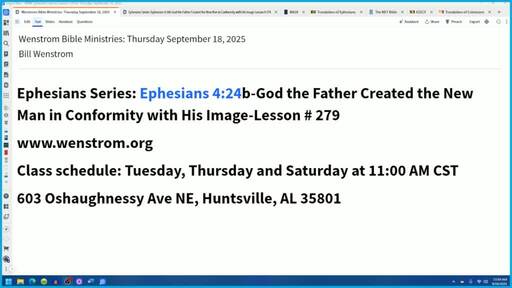

Wenstrom Bible Ministries
Pastor-Teacher Bill Wenstrom
Thursday September 18, 2025
Ephesians Series: Ephesians 4:24b-God the Father Created the New Man in Conformity with His Image
Lesson # 279
Ephesians 4:24 Specifically, each and every one of you as a corporate unit were taught to clothe yourselves with the new man, which has been created in conformity with God’s image by the exemplification of righteousness, yes the exemplification of a holy righteousness as well by means of the one and only truth. (Lecturer’s translation)
Ephesians 4:24 is composed of the following:
(1) infinitival clause endysasthai ton kainon anthrōpon (ἐνδύσασθαι τὸν καινὸν ἄνθρωπον), “each and every one of you as a corporate unit were taught to clothe yourselves with the new man. (Lecturer’s translation)
(2) attributive participial clause ton kata theon ktisthenta (τὸν κατὰ θεὸν κτισθέντα), “which has been created in conformity with God’s image. (Lecturer’s translation)
(3) prepositional phrase en dikaiosynē kai hosiotēti tēs alētheias (ἐν δικαιοσύνῃ καὶ ὁσιότητι τῆς ἀληθείας), “by the one and only truth exemplifying righteousness, indeed by exemplifying a holy righteousness.” (Lecturer’s translation)
Syntactically, the infinitival clause completes the protasis of a first class condition, which began in Ephesians 4:21 and whose apodosis appears in Ephesians 4:20.
This infinitival clause also defines what Paul means when he asserts in Ephesians 4:23 that the recipients of this epistle were taught to replenish their human spirit, which is their regenerate mind or mind of Christ.
It reminds them that they were to replenish their human spirit or regenerate mind by clothing themselves with the new man, which is the new identity because of their union and identification with Jesus Christ.
This infinitival clause is modified by a participial clause, which serves to describe the new man as being created in conformity with God the Father’s image.
The prepositional phrase modifies this participial clause by presenting the means by which the Father created the new man in conformity with His image and it also presents the agency through whom the Father did this.
Namely, the Father created this new man in conformity with His image by perfectly exemplifying His holy righteousness by means of the one and only truth, who is His Son, Jesus Christ.
Therefore, Paul is reminding the recipients of this epistle that the new man was created by the Father through the person and work of His Son, Jesus Christ in the sense that His Son became the head and prototype of the new creation as a result of His crucifixion, death, burial, resurrection and session at His Father’s right hand.
Now, as we noted, in Ephesians 4:24, the infinitival clause endysasthai ton kainon anthrōpon (ἐνδύσασθαι τὸν καινὸν ἄνθρωπον), “each and every one of you as a corporate unit were taught to clothe yourselves with the new man” is modified by the attributive participial clause ton kata theon ktisthenta (τὸν κατὰ θεὸν κτισθέντα), “which has been created in conformity with God’s image.”
In this participial clause, the noun theos (θεός) refers to the Father, which is indicated by the fact that in every instance in which the word has appeared in this epistle up to this point, the Father is this word’s referent (1:1, 2, 3, 17, 2:4, 8, 10, 16, 19, 22, 3:2, 7, 9, 10, 19; 4:6, 13, 18).
It contains the figure of metonymy, which means that God the Father is put for His image.
As was the case in Colossians 3:10, this word eikōn (εἰκών) in Ephesians 4:24 means “image” but is used in relation to the new man or new nature given to the Christian at regeneration which desires to be replenished for the purpose of an experiential knowledge.
However, unlike Colossians 3:10, the noun eikōn (εἰκών) in Ephesians 4:24 is used of God the Father rather than His Son, Jesus Christ.
Also, the verb ktizo (κτίζω) is also found in this participial clause in Ephesians 4:24 and means “to create” in the sense of bringing into existence that which did not exist prior to the creative act.
The word means “to create something out of nothing” and emphasizes the initiation of the object out of previously non-existent material.
In Ephesians 4:24, the referent of the masculine singular form of this verb is the new man, which is the nature of Jesus Christ, was created by the Father through the work of His Son and the Holy Spirit.
The noun theos (θεός) is the object of the preposition kata (κατά) which means “according to, in accordance with, in conformity with” since it is functioning as a marker of conformity.
This would indicate that this new man or new humanity or new person is “in conformity with” the image of God the Father who created this new man through His Son and the work of the Holy Spirit at justification.
The aorist tense of the verb ktizo (κτίζω) is a consummative aorist, which would be emphasizing the cessation of the act of the new man or the church age believer’s new nature of Christ being created in them at the moment of justification through the baptism of the Spirit and regeneration by the Holy Spirit.
The passive voice of the verb ktizo (κτίζω) indicates that the new man or new nature now residing permanently in the church age believer through the work of the Spirit in baptism and regeneration, receives the action of being created by means of the incarnate truth of God, Jesus Christ during His First Advent.
The Father created this new humanity to replace the old creation under the first Adam through His Son’s First Advent.
Specifically, He did so through the perfect obedience of His Son who perfectly obeyed the Mosaic Law.
He also did this through His Son suffering the consequences of all of sinful humanity by suffering the wrath of God in the place of all of sinful humanity.
He also created this new humanity through His Son’s crucifixion, death, burial, resurrection and session at His right hand.
These events in His Son’s life delivered sinful humanity from eternal condemnation, condemnation from the Law, enslavement to the sin nature, Satan and his cosmic system, personal sins, spiritual and physical death.
Thus, He redeemed them out of the slave market of sin, reconciled them to a holy God and propitiated the Father’s holiness, which demanded that sin and sinners be judged but also restored humanity to its original position as the rulers over creation.
The sinner appropriates this deliverance through faith in His Son Jesus Christ.
Simultaneously, the Holy Spirit regenerates them and places them in union with Jesus Christ and identifies them with Him in His crucifixion, death, burial, resurrection and session at the Father’s right hand.
The participle form of the verb ktizo (κτίζω) functions as an attributive participle, which indicates that it is ascribing to the new human being that of being created by the Father by means of His Son, Jesus Christ, the truth of God incarnate who perfectly exemplified God’s holy righteousness during His First Advent.
The participle conjugation of the verb ktizo (κτίζω) functions as an accusative of simple apposition, which means that it describes this new man as having been created by the Father by perfectly exemplifying His holy righteousness through the agency of His Son, Jesus Christ, who is the incarnate truth of God because He is the incarnate Son of God.
