The Prayer of Abraham's Servant to Identify Isaac's Wife (Doctrinal Bible Church in Huntsville, Alabama)

Doctrinal Bible Church
Pastor-Teacher Bill Wenstrom
Wednesday September 17, 2025
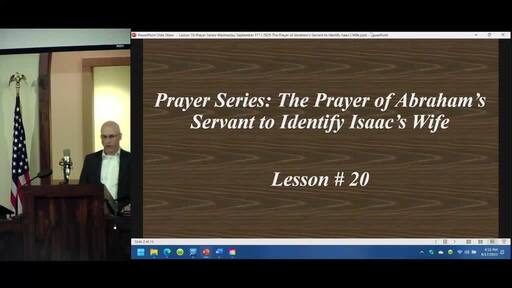
Prayer Series: The Prayer of Abraham’s Servant to Identify Isaac’s Wife
Lesson # 19
Genesis 24 records one of the most beautiful passages in the Bible, and one of the most self-less and wonderful prayers from the lips of a believer.
In this passage, Abraham desired to secure a bride for his son Isaac, from his own relatives.
He sent his faithful and trusted servant, Eliezer of Damascus, to find a wife for Isaac.
Eliezer, faithful to the Lord as he was to Abraham, prayed to the Lord first to help him identify Isaac’s wife.
Genesis 24:1 Abraham was now old and well advanced in years, and the Lord had blessed him in every way. 2 He said to the chief servant in his household, the one in charge of all that he had, “Put your hand under my thigh. 3 I want you to swear by the Lord, the God of heaven and the God of earth, that you will not get a wife for my son from the daughters of the Canaanites, among whom I am living, 4 but will go to my country and my own relatives and get a wife for my son Isaac.” 5 The servant asked him, “What if the woman is unwilling to come back with me to this land? Shall I then take your son back to the country you came from?” 6 “Make sure that you do not take my son back there,” Abraham said. 7 “The Lord, the God of heaven, who brought me out of my father’s household and my native land and who spoke to me and promised me on oath, saying, ‘To your offspring I will give this land’—he will send his angel before you so that you can get a wife for my son from there. 8 If the woman is unwilling to come back with you, then you will be released from this oath of mine. Only do not take my son back there.” 9 So the servant put his hand under the thigh of his master Abraham and swore an oath to him concerning this matter. (NIV84)
Unlike today, there were arranged marriages in Biblical times.
In this passage, Abraham set an example for his descendants to secure wives from the Semites, who were blessed by God, and not from the Canaanites, who were cursed by God according to Noah’s prophecy recorded in Genesis 9:24-27 (Gen 15:16; 18:18-19; Deut 7:1-4).
It was customary, especially among wealthy families, to make marriage arrangements through an intermediary, like a faithful servant.
Therefore, since Abraham was too old to make the trip back to Mesopotamia, which was over five hundred miles away, he sent his servant.
Furthermore, Abraham, by then, had learned that being the recipient of God’s promises demanded that he stay in the Promised Land, which was Canaan.
Therefore, Abraham sent his servant, who was unnamed, since the servant was going in the name of Isaac, rather than himself.
The unnamed servant was Eliezer of Damascus, who Genesis 15 mentions as being the heir of Abraham’s household.
The fact that Abraham planned on Eliezer being his heir, until God promised him a child from his own body, indicated that Abraham trusted Eliezer, enough to leave him his estate.
This trust was crucial in giving him the responsibility to secure a bride for Isaac.
This assignment would only be given to a loyal servant.
Genesis 24:2 records that this unnamed servant was Abraham’s “oldest” servant in his household, which Eliezer would have been at this point in the narrative, and one who had “charge of all” that Abraham owned.
Abraham’s command to his servant to “place your hand under my thigh” is a euphemism for genitalia (Gen 46:26; Exo 1:5; Judges 8:30).
By putting his hands under Abraham’s thigh and touching his genitals, the servant gave a special and solemn oath.
Genesis 24:10-14 records Abraham’s servant, providentially, meeting Isaac’s future wife, Rebekah, at a well in Nahor in Aram Naharaim.
Genesis 24:10 Then the servant took ten of his master’s camels and left, taking with him all kinds of good things from his master. He set out for Aram Naharaim and made his way to the town of Nahor. 11 He had the camels kneel down near the well outside the town; it was toward evening, the time the women go out to draw water. 12 Then he prayed, “O Lord, God of my master Abraham, give me success today, and show kindness to my master Abraham. 13 See, I am standing beside this spring, and the daughters of the townspeople are coming out to draw water. 14 May it be that when I say to a girl, ‘Please let down your jar that I may have a drink,’ and she says, ‘Drink, and I’ll water your camels too’—let her be the one you have chosen for your servant Isaac. By this I will know that you have shown kindness to my master.” (NIV84)
Notice that Abraham’s servant did “not” attempt to advertise in the city that he was looking for a wife for his rich master; but rather, he prayed to God, demonstrating his wisdom.
Now that Abraham’s servant was in the perfect location to observe the unmarried women of the city of Nahor, he was faced with an almost impossible problem to resolve.
Namely, how could he go about determining the spiritual character of the woman, which would identify her as the woman that God wanted Isaac to marry?
Therefore, we see the servant turning to prayer to resolve this problem.
Do not be misled, though Eliezer’s proposal to God to determine the identity of the woman may appear, on the surface, to be “putting out the fleece” and testing God—as Gideon did in Judges 6:36-40, it was, instead, meant to test the woman because only a woman with character and integrity would offer to take on the grueling task of watering his camels.
Therefore, the proposal was simply to confirm that he found the right woman for Isaac by testing her.
The fact that the servant’s proposal to God in prayer was to test the woman expresses his care and concern for Isaac and his high opinion of Isaac and Abraham, for he genuinely wanted to find the right woman that God ordained for Isaac.
He did not want Isaac to marry a woman with poor character.
Proverbs 12:4 A wife of noble character is her husband's crown, but a disgraceful wife is like decay in his bones. (NASB95)
Therefore, according to the servant’s plan, the woman must volunteer to draw water for ten thirsty camels.
As we noted, camels could drink up to twenty-five gallons of water!
The servant knew this and so did Rebekah.
Only a woman with that kind of integrity would fit into Abraham’s household.
Genesis 24:15-20 records Rebekah appearing to Abraham’s servant and identifying herself as Isaac’s bride by her actions.
Genesis 24:15 Before he had finished praying, Rebekah came out with her jar on her shoulder. She was the daughter of Bethuel son of Milcah, who was the wife of Abraham’s brother Nahor. 16 The girl was very beautiful, a virgin; no man had ever lain with her. She went down to the spring, filled her jar and came up again. 17 The servant hurried to meet her and said, “Please give me a little water from your jar.” (NIV84)
Notice, the servant did not walk to meet Rebekah, but ran to meet her, expressing his eager anticipation for the answer to his prayer.
Genesis 24:18 “Drink, my lord,” she said, and quickly lowered the jar to her hands and gave him a drink. 19 After she had given him a drink, she said, “I’ll draw water for your camels too, until they have finished drinking.” 20 So she quickly emptied her jar into the trough, ran back to the well to draw more water, and drew enough for all his camels. 21 Without saying a word, the man watched her closely to learn whether or not the Lord had made his journey successful. (NIV84)
Genesis 24:22 records Rebekah finishing the task and then Eliezer showering her with gifts and praised the Lord for answering his prayer.
Genesis 24:22 When the camels had finished drinking, the man took out a gold nose ring weighing a beka and two gold bracelets weighing ten shekels. 23 Then he asked, “Whose daughter are you? Please tell me, is there room in your father’s house for us to spend the night?” 24 She answered him, “I am the daughter of Bethuel, the son that Milcah bore to Nahor.” 25 And she added, “We have plenty of straw and fodder, as well as room for you to spend the night.” 26 Then the man bowed down and worshiped the Lord. (NIV84)
Here we witness a marvelous display of gratitude by Abraham’s servant, when he manifests two significant aspects of prayer, namely, thanksgiving and worship of God.
Genesis 24:27 saying, “Praise be to the Lord, the God of my master Abraham, who has not abandoned his kindness and faithfulness to my master. As for me, the Lord has led me on the journey to the house of my master’s relatives.” (NIV84)
“Blessed” is the verb bā·rǎḵ (בָּרַךְ), which means, “to bless,” in the sense of praising the Lord for His providence and sovereignty over circumstances and denotes the covenant relationship between Abraham and the Lord.
