Blessed Path - Sep. 28th, 2025
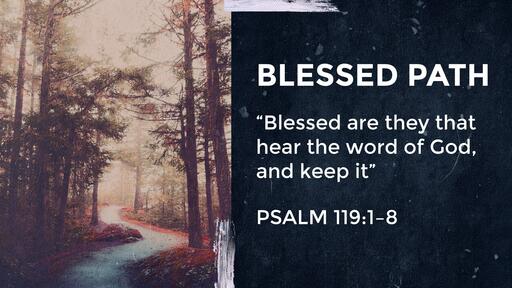

Savoring the Psalter • Sermon • Submitted • Presented • 52:21
0 ratings
· 31 viewsThe psalmist declared that those who walked blamelessly in the LORD’s law were blessed and sought His guidance. Walking blamelessly in the LORD’s Word brings blessing as we trust Him to guide our ways.
Files
Notes
Transcript
Passage: Psalm 119:1-8
1 ALEPH. Blessed are the undefiled in the way, who walk in the law of the LORD. 2 Blessed are they that keep his testimonies, and that seek him with the whole heart. 3 They also do no iniquity: they walk in his ways.
4 Thou hast commanded us to keep thy precepts diligently. 5 O that my ways were directed to keep thy statutes! 6 Then shall I not be ashamed, when I have respect unto all thy commandments.
7 I will praise thee with uprightness of heart, when I shall have learned thy righteous judgments. 8 I will keep thy statutes: O forsake me not utterly.
CIT: The psalmist declared that those who walked blamelessly in the LORD’s law were blessed and sought His guidance.
Proposition: Walking blamelessly in the LORD’s Word brings blessing as we trust Him to guide our ways.
Purpose: General: To teach that true blessedness comes from obeying God’s Word. Specific: To encourage families to walk wholeheartedly in the LORD’s law and depend on His guidance.
Introduction
Introduction
Imagine a young child learning to walk. She takes her parent’s hand and lifts one tiny foot after another, trusting completely that the hand guiding her will keep her safe. In the same way, every member of our family, from toddler to grandparent, needs guidance on life’s path. We want direction that leads to blessing, not danger. In Psalm 119:1-8, the psalmist uses the picture of walking to show us the source of true happiness. This “love letter to God’s law”[1] opens with a beatitude: those who walk blamelessly in the LORD’s law are blessed. Psalm 119’s first eight verses echo the blessing of the righteous in Deuteronomy and Psalm 1[2], and Jesus Himself echoes it in the New Testament (Luke 11:28 KJV: “Blessed are they that hear the word of God, and keep it”). Tonight we will see what it means to walk blamelessly, how God enables that walk, and how we respond; all leading to real blessing.
Let’s turn to our passage. Psalm 119:1 begins with a Hebrew word asher (אַשְׁרֵי), “blessed” or “happy,” and continues: “Blessed are the undefiled in the way, who walk in the law of the LORD.” The law of the LORD here means the whole covenantal instruction of God: His Word. The Hebrew word tamīm (תָּמִים) rendered “undefiled” or “blameless,” really means “whole” or “complete in character”[3]. Freedman notes the verse literally reads, “Happy are those who are perfect in the way, those who walk in the Torah of Yahweh,” underscoring how central God’s law (Torah) is[4]. In other words, the blessed life begins with a wholehearted, blameless walk in God’s Word.
In this stanza the psalmist proclaims that those who live blamelessly according to God’s law are truly blessed. The first three verses declare a beatitude for the righteous: walking in God’s instruction leads to happiness[3]. Verses 4-8 then express the psalmist’s response and prayer. He acknowledges that God has commanded His precepts to be kept (v.4) and earnestly asks for divine help: “Oh that my ways may be established to keep Your statutes!” (v.5). He trusts that if God directs his path, he will have no cause for shame (v.6) and will gladly praise God from a sincere heart (v.7-8). Thus the primary sense is: wholehearted obedience to God’s Word brings blessing, and we depend on the LORD’s help to live it out[7][3].
This is not a burdensome legalism, but a path of joy. As Spurgeon put it, the psalmist cherishes God’s commands “like a bride cherishing her ring”[1]. Walking by God’s word doesn’t feel like drudgery to a grateful heart; it leads to blessing.
Imagine standing at a crossroads in life, unsure which path to take. Psalm 119:1-8 steps into that moment and says: true happiness is found in God’s way. This “alphabet” psalm, an 8-line love letter to the Lord’s Law, opens with a beatitude. It echoes Psalm 1, promising blessing to those who walk blamelessly in the law of the LORD[3]. In our busy world we often search for fulfillment in career, family, or pleasure. But these verses turn us back to the simple truth: delighting in God’s Word leads to a blessed life.
With that in mind, let us explore three truths from Psalm 119:1-8:
I. Walking blamelessly in the LORD’s law brings blessing.
I. Walking blamelessly in the LORD’s law brings blessing.
1 ALEPH. Blessed are the undefiled in the way, who walk in the law of the LORD. 2 Blessed are they that keep his testimonies, and that seek him with the whole heart. 3 They also do no iniquity: they walk in his ways.
In verse 1 we see the promise: those who walk blamelessly in God’s law are blessed. This means God’s favor, happiness, and approval rest on their lives.
The word “blessed” (אַשְׁרֵי; s.v. Ps. 1:1) begins both verses 1 and 2. The expression (literally “O the blessednesses of”) signifies the spiritual and heavenly bliss of those who are right with God. But it is not limited to an inner, spiritual joy; there is often external, physical evidence of God’s blessing on such a proper relationship, blessing that may take the form of provisions and protective care.
Their conduct is first described as blameless (“those blameless of way,” תְמִימַי־דָרֶךֶ), that is, those who in their lives are forgiven for sin and free from sin (s.v. Ps. 7:8). The idiom of “way” is then expanded in the second colon with the participle “who walk” (הַהֹלִכִים) in the law of the LORD, that is, who live out their lives in obedience to God’s instructions (for תּוֹרָה, s.v. Ps. 1:2).
[Allen P. Ross, A Commentary on the Psalms (90-150): Commentary, vol. 3, Kregel Exegetical Library (Grand Rapids, MI: Kregel Academic, 2016), 468.]
Notice “in the way” (בַּדֶּרֶךְ), it’s a lifestyle, not a one-time event. To “walk in the law of the LORD” (וְהֹלְכִים בְּתוֹרַת יְהוָה) implies daily obedience. The psalmist is painting a picture of a person whose every step is guided by Scripture.
The idea echoes Psalm 1:1-2 and Deuteronomy 28:2: obedience to God leads to blessing[2]. Psalm 119:1 lists synonyms for God’s Word, law, testimonies, ways, showing it’s the same blessing promised to the righteous in the Torah. Even David said “I will walk in the presence of the LORD in the land of the living” (Psalm 116:9 KJV) as a path of blessing. Psalm 119:1 invites us: if we want a happy life, let every step be ruled by the Bible.
Illustration: Consider a GPS guiding a traveler. When a family is on a road trip, everyone is happier if dad follows the GPS directions faithfully rather than guessing. Skipping a turn or going off-map leads to getting lost and frustrated. In life’s journey, God’s Word is our faithful guide. The psalmist is saying: “If you follow the LORD’s directions exactly, you will arrive safely. You will be blessed.”
Application: Are you walking according to God’s Word today? This might mean obeying parents and teachers, being honest in daily tasks, or choosing friends who follow Jesus. Verse 3 adds, “They do no iniquity: they walk in his ways.” A blessed person doesn’t live an excuse-filled life but conforms conduct to Scripture. For a family, this means teaching children that God’s rules bring life. As Freedman notes, the Hebrew tamīm means “wholeheartedly”[3]; not fearing we’ll mess up, but resolving to follow His path fully.
There is a whole person involvement in doing God’s will, where an inner attitude (‘the whole heart’, verse 2) is expressed in outward actions (‘keep’, verses 2, 4, 5, 8). While ‘walking’ is associated with living the godly life, ‘keeping’ speaks more directly of observing God’s commandments. There is no idea of legalistic duty but of an enthusiastic endeavour to obey God. Deuteronomy encouraged a love for God from the heart that would issue in joyful obedience, but it also recognised the need for a circumcised heart to produce this kind of devotion (Deuteronomy 5:29; 6:4-6; 10:16; 30:6). This is the new birth of which Jesus spoke and is essential if we are to have this love for God that would keep his commandments sincerely (John 3:3-8; 1 Peter 1:22-23). Those who have this spiritual birth, receive Jesus as Saviour and Lord and out of love for him keep his commandments (John 1:12-13; 14:15).
[Philip Eveson, The Book of Psalms: From Suffering to Glory, vol. 2, Welwyn Commentary Series (Welwyn Garden City, UK: EP, 2014-2015), 322-323.]
And God doesn’t let us walk it alone; as we will see, He guides every step.
Blessed by obedience to God. Verse 1 teaches that those who “walk in the law of the LORD” are happy and blessed. In context, this means making Scripture our guide. Whether at work or home, ask: Am I living according to God’s instruction? Obedience isn’t drudgery here but the key to blessing.
Wholehearted devotion, not mere duty. Verse 2 highlights seeking God with all your heart. We obey not to earn salvation, but out of love. The psalmist links obedience with love: “I seek Him with my whole heart.” When we approach God’s commands joyfully, we join the ones Proverbs calls “upright in their way”. Making worship and Bible time a priority naturally fills our hearts with gladness[17][3].
Transition: But how do we walk blamelessly? Does God just demand obedience and leave us to it? The next verses show that God not only commands us, but empowers us to obey.
II. God calls us to obedience and empowers our walk.
II. God calls us to obedience and empowers our walk.
4 Thou hast commanded us to keep thy precepts diligently. 5 O that my ways were directed to keep thy statutes! 6 Then shall I not be ashamed, when I have respect unto all thy commandments.
Verse 4 says, “Thou hast commanded us to keep thy precepts diligently.” Here the psalmist shifts to God’s voice: “You have commanded” (אַתָּה, צִוִּיתָ) that His people keep (יִשְׁמְרוּ) His testimonies. We see first the command: God expects His people to obey His Word diligently, not half-heartedly. Verse 2 says, “with all [their] heart they seek Him,” emphasizing devotion. The verbs in Hebrew are imperfect (ongoing action): keeping, seeking, walking; it’s a continuous pursuit. As the psalm says, loving God involves "keeping His testimonies" and "seeking Him with all your heart."
Yet the psalm also makes clear we need God’s help. In verse 5 the psalmist prays, “O that my ways were established to keep thy statutes!” The Hebrew yikkōnū (“may be established”) is in a form that conveys, as Zemek notes, a plea for divine help[5]. In effect he is saying, “Lord, make my paths straight so I can obey You!”
The word for “statutes” here and in verse 8 (חֻקִּים, from חֹק) emphasizes the binding nature of God’s laws.[19] By keeping these statutes one’s conduct will be steadfast.
[19] The verb חָקַק means “to inscribe, prescribe”; it occurs 12 times in the Old Testament. More common are the derivatives: the noun חֹק occurs 128 times; חֻקָּה occurs 104 times, and מְחֹקֵק 7 times. The verb has the sense of carving out, digging, inscribing, and from thence “to write, prescribe, determine.” The clearest sample is found in Isaiah 22:16 where it is used for the excavation of a grave in the rock; Ezekiel 4:1 also uses it for engraving on a brick, and Job 19:23 for engraving on a rock. In Isaiah 49:16 it refers to tattooing on the hand.
In the legal realm the verb has the sense “to establish justice” or “to govern” (see Prov. 8:15; Judg. 5:9). In connection to this, מְחֹקֵק means “staff” or “scepter” in Genesis 49:10 and Numbers 21:18.
The word חֹק may be illustrated from its meaning of something “inscribed” such as marked out boundaries that must not be crossed (see Jer. 5:22). So the word describes the boundary lines that a sovereign prescribes for his subordinates. In Job 38:10 it is the boundary of the sea that cannot be crossed, and in Proverbs 8:27 and 29 the circle of the earth. In Psalm 148:6 the noun is the boundary of the heavenly ocean. And in Micah 7:11 it refers to the boundaries of the territory of Zion. In relation to this the word can refer to the quota of work required (Exod. 5:14).
The word comes to mean then an “established order” (Judg. 11:39). In its usage, especially when it is the LORD’s statute, the word refers to the laws that the sovereign makes which no one dare cross over. The word signifies the nature of the law as it establishes binding regulations. But חֹק can be used for God’s promises as well (Ps. 2:7).
In legal contexts this word overlaps with מִשְׁפָּט, “decision” or a casuistic statement of law, and מִצְוָה, “commandment,” most frequently. The different words usually refer to the whole of the law of God in its various aspects and characteristics. חֹק emphasizes the legally binding statutes, the boundaries God places on his people.
For a full discussion, see G. Liedke, “חקק hqq to inscribe, prescribe” in Theological Lexicon of the Old Testament, edited by Jenni and Westermann, II:468-472. (Ross, 470.)
We are not stoic lone-rangers; we turn to God to steady us. Then verse 6 says, “Then shall I not be ashamed, when I have respect unto all thy commandments.”
The focus of this attention is expressed by the prepositional phrase: “to all your commandments (אֶל־כָּל־מִצְוֹתֶיךָ).”[21] When believers stay focused on the commands of the LORD, they will be confident that they will find deliverance.
[21] The word “commandments,” מִצְוֹת (singular מִצְוָה), is connected to the verb “command,” צִוָּה. The verb occurs almost 500 times, and the noun approximately 181 times. The verb “command” is a verb of speech, a specific kind of speech—a superior’s discourse ordering and commanding a subordinate (see G. Liedke, “צוה ṣwh pi. to command,” in Theological Dictionary of the Old Testament, edited by Jenni and Westermann, II:1062-1065). It has a fairly wide range of nuances, but all with the emphasis of orders given by a superior. For example, it can have the sense of “lay a charge upon” people, meaning to set commandments for them (Gen. 2:16; Exod. 1:22). This is closely related to the idea of appointing people (2 Sam. 7:11) or putting people in charge of some service (Gen. 12:20). This may be a lifelong commission (Exod. 6:13).
The meaning appropriate for this context is its normal meaning of “command.” It is used in general for the commandments that God gives in the law (Deut. 4:40; 6:2, 6). God’s commands are not limited to the law code in the Old Testament: he also commanded creation (Ps. 33:9), redemption (Ps. 68:29), and blessing (Ps. 133:3).
The noun מִצְוָה may be used for the orders given by humans who are in places of authority, such as a father to his children (Prov. 6:20), or a king to his people (1 King 2:43). But again the noun most often refers to the LORD’s commandments. When the word is used in the singular it refers to the whole law (Deut. 30:11); when used in the plural it refers to individual commands (Lev. 26:14).
These words then stress God’s sovereign authority over all creation; everything that happens is based on God’s commands. The law especially is the result of his command (as stated in verse 4): The LORD commands tôrāh (Num. 19:2), berît (covenant; Josh. 7:11), ḥuqqîm (Deut. 6:20), and mišpāṭ (Ps. 7:7). God’s prophetic word (Jer. 1:7 and Ezek. 37:7) is also by commandment (Liedke, p. 1065).
These words then emphasize that the law is the decree of the divine sovereign; they are commands to be obeyed. The word is one of the main descriptions of the law in the Pentateuch. (Ross, 471-472.)
In other words, if God establishes our walk, we can face life with confidence instead of shame.
Illustration: Think of learning to ride a bicycle. The child tries to pedal and keep balance, but until she’s learned, she holds mom or dad’s hand. The adult does not say, “You should ride this bike perfectly, go ahead and try alone.” No; they hold the child’s hand and guide her path. God works like that with us: He holds our hand through grace.
Scripture: The psalmist’s prayer in verse 5-6 fits with wisdom literature (cf. Prov. 4:26). Jesus Himself said, “Take no thought” (think or worry) about how to succeed; trust that your heavenly Father is guiding you (Matt 6:25-34 KJV). Similarly, the apostle James warns that if we are only hearers of the word, not doers, we deceive ourselves (James 1:22-25 KJV). God’s commands are not optional, but neither do they collapse us under guilt: He calls us to keep them and enables us by His Spirit.
Application: We must both obey and pray. Verses 5-6 teach humility: we don’t think we can live blamelessly on our own. We pray, “O God, establish my ways by Your Word” (Psm 119:5, paraphrase). For example, before making a decision, we might ask God, “Show me Your way,” and then open His Word for guidance. In family life, this could mean having family devotions and praying together about daily choices; asking God to keep each child on a straight path so “I will not be ashamed” (v.6). The promise is clear: if God directs our steps, we need not fear failure. Through Christ and the Holy Spirit, God’s power comes to do in us what we cannot do by ourselves (Phil 2:13).
God empowers the obedient heart. Verses 5-6 show the psalmist’s trust: “O that my ways may be established to keep Your statutes! Then I will not be put to shame” (Ps. 119:5-6). He admits he needs God’s help to obey. We should too. As Jesus reminded us (Matt. 5:48), perfect obedience comes from God’s grace. The good news is God commands these things because He provides the strength to do them. We can pray, “Lord, guide me and grant me Your Spirit to live as You say,” confident that when our lives align with God’s Word, we stand secure before Him.
Transition: Having God’s enabling, the psalmist ends with a natural response: gratitude and renewed commitment. His heart overflows with praise because God has given him a way to live.
III. We respond with grateful obedience to God’s Word.
III. We respond with grateful obedience to God’s Word.
7 I will praise thee with uprightness of heart, when I shall have learned thy righteous judgments. 8 I will keep thy statutes: O forsake me not utterly.
Verses 7-8 show the psalmist’s decision: “I will praise thee with uprightness of heart… I will keep thy statutes.”
The blessing of God (ʾašrê see 1:1) rests on those who give themselves to wise living. The wise are people of integrity (temîmê-ḏāreḵ, “blameless,” v. 1; cf. Gen 17:1; Prov 11:20; 13:6). Their walk follows the path set out in God’s revelation, “the law” (tôrāh; see 1:2). Blessed are all who live for the sake of God, by seeking (d-r-š, v. 2) him with all their heart (cf. Deut 4:29; 6:5; 10:12; 11:13).
[Willem A. VanGemeren, “Psalms,” in The Expositor’s Bible Commentary: Psalms, Proverbs, Ecclesiastes, Song of Songs, ed. Frank E. Gaebelein, vol. 5 (Grand Rapids, MI: Zondervan Publishing House, 1991), 738-739.]
After praying for help, he rejoices. Verse 7 begins, “I will give thanks unto the LORD with my whole heart, I will speak of all thy marvelous works.” The Hebrew root yaḏah, “give thanks,” is a deliberate action of praise. In context this means as he learns God’s righteous judgments (v.7), his immediate response is worship. His obedience is not a grim duty but a grateful one: he delights in learning God’s ways. Verse 8 says, “I will keep thy statutes: O forsake me not utterly.” Notice again the emphasis on keeping God’s commands (Hebrew ’aśmor, “I will keep”) and trusting God’s faithfulness (the plea “do not utterly forsake me”).
Illustration: Imagine a family around the dinner table. After enjoying a meal prepared with love, the children naturally say “Thank you” and have smiles on their faces. They don’t just silently obey; they thank Mom or Dad, and promise to help clear the dishes with joy. Likewise, when God shows us a path, our hearts should say, “Thank You, Lord!” and we rededicate ourselves to Him.
Application: Verse 7 calls us to coupling Bible learning with praise. We might say, “Lord, thank You for this truth,” whenever a verse stands out. As verse 8 makes clear, keeping God’s Word is a way of life, but we often feel the need to cry, “Do not leave me, God!” and He never will, if we hold fast. In practical terms, a family can respond by memorizing a verse together, then thanking God for it. Or when a child behaves kindly, a parent might say, “Praise God for helping you do that,” pointing back to the teaching.
Prophetically, Psalm 119:1-8 looks forward to the ultimate fulfillment of walking in God’s way. The longing for a pure heart (v.2) and established ways (v.5) anticipates New Testament themes: God’s promise to write His law on people’s hearts (Jer. 31:33; Ezek. 36:26) and Christ’s own perfect obedience (Matt. 5:17-20). Jesus reaffirms that those who hear and do God’s word are blessed (Luke 11:28), echoing v.1-3’s blessing for the obedient. In Christ we see the blameless One who walks fully in the Father’s law; by His Spirit, believers today share in that obedient life. In this way, the psalm both reflects the covenant-law era and prophetically points to the gospel reality of grace-empowered obedience.
Ultimately, this grateful obedience points forward to Christ. We know we fall short of blamelessness (Rom 3:23 KJV), so Jesus came and fulfilled the law perfectly and gave us His righteousness (2 Cor 5:21 KJV). In Him the blessing is ours. He planted God’s Word in our hearts (Ezek 36:27). By His Spirit we can indeed “walk in His ways” in principle, if not in perfection. The psalmist’s heartfelt vow “I will keep Thy statutes” anticipates New Covenant reality. As he will later testify, “Thy word hath quickened me” (Ps 119:50).
Conclusion
Conclusion
Psalm 119:1-8 has shown us that God’s way is our blessed way. Walking whole-heartedly in the LORD’s law leads to blessing; God commands and enables such obedience; and our fitting response is gratitude and faithful commitment. What will you do now? Will you trust God to guide your path and obey His Word? I urge each family here: let this be our call to action. Commit today to love and obey Scripture together; reading it, talking about it with your children, and praying for God’s help to keep it.
These verses demand a daily, humble love for God’s Word. We should ask ourselves, “Am I walking in the LORD’s way?” (v.1) and “Do I seek Him with my whole heart?” (v.2). This may mean restructuring priorities (v.4: “Keep them diligently”) and praying like the psalmist, “O God, establish my ways by Your word” (v.5). We can apply this by setting aside time each day to study Scripture, obeying its commands, and thanking God for its guidance (v.7). When temptations or doubts arise, remember v.6: with God’s help, we “shall not be put to shame” if we trust in His statutes. In other words, real confidence comes from living honestly before God, not by our own strength but by His enabling grace.
And remember the gospel hope: we cannot earn this blessed life on our own. But praise God, “Christ ... is the end of the law for righteousness to every one that believeth” (Rom 10:4 KJV). He has made a way for us to be blameless by faith. The same Spirit that raised Christ now writes God’s law on our hearts. So with gospel confidence we walk in His path, not by our might, but by His grace.
Pick one area of your life where you need “wholehearted” change. Perhaps it’s time with family, or honesty at work, or attitudes at school. Pray Psalm 119:5, “O Lord, establish my ways by Your word,” and let Scripture guide that part of your life all week. Each morning, read a short passage of God’s Word and ask how to live it out that day. Then give thanks each evening for God’s faithfulness. In this way you’ll experience the blessing that comes from walking God’s way.
“Thy word is a lamp unto my feet and a light unto my path” (Psalm 119:105).
May the LORD bless us as we walk in His statutes. Let us pray: “O establish our ways by Your Word (Ps. 119:5). Help us, Father, to walk blamelessly and to glorify You all our days. Amen.”
HYPERLINK "https://netorgft3038877-my.sharepoint.com/personal/jwalker_fbcwestminster_com/_layouts/15/Doc.aspx?sourcedoc=%7BB52A71DA-D9BA-4B30-94AD-BCDE6A5AF48F%7D&file=Ps.%20119.1-8%20Exegetical%20Work.docx&action=default&mobileredirect=true" \h[1] [2] [3] [4] [5] Ps. 119.1-8 Exegetical Work.docx
https://netorgft3038877-my.sharepoint.com/personal/jwalker_fbcwestminster_com/_layouts/15/Doc.aspx?sourcedoc=%7BB52A71DA-D9BA-4B30-94AD-BCDE6A5AF48F%7D&file=Ps.%20119.1-8%20Exegetical%20Work.docx&action=default&mobileredirect=true
