From Desperation to Deliverance - Oct. 5th, 2025
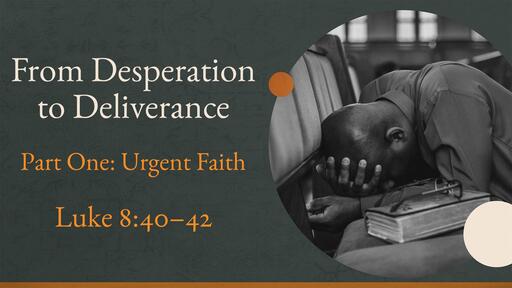

Luke: Living in Light of Promise • Sermon • Submitted • Presented • 1:04:20
0 ratings
· 11 viewsDesperate faith reaches out to Jesus in life-and-death moments.
Files
Notes
Transcript
Introduction
Introduction
[The introduction is delivered conversationally, painting a scenario and connecting with the congregation.]
{Begin with a relatable story}
On a fateful December night many years ago now, a frantic father sped through a grueling 5-hour drive with his exhausted and very expecting wife in the passenger seat, on their way to the Birmingham Children’s Hospital Burn Unit, to find their 9-month-old daughter, who had tragically suffered third degree burns in an accident at home, and was life-flighted for emergency medical care. He was flying up I-65 as fast as he could safely drive, with adrenalin coursing through his system, praying the whole way, “Please, God, please!” Some of us here know that panic: the moment you realize you’re utterly helpless and your child’s life is on the line. Friends, this is exactly where we meet Jairus in our Scripture today.
Jairus was an important man, a ruler of the synagogue, but all that status fades as he falls at Jesus’ feet begging for the life of his only daughter. The Gospel of Luke, chapter 8, verses 40 through 56, takes us on Jairus’s journey from desperation to deliverance. And nestled within his story is another, the healing of a woman with a twelve-year affliction, a miracle within a miracle. But this morning, our focus is on Jairus, the father whose dying 12-year-old teaches us timeless lessons of faith.
{State the focus}
In this passage, we’ll see three key movements: First, the urgent plea of faith (Jairus approaches Jesus). Second, the testing of that faith (delays and bad news come). Third, the triumph of Christ over the impossible (the daughter is restored). Throughout, one message rings clear; and if you forget everything else, hold onto this: Jesus is the Lord of life who calls us from fear to faith.
{Connect to listeners}
Perhaps you walked into church today carrying a heavy heart; a crisis in your family, a dire health issue, a soul-deep worry. We’ll see in Scripture that Jesus not only has the power to help, but also the compassion. By the end of this account, I pray we’ll all be encouraged to answer, “Yes, Lord, I will fear not; I will believe.”
{Transition to body}
Let’s journey with Jairus now. Picture the scene as Luke describes it: Jesus stepping off a boat to a crowd that’s been waiting for Him. And among them steps a man in agony who does something very unexpected...
I. The Humble, Desperate Plea of Faith (Luke 8:40-42a)
I. The Humble, Desperate Plea of Faith (Luke 8:40-42a)
40 And it came to pass, that, when Jesus was returned, the people gladly received him: for they were all waiting for him. 41 And, behold, there came a man named Jairus, and he was a ruler of the synagogue: and he fell down at Jesus’ feet, and besought him that he would come into his house: 42 For he had one only daughter, about twelve years of age, and she lay a dying. But as he went the people thronged him.
A. A Welcoming Crowd and a Waiting Heart (v.40)
A. A Welcoming Crowd and a Waiting Heart (v.40)
1. The Setting of Expectation
1. The Setting of Expectation
Jesus returns from the far shore of Galilee (where He’d freed a demon-possessed man) and steps into a markedly different reception. Verse 40 tells us “the people gladly received him: for they were all waiting for him.” What a contrast to the Gerasene folks who begged Jesus to leave! Here, a multitude on the Galilean side, likely Capernaum, is eagerly awaiting Jesus’ arrival. These people had tasted His teaching and seen His miracles, and they “received Him,” literally welcomed Him gladly. This crowd models the right attitude: hopeful, receptive.
{Application}
2. Cultivate Expectancy
2. Cultivate Expectancy
Before we meet Jairus, let’s not rush past our own need to “wait for Jesus” daily. The crowd’s expectancy is the backdrop for what’s about to happen.
B. Jairus: A Leader Laid Low (v.41)
B. Jairus: A Leader Laid Low (v.41)
1. “Behold... a man named Jairus”
1. “Behold... a man named Jairus”
Here comes Jairus. He’s described by name (not always the case in miracle stories, many beneficiaries remain anonymous) and by title: “he was a ruler of the synagogue.” That means Jairus was a respected lay leader managing synagogue affairs, a man of high standing in the community, likely devout, perhaps even wealthy. But notice what suffering does: it levels social distinction.
2. He fell at Jesus’ feet
2. He fell at Jesus’ feet
This dignified ruler throws himself down in the dirt at Jesus’ feet. Desperation has driven out any concern for image or protocol. Jairus doesn’t care what others think, he is begging for a miracle. Mark’s Gospel adds that Jairus “besought Him greatly” (Mark 5:23), we can hear the tremble in his voice, “Please, please come...!” Here is humility; here is earnest faith. Jairus illustrates James 4:10, “Humble yourselves in the sight of the Lord, and he shall lift you up.”
3. The content of his plea
3. The content of his plea
Verse 41 (end) and 42 (start) say he “besought him that he would come into his house: For he had one only daughter, about twelve years of age, and she lay a dying.” His only child: Luke emphasizes that (perhaps the family had hoped many years for even one child). And now she’s “laying a-dying,” at death’s door. Notice Jairus doesn’t even verbalize his whole request in Luke’s account (Matthew’s account has him say, “Lay your hand on her, and she shall live”). But here, it’s as if the brevity of “besought him… come to his house” and “she was dying” conveys it all. His eyes, his tears, his tone; they all cry out, “Jesus, please, do something!”
4. Faith in Action
4. Faith in Action
By coming to Jesus, Jairus is displaying faith, even if it’s an embryonic faith. He truly believes Jesus can save his daughter. How do we know? Because verse 41 shows his posture of worship and verse 42 (Matthew’s parallel) shows his confidence that if Jesus would just come and touch her, she’d be healed. But personal crisis has clarified who Jesus is for Jairus, not just a teacher, but his last and only hope. Jairus’s faith, though genuine, is not yet fully developed; he thinks Jesus needs to come physically to the bedside. (The centurion in Luke 7 had a greater faith, saying Jesus could heal from afar.) Jairus’s faith is perhaps like a little mustard seed; real, but with room to grow. Yet Jesus does not scorn the small faith. He goes with him.
C. Lessons from the Plea
C. Lessons from the Plea
1. No one is beyond needing Jesus
1. No one is beyond needing Jesus
Jairus was prominent, but tragedy reveals we all utterly need the Lord. Wealth, rank, piety; none can shield from life’s sorrows. His turning to Jesus teaches that Jesus is approachable by everyone.
2. Interceding for Others
2. Interceding for Others
Jairus didn’t come for himself, but for his daughter. This is intercessory prayer vividly lived out. Notice, Jairus didn’t send a servant; he went himself. There’s a time to ask others to pray (and we should), but never neglect personally crying out to God for those under your care.
Missions bridge (30–45 sec): This month we’re sharing a brief missions update each Sunday—an actual face, family, or field where Christ is at work. Let’s take Jairus’s posture for them: fall at Jesus’ feet, call on Him by name, and intercede. During the update and afterward, pray as if your “son or daughter” were there, because in Christ’s body we are “ambassadors” pleading for others to be reconciled to God (cf. 2 Cor. 5:20, KJV language). Our midweeks are focused on this—“Ambassadors for Christ” and the LifeGuide studies—so we can pray and act with informed compassion.
3. Desperation can deepen faith
3. Desperation can deepen faith
We wouldn’t wish Jairus’s trial on anyone, but see how it propelled him into Jesus’ arms. Jairus was “roused,” and because of that, he experienced a miracle. If you are in such a valley now, do as Jairus: fall at Jesus’ feet and tell Him everything. That’s the safest, surest place to be.
Missions bridge (30–45 sec): Faith‑Promise lives here.
Later this month we’ll practice interceding with our giving through Faith‑Promise. We’ll take a special offering to collect any remaining Commitment Cards on Oct 26 and again on Nov 2 as a tangible way to say, “Lord, by faith we will give what You enable, so the gospel can go.”
{Transition}:
Thus far, the story is encouraging, a needy father finds Jesus willing to go with him. But now tension enters the narrative. Just when things seem to be headed toward a quick solution, there’s a delay... and then a devastating word. How will Jairus’s faith hold up when it’s put to the test? Let’s move to scene two.
II. The Testing and Stretching of Faith (Luke 8:42b-50)
II. The Testing and Stretching of Faith (Luke 8:42b-50)
42b …But as he went the people thronged him. 43 And a woman having an issue of blood twelve years, which had spent all her living upon physicians, neither could be healed of any, 44 Came behind him, and touched the border of his garment: and immediately her issue of blood stanched. 45 And Jesus said, Who touched me? When all denied, Peter and they that were with him said, Master, the multitude throng thee and press thee, and sayest thou, Who touched me? 46 And Jesus said, Somebody hath touched me: for I perceive that virtue is gone out of me. 47 And when the woman saw that she was not hid, she came trembling, and falling down before him, she declared unto him before all the people for what cause she had touched him, and how she was healed immediately. 48 And he said unto her, Daughter, be of good comfort: thy faith hath made thee whole; go in peace. 49 While he yet spake, there cometh one from the ruler of the synagogue’s house, saying to him, Thy daughter is dead; trouble not the Master.
“But as he went the people thronged him…. [Jesus stops to heal and address the woman with the issue of blood (vv. 43-48)] ...While he yet spake, there cometh one from the ruler of the synagogue’s house, saying to him, Thy daughter is dead; trouble not the Master.”
A. An Interruption on the Way (v.42b-48 context)
A. An Interruption on the Way (v.42b-48 context)
1. The Crowds Slow Progress
1. The Crowds Slow Progress
Verse 42 says, “But as he went, the people thronged him.” Jesus and Jairus begin the urgent walk to Jairus’s home, but the crowd is pressed so tight around Jesus it's like trying to hurry through molasses. The word “thronged” means they almost crushed Him. Then, it happens: Jesus stops.
2. Jesus stops to find “Who touched me?”
2. Jesus stops to find “Who touched me?”
We won’t re-read all the details (verses 43-48), but you know them: a woman with a 12-year hemorrhage sneaks up and touches Jesus’ garment, is healed instantly, and Jesus pauses to draw her out and affirm her. Now, from Jairus’s perspective, this is a delay, and a potentially disastrous one. His daughter’s life is slipping away with every moment. It’s a test of his patience and trust.
3. Divine Delays
3. Divine Delays
How many of us have felt the same? We pray urgently, we seek the Lord, and it seems like He’s “stopping” or taking care of something else while our need grows more dire. Jairus’s experience shows us that divine delays are not denials. Jesus fully intended to heal Jairus’s daughter; the delay with the woman was a divine appointment, not a diversion. But it is hard for us to wait. This is where our faith is stretched. God’s timing is rarely aligned with our frantic schedule. In this case, the delay allowed the daughter to actually die... which set the stage for an even greater miracle, raising her, rather than healing a fever. So, take heart: when God seems slow, He may be preparing an outcome bigger than what you asked. Isaiah 30:18 says, “Therefore will the LORD wait, that he may be gracious unto you.”
4. A Lesson in Faith via the Woman
4. A Lesson in Faith via the Woman
Her long trial ended in joy at the very moment Jairus’s acute trial plunged into sorrow. Jesus calls the woman “Daughter” publicly and says, “Thy faith hath made thee whole; go in peace” (v.48). I wonder if Jairus, standing there, heard Jesus commend her faith and took that to heart. It’s as if God gave Jairus a front-row seat to witness what faith in Jesus can do, a chronic illness healed instantly. Maybe you’ve experienced that; you’re waiting on the Lord, and you see Him answer another’s prayer. Instead of envying or despairing, take it as a boost: God is at work; your turn is coming.
B. Faith Shattered by Circumstance (v.49)
B. Faith Shattered by Circumstance (v.49)
1. The Worst News Arrives
1. The Worst News Arrives
Verse 49 hits like an arrow: “While he yet spake, there cometh one from the ruler of the synagogue’s house, saying to him, Thy daughter is dead; trouble not the Master.” I picture his shoulders slumping, perhaps a sob breaking forth. His greatest fear realized. One moment hope was alive, Jesus was coming; the next, hope is extinguished, “she’s gone.” That’s effectively what the messenger says: “No need to trouble the Teacher further.” In their view, death is final; even Jesus can’t help now.
2. Fear’s Voice vs. Faith’s Potential
2. Fear’s Voice vs. Faith’s Potential
That statement “trouble not the Master” reflects a kind of polite unbelief. It acknowledges Jesus as a respected teacher, maybe a healer, but surely not someone who deals with death. Isn’t it interesting? They believed Jesus could heal a dying person (or else they wouldn’t have bothered Jairus to go initially), but they didn’t believe He could raise the dead. How often do we put God in a box? “Lord, I believe You up to this point, but beyond that, I won't even ask.” We all hit those limits in our faith where fear or fatalism creeps in saying, “Don’t trouble the Master; this is beyond even God.” That is the critical juncture Jairus is in. Fear is whispering (through that servant’s voice): “Give up. It’s too late.”
3. Our Savior’s Immediacy
3. Our Savior’s Immediacy
Jesus doesn’t even wait for Jairus to respond. Mark’s Gospel says, “As soon as Jesus heard the word that was spoken, He saith... ‘Be not afraid, only believe’” (Mark 5:36). It’s as if Jesus quickly intercepts that poisonous dart of hopelessness before it can lodge in Jairus’s heart. Thank God, He speaks the final word, not the messengers of doom. Jesus here demonstrates that His promises are not nullified by our worst fears. In fact, the situation’s “impossibility” is precisely where He will show His glory.
C. Jesus’ Call to Fearless Faith (v.50)
C. Jesus’ Call to Fearless Faith (v.50)
50 But when Jesus heard it, he answered him, saying, Fear not: believe only, and she shall be made whole.
1. Jesus Speaks to Jairus’s Heart
1. Jesus Speaks to Jairus’s Heart
Verse 50 (KJV) is one of the most powerful little verses. I want us to notice four aspects of what Jesus says here.
First, it says Jesus “answered him;” that implies Jairus didn’t even get a chance to voice his feelings; Jesus answered the unspoken cry of Jairus’s soul. He knew Jairus was about to collapse in despair, so He answered that.
Second, Jesus gives a gentle command: “Fear not.” Literally, “Stop being afraid.” At that moment, Jairus had every earthly reason to fear; but Jesus tells him to lay aside the panic and dread, to refuse to let fear control the moment. It is a command often repeated by God in Scripture, because fear is the great enemy of faith. “Fear not” doesn’t mean don’t feel anything; it means do not allow anxiety to take the driver’s seat. Jesus says, “Don’t buy that lie.”
Third, Jesus issues a positive directive: “believe only.” Other translations: “Just believe,” “Keep on believing.” He’s telling Jairus to continue the faith he initially showed when he came to Jesus; don’t let this development derail your trust. Note “only;” that is, don’t mix faith with doubt; right now, a singular, focused trust is required. Isn’t that what the Lord whispers to us in our darkness? “Trust Me.” He’s asking Jairus to do something seemingly irrational to the world: to believe Jesus can do something about this, even now.
Finally, see the promise embedded: “and she shall be made whole.” Jesus gives him a word to cling to. Essentially: “If you trust Me, I promise you, your daughter will be restored.” What an anchor for Jairus’s soul! Notice, Jesus doesn’t accompany that with details of how or when, just the assurance of the outcome. The word “made whole” is the same term as “saved.” Jesus is saying, “Believe, and your little girl will be saved.”
2. Faith vs. Fear in Our Lives
2. Faith vs. Fear in Our Lives
This interaction is so instructive for us. We see that faith is the antidote to fear. Fear says, “It’s too late, give up.” Faith says, “It’s never too late for Jesus.” Fear focuses on the problem; faith focuses on the Problem-Solver. Jesus often calls us to hope when it seems absurd to do so. If He were anyone else, such advice would be cruel or naïve. But because He is the resurrection and the life, He has the authority to command this. Here, Jesus essentially says, “Fear not; because I’m here, and I’ve got this.” Friends, let that sink in; whatever you wrote off as hopeless in your life, Jesus says, “Don’t be afraid; trust Me with it.”
But we do get a guarantee that if we trust Jesus, He will work all things for good and His glory. The key is to listen when Jesus speaks to your heart through Scripture or His Spirit, giving you that ray of promise. Hold onto that word like Jairus had to hold onto Jesus’ promise as they walked the rest of the way home. I imagine each step Jairus took after verse 50 was a battle between the sight of mourners and the sound of Jesus’ promise. We walk by faith, not by sight (2 Cor 5:7).
{Transition}
What happened when they arrived at the house? Jesus’ words must be put to the ultimate test; her body lies still and lifeless. Let’s see how the story concludes and how faith is vindicated by our powerful Lord.
III. The Triumph of Christ’s Power & the Fulfillment of Faith (Luke 8:51-56)
III. The Triumph of Christ’s Power & the Fulfillment of Faith (Luke 8:51-56)
51 And when he came into the house, he suffered no man to go in, save Peter, and James, and John, and the father and the mother of the maiden. 52 And all wept, and bewailed her: but he said, Weep not; she is not dead, but sleepeth. 53 And they laughed him to scorn, knowing that she was dead. 54 And he put them all out, and took her by the hand, and called, saying, Maid, arise. 55 And her spirit came again, and she arose straightway: and he commanded to give her meat. 56 And her parents were astonished: but he charged them that they should tell no man what was done.
A. Clearing the Atmosphere of Unbelief (v.51-53)
A. Clearing the Atmosphere of Unbelief (v.51-53)
1. Jesus limits the audience
1. Jesus limits the audience
Upon arriving, Jesus permits only Peter, James, John, and the girl’s parents to enter the room with Him. He “suffered no man to go in” except those five. Why? Jesus, in His wisdom, creates a space free from the cacophony of unbelief. This isn’t for His own ability’s sake (He doesn’t need the right environment to do miracles, as raising Lazarus publicly shows). Rather, it may be for the sake of the family’s faith and to manage the situation delicately. There’s a principle here: sometimes when you are trusting God for something big, you need to get away from the noisy skeptics. Jesus invited only those who believed or were at least reverently hopeful.
2. A startling pronouncement
2. A startling pronouncement
We then see Jesus saying to the mourners, “Weep not; she is not dead, but sleepeth.” (v.52). This likely sounded utterly absurd to them; and verse 53 shows their reaction: “They laughed him to scorn, knowing that she was dead.” Grief mixed with cynicism. So, they mock Jesus. It’s a good thing Jesus had spoken to him earlier, because these scorners could have utterly deflated him. Jesus uses the metaphor “sleep” to indicate that this death is temporary, that He’s about to “wake” her. From heaven’s perspective, this is exactly how we should view death; not as annihilation, but as a sleep awaiting resurrection.
{Application}
3. Sympathy in “Weep not”
3. Sympathy in “Weep not”
Also notice, Jesus says “Weep not.” He’s not being insensitive. In fact, by saying “Weep not,” He’s implying there’s about to be joy. It’s reminiscent of how He told the widow of Nain “Weep not” right before raising her son (Luke 7:13). In both cases, those tears weren’t wrong; but Jesus knew He was about to turn them into laughter (the right kind of laughter: joy!). Psalm 30:5: “Weeping may endure for a night, but joy cometh in the morning.” Here morning was about to dawn in this dark house. That’s our hope too; Jesus has the last word over our sorrows.
B. “Maid, Arise” | The Miracle (v.54-55)
B. “Maid, Arise” | The Miracle (v.54-55)
1. Tender Authority
1. Tender Authority
Now we come to the miracle itself, described with beautiful simplicity. Verse 54, “And he put them all out, and took her by the hand, and called, saying, Maid, arise.” Imagine that hush in the room; just the father, mother, the three disciples watching intently. Jesus approaches the still form on the bed. He takes her cold little hand in His warm, living hand. In the other two Gospel accounts, we’re given the Aramaic words Jesus spoke: “Talitha cumi,” meaning “Little girl, arise.” Mark even translates it as “Damsel, I say unto thee, arise” (Mark 5:41). Notice how intimate and authoritative that is, “I say unto thee...” Here in Luke, “Maid, arise” has the same force. Jesus issues a life-giving command, not a frantic plea. He speaks to the dead as if she could hear; and indeed, she could, because “the hour is coming when the dead shall hear the voice of the Son of God: and they that hear shall live” (John 5:25). This is a preview of that truth. The voice that called worlds into existence now calls this girl back to life.
2. Immediate Restoration
2. Immediate Restoration
Verse 55 triumphantly reports, “And her spirit came again, and she arose straightway: and he commanded to give her meat.” How the parents must have gasped and then cried out with joy! Dr. Luke the physician makes sure we know this was no resuscitation of someone who was merely unconscious, it says her spirit returned. That’s the definition of death reversed. It also confirms the biblical anthropology: the spirit lives on and can return at God’s command. Jesus truly called her back from beyond. Then, ever practical and caring, Jesus says, “Give her something to eat.” Why include that? Several reasons: physiologically, the girl probably hadn’t eaten in days due to illness, and now to regain strength she needs food. It’s also proof that she’s truly alive and well; ghosts don’t eat; revived bodies do. It grounds the miracle in reality; she’s not only alive, but hungry, functioning normally. What a Savior!
3. Joy and Astonishment
3. Joy and Astonishment
The Bible says the parents “were astonished;” an understatement if there ever was one (the Greek implies ecstasy, amazed out of their minds). Their mourning turned to dancing in a heartbeat. Can you imagine that walk out of the room to all those mourners outside? Perhaps the door opens and out walks the little girl, hand-in-hand with her mother... You can bet the mocking laughter of the crowd outside stopped in an instant, replaced with screams of delight and worship and fear of God.
4. Life Lessons
4. Life Lessons
There are so many. For one, Jesus kept His promise to Jairus, “she shall be made whole,” He said, and she was. Jesus’ promises to us will likewise never fail, though between promise and fulfillment our faith is tested. Another lesson: Jesus has absolute authority over death, which gives us hope for our loved ones who die in Christ. For us, that means we need not live enslaved by the fear of death (Hebrews 2:14-15). Christ “took the keys,” and one day He’ll say to all His people, “My children, arise!”
C. A Gentle Command for Silence (v.56)
C. A Gentle Command for Silence (v.56)
1. Jesus charges them to tell no one
1. Jesus charges them to tell no one
The final verse says, “He charged them that they should tell no man what was done.” This may seem puzzling; wouldn’t Jesus want everyone to know of this miracle? But Jesus often gave such instructions after mighty works, especially in Jewish regions, to prevent a premature or misinformed push for Him to be made king, and to manage the crowds. But Jesus didn’t want the parents to be blabbing details, perhaps to shield the young girl from excessive publicity and to avoid a frenzy. There’s also an element of Jesus not wanting people to follow Him just as a miracle-worker; His ultimate mission was the cross, not to be a celebrity healer.
2. Obedience in witness
2. Obedience in witness
After He rose and ascended, the message is clear: “Ye shall be witnesses unto me” (Acts 1:8). So, while the parents of Jairus’s girl likely kept a low profile (at least for a time), we are called to proclaim that Jesus raises the dead; spiritually now, and physically at His return. Our application is to not stay silent about the hope we have.
Conclusion
Conclusion
As we conclude, let’s revisit Jairus’s journey. He chose to trust Jesus’ word, walking home in faith. And he witnessed an incredible deliverance, his little girl alive again and in his arms. His desperation turned into deliverance, his sorrow into praise. “Humble yourself and bring your desperate need to Jesus today.” Don’t let pride or hesitation keep you from falling at His feet in prayer. He wants you to replace that fear (that has been dominating your mind at 3 a.m.) with simple trust. Or maybe God is reminding you of the ultimate hope: that because Jesus lives, we too shall live. That no matter what happens in this life, if you are in Christ, death is not the end of your story. Your weeping will be turned to joy in the morning of resurrection.
In the opening story, God mercifully spared that child’s life, and a grateful father knelt in thanks. Not every crisis ends with a physical miracle like that, but every crisis we entrust to Jesus ends with God’s goodness revealed in one way or another. Sometimes the miracle is in us, a heart renewed, a soul saved, sometimes it’s in our circumstance. In Jairus’s case, he received his daughter back as a gift of grace. The same Jesus who did that is here among us by His Spirit.
So, I urge you: trust Him in your desperation. Hear Him saying to you right now as you face whatever situation: “Fear not; believe only.” Keep walking with Him toward the goal. He has the final say, not the messengers of gloom. Jesus can take a situation pronounced “dead” and speak life into it. Our Lord Jesus is the same yesterday, today, and forever.
{Invitation:}
Now, I want to speak to anyone here who perhaps identifies more with the little girl than with Jairus. Spiritually speaking, the Bible says we are “dead in trespasses and sins” apart from Christ. Here’s the good news: Jesus can take you by the hand today and say, “Arise.” He went to the cross and died for our sins, and then He rose again, so that “you, who were dead, hath He quickened (made alive) together with Christ” (Eph 2:5). If you’ve never trusted Jesus as Savior, He is calling you. Don’t resist. Respond as that child did, immediately. How do I do that? you might ask. By turning from your sin (that’s repentance; akin to Jairus turning from self to Jesus) and by believing in Jesus (just as Jairus believed and came). Romans 10:9 says, “If thou shalt confess with thy mouth the Lord Jesus, and believe in thine heart that God hath raised Him from the dead, thou shalt be saved.”
In a moment, we will have a time of invitation. That’s an opportunity for you to act on what God is stirring in your heart. If you need to receive Jesus’ gift of salvation, to be raised from spiritual death to life, I invite you to come forward. I or another counselor will pray with you. Jesus delights when we trouble Him with our needs! He was “troubled” on the cross so that He can answer you today.
Maybe you are a believer, but you’re carrying a crushing burden or fear. This altar is open for you to come and, like Jairus, kneel and earnestly seek the Lord. By coming, you’re not informing Him (He already knows), but you’re demonstrating humility and faith. Perhaps you’re praying for someone else; a “daughter” or “son” who’s in dire condition (physically or spiritually). You can be a Jairus for them today; intercede with persistence. Jesus hears that.
Jesus passed the ultimate test of His power in Jairus’s home, and He is present here to work in our homes and hearts. Let’s respond to Him with the same faith we’ve just seen displayed. Don’t be afraid; just believe.
{Musicians begin to play softly...}
I invite you now: come to Jesus, bring Him your need. He is the Lord of life: compassionate, powerful, and worthy of your trust. Come as we sing...
{Invitation Hymn: “Only Trust Him”}
HYPERLINK "https://drive.google.com/file/d/1BPyHfnm7VB_hrAAtKK2QyWcnoixrOchs" \h[1] [2] [3] [4] [5] [6] [7] [8] [9] [13] [14] [23] [24] [26] [31] [46] [49] [56] [57] [58] [59] [60] Gaebelein, EBC, Vol. 8.4_Luke.docx
https://drive.google.com/file/d/1BPyHfnm7VB_hrAAtKK2QyWcnoixrOchs
[10] [11] [12] [18] [47] [48] [50] [51] [62] POSB_Luke 1-8.docx
https://drive.google.com/file/d/1bAkKGMMqk6GeeyINGatopOqD_9EXtzHV
[15] [16] [25] [43] [44] [53] [54] [55] [63] Bock (BECNT)_LUKE v1 6-9.50.docx
https://drive.google.com/file/d/1Rqh8dWqMMFYJmbWiVUpZUEFyBaUbHZxX
[17] [20] [21] [27] [30] [40] [41] [45] [61] Luke 8:40 Commentaries: And as Jesus returned, the people welcomed Him, for they had all been waiting for Him.
https://biblehub.com/commentaries/luke/8-40.htm
[19] [32] [33] [34] Luke 8:40 Greek Text Analysis
https://biblehub.com/text/luke/8-40.htm
[22] [35] Luke 8:41 Parallel Greek Texts
https://biblehub.com/texts/luke/8-41.htm
[28] [29] [52] Matthew 9 Barnes' Notes
https://biblehub.com/commentaries/barnes/matthew/9.htm
[36] [37] [38] [39] [42] Luke 8:42 Greek Text Analysis
https://biblehub.com/text/luke/8-42.htm
