Pentecost 17 — October 5, 2025
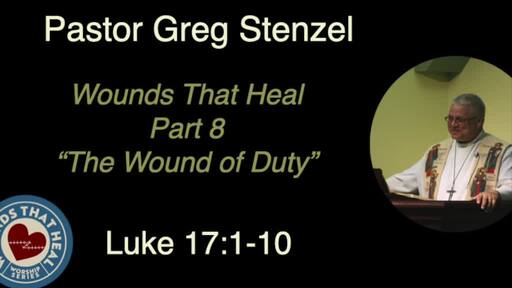

Notes
Transcript
The Wound of Duty and Delight
The Wound of Duty and Delight
Wounds That Heal – Part 8
Text: Luke 17:1–10
Introduction
Introduction
In the name of Jesus. Amen.
Over the past seven weeks, we've embarked on a journey exploring how the words of our Savior, though at times wounding, are ultimately instruments of grace and healing. Each week, we've faced a different challenge—division within families, pride that separates us, the cost of discipleship, and more. These wounds, painful as they are, serve a divine purpose: they draw us closer to the heart of the Gospel, revealing our deepest need for Christ and the transformative power of His grace.
Today we conclude our series with the "Wound of Duty," and we find Jesus’ words cutting through our pride and sense of entitlement. He reminds us, “We are unworthy servants; we have only done our duty.” This wound, too, is intended for our healing. It redirects our focus from our own insufficiencies to the sufficiency of Christ, ultimately transforming our sense of duty into a profound delight.
Let’s delve into how Jesus’ Word in today’s Gospel reading confront us and lead us to His grace
I. The Challenge of Christ’s Words
I. The Challenge of Christ’s Words
The disciples must have felt overwhelmed. Jesus had just told them:
“Things that cause people to sin are bound to come, but woe to that person through whom they come. It would be better for him to be thrown into the sea with a millstone tied around his neck than for him to cause one of these little ones to sin.
Here, Jesus highlights the profound responsibility we have as His followers. Our actions and words have the power to shape others' faith journeys. This stern warning isn’t just about avoiding sin; it's a call to be mindful stewards of the influence we have on each other's spiritual lives.
Why? Because sin destroys faith. Jesus came not to wield sin, but to destroy it and give life. That’s his whole mission. And yet, people—even Pastors—can become stumbling blocks, and well-meaning Christians can actually cause others to fall away from the faith!
In my boyhood church in Vallejo CA they now fly rainbow flag announcing to the world that they are “welcoming.” But in flying that flag they are condoning certain kinds of sexual sin condemned by the Lord. Woe to them! And woe to the Pastors who shrink from speaking God’s Word against popular sins, afraid of losing approval. Left unchecked, this leads to apostasy, something Jesus lamented of earlier in Luke.
So seriously does our Lord Jesus take this that he adds a special warning: It would be better for the the person to have a millstone hung around his neck and be tossed into the sea than to lead any one of his flock into temptation.
Jesus came to forgive sins. So let’s keep listening to what He has to say:
So watch yourselves. “If your brother sins, rebuke him, and if he repents, forgive him. If he sins against you seven times in a day, and seven times comes back to you and says, ‘I repent,’ forgive him.”
Imagine the moment when a doctor delivers a sobering diagnosis: cancer. Instantly, a wave of fear and uncertainty washes over the patient and their family. The reality sets in that treatment is necessary—a treatment that's often harsh, such as chemotherapy. This process involves introducing potent chemicals into the body. It's paradoxical: a poison designed to eradicate the illness, yet it simultaneously creates other harsh side effects. It's a hard path, but one filled with hope, because the goal is to save and restore life.
Likewise, Jesus’ call to confront sin in ourselves and in others can feel just as harsh and uncomfortable. We're called to address painful truths, forgive repeatedly, and rebuke when necessary. This spiritual process can be as challenging as undergoing chemotherapy. However, just as chemotherapy aims to eliminate the disease to allow for healing, so does forgiveness and repentance aim to remove sin's destructive hold on us, making way for renewed life and relationships.
Through forgiveness—the medicine Jesus prescribes—we find restoration. It may hurt to confront sin, but it’s essential for true healing. And the disciples knew it. When Jesus said, “If he sins against you seven times in a day, and seven times comes back to you and says, ‘I repent,’ forgive him.”
They cried out, “Lord, increase our faith!” They knew this was humanly impossible.
We feel it too. Who among us has been quick to rebuke sin in love, but slow to forgive? Who hasn’t set limits—“Enough is enough. Three strikes and you’re out”? But Jesus sets no limit. He calls us to forgive as we have been forgiven. That’s why Paul reminds us in Colossians 3:13: “Forgive as the Lord forgave you.”
This is the wound. Our pride resists forgiving without limit. But it drives us to cry out for what only Christ can supply.
We want the blessings of faith without the burden. We want the comfort that Christ gives in forgiveness without the call to forgive others, as we have been forgiven. Then St. Paul tells us this in Colossians 3:13
“As the Lord has forgiven you, so you also must forgive.”
Oh Lord, please help!
While Jesus challenges us to rebuke sin and forgive generously, He also exposes the core of our pride and perceived self-sufficiency. In His story about the unworthy servant, Jesus introduces us to the 'Wound of Unworthiness,' urging us to recognize the true source of our strength.
II. The Wound of Unworthiness
II. The Wound of Unworthiness
Having heard the disciples cry out, “Lord, increase our faith!” Jesus immediately told them a story. A servant works all day in the field. When he comes in, does the master thank him? No. The master says, “Prepare supper, dress properly, and serve me while I eat and drink.”
And Jesus concludes: “So you also, when you have done all that you were commanded, say, ‘We are unworthy servants; we have only done our duty.’”
Do you see the flow? First, Jesus shows that forgiving without limit is impossible in our own strength. Then, He reminds us that even if we could carry it out perfectly, it would not make us worthy. Duty is duty, not merit.
That wounds us, because:
We like to be noticed for our achievements.
We like to be thanked for our acts of grace.
We like to think God owes us something.
But Jesus’ words cut through our illusions. Even if we did everything perfectly—and we don’t—we would still be unworthy. Our service does not put God in our debt. Our obedience does not earn His favor. We are, as we confess, “poor, miserable sinners.”
And yet, this is not the end of the story. This wound of unworthiness is meant to drive us back to the One who is worthy.
Let’s explore how Jesus transforms our duty into a delight.
III. The Healing in Christ’s Service
III. The Healing in Christ’s Service
If all Jesus gave us was the command to forgive without limit and the reminder that we are unworthy servants, we would be left in despair. But that’s never where He leaves His disciples. This command is meant to drive us to Himself—the only worthy Servant.
Jesus Christ is the true Servant who went beyond all duty.
He never caused anyone to stumble.
He always rebuked sin and always forgave.
He came not to be served but to serve, and to give His life as a ransom for many.
What He commands, He supplies. When the apostles cried, “Lord, increase our faith!” Jesus responds by pointing to the power of faith, even as small as a mustard seed. What Jesus articulates here is profound: the power of faith is not contingent on its size, but on its object—Jesus Christ.
It is Jesus, not the depth of our faith, that uproots mulberry trees and transforms lives. Just as Hebrews 12:2 exhorts us, 'fix your eyes on Jesus, the author and perfecter of our faith,' we are reminded that our strength and capability to forgive are not from within us, but from the One in whom we place our trust and faith, the One who has forgiven us much.
Illustration: Consider Mrs. Erica Kirk. After her husband Charlie was martyred for the faith a few weeks ago, she publicly forgave the man who killed him. In the midst of her immense grief, she courageously forgive the one who wronged her. That was not her strength. She knew herself to be an unworthy servant. But she also knew Christ, who forgave her first and carried her burdens.
Her forgiveness of the man shines as a testimony of Colossians 3:13: “As the Lord has forgiven you, so you also must forgive.” What seemed an impossible duty became, by Christ’s power, a holy delight.
Having seen how Christ's worthiness enables us to do what we cannot do on our own, we now turn to the result of this freedom. By His grace, what we perceive as obligations are no longer burdens but become paths to joy. Let's consider how this duty to forgive now becomes a source of delight in His service.
IV. From Duty to Delight
IV. From Duty to Delight
If the work of forgiveness was ours we could could easily say, “We are worthy servants.” But since the work is Christ’s and not ours, we have no choice but to say, “We are unworthy servants.”
Yet this confession is not despair, but joy. Because what we have is pure gift:
The Lord who gives us life also sustains it.
The Lord who rescues us from sin and death.
The Lord who welcomes us into His holy Church, forgiving us day after day.
I recently upgraded my Bible software program, where it has capture every book I own upon my bookshelves in the office, and every electronic book I own. This upgrade now enables me to ask questions, then it searches for the answer. So I asked it this question: “What was Luther's understanding of a Christian forgiving others?” This was the answer, and it cited which book and page number:
Luther’s understanding of Christian forgiveness was deeply rooted in the transformative power of God’s grace. He once illustrated this by challenging his wife Käthe to remember that we all do bad things toward God yet experience only good, and should act accordingly[1]. Luther viewed the act of forgiving others as a “comforting clause,” arguing that when we are able to forgive, it provides sacramental evidence that God’s forgiveness is at work within us[2].
While Luther declared that forgiving others was a “condition” of being forgiven, he simultaneously emphasized that God’s forgiveness is given freely, out of pure grace[3]. He even spoke of a twofold forgiveness: an inner forgiveness received through faith, and an outward forgiveness received in the act of forgiving one’s neighbor - which he considered almost equivalent to a sacrament that strengthens faith[4].
Luther acknowledged that forgiveness can initially seem difficult, but it becomes easier when we consider God’s abundant love, and it becomes progressively more manageable with practice[1]. Ultimately, he believed Christians should forgive “warmly and gladly”[1]. He advised believers to seek comfort, advice, and strength from fellow Christians, viewing this mutual consolation as a divinely ordained way of absolving one another from sins[5].
[1] Bonhoeffer, D. (2008). Barcelona, Berlin, New York: 1928–1931 (C. J. Green, R. Staats, H. C. Von Hase, H. Roggelin, & M. Wünsche, Eds.; D. W. Stott, Trans.; Vol. 10, pp. 570–571). Fortress Press.
[2] Bruner, F. D. (2007). Matthew: A Commentary: The Christbook, Matthew 1–12 (Revised and Expanded Edition, Vol. 1, p. 311). William B. Eerdmans Publishing Company.
[3] Pelikan, J. (1985). Reformation of Church and Dogma (1300–1700) (Vol. 4, pp. 148–149). The University of Chicago Press.
[4] Althaus, P. (1966). The Theology of Martin Luther (R. C. Schultz, Trans.; p. 247). Fortress Press.
[5] Kolb, R., & Arand, C. P. (2008). The Genius of Luther’s Theology: A Wittenberg Way of Thinking for the Contemporary Church (pp. 186–187). Baker Academic.
Forgiveness offers numerous profound benefits that extend far beyond the immediate act of pardoning someone. Psychologist say it can reduce stress and anxiety, improve relationships, increase empathy and compassion, and enhance emotional and mental well-being. Many people unknowingly harm their health by harboring bitterness. Forgiveness releases us to receive God’s gifts. By forgiving, we remove ourselves from the situation and allow God to work.
Friends, Jesus is our worthiness. And because He is, even forgiving others who have sinned against us becomes delight.
So let me ask, who in your life do you still need to forgive?
Who are you holding at arm’s length, waiting until they say the right words?
Consider the Father in the story of the prodigal son. Although the son squandered his Father’s wealth, the Father restored the boy. He happened to see the boy off in the distance, so the Father ran down the road and started to embrace and kiss his son before the son’s apology was even finished. Then the Father commanded his servants to get a robe for his son, to get the family ring and put it on his hand, and don’t forget the shoes for his feet. And let’s kill the fatted calf and celebrate. That is how Christ has forgiven you.
As we strive to forgive and serve, may we too draw upon the strength of Christ, recognizing that it is His work in us that turns duty into delight.
Colossians 3:13 echoes Jesus’ teachings when it instructs us to, “bear with each other and forgive one another if any of you has a grievance against someone. Forgive as the Lord forgave you.” This is a powerful reminder that our acts of forgiveness are a reflection of the forgiveness we have already received. Here, Paul articulates that the cycle of grace begins and ends with Christ, making our acts of forgiveness part of something much greater than ourselves—a vivid demonstration of God’s love and grace.
I’d like you to consider reaching out this week to someone you’ve held at arm’s length, empowered by the forgiveness Christ has shown you.
Conclusion – The Series Finale
Conclusion – The Series Finale
As we reach the conclusion of our series, it’s essential to reflect on the transformative journey we’ve undertaken. We began by exploring how Jesus’ words can wound us, revealing our deepest flaws and needs. Yet, each wound has led to healing, bringing us closer to the truth of the Gospel.
Today, we’ve seen how Christ’s call to duty might seem burdensome, but it ultimately leads to delight. This transformation is only possible because our service stems from His grace. What Christ commands, He also supplies the strength to fulfill. Our acknowledgment of unworthiness drives us not to despair, but to the all-sufficient worthiness of Christ. In Him, every duty we undertake is infused with joy and purpose.
So, as you go forth, hold onto this final truth: increased faith indeed increases our duty, but this duty transforms into delight under the shadow of Christ's cross. This is our ultimate healing.
Therefore, brothers and sisters in Christ, embrace the words you hear today as a direct message from God: “Your sins are forgiven. Go in peace.” Let this assurance propel you to serve with newfound joy and zeal, as unworthy servants who delight in the grace and work of our worthy Savior.
In Jesus’ name. Amen.
Prayers of the Church
Prayers of the Church
P: Let us pray for the whole people of God in Christ Jesus and for all people according to their needs.
For God’s Forgiveness and Our Forgiving Hearts
Gracious Father, we thank You that in Christ You have forgiven us fully and freely. Teach us to forgive as we have been forgiven. Where resentment lingers, replace it with Your peace. Where bitterness festers, pour in the healing medicine of Your mercy. Lord, in Your mercy,
C: Hear our prayer.
For the Church’s Witness
Lord Jesus, You call us to be Your disciples—unworthy servants made worthy through Your service to us. Give to Your Church boldness in proclaiming the forgiveness of sins, that all may know the joy of being reconciled to You and reconciled to one another. Lord, in Your mercy,
C: Hear our prayer.
For Those Burdened by Sin and Brokenness
Holy Spirit, come alongside those who carry heavy guilt, broken relationships, or the wounds of betrayal. Grant them repentance where needed, and assure them of full pardon in Christ. Empower us, as Your people, to extend mercy without limit, just as Christ commanded. Lord, in Your mercy,
C: Hear our prayer.
For Our Daily Duty Turned into Delight
Almighty God, remind us that our service is not to earn Your favor but to live out the favor already given in Christ. Let our duty of forgiving, serving, and loving become our delight, for You delight in us through Jesus. Lord, in Your mercy,
C: Hear our prayer.
Thanksgiving for God’s Daily Forgiveness
Father, we thank You that each day You wipe away our sins through Baptism, through Absolution, and through the body and blood of Christ given at this altar. Keep us ever thankful for Your grace and eager to share that forgiveness with others. Lord, in Your mercy,
C: Hear our prayer.
Closing Collect
Into Your hands, O Lord, we commend all for whom we pray, trusting in Your mercy; through Your Son, Jesus Christ our Lord.
C: Amen.
