Luke 17:11-19 Have Mercy!
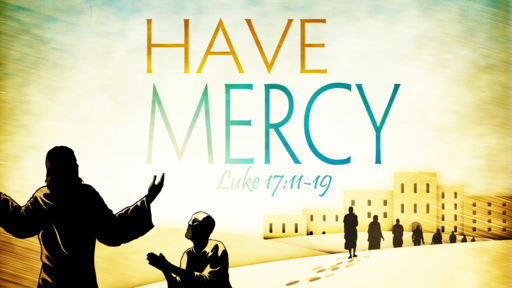

Luke 17:11-19 (Evangelical Heritage Version)
11On another occasion, as Jesus was on his way to Jerusalem, he was passing along the border between Samaria and Galilee. 12When he entered a certain village, ten men with leprosy met him. Standing at a distance, 13they called out loudly, “Jesus, Master, have mercy on us!”
14When he saw them, he said, “Go, show yourselves to the priests.” As they went away they were cleansed.
15One of them, when he saw that he was healed, turned back, glorifying God with a loud voice. 16He fell on his face at Jesus’ feet, thanking him. And he was a Samaritan. 17Jesus responded, “Were not ten cleansed? Where are the other nine? 18Was no one found to return and give glory to God except this foreigner?” 19Then he said to him, “Get up and go your way. Your faith has saved you.”
Have Mercy!
I.
It was a miserable existence. They had to stay six feet from anyone. They had to wear a mask, or at least cover the lower part of their face. It wasn’t 2020 and the Covid lockdown, this was their whole life. Every day, without any interruption. They were only allowed to be around others who had the same condition.
There was more to it than six feet of separation and wearing a mask, too. Another visible distinction was to make sure their hair was unkempt and messy. The clothing they wore was to be the style people would wear when they were mourning the death of a loved one. They couldn’t live with the “regular” population, they were forced into little shanty towns, outside the city walls from the rest of society.
It’s a challenge to be heard from any distance when wearing a mask; the challenge was compounded by the fact that disease weakened their voices, as well. Still, one of the requirements was that if anyone seemed to be getting too close to the six-foot-rule, the leper had to start shouting: “Unclean, unclean!”
Uncleanness was a serious concern to the upstanding Jew. The only thing worse than leprosy was coming in contact with a dead body. Contact with remains, however, was an uncleanness that lasted only a little while. Having leprosy was an uncleanness that lasted a long time; it rarely went away. Besides that, it was seen as a punishment from God for some sin in the life of the leper—a special judgment from God.
Uncleanness of any kind made it impossible to participate in worship. Since lepers had little to no chance of ever recovering, it meant they could assume they would never be able to participate in worship the way God required. Those were the rules.
II.
By this time Jesus had developed quite a reputation; he was seen as a gifted teacher, but he also had the reputation of healing many people. Even being separated from society and having to maintain the six feet of social distancing that made meaningful contact with others next to impossible, the news had had filtered into their shanty town. The ten lepers had heard all about Jesus.
“Standing at a distance, 13they called out loudly, ‘Jesus, Master, have mercy on us!’” (Luke 17:12-13, EHV). The ten followed the rules, but got as close as they thought was reasonable. It was clear to others what sort of people these were as they stood dressed as mourners with unkempt hair and masked faces. Perhaps one of them served as the cheer leader to make sure they all gave their message together. With strength sapped by disease and masks over their faces, one of them alone would have had a hard time getting the message out.
“Jesus, Master...” How much did they know, how much did they understand, that Jesus was the long-promised Messiah? Luke doesn’t give any indication. Certainly the ten saw Jesus as someone who deserved respect.
Though they knew of him as someone who had healed many people, the ten didn’t specifically ask for the thing they wanted most in all the wide world—to be healed of the debilitating disease that kept them isolated from their families. They just wanted mercy, in whatever form Jesus might be willing to give.
“When he saw them, he said, ‘Go, show yourselves to the priests’” (Luke 17:14, EHV). Jesus saw them. He heard their plea for mercy. His answer hinted at the powerful response. Though leprosy was generally incurable at that time, once in a while someone did seem to recover. After a person had been declared unclean, only a priest could pronounce them clean again. If they were told to appear before the priests, there was a chance that their life of separation would come to an end.
“As they went away they were cleansed” (Luke 17:14, EHV). The ten didn’t ask for clarification; they didn’t reply: “Does this mean we will be healed?” They just began their journey. Did the healing happen all at once, or gradually, as they walked along? Luke doesn’t say.
Jesus’ miracle was life-altering. No longer would they be considered lepers. No longer would they be ostracized from their families. No longer would they face a premature, and probably painful, death. Most importantly, no longer would they be unclean. Once pronounced “clean” they would be able to join the family of believers and gather with the faithful at the Temple of the Lord for worship.
“One of them, when he saw that he was healed, turned back, glorifying God with a loud voice. 16He fell on his face at Jesus’ feet, thanking him. And he was a Samaritan” (Luke 17:15-16, EHV).
It would be hard to believe that the other nine didn’t notice their skin was cleared up, like the one man did. Did the nine take it for granted? Perhaps as Jews they considered themselves entitled to God’s blessings. When they saw the results of Jesus’ mercy, they took off at a run, making a beeline for the priest who could pronounce them clean.
The other one, when he noticed, stopped in his tracks, turned around, and made a beeline back to Jesus. Like the Jews, Samaritans could trace their roots to Abraham, Isaac, and Jacob. The Jews considered Samaritans of “mixed race” and didn’t typically associate with them.
“Jesus responded, ‘Were not ten cleansed? Where are the other nine? 18Was no one found to return and give glory to God except this foreigner?’” (Luke 17:17-18, EHV). The nine didn’t lose the gift of healing Jesus had given, but they did lose an opportunity. As did the Samaritan former-leper, they could all have come back to Jesus to give thanks to the One they had identified as “Master.” They missed their chance to say thanks.
III.
Luke began today’s Gospel: “On another occasion, as Jesus was on his way to Jerusalem, he was passing along the border between Samaria and Galilee.” (Luke 17:11, EHV). This whole episode took place as Jesus was headed to Jerusalem for the last time.
God’s Old Testament Ceremonial Law declared that certain conditions made someone unclean—that is, they were declared unfit to go to worship in God’s temple. Leprosy, as mentioned, was one of those things.
Sin, is far worse than leprosy. Again and again the pages of Scripture show us the truth of what God said in today’s First Reading: “The thoughts [a person] forms in his heart are evil from his youth” (Genesis 8:21, EHV). In other words, people are permeated with sin—it infects us through and through—it is part of our very nature.
It gets even worse. David writes: “The arrogant cannot stand before your eyes. You hate all evildoers” (Psalm 5:5, EHV). Our sin is far worse than something that excludes us from worship for a little while, it makes it impossible to be with God in any way.
Jesus was headed to Jerusalem to deal with the sin that makes us unworthy for God to have anything to do with us. Jesus went to take the punishment we deserved for our sins. He loved us so much that he died for us to defeat what we could never hope to defeat on our own—sin, and Satan, and even death itself.
“Then he said to him, ‘Get up and go your way. Your faith has saved you’” (Luke 17:19, EHV). The Samaritan knew there was a far-greater mercy Jesus could provide than the mercy of healing. When he gave thanks to Jesus for the mercy shown to him in his leprosy-free body, Jesus announced to him the greatest of all gifts—the gift of forgiveness from the leprosy of sin. “Your faith has saved you.” Not just from a skin problem, but from a sin problem. Jesus announced to the Samaritan former-leper that the curse of his sin had been removed.
IV.
“Jesus, Master, have mercy!” (Luke 17:13, EHV). Like the ten lepers, you might have requested mercy due to an illness that laid you low. Maybe you wanted mercy for financial hardships or a failing or failed relationship. “Have mercy!” might have been your request for any one of a hundred reasons.
Sometimes God’s answer is more like the one he gave to Paul, who prayed to have his thorn in the flesh taken away: “My grace is sufficient for you” (2 Corinthians 12:9, EHV). At other times, God answers the way you were hoping. What, then?
“Were not ten cleansed? Where are the other nine? 18Was no one found to return and give glory to God except this foreigner?” (Luke 17:17-18, EHV). It can be all too easy to forget to give thanks to God for his many benefits. All kinds of blessings pour out on us from the hand of God: everything we are and everything we have. Is it not good and right to give thanks for all those things?
“Get up and go your way. Your faith has saved you” (Luke 17:19, EHV). Don’t forget to give thanks for this greatest gift: that Jesus did remove the leprosy of sin for you. Act like the one in ten. Fall at the feet of Jesus in worship. You have been given faith. Use the gospel in Word and Sacraments to strengthen and nourish your relationship with Jesus, your Master, on a regular and continual basis.
Have mercy! It was a miserable existence. It wasn’t an illness that excluded you from close personal contact with other people. You needed a mercy far greater than that. You needed mercy because your sin separated you from God.
God did have mercy. Long before you were born he planned your salvation. Jesus came and paid the price so you could receive mercy in the forgiveness of your sins. God the Holy Spirit even gave you the faith that you needed that has saved you. Get up and go your way in the peace of God that passes all human understanding. Your faith in Jesus has saved you. Amen.
