The Forgotten Love: When Service Outruns Surrender
The Seven Churches of Revelation • Sermon • Submitted • Presented • 1:06:05
0 ratings
· 25 viewsFiles
Notes
Transcript
The Forgotten Love: When Service Outruns Surrender
The Forgotten Love: When Service Outruns Surrender
Review: The Lord's Report Card
Review: The Lord's Report Card
Good morning, Branches Church!
Last Sunday, we established that the messages to these seven churches were not just for them, but for us as well. They have a three-fold application:
Practical
Prophetic
Personal
they were practical for the original churches, prophetical for the Church throughout history, and personal for each one of us today. We also saw that Jesus, as the one walking in the midst of the seven lampstands, has a perfect view of every church and every individual.
We also focused on two key phrases that apply to all seven churches:
"I know your works." This is a powerful reminder that while we are saved by grace, our faith must be evidenced by our works. Our deeds will be tested by fire, and only what is built on the foundation of Christ will endure.
"He who has an ear, let him hear what the Spirit says to the churches." This is a singular call to a plural group. It reminds us that our spiritual condition is an individual matter. We can't hide in the crowd; God is speaking to each of us.
Today, we'll see these principles at play as we dive into the very first of these letters, addressed to the church at Ephesus.
The City of Ephesus
The City of Ephesus
Ephesus was a major metropolitan hub in the Roman province of Asia Minor (modern Turkey), known for its immense wealth and prominence.
It was home to the Temple of Diana (Artemis), one of the Seven Wonders of the Ancient World, and a massive theater that seated over 25,000 people. This was a city steeped in pagan worship and commerce.
Yet, this is where the Gospel took root. Paul spent three years ministering here.
The book of Ephesians is addressed to the saints who are in Ephesus to outline that all spiritual resources are given through Christ for the purpose of building us up in unity.
The church became a missionary center, spreading the Gospel throughout the region. Priscilla and Aquila as well as Erastus were associated with the early preaching in Ephesus.
Timothy was its first pastor, and tradition holds that the Apostle John after his exile on the island of Patmos, returned to live in Ephesus and spent his final years, writing much of his work here.
This was a powerful, influential church, a pillar of apostolic Christianity.
1. Jesus' Introduction (Revelation 2:1)
1. Jesus' Introduction (Revelation 2:1)
1 “To the angel of the church of Ephesus write, ‘These things says He who holds the seven stars in His right hand, who walks in the midst of the seven golden lampstands:
Jesus begins by identifying Himself not as a distant deity, but as the one who is actively involved in His church.
The One speaking is not a co-equal member of a trinity; He is the Almighty God revealed in the flesh, walking actively in the midst of His Church.
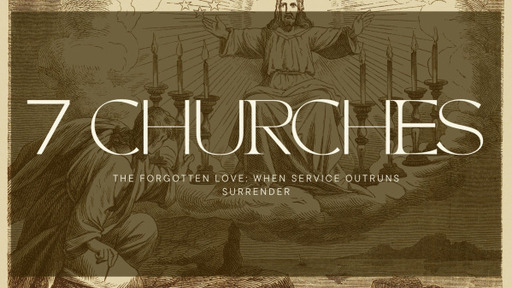
Let's revisit John's description of Him:
17 And when I saw Him, I fell at His feet as dead. But He laid His right hand on me, saying to me, “Do not be afraid; I am the First and the Last.
18 I am He who lives, and was dead, and behold, I am alive forevermore. Amen. And I have the keys of Hades and of Death.
The Deity of Jesus: The title "The First and the Last" belongs to God alone (Isaiah 44:6).
6 “Thus says the Lord, the King of Israel, And his Redeemer, the Lord of hosts: ‘I am the First and I am the Last; Besides Me there is no God.
This is Jesus Christ, the one and only Lord, who has absolute sovereign power—He holds the keys to death and the grave. This powerful, glorified God is the one examining His church.
He holds the seven stars (the pastors) in His right hand, signifying His power and authority over them. He also walks in the midst of the seven golden lampstands (the churches), showing that He is present, He is aware, and He is working among His people.
This is a direct refutation of any idea that God is not active in the church today. God is still moving, still speaking, and still walking in our midst.
2. The Commendation (Revelation 2:2-3)
2. The Commendation (Revelation 2:2-3)
Jesus praises the Ephesian church for three things: their hard work, their endurance, and their intolerance for evil.
2 “I know all the things you do. I have seen your hard work and your patient endurance. I know you don’t tolerate evil people. You have examined the claims of those who say they are apostles but are not. You have discovered they are liars.
He knows your activities: Jesus sees your service, your labor, and every good thing you do for His kingdom.
He knows your endurance: God sees your suffering and the perseverance you show in the face of tribulation. The Ephesians were persecuted for the name of Jesus, and they stood strong. We must do the same. Galatians 6:9 (GW) reminds us: "We can't allow ourselves to get tired of living the right way...if we don't give up."
They had a hatred for evil: They didn't tolerate false prophets or false teachers. This church was a guardian of the truth, testing every spirit as 1 John 4:1 commands. They had no patience for the doctrine of the Nicolaitans, which Jesus Himself hates. They were doctrinally sound and faithful to the apostolic message.
Discussion Question: What are some of the "false doctrines" we need to be vigilant against in the church today?
3. The Rebuke (Revelation 2:4)
3. The Rebuke (Revelation 2:4)
Despite all their strengths, Jesus had a critical warning for them.
4 Nevertheless I have this against you, that you have left your first love.
This is a sobering statement. They were working hard, enduring persecution, and upholding sound doctrine, yet they had abandoned their first love. T
hey hadn't backslidden into sin, but their hearts had grown cold. Their obedience had become a duty, not a delight. Their work was from habit, not from a heart overflowing with love for Christ. As Jesus said in Matthew 24:12,
12 And because lawlessness will abound, the love of many will grow cold.
The Nature of "First Love": This wasn't just a warm feeling; this was the fervent passion, zeal, and devotion that immediately followed their initial New Testament experience—the conviction, the repentance, the water baptism in Jesus' Name, and the initial infilling of the Holy Ghost.
Romans 5:5 (NKJV) teaches us that "the love of God has been poured out in our hearts by the Holy Spirit." When the fire of the Spirit is neglected, the love diminishes.
5 Now hope does not disappoint, because the love of God has been poured out in our hearts by the Holy Spirit who was given to us.
The Paradox of the Careless Church: They kept the form of doctrine but lost the fervor of the Spirit. Their service became a duty instead of a delight. Their works were from habit, not from a heart continually surrendered.
Personal Reflection: Have you let your love for Jesus grow cold? Do you still have the passion and zeal you had when you were first filled with the Holy Ghost?
4. The Remedy (Revelation 2:5-7)
4. The Remedy (Revelation 2:5-7)
Jesus doesn't just point out the problem; He provides the solution.
5 Remember therefore from where you have fallen; repent and do the first works, or else I will come to you quickly and remove your lampstand from its place—unless you repent.
Remember: Think back to where you started. Recall the joy of your salvation, the freshness of your prayer life, and the fire in your soul.
To do the first works (v. 5) means returning to the fervor of prayer, praise, and obedience that was present when we first encountered God's saving grace.
Repent: This is more than just saying "I'm sorry." It means to change your mind, turn around, and go in the opposite direction.
Do the first works: Get back to the basics! Praying through until you feel the Holy Ghost, seeking His face with all your heart, and letting your love for Him produce actions. This isn't about working to be saved, but about working because you are saved.
Jesus' warning is severe: "I will come... and remove your lampstand." He won't remove the light of His truth, but He will remove the church that no longer carries it with a burning love.
5. The Ultimate Promise (Revelation 2:7)
5. The Ultimate Promise (Revelation 2:7)
Finally, Jesus gives a promise to those who overcome:
7 “He who has an ear, let him hear what the Spirit says to the churches. To him who overcomes I will give to eat from the tree of life, which is in the midst of the Paradise of God.” ’
There's a reward for our endurance! The Tree of Life, mentioned in the Garden of Eden and in Revelation 22, symbolizes eternal life.
This is the ultimate promise for those who get back to their first love and endure until the end.
God is strong in His rebuke, but stronger in His love.
Will you overcome the obstacle of complacency and ensure your love for Jesus is the driving force of everything you do?
