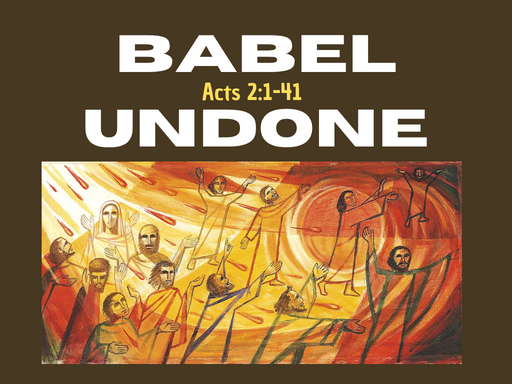
Babel Undone
Acts - The Spirit and the Church • Sermon • Submitted • Presented • 43:21
0 ratings
· 12 viewsFrom Babel to Pentecost, God moves from scattering to unifying. Pastor Rodney explores how human pride fractures communities—and how the Spirit restores, bringing people from every nation together to proclaim His glory.
Files
Notes
Transcript
Acts 2:1-41
Acts 2:1-41
Our story today, didn’t begin in Jerusalem, It began long before, on the plains of Shinar.
The world spoke one language then—one tongue, one vocabulary, one people moving in the same direction.
At first, that might sound beautiful—unity, harmony, cooperation. But this unity wasn’t rooted in the worship of God; it was rebellion disguised as progress.
They said to one another, “Come, let us build ourselves a city and a tower with its top in the heavens, and let us make a name for ourselves.”
They weren’t concerned with reaching God—they wanted to replace Him. They wanted glory without obedience, greatness without dependence, and a kingdom without a king. They wanted the same thing as Adam and Eve when they bit from the forbidden fruit.
And so, brick by brick, they built their monument to pride. The tower grew higher, their confidence stronger, their hearts harder. But then, God came down.
He saw their tower, their arrogance, their false unity—and He scattered them.
He confused their language so they could no longer understand one another.
What had been one voice became a thousand voices, each speaking past the other.
What had been one people became divided nations, each drifting further apart, left to worship spiritual beings disguised as gods.
That day, humanity’s single tongue fractured into absolute chaos. The builders who once said, “Let us make a name for ourselves,” walked away nameless—confused, scattered, undone.
And yet, even in their scattering, God had a plan.
Because one day, centuries later, in another gathering of people from every nation under heaven—not on a plain, but in an upper room—God would move again.
But this time, instead of confusing their speech, He would unify it.
Instead of scattering them, He would send them.
Instead of prideful rebellion, He would birth humble proclamation.
At Babel, God divided the nations.
At Pentecost, He began to gather them back.
When the day of Pentecost arrived, they were all together in one place. And suddenly there came from heaven a sound like a mighty rushing wind, and it filled the entire house where they were sitting. And divided tongues as of fire appeared to them and rested on each one of them. And they were all filled with the Holy Spirit and began to speak in other tongues as the Spirit gave them utterance.
Now there were dwelling in Jerusalem Jews, devout men from every nation under heaven. And at this sound the multitude came together, and they were bewildered, because each one was hearing them speak in his own language. And they were amazed and astonished, saying, “Are not all these who are speaking Galileans? And how is it that we hear, each of us in his own native language? Parthians and Medes and Elamites and residents of Mesopotamia, Judea and Cappadocia, Pontus and Asia, Phrygia and Pamphylia, Egypt and the parts of Libya belonging to Cyrene, and visitors from Rome, both Jews and proselytes, Cretans and Arabians—we hear them telling in our own tongues the mighty works of God.” And all were amazed and perplexed, saying to one another, “What does this mean?” But others mocking said, “They are filled with new wine.”
So last week, we left Acts 1 with Christ’s command to “wait for the promise of the Father.”
And so they found themselves waiting early in the morning, in Jerusalem. The city was alive with the sounds and smells of Pentecost, the great harvest festival that had drawn Jews from every corner of the known world.
The narrow streets were crowded with pilgrims— various languages mingling in the air.
Meanwhile, in an upper room not far from the Temple, the followers of Jesus waited. There were about 120 of them—men and women who had clung to His promise: “You will receive power when the Holy Spirit has come upon you.” They didn’t know exactly what that meant, but they waited, praying and remembering His words.
Then, suddenly, the stillness broke.
A sound like a mighty rushing wind filled the house—so loud it seemed to shake the very walls. The disciples froze, eyes wide. The noise wasn’t coming from outside—it was as though heaven itself had burst open right there among them.
And then they saw it.
Flames—tongues of fire—appeared and rested on each of them. It wasn’t like any fire they’d seen before. It didn’t burn or destroy—it empowered. The moment it touched them, something surged within—an overwhelming sense of God’s presence, alive and burning in their chests.
They began to speak—words pouring out faster than they could comprehend. Not in their familiar Aramaic, but in the languages of distant lands they had never learned.
They stumbled into the streets, unable to contain the joy, the power, the wonder of what was happening.
Down below, the crowds stopped and stared. “What is going on?” someone muttered.
They gathered quickly, drawn by the noise and the sight of ordinary Galileans proclaiming the mighty works of God—in Parthian, Egyptian, Roman, and dozens more tongues.
“Wait,” said one man from Mesopotamia, “he’s speaking my language—about God’s wonders!”
Another from Libya nodded in disbelief, “So is she!”
The air buzzed with confusion and amazement. Some stood in awe, hearts stirred, tears filling their eyes. Others laughed and sneered.
“They’ve had too much wine,” someone joked, shaking his head.
But even amid the mockery, the crowd could not deny it: something holy, something from heaven itself, had broken into the ordinary that day.
And the world would never be the same.
The world changed that day…because God’s promise to His people was fulfilled.
His power and presence was gifted, and it was gifted for a purpose.
I want to talk today, about that purpose, because everything you believe about your life…
your job,
your family,
your personal time,
your finances,
your dreams….
All of it.
I contend, reveals what you believe about the:
Power and Purpose of that Gift.
Power and Purpose of that Gift.
To understand a gift, we must first understand the intent of the Giver. Mainly, that:
Jesus Came to Establish His Kingdom
Jesus Came to Establish His Kingdom
When Jesus first stepped onto the scene, He didn’t ease His way in. He came declaring a revolution:
“The time is fulfilled, and the kingdom of God is at hand; repent and believe in the gospel.”
For generations, the world had been ruled by darkness. Evil seemed to have the upper hand. God’s people—once chosen and set apart—were now scattered, weary exiles under the thumb of foreign powers. Even their religion had been hollowed out. What once was meant to draw them near to God had become a system of self-effort and pride. They no longer trusted in God’s grace; they trusted in their own performance.
And behind it all, satan sat on a throne that was never his—holding the world hostage through deception, sin, and death.
All he had to do was keep the Messiah from coming.
But then, one day in Galilee, a carpenter’s son opened His mouth and said,
“The time is fulfilled.”
In other words, the waiting was over. The true King, long waited for, had arrived.
And His words rang out like a battle cry:
“Repent of the world’s lies, and believe the good news.” For,
“The Kingdom of God is at hand”
The word “kingdom”—basileia in Greek—means far more than borders or boundaries. It’s not about land; it’s about authority.
Jesus was announcing the arrival of a new rule—the reign of heaven itself breaking into the dominion of darkness.
He wasn’t here to negotiate with evil. He came to overthrow it.
He came to reclaim what sin had stolen.
He came to set everything right again.
As the apostle John would later write:
The reason the Son of God appeared was to destroy the works of the devil.
The Kingdom had come—not with fanfare, but with power. Power demonstrated as:
Jesus came to share the good news
Jesus came to share the good news
Right out of the gate, Jesus declared His purpose, and a couple weeks ago we read about this and I want to do so again, but it’s importance cannot be overstated.
Jesus went to the synagogue in Nazareth, His hometown, and He quoted from Isa 61 as recorded in Luke 4:18-21:
“The Spirit of the Lord is upon me,
because he has anointed me
to proclaim good news to the poor.
He has sent me to proclaim liberty to the captives
and recovering of sight to the blind,
to set at liberty those who are oppressed,
to proclaim the year of the Lord’s favor.”
And he rolled up the scroll and gave it back to the attendant and sat down. And the eyes of all in the synagogue were fixed on him. And he began to say to them, “Today this Scripture has been fulfilled in your hearing.”
Jesus declares the mission statement of His ministry, and it sets forth a pattern that would begin with Him and continue with the disciples.
A pattern of proclamation and demonstration.
And he went throughout all Galilee, teaching in their synagogues and proclaiming the gospel of the kingdom and healing every disease and every affliction among the people.
Jesus taught (discipleship)
Jesus preached (gospel proclamation)
and Jesus healed (spiritual power)
And this pattern continues all through the book of acts, it’s remarkable when you see it time and time again. And the result of this pattern, continue that which Christ demonstrated…
And great crowds followed him from Galilee and the Decapolis, and from Jerusalem and Judea, and from beyond the Jordan.
I was twelve years old when I first sensed God calling me into pastoral ministry. But it wasn’t until I was nineteen—after a dramatic encounter that humbled me to the core—that I finally surrendered to that call.
And as I’m prone to do, I ran headfirst into ministry with very little patience for instruction. I didn’t want to learn the slow, faithful way—I wanted to do what worked. I wanted results.
So, in my early twenties, I bounced around a handful of small churches in northern Missouri. I figured out something pretty quickly: if you went to a small rural town, and brought enough energy, fun, games, and snacks—you could grow a youth group fast.
In my first paid youth ministry job, we started with three kids. But before long, we were drawing nearly fifty every week—more than double the size of the Sunday morning service. We added volunteers, blasted loud music, and turned the fellowship hall into what felt like a mini youth revival. I even launched a Sunday night “youth service” that drew students and a bunch of unchurched adults.
My ministry was growing—and so was my ego. Because I thought I had found the formula.
And sure enough, a bigger church down the road heard about it and offered me more money to bring my “formula” to their town. So, of course, I went. And after that, I got the ultimate call: a paid internship at a megachurch in Columbia, Missouri.
I’ll never forget walking through those doors for the first time. The building was massive. The people were friendly. The coffee was good—and they even let you take it into the sanctuary! That alone felt revolutionary. I remember thinking, This is it. This is heaven on earth. Surely, my six-month internship would end with me joining their staff. I couldn’t imagine anything better.
And honestly, the first few months were great. The same formula I’d used before worked even better here—because now I had a budget. We hosted huge Halo tournaments, lock-ins, and high-energy events every week. Youth nights were high production, high impact, and high attendance. I thought I was living the dream.
But about halfway through that internship, something in me began to shift.
As I became more involved in Sunday services and behind-the-scenes planning, I started to notice things that didn’t sit right. The pastor preached three identical services every Sunday, and each one was rehearsed—every word, every movement, even his pacing across the stage—timed perfectly to the background music by professional overseers.
And one morning, as I sat in the sanctuary during rehearsal, it hit me.
All of this excitement… all of this emotion… was being manufactured. Carefully choreographed by people—but almost completely detached from the power of the Spirit. Nobody was known, church discipline wasn’t taking place, transparency wasn’t being practiced.
The next Sunday, we opened the service with a clip from the newest Friends episode and followed it with a “Christianized” version of the latest top-40 hit. And sitting there, it became painfully clear: this wasn’t what God had called me to give my life to.
And worse—I realized that my own ministry had been built the same way. Just with a smaller budget.
I could justify it in my head when it was teenagers, but seeing adults being pacified with the same tactics, well that shook me.
Because making people comfortable, entertaining them into attendance, is easy. But it’s not the reason Jesus died.
So, I quit the internship a month early. Everyone was shocked. “Why would you walk away from such a cushy gig?” they asked.
But I didn’t want cushy after all—I realized that what I wanted was Christ. I wanted to see the power of the Spirit move in people’s lives.
And I did.
The years that followed were some of the hardest of my life. I saw spiritual warfare up close—in some ways would sound unbelievable if I told you about them.
But I also witnessed something far greater: the power of the gospel to bring light into darkness, and life out of death.
When I walked away from that internship, I wasn’t walking away from the church—I realize now I was walking toward Pentecost.
I didn’t know it then, but what I was longing for wasn’t better strategy or style—it was the Holy Spirit.
Because the same thing that happened to me on a small, personal level—the shift from self-effort to surrender—is what happened to the disciples in Acts 2 on a global scale.
They had the message. They had the mission. But until the Spirit came, they didn’t have the power.
And when He came… everything changed.
And Acts 2 tells us exactly what that change looked like.
On the day of Pentecost, the Holy Spirit came upon the disciples in a dramatic, unmistakable way—tongues of fire rested on each of them, and they began speaking in languages they had never learned. The Spirit didn’t just fill them; He equipped them to proclaim the gospel to a world fractured by sin, fear, and division. People from every nation heard the message in their own tongue, and three thousand responded in faith that very day.
The sound of the rushing wind caught the attention of everyone, and soon the streets of Jerusalem were buzzing with confusion and curiosity. Some were amazed, others mocked—“They’re just drunk,” they said. But Peter—the same man who once denied Jesus—stood up with courage and clarity. Filled with the Spirit, he spoke words that pierced hearts and birthed the church.
He didn’t begin with a pep talk or a defense; he began with Scripture. Shandon read his sermon to you earlier, but I want to highlight some key points from his sermon, ee said…
Acts 2:16–17
“This is what was uttered through the prophet Joel:
‘And in the last days it shall be, God declares,
that I will pour out my Spirit on all flesh…”
Peter was saying, This is it. The thing Israel had longed for—the promised age of the Spirit—had arrived. God was not distant; He was dwelling among His people.
Then Peter lifted their eyes higher—to Jesus.
Acts 2:22–24
“Jesus of Nazareth, a man attested to you by God with mighty works and wonders and signs that God did through him in your midst… this Jesus, delivered up according to the definite plan and foreknowledge of God, you crucified and killed… but God raised him up, loosing the pangs of death, because it was not possible for him to be held by it.”
That’s the gospel in one breath: humanity’s greatest failure met by God’s greatest victory.
Peter declared that the risen Christ now sat exalted at the right hand of God and had poured out the Spirit they were witnessing. He concluded with boldness:
Acts 2:36
“Let all the house of Israel therefore know for certain that God has made him both Lord and Christ, this Jesus whom you crucified.”
And when those words landed, something remarkable happened. The same crowd that had mocked now stood cut to the heart. They cried out, “What shall we do?”
Peter answered simply:
Acts 2:38
“Repent and be baptized every one of you in the name of Jesus Christ for the forgiveness of your sins, and you will receive the gift of the Holy Spirit.”
Three thousand people were saved that day—not because of Peter’s eloquence, not because of strategy or production, but because the Spirit of God was moving.
And that’s still how revival happens. When the people of God are filled with the Spirit of God, proclaiming the gospel of God—lives change, hearts awaken, and the church grows in power and grace.
I want you to understand, to feel deep down in your bones, that the mission Christ gave, and the Spirit ignited, in the disciples, He continues to ignite in the church today.
We are called to continue, what began at pentecost. We are to be a people who both proclaim, and demonstrate, the power of the Holy Spirit in every corner of our life where God has sent us.
So, what does this mean practically for us today?
First, we have to resist reliance on human formulas.
First, we have to resist reliance on human formulas.
Energy, programs, and entertainment can draw a crowd, but only the Spirit transforms lives. Our goal is not attendance; it’s obedience, power, and fruit in the Kingdom.
And I will be honest here, I say that in front of you because I still have to be held accountable to that end by our elders, every day. I still understand the formula that’ll draw a crowd, and I am often prone to want to tap back into that (Radiant leaves and all the sudden I am 22 again)…but the truth is, there’s no power in that, just a lot of toil.
To seek the Spirit, to pray for His power, to engage each day in the unnoticed works that He leads us too…this is power that lasts.
A thousand people who gather each Sunday, and then go back to the ways of the world on Monday, pale in comparison to the little church of 25 faithful believers that seek to proclaim and demonstrate the power of the Spirit each day, in every place they are sent.
This is what we must aspire to, this is kingdom work, and to do that kind of work we must:
Wait for the Spirit and Expect Him to Do Amazing Things
Wait for the Spirit and Expect Him to Do Amazing Things
Acts 2 shows us that the Spirit’s arrival was dramatic and unmistakable—tongues of fire, a rushing wind, and a miraculous ability to speak in languages people had never learned. This was not a subtle whisper; it was God moving in power.
The disciples waited as Jesus commanded—not passively, but expectantly. They didn’t try to manufacture results on their own. And when the Spirit came, the ordinary became extraordinary.
Church, we need to learn this lesson today. Don’t be afraid of God’s supernatural work in our midst. I have seen God change dead hearts. I have seen marriages that were utterly destroyed, repaired through His grace. I have seen cancer taken away, I have seen my own son suffer with terrible seizures that didn’t relent until we were finally desperate enough to bring him before the church for prayer…then they went away.
Church, pray for boldness, pray for empowerment, and wait expectantly.
Like a car without fuel, ministry without the Spirit can look polished on the outside but won’t move anyone toward Christ.
The Spirit is the fuel that propels our mission forward, and positions us to:
Be a Church that Unites and Reaches Beyond Comfort Zones
Be a Church that Unites and Reaches Beyond Comfort Zones
At Pentecost, the Spirit broke down barriers of language and culture. People from every nation heard the gospel in their own tongue. Acts 2 reminds us that God’s Kingdom is inclusive and far-reaching.
Our church must reflect this same mission. We are called to step beyond our comfort zones—to love, reach, and serve those who are different from us, whether culturally, generationally, or socially. We don’t stay in our group, or with our people, we see the gospel as bigger than all our divides.
The old can reach the young and vice versa…
The democrat and republican can equally be convicted to hold God’s word above party lines…
The Spirit equips us to communicate God’s love in ways that transcend barriers, bringing unity and understanding in the midst of diversity. Undoing the curse Babel and reflecting the promise of the Kingdom.
But to see this take place, we must posture our hearts to:
Expect Transformation, Not Entertainment
Expect Transformation, Not Entertainment
Peter’s sermon did not rely on clever methods or showmanship—it relied on the Spirit’s power. People didn’t respond to the performance; they responded to God. Lives were changed, hearts were pierced, and three thousand people were baptized that day.
Church, this is our mission too. Our goal is not to entertain, impress, or please people with polished programs. Our goal is to see Jesus move. We want transformation, not applause. We want resurrection power breaking into the ordinary, seeing death defeated by life.
I will take one lost soul being saved, over 100 christians who “like our music better…” I will take that trade all day everyday.
Because that kind of work, declares that:
God’s Power, Not Ours, Builds His Kingdom
God’s Power, Not Ours, Builds His Kingdom
My own journey taught me that human formulas, high energy, or clever strategies may draw crowds, but they cannot build God’s Kingdom. Pentecost reminds us that it is God’s Spirit who transforms ordinary people into bold witnesses, who breathes life into ministry, and who brings fruit that lasts.
The Spirit doesn’t just enhance our efforts—He empowers them. When we surrender our ego and strategy, and wait on Him, ordinary people like us are capable of extraordinary things. What happened on that day in Jerusalem is meant to happen today, in our lives, in our churches, and in our communities.
Closing
Closing
So as we close today church, my prayer is that we would not settle for ministry that simply fills seats or entertains. But instead, let us pray fervently, wait expectantly, and step boldly as the Spirit empowers us.
Let us reach across boundaries, speak the gospel into every heart, and trust that God will do what only He can do.
Pentecost is a reminder: the same Spirit that filled the disciples is available to us.
When we seek His power above our own, ordinary people are transformed, ordinary gatherings become powerful, and ordinary lives become vessels for extraordinary kingdom work.
I leave you with the ultimate testimony of this kind of church, from:
And they devoted themselves to the apostles’ teaching and the fellowship, to the breaking of bread and the prayers. And awe came upon every soul, and many wonders and signs were being done through the apostles. And all who believed were together and had all things in common. And they were selling their possessions and belongings and distributing the proceeds to all, as any had need. And day by day, attending the temple together and breaking bread in their homes, they received their food with glad and generous hearts, praising God and having favor with all the people. And the Lord added to their number day by day those who were being saved.
Pray for an Acts 2 Church
Communion declares where our power comes from!
