Reformation — October 26, 2025

Notes
Transcript
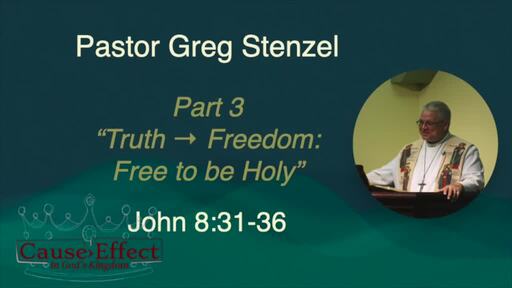
Truth → Freedom: Free to Be Holy
Truth → Freedom: Free to Be Holy
John 8:31–36
Reformation Sunday
Our Redeemer’s Lutheran Church, Williston, ND
Series: Cause and Effect
Introduction – What Is Freedom, Really?
Introduction – What Is Freedom, Really?
In the name of Jesus. Amen.
God’s promises give us confidence to pray without ceasing. But how do we know those promises are sure? Because they are anchored in the truth of God’s Word. As we celebrate the Reformation, we rejoice that the truth of Christ is what truly sets us free.
If you ask most people what freedom means, they’ll say something like, “Freedom is doing whatever I want.” But that kind of freedom—without truth, without limits—isn’t freedom at all. It’s just another kind of slavery: slavery to self, to desire, to sin. It is truly to be in bondage.
Today, Jesus tells us about a very different kind of freedom. Not freedom from God’s Word, but freedom in it. “If you abide in My word,” He says, “you are truly My disciples, and you will know the truth, and the truth will set you free.”
Reformation Sunday is all about that freedom. It’s about the Truth that frees us—not a truth we invent, but the Truth that took on flesh and dwelt among us. It’s about the Son who entered our bondage to sin and death so that, through His cross, we might be set free indeed.
The world says freedom means no master. Jesus says true freedom means having the right Master—the One whose yoke is easy and whose burden is light.
I. The Bondage of the Lie
I. The Bondage of the Lie
The Jews who heard Jesus that day didn’t think they were slaves to anyone. “We are descendants of Abraham,” they said. “We’ve never been slaves.” You can almost hear the pride in their voices.
But Jesus exposes the lie. “Everyone who commits sin is a slave to sin,” He says. “And the slave has no permanent place in the household.”
It’s a hard word, but an honest one. Sin isn’t just something we do; it’s something that owns us. We may boast of our independence, our achievements, our heritage—just like those children of Abraham—but apart from Christ we’re still chained.
The Reformation began when one monk came face to face with that truth. Martin Luther tried to climb the ladder of righteousness by his own effort—fasting, confessing, striving for holiness—but the more he climbed, the heavier his guilt became. He realized that no matter how much he did, he was still captive to sin.
The Law had done its work. It had shown him what Jesus declares in this text: apart from the Son, we are slaves.
And that’s where the Law leaves us too. We may not boast in Abraham’s bloodline, but we boast in other things—our family name, our good reputation, our church involvement, our good intentions. We think: Surely God must be pleased with me.
But then the Law speaks: “Everyone who sins is a slave to sin.” It doesn’t say, “Everyone who sins a lot.” Just everyone who sins. And that includes us all.
The Law tears down every false freedom and leaves us with this truth: we are not free people trying to keep ourselves from falling into bondage; we are enslaved people who need to be rescued.
II. The Freedom of the Son
II. The Freedom of the Son
And that’s exactly what the Son has done.
“If the Son sets you free,” Jesus says,
“you will be free indeed.”
Notice the shift: the Son doesn’t offer advice on how to escape; He acts. He steps into the slave market Himself. He takes the chains we forged with our own sin and lets them be fastened around His wrists. He enters our prison so that He can walk us out of it.
Freedom in Christ isn’t an idea—it’s an event. It happened on a cross. As one theologian put it, “To remain in the Word of Jesus is to remain where Jesus Himself remains—under the cross, where the will of the Father is done and freedom is won.” (Weinrich)
That’s the heart of the Gospel. Freedom isn’t gained by our striving; it’s given by the Son’s dying.
And that freedom is complete.
It’s freedom from sin’s guilt,
freedom from death’s grip,
freedom from the devil’s accusation.
But it’s also freedom for something—freedom to be holy.
III. Freedom for Holiness
III. Freedom for Holiness
That may sound surprising. We don’t usually put “freedom” and “holiness” in the same sentence. But that’s exactly where the Pastor’s Conference speaker from last week directs us.
He says, “Holiness is not our achievement but our participation in Christ’s life through the means of grace. It’s the freedom to live as we were created—holy and whole before God.” — Harold Senkbeil
The Reformation rediscovered that truth. Luther’s great insight was that justification by faith doesn’t make holiness optional—it makes it possible.
Once you’ve been set free by Christ, you are no longer bound to sin’s dominion. You are free to live in the Father’s house. The chains are gone, not so you can wander, but so you can walk in His ways.
That’s why Luther could say both:
“A Christian is a perfectly free lord of all, subject to none,”
and
“A Christian is a perfectly dutiful servant of all, subject to all.”
True freedom is not the absence of authority; it’s the presence of grace. It’s the joyful ability to love God and neighbor without fear.
The world thinks holiness means losing yourself; Jesus shows that holiness is where you finally find yourself. Sin makes us less human; holiness restores our humanity.
IV. Abiding in the Word
IV. Abiding in the Word
So how does this freedom take hold of us? Jesus says, “If you abide in My word, you are truly My disciples.”
The word abide means to dwell, to remain, to make your home. Picture a child who knows where he belongs, who finds rest and safety in his father’s house. That’s what it means to abide in the Word.
It means staying close to the Gospel—hearing it, reading it, singing it, clinging to it. It means letting the Word interpret your life, not letting the world interpret the Word.
Luther called this the Abiding Word—the Word that remains when everything else falls apart. He experienced that firsthand. In 1530, while the Augsburg Confession was being presented, Luther was kept away at Coburg Castle, still under the emperor’s ban. Sick in body and heavy in heart, he covered his walls with Scripture verses to remind himself of God’s promises. There he wrote:
“There is a kingdom of grace that is mightier in us and over us than all wrath, sin, and evil. Far more grace is here to rule over sin, far more life to rule over death, far more of God to rule over all the devils.”
That’s what it means to abide in the Word—to live under the heaven of grace, where sin and death are only dark clouds that can never block the sunlight of Christ forever.
V. The Law and the Gospel in Reformation Perspective
V. The Law and the Gospel in Reformation Perspective
The Reformation was not about rebellion but reformation—being reshaped by the Word of Truth.
Luther didn’t invent something new; he rediscovered something eternal: that the Law condemns and the Gospel sets free.
The Law says, “Do this, and you will live.”
The Gospel says, “It is finished.”
The Law reveals our slavery.
The Gospel proclaims our freedom.
The Law drives us to Christ.
The Gospel draws us to the Father’s heart.
And out of that freedom flows holiness—not the pride of “Look what I’ve done,” but the joy of “Look what Christ is doing in me.”
VI. Living as the Freed and Holy People of God
VI. Living as the Freed and Holy People of God
So what does this look like for us?
It means we’re free from sin’s tyranny—but not free to sin again.
We’re free from the world’s lies—but not free to despise the world for which Christ died.
We’re free from the need to prove ourselves—but free for the neighbor who needs our love.
It means that the Reformation isn’t just a date on the calendar—it’s a daily rhythm of repentance and renewal. Every time you confess your sin and hear the words of absolution, the Reformation happens again: Truth → Freedom.
And this freedom has a shape—the shape of the cross.
When the Son makes you free, He doesn’t make you wild; He makes you His own.
—You’re free to forgive,
—Free to endure,
—Free to speak truth in love,
—Free to stand firm when the world mocks you,
—Free to serve when the flesh resists you.
In a world that calls evil good and good evil, it takes courage to remain in the Word. But Jesus says, “If you remain in My Word, you are truly My disciples.” That’s a promise. He’s saying, I’ll hold you fast. My Word will keep you free.
VII. Conclusion – Free Indeed
VII. Conclusion – Free Indeed
“If the Son sets you free, you will be free indeed.”
—Free not to run from God, but to run to Him.
—Free not to hide your sin, but to confess it.
—Free not to chase your own glory, but to reflect His.
—Free not to be God, but to be His child.
That’s what Jesus offers in His abiding Word. That’s what Luther rediscovered in the Scriptures. And that’s what we celebrate today: freedom that leads to holiness, truth that leads to love, grace that leads us home.
So, dear friends, abide in His Word. Let it dwell richly in you. Let it shape your thoughts, your prayers, your life. For in that Word is the power of the Gospel—the Truth that sets you free.
And when the Son sets you free, you are free indeed.
In the name of the Father and of the Son and of the Holy Spirit. Amen.
—————————
—————————
Prayers of the Church
Prayers of the Church
Reformation Sunday – October 26, 2025
Theme: Truth → Freedom: Free to Be Holy
P: Let us pray for the whole people of God in Christ Jesus and for all people according to their needs.
A brief pause.
P: Almighty and everlasting God, we thank and praise You for the truth of Your Word, which endures forever. As Your Son has promised, “If you abide in My Word, you are truly My disciples, and you will know the truth, and the truth will set you free.” Guard Your Church on earth that she may always cherish the pure Gospel, proclaim it with courage, and rejoice in the freedom it brings through forgiveness and grace.
Lord, in Your mercy,
C: Hear our prayer.
P: Lord Jesus Christ, You are the Truth who frees us from sin and death. Keep this congregation steadfast in Your Word. Give us grace to love Your truth, to speak it with humility, and to live it with joy. Protect us from false teaching and from every temptation to exchange the freedom of faith for the slavery of self. Let Your Word dwell richly in us, that we may be Your holy and free people.
Lord, in Your mercy,
C: Hear our prayer.
P: God of peace and justice, we pray for Your mercy upon the nations of the world, especially for continued peace in the Middle East. Bring an end to violence, hatred, and bloodshed. Protect the innocent, guide the leaders of nations to seek reconciliation and righteousness, and establish Your peace where human efforts fail.
Lord, in Your mercy,
C: Hear our prayer.
P: Gracious Father, have compassion on all who are suffering in body or spirit—those who are sick, those undergoing medical treatment, and those who struggle with addiction or mental anguish. Deliver them from despair, strengthen their faith, and remind them that their true freedom is secure in Christ’s victory over sin and death. Surround them with Your people, that they may experience Your healing love.
We especially remember Celeste and Heidi, asking for Your healing mercy upon them both; bring relief, strength, and restoration according to Your good will.
We also give You thanks and praise for Cheryl Bauer, whose hip surgery was successful. Continue to bless her recovery with patience, strength, and a full return to health.
Lord, in Your mercy,
C: Hear our prayer.
P: Lord of the nations, bless our country. Teach us to pray without giving up, to seek Your will above all, and to live as citizens who walk in truth and integrity. Grant wisdom and humility to those in positions of authority, and turn the hearts of our people toward what is good, right, and pleasing to You.
Lord, in Your mercy,
C: Hear our prayer.
P: Holy Spirit, sanctify our hearts and minds through the truth. Lead us to delight in the holiness that comes from abiding in Christ’s Word. Make our homes places of prayer, our words gentle with grace, and our lives reflections of the Savior’s love. Keep us steadfast when the world’s lies entice and when the cross feels heavy, that we may be free to serve and holy in all we do.
Lord, in Your mercy,
C: Hear our prayer.
P: We give You thanks, O Lord, for the fellowship of Your servants who gathered this past week at the Pastor’s Conference in St. Paul. Thank You for the gift of learning, the encouragement of brothers in ministry, and for the truth they heard about holiness—that we are not holy by our achievement but by our participation in Christ’s life through the means of grace. Bless all pastors with renewed faithfulness to preach Your Word in truth and love.
Lord, in Your mercy,
C: Hear our prayer.
P: Into Your hands, O Lord, we commend all for whom we pray, trusting in Your mercy through Jesus Christ, our Lord, who has taught us to pray:
C:
Our Father who art in heaven,
hallowed be Thy name,
Thy kingdom come,
Thy will be done on earth as it is in heaven.
Give us this day our daily bread;
and forgive us our trespasses,
as we forgive those who trespass against us;
and lead us not into temptation,
but deliver us from evil.
For Thine is the kingdom and the power and the glory
forever and ever. Amen.
