Moses' Intercessory Prayer for Israel at Mount Sinai (Doctrinal Bible Church in Huntsville, Alabama)

Doctrinal Bible Church
Pastor-Teacher Bill Wenstrom
Wednesday October 15, 2025
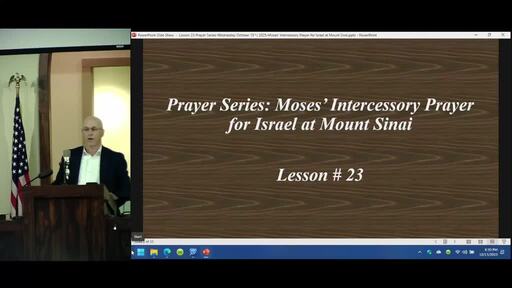
Prayer Series: Moses’ Intercessory Prayer for Israel at Mount Sinai
Lesson # 23
Like Abraham, Moses is known in Scriptures as a man of great faith.
In fact, Moses is listed in God’s Hall of Fame of Faith in Hebrews 11:24-29.
Exodus 32 presents one of the greatest lessons on intercessory prayer that is found in the Bible, offered by one of the greatest prayer warriors in the Bible, namely, Moses.
Moses, again, interceded for the children of Israel in Exodus 32.
While on Mount Sinai communing with the Lord for forty days and nights and receiving the Law, the children of Israel demonstrated their rebellion by worshipping idols, particularly the golden calf.
While waiting for Moses in Exodus 32, the people of Israel assembled themselves against Aaron as an angry and aggressive mob.
It is understandable that Aaron capitulated to the mob and did what they commanded him, but this does not justify his actions.
Aaron should have done what Moses did in Numbers 16:4, and fall on his face, praying to God for help, however, Aaron lacked courage because he lacked faith at this time.
His lack of faith in the Lord is manifested in his failure to pray while during this adversity with the children of Israel.
In perfect contrast to Moses, Aaron failed in his role as a spiritual leader of the people because he was arrogant to seek a solution independent from God.
Moses was the humblest man on the earth according to Numbers 12:3, and this was the secret to his fantastic intercessory prayer ministry and his effective and productive prayer life.
Exodus 32:1 When the people saw that Moses was so long in coming down from the mountain, they gathered around Aaron and said, “Come, make us gods who will go before us. As for this fellow Moses who brought us up out of Egypt, we don’t know what has happened to him.” 2 Aaron answered them, “Take off the gold earrings that your wives, your sons and your daughters are wearing, and bring them to me.” 3 So all the people took off their earrings and brought them to Aaron. 4 He took what they handed him and made it into an idol cast in the shape of a calf, fashioning it with a tool. Then they said, “These are your gods, O Israel, who brought you up out of Egypt.” 5 When Aaron saw this, he built an altar in front of the calf and announced, “Tomorrow there will be a festival to the Lord.” 6 So the next day the people rose early and sacrificed burnt offerings and presented fellowship offerings. Afterward they sat down to eat and drink and got up to indulge in revelry. 7 Then the Lord said to Moses, “Go down, because your people, whom you brought up out of Egypt, have become corrupt. 8 They have been quick to turn away from what I commanded them and have made themselves an idol cast in the shape of a calf. They have bowed down to it and sacrificed to it and have said, ‘These are your gods, O Israel, who brought you up out of Egypt.’ 9 “I have seen these people,” the Lord said to Moses, “and they are a stiff-necked people. 10 Now leave me alone so that my anger may burn against them and that I may destroy them. Then I will make you into a great nation.” (NIV84)
God’s words in verse 7-10 reflect the consequences of sin—a separation from God and the ominous threat of judgment.
God no longer spoke of Israel as “His” people, but rather as the people of Moses.
Both in what God said and in the way He said it, Israel’s sin had put the nation in great danger.
Exodus 32:10 again records God threatening to annihilate the entire nation of Israel, to wipe them out, and start over, making a new nation of Moses.
These words posed an ominous threat to Israel’s future.
God’s words here were intended to convey the great danger Israel faced.
His words, however, were also intended to produce something apart from destruction, which is suggested by both the outcome of the story and by the words themselves.
If God truly intended to wipe Israel out, what reason was there for Him to tell Moses about it and then send Him down to the people?
God tells of judgment in advance to afford men an opportunity to repent.
Furthermore, the words “let Me alone” suggest to Moses that if he did not leave God alone, the people would not be destroyed.
The inference is that if Moses did intercede for Israel, God would likely turn His wrath from His people.
Finally, as we have already noted with Numbers 14:12, Moses knew that God’s threatened action of destroying Israel, as well as His offer to him of making a new nation through him, was inconsistent with God’s character and His covenant with Israel.
It would be against the plan of God to destroy Israel because of His promise to Abraham, Isaac, and Jacob.
Thus, these words were intended to stimulate Moses to intercede for his people and, thus, bring about forgiveness.
As we have noted many times in our study of prayer, prayer must be according to the will of God (1 Jo 5:14) and God’s will in saving us is to glorify Himself.
All our prayers must have this ultimate objective, the glory of God and since God’s will is to glorify Himself, the intercessory prayer of Moses on behalf of rebellious and idolatrous Israel in Exodus 32 appealed to the will of God.
By being slow to execute judgment and gracious in forgiving Israel’s sin, God’s glory would be manifested before Israel and the entire world.
Exodus 32:11-14 records Moses pleading with God to withhold judgment upon idolatrous Israel.
Exodus 32:11 But Moses sought the favor of the Lord his God. “O Lord,” he said, “why should your anger burn against your people, whom you brought out of Egypt with great power and a mighty hand? 12 Why should the Egyptians say, ‘It was with evil intent that he brought them out, to kill them in the mountains and to wipe them off the face of the earth’? Turn from your fierce anger; relent and do not bring disaster on your people. 13 Remember your servants Abraham, Isaac and Israel, to whom you swore by your own self: ‘I will make your descendants as numerous as the stars in the sky and I will give your descendants all this land I promised them, and it will be their inheritance forever.’ ” 14 Then the Lord relented and did not bring on his people the disaster he had threatened. (NIV84)
To reiterate the principles in Numbers 14:12, Moses’ intercessory prayer revealed his deep humility in that his ultimate objective for delivering Israel was the glorification of God and that he was experiencing an intimate relationship with God.
He knew God’s character and nature and, therefore, petitioned Him with prayers in accordance with His will.
A humble person can pray effectively for others since He knows the Lord and His ways.
True spiritual leaders, like Moses, were willing to identify with and serve the people they led.
For the Lord to destroy Israel and blot out their memory (Deut 9:14) was tantamount to the termination of the Mosaic covenant, recently ratified in Exodus 24:1-8 and confirmed in Deuteronomy 29:18.
The phrase “the Lord changed His mind,” in Exodus 32:14, is an anthropopathism, which ascribes to God a human emotion or function that He does not possess in order to convey His attitude to our finite human minds.
It is language of accommodation since the Lord cannot change His mind, since the Lord is omniscient and immutable and knew in eternity past that Moses would respond and intercede for the children of Israel and God would hear his prayer and answer it according to His will.
The Lord was functioning according to His attribute of mercy, which is the function of His grace policy towards the undeserving or those with no merit with Him, in withholding judgment.
Exodus 32:31 So Moses went back to the Lord and said, “Oh, what a great sin these people have committed! They have made themselves gods of gold. 32 But now, please forgive their sin—but if not, then blot me out of the book you have written.” (NIV84)
The intercessory prayer of Moses in Exodus 32 demonstrates his divine love for rebellious and idolatrous Israel since he was willing to sacrifice himself and be separated from the Lord for their sake.
This is another example of how Moses is a type of Christ, for Christ voluntarily separated Himself from the Father for our sake.
The intercessory prayer of Moses on behalf of rebellious and idolatrous Israel and his willingness to sacrifice himself for them sets a fantastic example for pastors when their flock rebels and lapses into idolatry and rebellion and pastors today should pray for wayward members of their flock, not disown them.
Exodus 32:33 The Lord replied to Moses, “Whoever has sinned against me I will blot out of my book. 34 Now go, lead the people to the place I spoke of, and my angel will go before you. However, when the time comes for me to punish, I will punish them for their sin.” 35 And the Lord struck the people with a plague because of what they did with the calf Aaron had made. (NIV84)
The nation of Israel was judged but not destroyed.
Moses’ intercessory prayer appealed to God’s glory and was based upon His promises to Abraham, Isaac and Jacob, and thus prevented the total destruction of the nation.
This intercessory prayer demonstrates the selflessness of Moses and his love for his people, as well as his deep humility and reverence for the Lord.
