Ephesians 4.28a-Solemn Prohibition Against Stealing
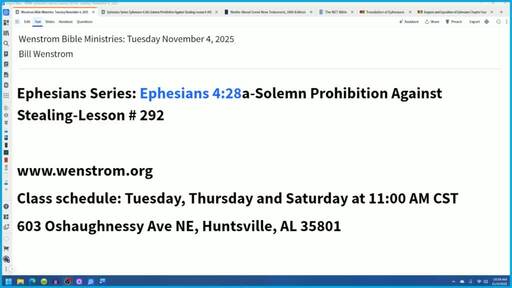

Wenstrom Bible Ministries
Pastor-Teacher Bill Wenstrom
Tuesday November 4, 2025
Ephesians Series: Ephesians 4:28a-Solemn Prohibition Against Stealing
Lesson # 292
Ephesians 4:28 The one who does steal must no longer steal but rather they must begin to work hard for a living and continue doing so. Specifically, by making it their habit of being diligently engaged in performing activities with their own hands, which for their own benefit produce good, which is divine in quality and character in order to possess the capacity to make it their habit of sharing for the benefit of those who possess a need. (Lecturer’s translation)
Ephesians 4:28 is composed of the following:
(1) prohibition: ho kleptōn mēketi kleptetō (ὁ κλέπτων μηκέτι κλεπτέτω), “The one who does steal must no longer steal.” (Lecturer’s translation)
(2) command: kopiatō (κοπιάτω), “They must begin to work hard for a living and continue doing so.” (Lecturer’s translation)
(3) participial clause: ergazomenos tais idiais chersin to agathon (ἐργαζόμενος ταῖς ἰδίαις χερσὶν τὸ ἀγαθόν), “Specifically, by making it their habit of being diligently engaged in performing activities with their own hands, which for their own benefit produce good, which is divine in quality and character.” (Lecturer’s translation)
(4) purpose clause: hina echē metadidonai tō chreian echonti (ἵνα ἔχῃ μεταδιδόναι τῷ χρείαν ἔχοντι), “in order to possess the capacity to make it their habit of sharing for the benefit of those who possess a need.” (Lecturer’s translation)
Therefore, we can see that Paul issues a solemn prohibition to the recipients of this epistle who we noted were the members of the Gentile Christian community in the Roman province of Asia, which deals with a hypothetical situation.
This prohibition required that this hypothetical Christian who does steal must no longer steal.
Then, he issues them a command, which stands in contrast to this prohibition, and required that this hypothetical Christian must begin to work hard for a living and continue doing so.
He then explains this command further with a participial clause which presents the means by which they were to execute this command, namely by making it their habit of being diligently engaged in performing activities with their own hands, which for their own benefit produce good, which is divine in quality and character.
The purpose of this was so that they would possess the capacity to make it their habit of sharing for the benefit of those who possess and material or financial need.
Now, as we noted, the prohibition, which begins Ephesians 4:28 is a solemn prohibition because as he did in Ephesians 4:26 and 27, the apostle Paul’s employs the figure of asyndeton.
As was the case in Ephesians 4:26 and 27, this figure is also used here in Ephesians 4:28 for rhetorical effect because beginning in Ephesians 4:26 Paul issues a series of commands and prohibitions, which conclude in Ephesians 6:20.
All of which are designed to conform the conduct of the Gentile Christian community to that of the conduct of the holy character of Jesus Christ.
Therefore, the figure of asyndeton emphasizes the solemn nature of the commands and prohibitions to follow in Ephesians 4:26-6:20 because obedience to them by the members of the Gentile Christian community will result in their spiritual growth and Christ-likeness as well as unity with each other.
We also noted that this prohibition presents a hypothetical situation in the Christian community.
This is indicated by the present tense of the verb kleptō (κλέπτω) when it appears the first time in this prohibition.
The presents tense is a gnomic present which is used in generic statements to describe something that is true any time rather than a universal statement which is true all the time.
Therefore, this gnomic present expresses the idea of a hypothetical member of the Gentile Christian community in the Roman province of Asia who “does” steal.
This use of the present is to present a hypothetical situation, which has not taken place.
This interpretation is indicated by the fact that Paul affirms in Ephesians 1:15 that the recipients of this epistle were practicing the love of God by obeying the Lord Jesus Christ’s Spirit inspired command in John 13:34 and 15:12 to love one another as He has loved the believer.
This command would prohibit the believer from stealing from anyone in the Christian community and the command to love your neighbor as yourself would prohibit them from stealing from anyone in the non-Christian community.
It was prohibited by the Mosaic Law (Exodus 20:15, Leviticus 19:11 and Deuteronomy 5:19).
In fact, the prohibition to not steal is one of the ten commandments.
Exodus 20:15 “You shall not steal.” (NASB95)
This prohibition demands that the Israelites respect each other’s property, which ignored creates instability in society.
Stealing is taking something that does not belong to you without permission.
This sin undermines the social order.
Those who steal food causes someone to go hungry.
The one who steals an animal hinders another’s ability to farm and the stealing of clothing can cause another to suffer from the elements.
Disobedience to this prohibition is a manifestation of not loving one’s neighbor as oneself.
This prohibition appears in other places in the Old Testament (Leviticus 19:11; Deuteronomy 5:19).
It is reinforced many times in the New Testament (Matthew 19:18; Romans 2:21; 13:9; 1 Corinthians 6:10; Ephesians 4:28; Titus 2:10; 1 Peter 4:15).
By way of contrast, instead of stealing believers are to work with their own hands so that they might be able to share with someone who is in need (2 Thessalonians 3:6-12).
The Greek New Testament teaches that if you love your neighbor as yourself you won’t steal from him.
Therefore, stealing is disobedience to the divine command to love your neighbor as yourself (Mark 12:28-34).
In Romans 13:8-10, the apostle Paul describes for the Roman believers what loving one’s neighbor means.
In 2 Thessalonians 3:6-12, Paul prohibits the members of the Thessalonian Christian community from stealing and the commands them that they must work in order to provide a living for themselves and their families and also to share with those in need.
Now, here in Ephesians 4:28, the verb kleptō (κλέπτω) appears twice and in each instance, the word speaks of stealing from someone.
When the apostle Paul employs this word the first time, he puts it in the articular nominative masculine singular present active participle conjugation.
The referent of the masculine singular form of this verb is a hypothetical member of the Gentile Christian community in the Roman province of Asia, who we noted were the recipients of this letter, who does steal.
This is indicated by the fact that the present tense of this verb is a gnomic present, which we noted is used in generic statements to describe something that is true any time rather than a universal statement which is true all the time.
The subject will be generic in this type of present tense, which is the case here in Ephesians 4:28.
Therefore, this gnomic present expresses the idea of a hypothetical member of the Gentile Christian community in the Roman province of Asia who “does” steal.
This use of the present is to present a hypothetical situation, which has not taken place.
When Paul employs the kleptō (κλέπτω) a second time in this prohibition in Ephesians 4:28, he puts the word in the third person singular present active imperative conjugation.
It is modified by the negative adverb of time meketi (μηκέτι), which expresses the idea of a member of the Gentile Christian community in the Roman province of Asia who does steal to the point in which they obey this prohibition and stop doing so.
Thus, these two words form a prohibition, which required those who do steal in the Gentile Christian community in the Roman province of Asia must never do so again.
The present imperative conjugation of this verb kleptō (κλέπτω) is not a customary present imperative expressing a general precept but rather, it is a progressive present imperative expressing the idea of the cessation of some act that is already in progress.
Therefore, the idea of the progressive present imperative conjugation of this verb is that the believer who does steal “must stop” stealing.
This prohibition in Ephesians 4:28 is another instance in Ephesians 4:17-28 in which Paul addresses the conduct of the Gentile Christian community in the Roman province of Asia who were the recipients of this letter.
Stealing was a way of life for many of them prior to their justification.
This prohibition is warning them of falling back into the way they used to live their lives prior to becoming Christians.
Thus, this prohibition is another instance in Ephesians 4:17-28 where Paul is using preventative maintenance.
He is warning them not to revert to their unregenerate lifestyle.
Stealing was inconsistent with the fact that at justification they became children of God who were in union with Jesus Christ and now possessed an eternal relationship with Him.
