SUNDAY, NOVEMBER 16, 2025 | AFTER PENTECOST PROPER 28 (C)
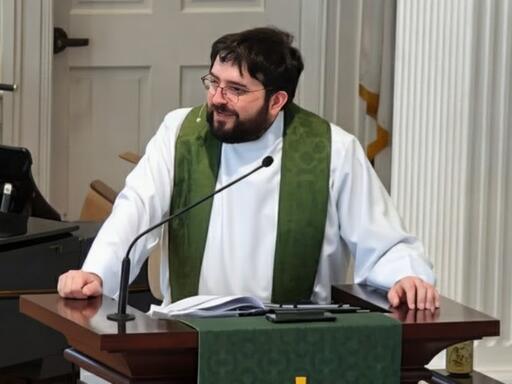
Sermon • Submitted • Presented • 16:47
0 ratings
· 10 viewsAudio: https://recorder.google.com/48438b31-e9dc-482a-a082-9b5ea10444dc
Files
Notes
Transcript
Sermon
Sermon
Good morning,
If you ask me we have some interesting texts for our annual meeting, especially the gospel! I suppose it can serve as a good reminder of temporality of where we stand now - not only this sanctuary, building, but also this hill, city, state, country, world… As we near the end of the church year, these apocalyptic themes remind us not to fear endings, but to be attentive to God’s presence in the midst of change. Our liturgical calendar itself guides us through patterns of loss and renewal, always pointing toward hope. Throughout history, various cultures and nations experienced their own “little apocalypse” - a destructive flood, fire, drought, or a volcano erupting. And the smaller their worldview, the bigger the apocalypse seemed - personally and mythologically. For a tribe deep in the jungle, a burning down of the village and surrounding trees may seem like an end of the world event.
Fragility of our existence is undeniable - there are the Big Five mass extinction events, of which the fifth is probably the most well known - Cretaceous–Paleogene extinction event that marked the extinction of all non-avian dinosaurs, but in more recent memory, it is the more localized or time limited apocalypses that we have to contend with. Great Famine of Ireland, Bubonic plague pandemic (Black death), not one, but two World Wars, COVID-19 pandemic, Spanish flu pandemic....and also the Fall of the Temple in Jerusalem in the year 70 CE. And it was a big one, mostly to the Jewish and Judaism.
It was the second temple to fall - the first one was built under King Solomon, King David’s son, about 950 BCE, containing Ark of the covenant and it was considered to be a dwelling place for God. “The first temple was destroyed, along with the ark of the covenant, in 587/6 BC as the Babylonians, under Nebuchadnezzar, crushed the Judaean Davidic dynasty, reduced Jerusalem to rubble, and deported thousands of people to Babylon as exiles.”
Alan J. Hauser and Earl Kellett, “Temple, Herod’s,” in The Lexham Bible Dictionary, ed. John D. Barry et al. (Bellingham, WA: Lexham Press, 2016). Thus the fall marks a milestone in the development of the Jewish nation. While a forceful exile is never good, it did broaden their worldview when they encountered different cultures and mythologies, which, according to scholars, led to the transformation of a minor tribe with mostly oral history into a nation with fleshed out creation narratives, genealogies, religious tenets, and a lot of mythology surrounding themselves with. It is then no surprise that the fall of the second temple built around 518 BCE also marked a new age for the Jewish people and religion. It was destroyed in 70 CE by then Commander Titus (who became an emperor a decade later) following the first Jewish-Roman War.
Over time, rabbinic Judaism emerged, where worship shifted from the temple to synagogues, Pharisees gained prominence with their belief in resurrection and of reward and punishment after death, and those who believed in Jesus’ messiahship were cast out as heretics and excluded from Judaism.
Leonard Greenspoon, “Judaism,” in The Lexham Bible Dictionary, ed. John D. Barry et al. (Bellingham, WA: Lexham Press, 2016).
Judaism expanded again, also sadly because of being basically pushed out of Rome after Christianity became the state religion. But it also contributed to the spread of Christianity - with Jewish Christians being officially ousted, the only direction is outwards!
A disaster, especially one that seems apocalyptic, is never good in essence, but what people do to salvage the situation may turn out to be beneficial - exploring new horizons, meeting new cultures and people groups, reinventing themselves after an established, comfortable system no longer works, or introspection into their history? I t would hardly happen without a push.
M. Scott Peck wrote in his book The Road Less Traveled: A New Psychology of Love, Traditional Values and Spiritual Growth:
“It is only because of problems that we grow mentally and spiritually. When we desire to encourage the growth of the human spirit, we challenge and encourage the human capacity to solve problems, just as in school we deliberately set problems for our children to solve. It is through the pain of confronting and resolving problems that we learn. As Benjamin Franklin said, “Those things that hurt, instruct.” It is for this reason that wise people learn not to dread but actually to welcome problems and actually to welcome the pain of problems.”
So yeah, these texts are relevant for today’s annual meeting - the spiritual landscape and church culture is shifting and many of the changes seem almost “apocalyptic” - less people, less volunteers, less money, more maintaining costs, higher fees, more need in the community, more volunteer hours needed to name just a few. It may feel like a never-ending flood or persisting fire, the way we are tested to stand firm and continue God’s mission in the world. But through that we can learn and grow, I believe. Relatively speaking, we are not a small church, our budget is in good shape, and there is a lot of possibilities for refining our identity as the church on the hill. Not every church in the area can say that!
Jesus blesses us in the fullness of our journey—through joys, through hardships, and even in moments when blessings are hard to see. Sometimes, God’s presence is most profound in seasons of struggle. Jesus admonishes his listeners not to rush to conclusion when hard times come as it is likely not yet the end times and the final apocalypse is still in the future. Tribulations come....and sometimes, hopefully and eventually, go away and we are still here! This community will not be here forever, but it is not meant to be - we are here only for as long as the Lord deems necessary. And as we live out our calling, we join Christians everywhere in working for a more just and compassionate world. Our witness is not just for ourselves but for neighbors near and far—those facing injustice, violence, loss, or displacement. God’s mission is always bigger than any single congregation, and we are part of that story. In times of hardship, God does not send suffering, but walks with us, inviting us to testify to love and mercy—especially when we face struggle or uncertainty. Our faith calls us to respond by caring for one another and for our wider world. We continue on, serving the community and proclaiming the good word of the Lord. We seek to welcome all—including those marginalized by society, such as immigrants, the vulnerable, LGBTQ+ siblings, the lonely, and anyone in need—knowing that Christ’s table is wide and inclusive. We feed and are fed, always remembering that God’s hospitality is radical and boundless.
We may not have the budget of Lakewood Church, the music program of Hillsong, or the volunteer force of a large Catholic charity—and that’s okay. Every congregation, large or small, has unique gifts and ways to serve. Our calling isn’t measured by size or resources, but by faithfulness to Christ’s mission here and now, in our context. We are invited to be Calvary Lutheran—as we are—trusting that God works through us and through others, each according to their calling. Our God gives us the opportunity to do all these things and perhaps we could take our challenges as little nudges to never, ever get too comfortable in what we are doing and who we are. So as we navigate our own challenges—our “little apocalypses”—may we trust that God brings forth new life from uncertainty, leading us to deeper compassion and boldness for justice. Let us go out with hope, together.Amen.
Notes
Notes
Malachi:
4 nSee, the day is coming, burning like an oven, when all the arrogant and all evildoers will be stubble; the day that comes shall burn them up, says the LORD of hosts, so that it will leave them neither root nor branch.* 2 But for you who revere my name the sun of righteousness shall rise, with healing in its wings. You shall go out leaping like calves from the stall.* 3 And you shall tread down the wicked, for they will be ashes under the soles of your feet, on the day when I act, says the LORD of hosts.*
New Revised Standard Version: Updated Edition (Friendship Press, 2021), Mal 4:1–3.
2Th: don’t just go around misusing other people’s kindness. Not about poverty
Luke: Jesus foretells the destruction of the temple and then speaks about false messiahs and other tribulations that will have to happen before the second coming comes.
Proposed children’s activity:
Children’s Time Activity (5 Minutes): “Invisible Houses and God’s Love”
Children’s Time Activity (5 Minutes): “Invisible Houses and God’s Love”
Theme: Understanding change, trusting God, welcoming others Supplies: None
Instructions
Instructions
1. Opening Question (1 minute)
Ask: “Have you ever had something change—like moving houses, a favorite toy breaking, or a friend moving away? How did you feel?”
Invite a few brief responses.
2. Building Our "Houses" (1 minute)
Say: “Let’s all build our own special house where we feel safe. Put your hands together over your head to make a roof.”
(Leader demonstrates making a roof shape with hands over their head).
Say: “This is your house, your safe spot. Look around! Everyone has a safe, happy house.”
3. The Change (1 minute)
Say: “But sometimes, things change. In today’s Bible story, we learn that even big, strong buildings, like the temple, can go away. Life changes, and that can feel scary. Let’s show that. On the count of three, let your house 'crumble' all the way down.”
Count: “One… two… three!”
(Leader and children "crumble" their hands down, bringing them low).
Say: “Oh no! Our houses are gone. How does that feel?”
4. God’s Love Is Always With Us (1 minute)
Say: “But here's the good news. Even when our 'houses' crumble and things change, God’s love never goes away. It’s always with us, like a warm, glowing light. Can you cup your hands together like you're holding a tiny, warm light?”
(Leader demonstrates cupping hands together).
Say: “Feel how warm it is? That light is God's love. It never goes out. It's always right there with you.”
5. We Are a "Welcome Mat" (1 minute)
Say: “God’s love helps us share that light by welcoming everyone. Let’s make a big, imaginary 'welcome mat' right here on the floor.” (Leader uses their hands to draw a big rectangle on the floor in front of them).
Say: “How can we show welcome? Let's put our ideas on the mat by acting them out. Does welcome look like a hug?” (Mime a hug). “Does it look like a high-five?” (Mime a high-five).
Ask: "What else looks like welcome?" (Get 2-3 ideas and have everyone act them out, like "sharing" or "smiling").
Say: “Great! Our church is like this giant welcome mat—everyone belongs. God helps us be kind and brave, even when things change.”
Closing
Closing
Short prayer: “Thank you, God, for always loving us. Help us welcome and care for everyone, even when life changes. Amen.”
Prayer:
O God of all peoples, our Creator and our Shelter, Your scripture commands us to welcome the stranger, for we too were once strangers. You know the heart of the sojourner, and you call the vulnerable blessed.We lift our hearts to you today for all who are navigating the long and difficult path of immigration. We pray especially for immigrant and refugee families in our nation and community.We pray for parents and children who live with uncertainty, and for all who fear what the future holds. Lord, for every family that fears being separated, be their comforter and their peace. In their anxiety, be their rock.In a world of complex laws and loud debates, anchor them in the unshakeable truth of their God-given dignity. Remind them, and remind us, that their worth is not found in a document, but in the sacred fact that they are made in Your image and are profoundly beloved by You.We pray for our nation and for all who lead us. Grant wisdom, O God, to our lawmakers and judges. Guide them as they seek a just, compassionate, and righteous path forward. We pray for all who enforce our laws; grant them a spirit of fairness, humanity, and understanding.And Father, we pray for ourselves. Quiet in us any spirit of indifference or suspicion. Give us eyes to see Your image in the face of our neighbor, no matter where they were born. Teach us what it means to love mercy, to seek justice, and to walk humbly with You.Unite our hearts in your compassion, and make us instruments of Your peace. In Your holy name, we pray.
