WHOSE IMAGE IS THIS?
Sermon • Submitted • Presented • 37:35
0 ratings
· 26 viewsFiles
Notes
Transcript
WHOSE IMAGE IS THIS?
WHOSE IMAGE IS THIS?
Matthew 22:15–22
Matthew 22:15–22
Opening Illustration
Opening Illustration
In my workplace—just like many of yours—I have to wear an ID badge. That badge has my picture on it, my name, and the logo of the company. It shows who I represent.
I work on the fourth floor of the building, but I can’t even get past the front desk without that badge. Security won’t let me through the entrance unless I’m wearing it. That badge tells the security team and the staff, “This person belongs here. This person is part of this organisation.”
But it also does something else.
Every morning when I put that badge on, I’m reminded that my actions—everything I say and do—reflect the name printed next to my picture.
If I’m kind or helpful, people notice that name.
If I’m rude or impatient, people notice that name too.
Wearing that badge reminds me that I represent something bigger than myself.
In the same way, Jesus teaches us something important in Matthew 22. A simple question about paying taxes becomes a lesson about who we are/our identity, our responsibility, and what it means to carry God’s image in a world that puts a lot of pressure on us.
Introduction
Introduction
Jesus was an incredible teacher. During His ministry, He answered hundreds—maybe thousands—of questions about God, life, faith, and how to live in a broken world.
But near the end of His life, many questions weren’t sincere. They were traps. Tricks. Attempts to get Him to slip up so the religious and political leaders could silence Him.
In today’s passage, the question is about paying taxes. It seems simple, but for Jesus it was a dangerous question.
If Jesus said “YES, pay the tax”:
If Jesus said “YES, pay the tax”:
The Jewish people would be angry.
If Jesus said “NO, don’t pay the tax”:
If Jesus said “NO, don’t pay the tax”:
The Roman government would be furious.
But Jesus doesn’t fall for the trap.
Instead, He turns the question around and reveals something deeper.......
And it all starts with one question:
WHOSE IMAGE IS THIS?
WHOSE IMAGE IS THIS?
15 Then the Pharisees went out and laid plans to trap him in his words. 16 They sent their disciples to him along with the Herodians. “Teacher,” they said, “we know that you are a man of integrity and that you teach the way of God in accordance with the truth. You aren’t swayed by others, because you pay no attention to who they are. 17 Tell us then, what is your opinion? Is it right to pay the imperial tax to Caesar or not?” 18 But Jesus, knowing their evil intent, said, “You hypocrites, why are you trying to trap me? 19 Show me the coin used for paying the tax.” They brought him a denarius, 20 and he asked them, “Whose image is this? And whose inscription?” 21 “Caesar’s,” they replied. Then he said to them, “So give back to Caesar what is Caesar’s, and to God what is God’s.” 22 When they heard this, they were amazed. So they left him and went away.
WHOSE IMAGE IS THIS?
WHOSE IMAGE IS THIS?
Transition
Before Jesus says anything about taxes, He deals with something deeper.
Not money.
Not politics.
Identity.
So let’s look at ......
I. Identity and Image.
I. Identity and Image.
A) Jesus’ Identity Was Clear
Let’s take a closer look at what happens in this passage. Before the Pharisees even ask their trap question, they begin by buttering Jesus up. They use flattery. They say:
16 “Teacher,” they said, “we know that you are a man of integrity and that you teach the way of God in accordance with the truth. You aren’t swayed by others, because you pay no attention to who they are.
Think about that for a moment.
These men didn’t like Jesus.
They didn’t agree with Jesus.
They wanted to get rid of Jesus.
But even His enemies could clearly see the truth about Him.
They saw His character.
They saw His strength.
They saw His honesty.
They recognised that Jesus was:
• A man who told the truth
• A man who taught God’s ways
• A man who didn’t change His message to please people
• A man who wasn’t afraid of public pressure
• A man focused on God above everything else
Jesus’ life and His identity were obvious—even to the people who wanted Him gone.
But watch this:
Even though they could see those qualities in Jesus, they still tried to trap Him.
Why?
Because deep down, they cared more about their own image than the truth standing right in front of them.
They were hooked on their status.
They loved the respect they got from the crowds.
They didn’t want to lose control or influence.
They didn’t want people to view Jesus as more important than them.
So, They held tightly to their own image—and it blinded them to God’s image standing right in front of them.
And church, that brings up a real question for us today:
What image are you trying to protect?
Are you trying to look strong?
Trying to look perfect?
Trying to look put-together?
Trying to keep a certain reputation?
Trying to impress people more than honour God?
The Pharisees did that.
They fought to protect an image of themselves—
and it blinded them to the Saviour standing right in front of them.
But God calls us to something different.
He gives us a new identity—one that isn’t shaky or fragile.
One that doesn’t depend on popularity or approval.
Jesus says in John 6:39:
39 And this is the will of him who sent me, that I shall lose none of all those he has given me.....
In other words:
If you belong to Jesus, your identity is safe.
It’s secure.
You are God’s child.
You carry His image on your life.
Real-Life Illustration: The Lost Wallet That Found Its Owner
A man named Tim Cameron from London accidentally dropped his wallet while walking home from work. A stranger found it, but Tim’s wallet didn’t have his phone number in it.
Now here’s the interesting part.
The person who found the wallet wanted to return it, so he came up with a creative solution. He sent four bank transfers of £0.01 each to Tim’s account. In the reference line of each transfer, he typed out a phone number and a short message:
“Hi, I found your wallet in the road. Text or call.”
And that’s how Tim got his wallet back.
The money transfers didn’t matter — the identifying information on the card mattered. His name, his picture, his details — those proved who the wallet belonged to and helped reconnect it to its owner.
(Time Magazine reported this story.)
Church, that’s how it is with us and God.
The world may lose us, distract us, confuse us, pull us in different directions…
but the image of God stamped on our lives tells heaven and earth exactly who we belong to.
Your identity is not found in:
• a job title
• a role
• a reputation
• a mistake
• a season of life
Your identity is found in the image of God on you.
Just like I have to put on my badge at work — the one that shows my name, my picture, and who I represent — you walk through life carrying the image of God everywhere you go.
You belong to Him.
He knows you.
He sees you.
He claims you as His own.
And nothing in this world can take that identity from you.
Transition
So once Jesus exposes their motives, He doesn’t walk away.
He doesn’t ignore them.
He goes deeper.
He takes their trap and turns it into a teaching moment.
Now that we’ve seen who He is…
let’s look at what He asks us to do.....which is
II. Giving God What Is God’s
II. Giving God What Is God’s
Now that the Pharisees have tried their flattery, they finally get to their real question. They ask Jesus:
17 Tell us then, what is your opinion? Is it right to pay the imperial tax to Caesar or not?”
At first, it sounds like a normal, harmless question.
It sounds like something any one of us might ask today.
But these leaders weren’t looking for wisdom. They weren’t looking for guidance.
They were looking for a trap.
They wanted Jesus to say something that would get Him in big trouble.
And here’s why the question was so dangerous:
If Jesus said “YES, pay the tax,” the Jewish people would be furious.
If Jesus said “YES, pay the tax,” the Jewish people would be furious.
Many Jews hated the Roman tax.
It reminded them that Rome controlled their land.
They saw the tax as a symbol of oppression.
So if Jesus said, “Yes, pay the tax,” the people would think He supported Rome more than He supported them. They might walk away from Him completely.
He would look like a traitor to His own people.
If Jesus said “NO, don’t pay the tax,” the Romans would be furious.
If Jesus said “NO, don’t pay the tax,” the Romans would be furious.
Rome didn’t play around with taxation.
Refusing the tax was rebellion. It could get a person arrested or even executed.
So if Jesus said, “Don’t pay,” the Romans would come after Him quickly.
He would look like a rebel to Rome.
Either answer meant trouble.
One answer would turn the people against Him.
The other answer would turn the government against Him.
But Jesus doesn’t panic.
He doesn’t argue.
He doesn’t fall into their trap.
Instead, He does something simple—and brilliant.
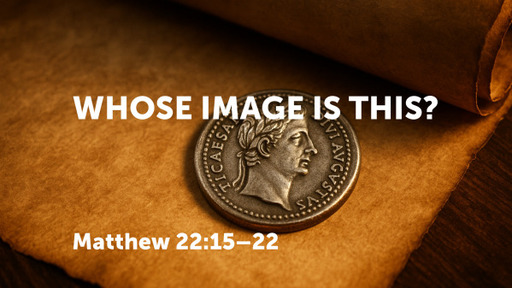
He asks for a coin.
Someone hands Him a denarius, the very coin used for that tax. Jesus holds it up and says:
“Whose image is this?”
They replied, “Caesar’s.”
Everyone could see Caesar’s face engraved on the coin.
And that’s when Jesus gives His famous answer:
21 “So give back to Caesar what is Caesar’s, and to God what is God’s.”
Church, that one sentence carries a whole sermon inside it.
In very simple language, Jesus is saying:
“Do your part in this world,
but don’t forget your responsibility to God.”
Jesus is saying,
“Be responsible citizens on earth,
but remember your greatest loyalty is to heaven.”
Jesus is teaching two big truths at the same time.
Jesus is teaching two big truths at the same time.
1. We have responsibilities on earth.
1. We have responsibilities on earth.
Jesus is not telling people to ignore their earthly duties. He’s not telling us to rebel or to withdraw from society. No, He’s saying:
• Pay your taxes.
• Follow the law.
• Respect authority.
• Be a good member of your community.
• Do your part to help the world function.
These things matter.
They show integrity.
They show responsibility.
They show that we can live in this world with wisdom and maturity.
Jesus is not against government. He is not against order. He is not telling us to ignore earthly responsibilities.
But…
2. We have a greater responsibility to God.
2. We have a greater responsibility to God.
While Caesar—while the government—may ask for some things from us, God asks for all of us.
God asks for:
• Our honour
• Our love
• Our worship
• Our obedience
• Our lives
Earthly leaders/governments can ask for part of your life,
but God asks for all of your heart.
Government may ask us to follow laws,
but God asks us to follow Jesus.
The government may give you highways, but God gives you oxygen. Tony Evans
You owe God more than just showing up on Sundays.
He deserves your full obedience every day because of everything He gives you.
That’s why Jesus draws a line:
“Give Caesar what belongs to Caesar…
but give God what belongs to God.”
And what belongs to God?
You do.
Chick-fil-A
Illustration: Chick-fil-A Closing on Sundays — Putting Worship First
(Source: CNBC – “Chick-fil-A now makes more per restaurant than McDonald’s”)
https://www.cnbc.com/2019/11/19/chick-fil-a-now-makes-more-per-restaurant-than-mcdonalds-.html
Most of us know that Chick-fil-A closes every Sunday.
In the fast-food world, that’s unheard of. Sunday is one of the busiest, most profitable days of the week.
Financial experts say the company loses millions of dollars a year by staying closed.
But founder Truett Cathy made that decision on purpose. He said:
“We want to honour God in everything we do.”
He wanted his employees to have a day to worship, rest, and put God before business.
Here’s the amazing part:
Even though Chick-fil-A closes one day every week, they still make more money per restaurant than almost all other fast-food places in America.
Why?
Because God honours obedience.
God blesses people and businesses that put Him first.
Chick-fil-A gives Caesar what belongs to Caesar—they run a responsible, excellent business.
But they give God what belongs to God—they honour Him above profit.
Back to Jesus’ Teaching
Back to Jesus’ Teaching
That’s the heart of what Jesus is saying here.
Yes, do your earthly duties.
Yes, respect authority.
Yes, do your part in society.
But never forget your first and highest responsibility:
honouring God with your whole life.
Romans 12:1 explains it beautifully:
1 Therefore, I urge you, brothers and sisters, in view of God’s mercy, to offer your bodies as a living sacrifice, holy and pleasing to God—this is your true and proper worship.
In other words:
Worship isn’t just singing.
Worship is living—living in a way that shows you belong to God.
A coin belonged to Caesar because Caesar’s image was stamped on it.
But you belong to God because His image is stamped on YOU.
And here’s the powerful truth in all of this:
God isn’t asking for a portion of your life.
He isn’t asking for a weekend visit or a Sunday check-in.
He wants:
• Your time
• Your heart
• Your character
• Your decisions
• Your life
• Your worship
Not a percentage — but all of you.
Not because He’s demanding—
but because He loves you, He made you, and His image is on your life.
And when God has your whole heart, you can live in this world
without letting the world shape who you are.
Transition
Jesus makes it clear:
We have responsibilities on earth,
and we have greater responsibilities to God.
But how do we live both out at the same time?
How do we live day-to-day in this world, pay bills, work jobs, obey laws…
and still keep our first loyalty to God?
The Bible gives us the answer......
III. Balancing Earthly and Heavenly Priorities
III. Balancing Earthly and Heavenly Priorities
How do we “give to Caesar what is Caesar’s”
without giving the world our heart… our soul… our identity?
The apostle Paul helps us in Romans 12.
He writes:
2 Do not conform to the pattern of this world, but be transformed by the renewing of your mind.
Paul is saying,
“The world has a pattern.
It has a way it wants you to think and live.”
The World’s Pattern
The World’s Pattern
If we put it in simple words, the world’s pattern sounds like this:
“Look out for yourself first.”
“Get more… more money, more things, more power.”
“Impress people. Make them notice you.”
“Don’t forgive. Hold on to your grudges.”
“Choose comfort. Avoid anything hard.”
“Follow the crowd. Don’t stand out.”
“Chase status. Be important.”
And if we’re honest, that way of thinking can sneak into our hearts without us even realising it.
It’s like a slow drip.
Over time, it shapes how we see ourselves, how we see others, and how we see God.
Paul says, in modern language:
“Don’t let the world shape you or pressure you to be like everyone else.”
Don’t let the world decide who you are.
Don’t let the world decide what matters most.
Don’t let the world decide how you respond.
Instead: Be Transformed
Instead: Be Transformed
Paul says we should be transformed—that means changed from the inside out—
“by the renewing of your mind.”
How does that happen?
Through God’s Word, prayer, worship, and godly community.
We Need God’s Word
We Need God’s Word
We can’t think clearly if we never hear from God.
The Bible does a few important things for us:
It clears the fog when life feels confusing.
It resets our thinking when our thoughts go in the wrong direction.
It strengthens our spirit when we feel weak or worn out.
It reminds us who we are and whose we are when the world tries to rename us.
If we don’t stay in the Word, the world will be the loudest voice.
And if the world is the loudest voice, we will slowly start to live just like it.
We Need God’s People
We Need God’s People
We don’t just need God’s Word;
we also need God’s people.
Hebrews 10:24–25 says:
24 Let us think of ways to motivate one another to acts of love and good works. 25 And let us not neglect our meeting together, as some people do, but encourage one another, especially now that the day of his return is drawing near.
God knew we couldn’t walk this road alone.
He gave us the church—brothers and sisters in Christ—to support us.
We need people around us who:
Remind us of the truth when we forget it
Pray for us when we’re tired or discouraged
Sharpen our faith when we’re getting lazy
Lift us up when we fall down
Point us back to God’s image in us when we start to see ourselves wrongly
Pastoral Moment
Pastoral Moment
There was a time in my own life when I felt stretched thin.
Work, family, ministry, bills, worries—it all felt heavy.
I remember a friend who simply came alongside me, listened, prayed with me, and said,
“Hey, you’re not alone. I’m with you, and God is with you.”
That simple moment of encouragement helped me stand firm.
It didn’t change my situation overnight,
but it changed my heart in the middle of it.
We all need that.
None of us can live a faithful Christian life on our own.
We need community.
We need accountability.
We need encouragement.
The World’s False Identities
The World’s False Identities
Part of the reason we need God’s Word and God’s people is because the world is full of false identities.
The world keeps trying to tell us who we are.
The world says your identity is based on:
Your job
Your income
Your past
Your mistakes
Your struggles
Your social status
Your achievements or lack of them
But Jesus tells a different story.
He says:
“Give to Caesar what belongs to Caesar…
but give to God what belongs to God.”
And who belongs to God?
You do.
Not the world.
Not your past.
Not your failures.
Not your fears.
Not your sins.
You belong to God.
You bear His image.
His mark is on your life.
And when you know that—deep down in your heart—it changes how you live.
Conclusion
Conclusion
So as we get ready to go back into our week, back into our routines, back into our workplaces, schools, and homes, let’s remember this simple question from Jesus:
“Whose image is this?”
A coin had Caesar’s image.
Your ID card has your photo.
But your soul—your life—
carries the image of God.
So this week, very practically:
Let God’s image show in how you treat people
Let God’s image show in your patience when things go wrong
Let God’s image show at work—in your honesty, your work ethic, your kindness
Let God’s image show in your home—in your tone, your love, your presence
Let God’s image show in your decisions—what you say yes to and what you say no to
We give to Caesar what belongs to Caesar—we do our earthly responsibilities.
But we give to God what belongs to God—and that is our whole life.
Because at the end of the day:
You bear His image.
You carry His name.
And you belong to Him.
Amen.
WHOSE IMAGE IS THIS?
WHOSE IMAGE IS THIS?
Altar Call
Altar Call
Church, as we come to the end of this message, I want to speak to your heart for a moment.
We’ve talked today about identity… about who we belong to… about giving God what is God’s.
And maybe as you listened, you felt something inside you saying,
“I want that. I want to belong to God. I want His image to be seen in my life.”
Maybe you’ve been living far from God.
Maybe you’ve been carrying a false identity the world gave you.
Maybe you’ve been running from Him, or just trying to do life on your own.
Maybe you’ve been giving your energy, your time, and your heart to everything else—
but not to God.
If you’re here today and you want to come home to God…
If you want to start fresh…
If you want His forgiveness, His peace, His direction…
If you want Jesus to lead your life…
This is your moment.
God is not far away.
He is not angry at you.
His arms are open wide.
He wants you.
He loves you.
He has been waiting for you.
If you want to give God your life today—if you want to say,
“God, I belong to You,”
I invite you to slip up your hand right now.
No pressure.
No embarrassment.
Just an honest moment between you and God.
And if you want to start this journey with Jesus, pray this simple prayer with me:
Big Idea:
Big Idea:
We live in the world, but we belong to God—so we give the world our responsibility, but we give God our whole life because His image is on us.
Closing Prayer
Closing Prayer
Lord, thank You for speaking to our hearts today.
Help us remember that we belong to You and that Your image is on our lives.
As we go into this week, guide our thoughts, guide our actions, and help us live in a way that shows Your love to others.
Give us strength to handle our responsibilities on earth, while keeping our hearts focused on You.
Protect us, lead us, and keep us close to You.
In Jesus’ name, Amen.
