Songs in the Night - Nov. 23rd, 2025
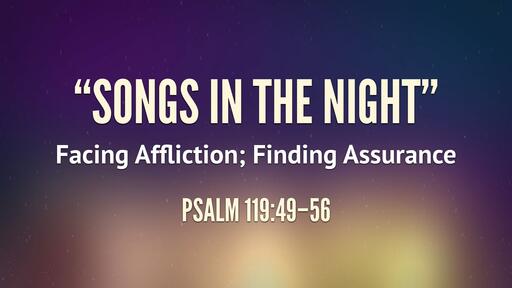

Savoring the Psalter • Sermon • Submitted • Presented • 1:14:53
0 ratings
· 5 viewsBelievers can endure affliction by holding onto God’s promises and making His Word their song of praise.
Files
Notes
Transcript
Text: Psalm 119:49–56 (Zayin Stanza, KJV)
Central Idea of the Text (CIT): The psalmist found hope and comfort in God’s Word amid affliction and responded with steadfast obedience and praise.
Sermonic Proposition: Believers can endure affliction by holding onto God’s promises and making His Word their song of praise.
Purpose: General: To encourage and challenge believers to trust and treasure God’s Word through trials. Specific: That each listener will remember God’s promises in hardships and respond with thankful obedience; learning to sing His truth even in the darkest night.
Introduction
Introduction
25 And at midnight Paul and Silas prayed, and sang praises unto God: and the prisoners heard them.
Picture that scene: two servants of God in a Philippian dungeon, backs bleeding, feet fast in stocks, yet lifting up songs in the night. Their fellow prisoners listened in awe. How could anyone sing in such darkness? Yet God gave them a song, and soon after, a great deliverance. There’s a biblical principle here: the God who permits us to walk through dark nights also provides songs to sustain us in them[1][2].
As we gather on this Sunday evening before Thanksgiving, we’re mindful that gratitude isn’t just for sunny days. We need a song even on the midnight side of life’s journey. In fact, the very first New England Thanksgiving was born out of a dark winter, and history tells us that when the Pilgrims sighted land after their harrowing voyage, they lifted their voices together and sang Psalm 100 to thank God[3].
Tonight’s text, Psalm 119:49–56, is tailor-made to teach us about songs in the night. This passage is the Zayin stanza of Psalm 119, eight verses, all beginning with the Hebrew letter Zayin (equivalent to “Z”). It’s as if the psalmist took the letter Z and wove an eight-line poem, each line starting with that same sound[6][7]. Why mention that? Because it shows the care and artistry behind these words; God’s Word is so precise that even the alphabet is employed for emphasis. In fact, the key word “Remember” in Hebrew is zakhar, which starts with Z (Zayin), and you’ll hear “remember” echoed throughout this stanza[8][9]. This whole section centers on remembering: it opens with the psalmist pleading, “Lord, remember Your promise to me,” and it continues with the psalmist himself remembering God’s past judgments and God’s name in the night[10][9]. It’s a dialogue of remembrance between the servant and his Lord.
The structure alternates between facing affliction and finding comfort: the psalmist prays for God’s word (v.49), testifies of comfort in suffering (v.50), describes the taunts of the wicked (v.51) yet recalls God’s just judgments (v.52), expresses horror at sin (v.53), then breaks into song and renewed obedience (v.54–56)[11][12]. It’s like a journey from midnight to morning within eight verses. We could sum it up this way: When afflicted and mocked, remember God’s Word and God’s character; it will comfort and enliven you[13]. Sing His truth on your pilgrimage. Remain faithful in the dark times. In the end, you’ll find this relationship with God’s law to be a priceless heritage[14].
With that theme in mind, let’s walk through three key insights from this passage. We’ll see (1) Hope from God’s promises, (2) Faithfulness under pressure, and (3) Joyful devotion on our pilgrimage. In each, God is teaching us how to have a song in the night.
I. Hope from God’s Promises (v.49-50)
I. Hope from God’s Promises (v.49-50)
The stanza begins with a bold prayer:
49 ZAIN. Remember the word unto thy servant, upon which thou hast caused me to hope.
Here the psalmist, likely King David, as tradition holds, is calling on God to keep His promise. God can’t forget things (our Lord is omniscient). So, this is more of a reverent boldness on the part of the Psalmist: “Lord, You made a promise to me; now I’m in trouble, so I’m asking You to act on that promise!”[15][16]. Like a child might say to a loving father, “Dad, remember you promised we’d go for ice cream? I’m holding you to your word because I trust you.” David is holding God to His Word because God Himself instilled hope in him through that Word. There’s also humility here (he calls himself “Thy servant”) but alongside an audacity of faith; the kind God is pleased with. Are we that familiar with God’s promises that we can pray, “Lord, remember Your word to me, your servant”?
Notice the immediate shift in verse 50: from plea to proclamation.
50 This is my comfort in my affliction: for thy word hath quickened me.
The very promise he’s clinging to is already giving him comfort. Even before deliverance comes, the hope of God’s Word is breathing life into his soul[18][19]. Scripture has a way of doing that: a single promise from God can keep you going through the darkest night. Romans 15:4 echoes this: “Whatsoever things were written aforetime were written for our learning, that we through patience and comfort of the scriptures might have hope”[20]. The psalmist here testifies to exactly that, the Scriptures gave him comfort in affliction by reviving his heart.
Think of a time you were discouraged or in pain, and then a verse of Scripture came to mind, or you read a passage that seemed written just for you. It lit up hope inside. That’s what “quickened” means, to spark life.
Illustration:
When we feel like giving up, the promise “Lo, I am with you alway” (Matt. 28:20) becomes like a lifeline in our heart. We might also recall how the Pilgrims clung to the Bible through their harsh journey, one sick passenger said Psalm 91 gave him comfort that he would not die on the Atlantic, and he lived to see the New World. God’s promises are like stars: we see them best when the night is darkest.
Application:
Do you have a promise of God that you are banking on right now? If not, find one in His Word and hold it tight. God wants us to hope in what He has said, “upon which Thou hast caused me to hope,” David says. The Lord invites you to take His promises and say, “Lord, do as Thou hast said.” “Lord, You have said, ‘I will never leave thee, nor forsake thee.’ I feel alone tonight, but remember Your promise, be with Your servant now.”
Where do we turn for comfort in affliction? The psalmist doesn’t say “This is my comfort, that my circumstances improved” or “that I found distraction.” No, “This is my comfort… for Thy word hath quickened me.” God’s Word was enough to spark joy even while pain was still present. The living Word gives inner life. Jesus said, “Man shall not live by bread alone, but by every word that proceedeth out of the mouth of God”[21]. When you feel drained and defeated, run to the promises of Scripture. Let God’s voice breathe life into you again. Open your Bible before you try to open an escape hatch. The hope God kindles in you through a promise will outlast the trial.
Transition to next point:
Now, holding onto God’s Word doesn’t mean troubles vanish. In fact, the psalmist’s devotion brings on ridicule from others. So in verses 51-53 we see the reality of opposition. How does a believer stay faithful when under attack? That brings us to our second point.
II. Faithfulness Under Pressure (v.51-53)
II. Faithfulness Under Pressure (v.51-53)
Here the scene shifts: from the personal prayer closet to the public arena, where proud mockers surround the man of God.
51 The proud have had me greatly in derision:
“The proud have had me greatly in derision,” in other words, arrogant people are taunting and ridiculing him. Perhaps they sneer at his faith: “Still holding on to that old promise, huh? Still obeying that God of yours? How silly!” The word derision speaks of scorn and mockery; and notice it’s not mild teasing, but “greatly,” severe, nonstop ridicule. We can imagine how hurtful that would be. Many of us know what it’s like to be laughed at for our faith or values. Young people, maybe classmates call you “holier-than-thou” for not joining in sin. Adults, maybe coworkers roll their eyes if you mention trusting God in a tough situation. It’s pressure. The proud of this world love to shame those who humbly follow God.
51 . . . yet have I not declined from thy law.
Yet look at the psalmist’s response: “yet have I not declined from Thy law.” He did not swerve one inch off course from obeying God’s Word[22]. Declined means “turned aside.” He’s saying, “They mocked me to my face, but I didn’t budge from God’s law!” Hallelujah! what holy stubbornness! By God’s grace, we too can have this kind of resolve. No matter how in-vogue sin becomes, no matter who snickers, we must not turn from God’s law. If anything, derision should drive us further into God’s Word. In fact, David testifies elsewhere, “The bands of the wicked have robbed me: but I have not forgotten thy law” (Ps. 119:61). He also said in Psalm 119:23, “Princes also did sit and speak against me: but thy servant did meditate in thy statutes” (Ps. 119:23). Spurgeon put it well: “The proud mock me for loving Your law, but that very law they scorn is my song!”[23]. “That which is their scorn is my song”[24]. We see here a direct contrast of character: the proud versus thy servant; their mockery versus his obedience. God “scorneth the scorners, but giveth grace unto the lowly” (Prov. 3:34). Remember, Jesus Himself also “endured such contradiction of sinners” (Heb. 12:3).
Verse 52 shows how the psalmist kept firm. He says,
52 I remembered thy judgments of old, O LORD; and have comforted myself.
Instead of stewing over the insult of the proud, he reframes his perspective by remembering the Lord’s “judgments of old.” God’s “judgments” here means His historic acts of justice, the decisions and interventions God made against the wicked in times past[25][26]. The psalmist comforted himself by recalling Bible history: how God dealt with pharaohs, tyrants, blasphemers, and all who proudly broke His law. Perhaps he thought of the Flood, of Sodom, of Goliath falling before a stone, of King Saul dying in defeat, or Nabal struck dead in a moment[27][28]. He knew God’s justice may move slowly, but it moves surely; the ancient record proves it. “Judgments of old” also likely include God’s past deliverances of His faithful ones, how He remembered Noah, defended Moses, preserved Elijah. This is gaining a long view: our present struggle is part of a much bigger story where God ultimately sets things right.
Now verse 53 shows another emotional response in the psalmist, one that might surprise us:
53 Horror hath taken hold upon me because of the wicked that forsake thy law.
Horror here means a burning indignation or a raging sorrow. The Hebrew word (zal’aphah) is rare, used for fierce anger or a “horrible tempest” of judgment[32][33]. David says he was absolutely seized with horror, gripped by a holy shudder, when he saw the wicked forsaking God’s law. In other words, he isn’t just upset that he was mocked; he’s deeply grieved that God’s law is being trampled. This is righteous anger, a zeal for God’s honor and a dread at the judgment looming over sinners[34][35]. Think of Lot “vexing his righteous soul” at Sodom’s sins (2 Pet. 2:7), or Jesus being angered at the hard hearts in the synagogue (Mark 3:5). The psalmist so loves God’s Word that seeing anyone rebel against it shakes him to the core. He doesn’t hate them in a personal, vindictive way, rather, he trembles at the offense against God and at the fate awaiting such rebels. “Horror” took hold on him, almost like he felt sick to his stomach at the blasphemies of the proud[1]. Have you ever felt that? Perhaps you’ve heard someone take Jesus’ name in vain and something twists inside you. Or you witness blatant immorality and feel a mix of anger and sorrow. That’s akin to what David describes.
In ancient poetic fashion, this “horror” is actually a flip side of comfort. In verse 52 he’s comforted that God will judge; in verse 53 he’s horrified for the wicked who will be judged[34]. It shows he doesn’t enjoy the thought of the wicked perishing; it appalls him. Spurgeon commented that when we hear God mocked, “our blood runs chill with horror” if we truly love the Lord[1]. That’s a godly reaction. In fact, 2 Corinthians 5:11 says, “Knowing therefore the terror of the Lord, we persuade men.” Paul knew the fearfulness of God’s coming judgment, and it moved him to evangelize urgently[36].
Application:
God calls us to have zeal with knowledge, conviction with compassion. Do the sins of our culture still grieve us? Or have we grown numb? Next time you see wickedness celebrated around you, don’t just shake your head, let it drive you to seek out ways to evangelize. Let a bit of that holy “horror” move you to intercede for our nation, for our lost neighbors, that they might turn back before judgment falls.
Transition to next point:
Next we see the psalmist’s inward joy and resolve, as he essentially says, “Despite the afflictions and enemies, God’s Word has been my song, my night-time meditation, and my treasure.” This is where the title of our sermon comes from, “Songs in the Night.”
III. Joyful Devotion on the Pilgrim Way (v.54-56)
III. Joyful Devotion on the Pilgrim Way (v.54-56)
What a beautiful trio of verses! In the midst of trials, David breaks into song.
54 Thy statutes have been my songs in the house of my pilgrimage.
This is the signature verse of the stanza. David is saying that God’s statutes (His decrees, commands, Scripture itself) have become like music to him. He sings the Word of God as one would sing a beloved song. And he does so “in the house of my pilgrimage.” That phrase means “during my sojourning,” it paints a picture of life as a journey, a temporary stay in a foreign land[37].
David says the Bible itself is his songbook. The laws of God, which others find restrictive or boring, are to him “sweet music”[24][39]. In fact, we know David literally was “the sweet psalmist of Israel” (2 Sam 23:1) who wrote psalms (songs) about God’s laws[40]. He likely composed tunes for God’s Word and sang them in worship. As Spurgeon noted, the previous verse had “horror” at the wicked; but immediately David says, “Yet that law they forsake is the very thing I sing about!”[23]. This is the triumph of joy over evil: the darker the night around him, the sweeter the song of God’s truth in him[41].
Illustration:
One of the Pilgrims in 1620 wrote that during the ocean voyage, they would sing from the Psalms to keep their courage up, even as waves crashed. A crude sailor mocked them as “psalm-singing weaklings,” yet that very sailor, it’s recorded, died of disease and was thrown overboard before reaching America, and the Pilgrims saw it as God’s judgment on his pride. The Pilgrims kept on singing anyway. For them, like David, God’s statutes were songs in their pilgrimage.
Moving to verse 55:
55 I have remembered thy name, O LORD, in the night, and have kept thy law.
“Thy name, O Jehovah,” he says, meaning God’s character, God’s revealed identity and presence. In the sleepless or sorrowful nights, David makes it a point to remember God’s name. Instead of letting anxieties consume him at 2 AM, he meditates on the Lord. Psalm 63:6 comes to mind: “When I remember Thee upon my bed, and meditate on Thee in the night watches.” This is a holy habit we all should cultivate: night-time remembrance of God. When you wake in the middle of the night, what’s your reflex? To worry? To reach for the phone? The psalmist teaches us instead to whisper God’s name and recite His goodness. In the stillness of night, our minds can either spiral into fear or rise in worship. David chooses the latter, and it helps him “keep Thy law.” He says, “I remembered Your name in the night, and kept Your law,” implying that these two are connected[43][44]. Private worship fuels public obedience. The person who remembers God at midnight will not easily forget God at noon the next day. There’s a symmetry: earlier (v.49) he asked God to remember His word; here he remembers God’s name. A real relationship is two-sided, God remembers us, and we remember Him[45]. The result is steadfast obedience.
Application:
It’s one thing to sing in church; it’s another to remember God at midnight when no one’s watching. We need both. Perhaps start a practice of recalling one attribute or promise of God each night as you fall asleep, essentially, end the day by “remembering His name.” Especially during hard seasons, fill your night with His presence. The psalmist says elsewhere, “He giveth songs in the night” (Job 35:10), it is often in our darkest hours that the sweetest fellowship with God is given, if we turn to Him. Jesus Himself spent nights in prayer to His Father; and on the cross, in the eerie midday darkness, He remembered God by quoting Scripture (Psalm 22:1). What an example, in His greatest agony, our Lord’s mind went to God’s Word and God’s name. So we too, as followers of Christ, should train our hearts to call on the Lord in lonely hours.
Finally, verse 56 wraps up the stanza with a concluding declaration:
56 This I had, because I kept thy precepts.
The verse is a bit enigmatic at first, “this” what? Some translations supply “This blessing I have” or “This has become mine.” Essentially David is summing up: “This (the comfort, the hope, the song, the relationship I’ve described) is what I have, because I kept God’s precepts.” By walking in God’s ways (despite hardship), he now possesses “this,” this comfort in affliction, this inner song, this assurance of hope, this closeness with God’s Word[52][53]. When he says “This I had,” it’s like he’s holding up the spiritual riches he’s gained and attributing them to keeping God’s Word. It’s not that he earned God’s grace by works; rather, by living in obedience he inherited the blessings attached to God’s Word[54]. There is a “heritage” for those who follow the Lord. Psalm 119:111 says, “Thy testimonies have I taken as an heritage for ever: for they are the rejoicing of my heart.” That’s exactly what David is expressing.
It’s reminiscent of Jesus’ words, “If ye know these things, happy are ye if ye do them” (John 13:17). There is a happiness that only doers of the Word know. James 1:25 likewise says the doer “shall be blessed in his deed.” David is essentially affirming that truth. Despite all the affliction, he wouldn’t trade the life of obedience for anything, because “this,” all this grace he’s described, is his reward from God.
Application:
It’s on the road of following Jesus that He shares His sweetest secrets with us (John 14:21, “he that keepeth My commandments… I will manifest Myself to him”). Conversely, if we find ourselves lacking comfort and song, perhaps we should examine if we’ve been keeping His Word or if we’ve let compromise steal our joy. David kept God’s precepts even when it was hard, and at the end of the day he could say, “I have this.” I want to come to the end of my life and be able to say something similar, “Lord, I wasn’t perfect, but I tried to keep Your Word, and this is what I have: a testimony of Your faithfulness, a life You sustained, a heart full of Your songs.” That is a heritage far richer than any earthly treasure.
Conclusion
Conclusion
As we conclude, notice how Christ-exalting this passage is when we consider the larger biblical story. The psalmist’s experience ultimately points to Jesus Christ, the perfect Word-bearer. Jesus is the one who supremely hoped in God’s Word, who cried “Remember Your promise” as He fulfilled Scripture. Jesus found comfort in God’s Word during His afflictions, think of how He answered Satan’s temptations by quoting Scripture, or how on the cross He quoted Psalms. “Thy word hath quickened me” finds its ultimate realization in Christ’s resurrection power, the living Word triumphing over death. Jesus also endured “the proud” having Him in derision, the mockers around the cross, the scorn of Pharisees, yet He never declined from God’s law, fulfilling it perfectly on our behalf. He remembered God’s judgments and committed His cause to the righteous Judge. And certainly, zeal for God’s law consumed Jesus, He felt horror over sin. Remember Him weeping over Jerusalem’s unbelief, or cleansing the Temple in righteous anger.
And how about songs in the night? On the night before the cross, Jesus sang a hymn with His disciples (Mark 14:26). In His darkest hour, He remembered the Father’s name and kept His will. Jesus is the ultimate Singing Pilgrim, who for the joy set before Him endured the cross. Because He did, we can now share in His song. He puts a new song in our mouths, the song of redemption. If you’ve trusted in Christ, you are on the pilgrim journey to heaven, and He has given you the Holy Spirit who sings in your heart even in suffering. In Acts 16, Paul and Silas could sing in prison because they carried Christ’s presence; after all, it was Christ’s Spirit inside them giving joy. In the same way, it is through Jesus that all these verses come alive for us. He is the reason we can have hope in God’s Word (for all God’s promises are Yes in Christ), He is the reason we have comfort (because by His stripes we are healed), and He is the giver of the song in our hearts. The old hymn says, “Jesus, Jesus, Jesus – sweetest name I know, fills my every longing, keeps me singing as I go.” How true. Remember His name in the night, and your heart will find a melody of peace.
If you do not yet know Jesus as Savior, you won’t truly have a song in the night. The best you’ll manage is a whistle in the dark to keep away fear. But when you belong to Christ, even in sorrow you can have genuine joy. I urge anyone here who hasn’t surrendered to Christ: call on Him tonight. Pray, “Lord, remember me,” as the dying thief did[55], and He will save you. Jesus died for our sins and rose again – He is the living Word who gives life. Turn from your sin (stop forsaking God’s law) and turn to the Law-keeper and Law-giver, Jesus, who offers forgiveness. Then you, too, will know the comfort of His Word and receive a song of salvation.
Heavenly Father, thank You for giving us songs in the night. Thank You for Your Word which sustains us when all else fails. Help us cherish Your promises and obey Your precepts. Forgive us for when we have forgotten Your name in our nights. Teach us, like David, to remember You, to sing to You, to walk with You steadfastly. I pray for those in this room who are in a dark valley – be near to them, Lord. Cause them to hope again upon Your Word. Put a new song in their mouth, a hymn of praise to our God. As we approach Thanksgiving, we say from our hearts: Great is Thy faithfulness, O Lord. Your Word has given us life. We will trust and obey, for there’s no other way to be happy in Jesus. We love You, Lord, and we thank You for the hope we have in Christ, in whose name we pray. Amen.
HYPERLINK "https://www.spurgeon.org/resource-library/sermons/the-singing-pilgrim-2/" \l ":~:text=before%20it%20runs%20thus%3A%20%E2%80%94,me%20it%20is%20an%20intense" \h[1] [2] [4] [5] [23] [24] [39] [50] The Spurgeon Library | The Singing Pilgrim
https://www.spurgeon.org/resource-library/sermons/the-singing-pilgrim-2/
[3] Pilgrims (Plymouth Colony) - Wikipedia
https://en.wikipedia.org/wiki/Pilgrims_(Plymouth_Colony)
[6] [7] [8] [9] [10] [11] [12] [13] [14] [18] [21] [22] [25] [29] [33] [35] [37] [38] [41] [42] [43] [44] [45] [51] [52] [53] [54] [56] 00 Poetic Analysis of Psalm 119_49–56 (Zayin Stanza).docx
file://file_00000000d514722f8c7ab8b609ce197c
[15] [16] [17] [19] [20] [26] [27] [28] [30] [31] [32] [34] [36] [40] [46] [47] [48] [49] [55] [57] Strouse, Thomas_An Exegesis of Psalm 119_BW.pdf
https://drive.google.com/file/d/1dph5q1_1OyXUzu5IdhMkXmEkSEjIJgck
