The Word Made Flesh
Notes
Transcript
Handout
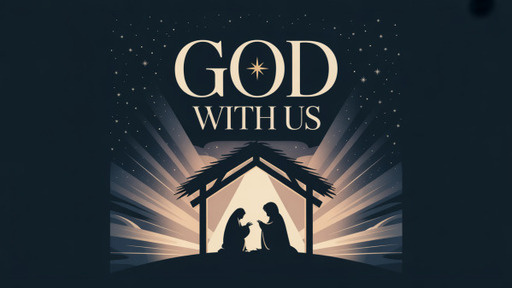
Series: God With Us
Title: The Word Made Flesh
Introduction: Beyond the Manger
Introduction: Beyond the Manger
Thanksgiving has passed and with it comes a distinct shift in focus.
We see the lights, we hear the carols, and our minds go immediately to the manger.
We picture that simple, humble start in Bethlehem.
And that’s beautiful. That’s essential.
But if we only start with the manger scene in Luke 2, we actually miss the eternal weight of what Christmas truly is. If we only look at the baby Jesus, we’re missing the bigger story.
We need to follow the Apostle John’s lead.
He doesn't start in Bethlehem. He says, “In the beginning…”
The story of Jesus begins in eternity, not in the manger. Before there was a physical world, before time, before matter, before the virgin Mary, there was the Word.
This is the essential foundation for our faith: Jesus is not just a great prophet, not merely a moral teacher, but the Eternal God made visible.
1. The Word Was God (John 1:1-3)
1. The Word Was God (John 1:1-3)
Our primary text is John 1:1–3 (NKJV):
1 In the beginning was the Word, and the Word was with God, and the Word was God.
2 He was in the beginning with God.
3 All things were made through Him, and without Him nothing was made that was made.
“In the beginning” John intentionally echoes Genesis 1:1. This isn't a coincidence.
John is announcing a new creation story—a new genesis, established through Christ.
The Word wasn’t created in the beginning; the Word existed before time, matter, or humanity.
He is the Creator, not the created. Think of it this way: Time is like a river flowing from the moment of creation forward. The Word is the mountain above the river source. He is outside of time, looking down on the moment time began.
“The Word was with God”
The original Greek here uses the phrase pros ton theon, which means toward God.
The Word is God’s Self-Expression.
God’s ultimate wisdom, plan, and mind made articulate.
He is the way God has eternally communicated and expressed Himself.
“The Word was God”
John leaves no ambiguity.
The essence of the Word is the essence of God.
Jesus is not "a god" or "part of God."
Jesus is God Himself in expression and revelation to creation.
The Apostle Paul confirms this in Colossians 1:17
17 And He is before all things, and in Him all things consist.
The Word is the cosmic glue that keeps the universe from falling apart.
Before anything was, He was. He is the eternal God.
2. The Word Became Flesh: The Incarnation (John 1:14)
2. The Word Became Flesh: The Incarnation (John 1:14)
Now we move from eternity to history. From the mind of God to the mud of earth.
John 1:14 is perhaps the most magnificent verse in all of Scripture:
14 And the Word became flesh and dwelt among us, and we beheld His glory, the glory as of the only begotten of the Father, full of grace and truth.
God Took on Real Humanity
The Word didn't just appear human (a heresy called Docetism).
He didn't wear a temporary disguise. He fully, genuinely became a man. He took on a human nature.
He experienced real human limitation and emotion.
He felt fatigue (John 4:6)
6 Now Jacob’s well was there. Jesus therefore, being wearied from His journey, sat thus by the well. It was about the sixth hour.
He knew hunger (Matt. 4:2)
2 And when He had fasted forty days and forty nights, afterward He was hungry.
He wept with profound emotion (John 11:35).
35 Jesus wept.
He was completely dependent. He was fully God, yet fully man.
Think of a King who doesn't send a representative. He steps out of his palace, sheds his royal robes, and voluntarily takes on the struggle and the rags of his poorest subject.
This is humiliation for the sake of salvation.
The Invisible God Made Visible
Look at the witness of Paul and the writer of Hebrews.
Colossians 1:15 calls Jesus the icon—the perfect, visible image of the invisible God.
15 He is the image of the invisible God, the firstborn over all creation.
Hebrews 1:3 says He is the exact imprint of God's nature.
3 He is the radiance of the glory of God and the exact imprint of his nature, and he upholds the universe by the word of his power. After making purification for sins, he sat down at the right hand of the Majesty on high,
If you want to know what God is like, you don't need to guess. You don't need to consult ancient philosophy. You look at the life, the actions, and the character of Jesus. He is the picture.
He Dwelt Among Us
John says He “dwelt” among us.
The Greek word is eskēnōsen—He tabernacled (pitched His tent) among us.
In the Old Testament, God’s glory resided in a physical tent—the Tabernacle—in the wilderness. This was the place of encounter.
In the New Testament, God’s glory now resides in flesh. The human body of Jesus is the new dwelling place, the true Temple of God.
This is the ultimate fulfillment of Immanuel, which means "God with us."
3. Jesus Reveals God (John 14:7-9)
3. Jesus Reveals God (John 14:7-9)
So, what is the ultimate result of the Word becoming flesh? He reveals the Father perfectly.
"Show us the Father"—The Disciple's Question
Toward the end of His ministry, the disciples were still struggling to grasp who He was. Philip asks this very human question in John 14:8: "Lord, show us the Father, and it is sufficient for us." Philip was looking for an external, separate display—a flash of light, a vision on a mountaintop.
8 Philip said to Him, “Lord, show us the Father, and it is sufficient for us.”
Jesus’ Earth-Shattering Reply
Listen to Jesus’ response in John 14:9:
9 Jesus said to him, “Have I been with you so long, and yet you have not known Me, Philip? He who has seen Me has seen the Father; so how can you say, ‘Show us the Father’?
This is the highest claim Jesus ever made about Himself. You want to see the Father? You’re looking at Him.
Jesus is not merely a representative. He is not a second-best option. He is the Father revealed in flesh. He is the definitive statement of who God is.
The Word is the Final Word (Hebrews 1:1-2)
Hebrews 1:1–2 brings it all home:
1 God, who at various times and in various ways spoke in time past to the fathers by the prophets,
2 has in these last days spoken to us by His Son, whom He has appointed heir of all things, through whom also He made the worlds;
The prophets were partial, imperfect, and scattered revelations. They gave us glimpses.
But Jesus is the full-stop, the final sentence, the ultimate expression of God’s nature, character, and plan.
4. Application
4. Application
So, let's bring this to our lives right now. What does it mean for us today that the Word became flesh?
It means:
Our God is a God of perfect empathy. (Hebrews 4:15)
Because the Word stepped into human flesh, Jesus understands every human struggle.
He knows what it is to be tempted, to be tired, to be betrayed, and to grieve.
15 For we do not have a High Priest who cannot sympathize with our weaknesses, but was in all points tempted as we are, yet without sin.
The result of the Incarnation is that God is not distant, cold, or remote.
He is:
Accessible
Approachable
Perfectly Empathetic
Eternally Faithful
He met us where we are—in the frailty of flesh—so that we could meet Him in the glory of the Spirit.
The invitation this morning and every day is simple: Draw near to the God who drew near to us.
Don't let the manger scene be a sweet, distant story. Let it be the moment the Eternal God became available to you.
(Time for Closing Prayer / Altar Call)
Let’s pray for a renewed closeness and comfort, knowing that God has experienced our humanity. And let’s ask for a deeper understanding of Jesus’ true identity: Eternal God in human form.
