Ephesians 4.31a-The Believer Must Eradicate Bitterness, Outbursts of Anger and Rage from Their Attitude and Speech
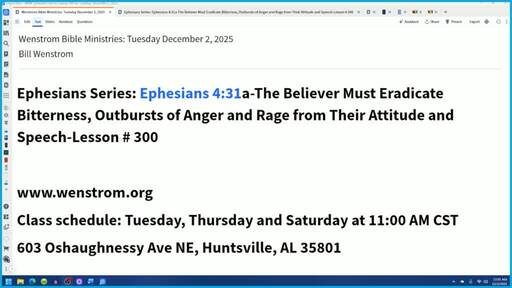

Wenstrom Bible Ministries
Pastor-Teacher Bill Wenstrom
Tuesday December 2, 2025
Ephesians Series: Ephesians 4:31a-The Believer Must Eradicate Bitterness, Outbursts of Anger and Rage from Their Attitude and Speech
Lesson # 300
Ephesians 4:31 Every expression of bitterness along with every expression of malice resulting in outbursts of anger, rage, quarrelling and slander must as a top priority be eradicated from the mental attitude and speech of each and every one of you as a corporate unit. (Lecturer’s translation)
In Ephesians 4:31, the apostle Paul issues another solemn prohibition to the recipients of this letter who were members of the Gentile Christian community in the Roman province of Asia.
This prohibition required that they must make it their top priority of eradicating from their mental attitude and speech every expression of bitterness and malice, which both result in outbursts of anger, rage, quarrelling and slander.
Failure to obey this prohibition in Ephesians 4:31 would result in the recipients of this letter grieving the Holy Spirit, which they were prohibited from doing in Ephesians 4:30.
Furthermore, failure to obey this prohibition would result in them living according to the sinful desires of their indwelling old Adamic sin nature, which they were taught not to do in Ephesians 4:22.
Correspondingly, failure to obey this prohibition would result in them not living in accordance of their new nature, which they were commanded to do in Ephesians 4:24.
The noun pikria (πικρία), “bitterness” pertains to a state of sharp, intense resentment or hate toward another and can be directed at God or one’s fellow human being.
It is a mental attitude sin that is brooding, irritable, resentful, and bears a grudge toward another and is usually the result of some petty disagreement and destroys homes, marriages, churches and friendships.
This mental attitude is the result of a stubborn unforgiving attitude.
The noun pikria (πικρία) is modified by the adjective pas (πᾶς), which is attributing “every expression of” bitterness that the recipients of this epistle could enter into if they have a stubborn, unforgiving attitude toward each other.
Interestingly, we noted that Paul employs the conjugation kai (καί) four times in this prohibition in Ephesians 4:31 to not only connect the nouns thumos (θυμός) orgē (ὀργή), kraugē (κραυγή) and blasphēmia (βλασφημία) together but also to mark each of them as the direct result of bitterness and malice.
The noun thumos (θυμός), “outbursts of anger” refers to an uncontrolled rage since it pertains to the state of relatively strong displeasure with someone with emphasis on the emotional aspect of this displeasure but suggests a loss of self-control from violence of emotion.
This another verbal sin which expresses bitterness in the soul and is the result of a stubborn unforgiving attitude toward another, which is the direct result of not practicing the love of God in one’s life.
The anger mentioned here in Ephesians 4:31 is not to be confused with the anger he refers to in Ephesians 4:26, which we noted was related to church discipline.
As we noted in our study of this verse, the command in verse 26 required that the recipients of this epistle must continue to make it their habit of permitting themselves to be justifiably angry because of the unrepentant sinful activity of a member of their community.
The first prohibition presents the result of obedience to the command and required that they must continue to make it their habit of not sinning by not administering church discipline immediately to those in the Christian community who are guilty of unrepentant sinful behavior.
The second prohibition required that they continue to make it their habit of not letting the sun go down when justifiably angered by those in the Christian community who are guilty of unrepentant sinful behavior.
This prohibition is figurative language for not procrastinating when administering church discipline.
Now, Ephesians 4:26 is referring to the first stage of church discipline, which the Lord Jesus Christ taught in Matthew 18:15, which required a member of the Christian community to confront the guilty party with their sin in private.
Paul alludes to this stage in Galatians 6:1.
That Paul is alluding to the first stage of church discipline in Ephesians 4:26-27 is indicated by the fact that he commands the Gentile Christian community in the Roman province of Asia to express righteous indignation or justified anger.
There is no explanation for this command unless it is a command to express justified anger because of the sinful activities of a member of this community.
Also, the command to not let the sun go down on their anger would only makes sense if this command is related to church discipline.
This command makes perfect sense if by this command Paul does not want the Christian community to procrastinate but to address the problem immediately regarding unrepentant sinful activity in their community.
This interpretation is supported by the fact that in 1 Corinthians 5, Paul severely rebukes the Corinthian Christian community for not confronting a member of their community who was cohabitating with his father’s wife.
He calls them proud for not confronting him and disciplining him and said they should have been sorrowful and removed him from the fellowship of the Christian community.
The implication is that they should be angry with this man’s unrepentant sinful behavior because God the Holy Spirit was because they did not confront the guilty party.
God hates sin and is angry with it as evidence by the fact that the entire human race is condemned by Him (Rom. 1:18-3:18).
However, He sent His Son to suffer His wrath or righteous indignation with regards to the sinful activities of the human race so that the latter would not have to suffer His wrath for all of eternity in the lake of fire.
2 Corinthians 2 reveals that eventually the guilty party repented and Paul instructed them to restore him to fellowship with the rest of the community.
Furthermore, the command in Ephesians 4:27 also supports this interpretation that Paul is alluding to church discipline in Ephesians 4:26 because the former contains a prohibition, which required that the recipients of this epistle not give the devil an opportunity.
The implication being that if they don’t address immediately the problem of unrepentant sinful behavior in their community, then they would be allowing Satan to destroy their testimony before the world and bring about the physical death of the guilty party, i.e., the sin unto death (cf. 1 Cor. 11: 11:30; 1 John 5:16).
Thus, the need for the second prohibition in verse 26, which required the Christian community to not let the sun go down on the cause of their anger.
This prohibition is only understandable if it is addressing the problem of unrepentant sinful behavior in the Christian community.
The implication of this prohibition is to address this problem immediately so that he would no longer be required to obey the command to be justifiably anger regarding unrepentant sinful conduct in their community.
Thus, the only explanation that makes sense of the command and the two prohibitions in Ephesians 426 is that Paul is using shorthand for the practice of church discipline and specifically, the first stage.
Lastly, further indicating that Paul is referring to church discipline in Ephesians 4:26-27 is that he is quoting from Psalm 4, which expresses David’s distress because the citizens of Israel practiced idolatry.
In fact, the Lord asserts in Deuteronomy 32:21, “They made me jealous by what is no god and angered me with their worthless idols.”
David was angry with this unrepentant idolatry in his nation and thus it was apropos that Paul quotes from this Psalm in Ephesians 4:26.
In fact, in Ephesians 5:5, Paul asserts “For you can be confident of this one thing: that no person who is immoral, impure, or greedy (such a person is an idolater) has any inheritance in the kingdom of Christ and God.” (NET)
Paul was concerned with idolatry in the Gentile Christian community because prior to their conversion, they were immersed in pagan idolatry unlike the Jewish Christian community.
Now, in Ephesians 4:31, the noun orgē (ὀργή), “rage” refers to destructive rage which can verge on madness since it pertains to the state of relatively strong displeasure with someone with emphasis on the emotional aspect of this displeasure.
This another verbal sin which expresses bitterness in the soul and is the result of a stubborn unforgiving attitude toward another, which is the direct result of not practicing the love of God in one’s life.
