Jonah 1.2a-The Lord Commands Jonah To Go Immediately To The Great City Of Nineveh (Doctrinal Bible Church in Huntsville, Alabama)

Doctrinal Bible Church
Pastor-Teacher Bill Wenstrom
Sunday November 30, 2025
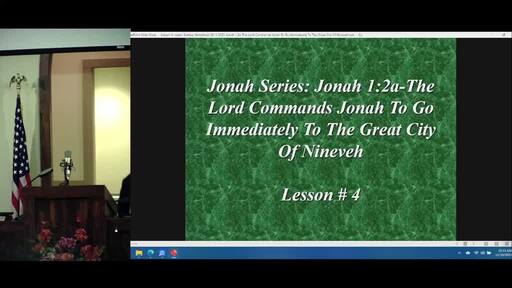
Jonah Series: Jonah 1:2a-The Lord Commands Jonah To Go Immediately To The Great City Of Nineveh
Lesson # 4
In Jonah 1:2a, the Lord commands Jonah to go immediately to the great city of Nineveh.
Jonah 1:1, “The word of the Lord came to Jonah the son of Amittai saying, 2 ‘Arise, go to Nineveh the great city and cry against it, for their wickedness has come up before Me.’” (NIV84)
In verse 1, we have introduced to the reader the principal characters, namely, the Lord and Jonah who function in the narrative as protagonist and antagonist.
All the other human characters in the narrative are unnamed with the exception of course, of Jonah’s father, Amittai.
These unnamed characters are foils to emphasize the relationship between Jonah and the Lord.
Interestingly, the word of the Lord begins the narrative and ends it.
Therefore, the book of Jonah is concerned with the effects and consequences of the word of the Lord.
“Arise, go” is the second person masculine singular qal active imperative form of the verb qum (קוּם), “arise” and the second person masculine singular qal active imperative form of the verb halak (הָלַך), “go.”
These two imperatives emphasize with the reader that Jonah is being ordered by the Lord to go to Nineveh and announce judgment against it.
We have here a divine directive for a prophetic mission.
Jonah 1:1, “The word of the Lord came to Jonah the son of Amittai saying, 2 ‘Arise, go to Nineveh the great city and cry against it, for their wickedness has come up before Me.’” (NIV84)
“To Nineveh” is composed of the preposition al (אַל), “to,” whose object is the feminine singular form of the proper noun nî∙newē(h) (נִינְוֵה), “Nineveh.”
The proper noun nî∙newē(h) appears 17 times in the Hebrew Bible, 9 of which occur in the book of Jonah (1:2; 3:2, 3 twice, 4, 5, 6, 7; 4:11).
Nineveh was one of the capitals of the Assyrian Empire and was located on the eastern bank of the Tigris River in northeastern Mesopotamia (modern Iraq, in the area of the city of Mosul).
This noun appears in Genesis 10:11-12, which is the earliest mention of this city and describes the origin and the builder of the city, Nimrod.
After Jonah’s day it was made the capital of Assyria by Sennacherib (705-681 B.C.), the successor of Sargon II (722-705 B.C.) who destroyed the Northern Kingdom of Israel.
The city of Nineveh was destroyed in 612 B.C. by the Medes and the Persians.
Its great size is mentioned in Jonah 3:3 which states, “Nineveh was an exceedingly great city, a three days' walk.”
Ancient Greek and Roman writers state that it was in the shape of a trapezium and was the largest city in the world in that day.
The accounts of these ancient Greek and Roman writers have been confirmed by modern archaeological excavations.
This journey from Gath-Hepher, Jonah’s hometown to Nineveh is approximately 500 miles, which would be a rugged journey.
Jonah 1:1, “The word of the Lord came to Jonah the son of Amittai saying, 2 ‘Arise, go to Nineveh the great city and cry against it, for their wickedness has come up before Me.’” (NIV84)
“The great city” is composed of the articular feminine singular form of the noun îr (עִיר), “the city” and the articular feminine singular form of the adjective gadhol (גָּדֹול), “great.”
The Hebrew expression hā·ʿîrʹ hǎg·geḏô·lā(h)ʹ (הָעִ֥יר הַגְּדוֹלָ֖ה) “the great city” appears three times in the book of Jonah (Jonah 3:2; 4:11).
The adjective gadhol occurs 14 times alone in the book of Jonah (1:2, 4 twice, 10, 12, 16; 2:1; 3:2, 3, 5, 7; 4:1, 6, 11) and is the most frequent word in this book.
It is used to describe not only Nineveh (3:2, 3; 4:11) but also men of distinction and social rank in the city of Nineveh (3:5, 7), a storm (1:4, 12), fish (2:1), Jonah’s anger (4:1), Jonah’s happiness (4:6).
Here in Jonah 1:2, the adjective emphasizes the size of the city of Nineveh highlighting its importance so that just as is the size of the city, so is the magnitude of its wickedness (The JPS Bible Commentary: Jonah, page 4).
In Jonah 3:3, the word is used in relation to Nineveh’s territory and in Jonah 4:11 with regards to its population.
