The Productive Prayer Life of Paul-Ephesians 1.15-23 (Doctrinal Bible Church in Huntsville, Alabama)

Doctrinal Bible Church
Pastor-Teacher Bill Wenstrom
Wednesday December 3, 2025
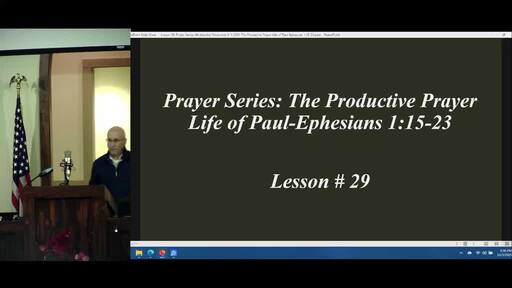
Prayer Series: The Productive Prayer Life of Paul-Ephesians 1:15-23
Lesson # 29
Ephesians 1:15 For this reason, ever since I heard about your faith in the Lord Jesus and your love for all the saints, 16 I have not stopped giving thanks for you, remembering you in my prayers. 17 I keep asking that the God of our Lord Jesus Christ, the glorious Father, may give you the Spirit of wisdom and revelation, so that you may know him better. 18 I pray also that the eyes of your heart may be enlightened in order that you may know the hope to which he has called you, the riches of his glorious inheritance in the saints, 19 and his incomparably great power for us who believe. That power is like the working of his mighty strength, 20 which he exerted in Christ when he raised him from the dead and seated him at his right hand in the heavenly realms, 21 far above all rule and authority, power and dominion, and every title that can be given, not only in the present age but also in the one to come. 22 And God placed all things under his feet and appointed him to be head over everything for the church, 23 which is his body, the fullness of him who fills everything in every way. (NIV84)
“For this reason” indicates that the apostle Paul interceded in prayer to the Father on behalf of the recipients of the Ephesian epistle because they were regenerated children of God who are in union with Jesus Christ and identified with Him in His crucifixion, death, burial, resurrection and session at the right hand of the Father.
Ephesians 1:15-23 is composed of the following: (1) Thanksgiving (Eph. 1:15-16a) (2) Intercession for the recipients of the epistle (Eph. 1:16b-19) (3) Praise of the Father for raising His Son Jesus Christ from the dead and seating Him at His right hand by means of His omnipotence (Eph. 1:20-23).
The purpose of this intercessory prayer is that Paul wants the recipients of this epistle to appropriate by faith the spiritual blessings the Father gave them at their justification.
These blessings are the result of the Holy Spirit in baptism uniting and identifying them with Jesus Christ in His crucifixion, death, burial, resurrection and session at the Father’s right hand at the moment of their justification.
“Your faith” refers to justifying faith meaning that the recipients of the Ephesian epistle exercised faith in Jesus Christ which resulted in God declaring them justified.
“Your love” is used of the love of God manifested in the life of the recipients of the Ephesian epistle after their justification and was prompted by the Spirit’s teaching in the Word of God regarding the Father’s love in eternity past for them by electing and predestinating them to be conformed to the image of His Son, Jesus Christ.
It is also prompted by the Spirit’s teaching in the Word of God regarding the Son’s love for them in time and which love was manifested through His crucifixion, death, burial, resurrection and session at the Father’s right hand.
Lastly, it is also prompted by the Spirit’s teaching in the Word of God regarding the work of the Holy Spirit at the moment of their justification when He identified them with Jesus Christ in His crucifixion, death, burial, resurrection and session at the Father’s right hand, and which action on the part of the Spirit is called the baptism of the Spirit.
In Ephesians 1:16, Paul is asserting that he never permitted himself to cease regularly expressing thanks to God the Father because of each and every one of the recipients of the Ephesian epistle.
This statement contains the figure of speech called “litotes,” which is statement negated in order to emphasize a positive notion, which in our context is that Paul always gave thanks to the Father because of the recipients of the Ephesian epistle.
Ephesians 1:16 brings out one of the characteristics of an effective and productive prayer life, namely, perseverance (Matt. 26:39-44; Luke 11:9-10; 18:1-8; 21:36; Rom. 12:12; 15:30; Acts 1:14; 6:4; 12:5; Eph. 6:18; 1 Thess. 5:17; 1 Tim. 5:5; 2 Tim. 1:3; Col. 1:9; 4:2, 12; Heb. 10:22).
Ephesians 1:17 continues Paul’s thought from Ephesians 1:15-16 in that it provides for the reader the content of what Paul asked the Father when interceding in prayer for the recipients of the Ephesian epistle.
He asserts that he prayed that the Father would cause them to receive divine wisdom, specifically, divine revelatory wisdom provided by the one and only Spirit with respect to an experiential knowledge of the Father.
Notice that in Ephesians 1:17 Paul addressed the Father when interceding in prayer on behalf of the recipients of the Ephesian epistle and not the Son or the Spirit.
In fact, the Scriptures teach there is a protocol to prayer.
They teach that the Christian is to pray to the Father in the name of the Lord Jesus Christ by the power of the Spirit.
Just as there is only one way for salvation, which is through faith in Jesus Christ, so also there is only one way to pray.
In Ephesians 1:17, the noun sophia (σοφία), “wisdom” refers to the wisdom of God, which is provided for the church age believer by the Holy Spirit.
The wisdom of God is a transcendent wisdom because it is based upon His omniscience and is His unique ability to devise a perfect plan to accomplish His goal to glorify Himself.
The word speaks of the function or exercise of God’s ability to perfectly execute His plan of salvation and as a result glorify Himself.
The Father’s wisdom is transcendent because it is beyond both angelic and human comprehension.
The wisdom of God was manifested through the crucifixion, death, burial, resurrection and session of Jesus Christ at the right hand of the Father which provided eternal salvation for all of sinful humanity.
The wisdom of God is also expressed through the gospel of Jesus Christ, which presents God’s provision of eternal salvation for the entire human race through the death and resurrection of Jesus Christ and it is revealed by the Spirit’s teaching in the New Testament.
The noun apokalypsis (ἀποκάλυψις), “revelation” pertains to communication of knowledge which was previously hidden to man by a divine or supernatural agency.
Specifically, it refers to the revelation the Holy Spirit provided Paul and his fellow apostles regarding the Father’s plan for the church age believer, which now appears in the Greek New Testament.
In Ephesians 1:17, the noun epignōsis (ἐπίγνωσις), “may know better” pertains to an experiential knowledge since the word pertains to possessing an experiential knowledge of someone or something and being affected by this encounter in that a person gains more practical wisdom and as a result mature in character.
Therefore, here in Ephesians 1:17, the word speaks of recipients of the Ephesian epistle personally encountering the Father by exercising faith in Paul’s Spirit inspired apostolic teaching and being affected by this encounter in that they gain a practical wisdom and more of the character of Christ.
The noun epignōsis (ἐπίγνωσις) means, “experiential knowledge” and refers to the recipients of the Ephesian epistle personally encountering the Father by receiving His wisdom provided by the Holy Spirit through Paul’s apostolic teaching, which he communicated in this epistle.
In other words, this word speaks of the recipients of the epistle personally encountering the Father through the process of fellowship when they accept by faith this revelation provided them through Paul’s Spirit inspired apostolic teaching.
The noun ophthalmos (ὀφθαλμός), “eyes” refers to having the spiritual capacity to understand or discern spiritually as a result of perception what constitutes their confident expectation of blessing, which is produced by Father’s effectual call as well as to what constitutes the glorious wealth of the Father’s inheritance, which is the saints.
The verb phōtizō (φωτίζω), “may be enlightened” is used in a figurative sense of the Holy Spirit providing the recipients of the Ephesian epistle spiritual understanding or discernment concerning the revelation Paul received from the Holy Spirit and which revelation he was communicating through the contents of the Ephesian epistle.
In other words, it refers to the recipients of the Ephesian epistle receiving spiritual understanding from the Spirit with regards to the spiritual phenomena Paul received from the Spirit, which he communicated through the contents of the Ephesian epistle.
“He has called you” refers to those sinners who have responded to the divine invitation or call of God when they were presented the gospel and have exercised faith in Jesus Christ as their Savior.
Therefore, this “effectual call” refers to the “effective evocation” of faith through the presentation of the gospel by the Holy Spirit who united the believer to Christ according to the Father’s electing him to privilege and His gracious eternal purpose and predetermined plan.
It refers to not only the Father’s invitation to salvation for the sinner through the presentation of the gospel by the Holy Spirit, but it also refers to the sinner’s acceptance of this invitation by faith and which invitation originates from eternity past.
The noun klēronomia (κληρονομία), “inheritance” speaks of the church age believer being perfected in a resurrection body at the rapture of the church or being in the presence of the Lord at physical death as well as rewards for faithful service from the Lord Jesus Christ at the Bema Seat Evaluation of the church.
The noun ploutos (πλοῦτος), “riches” is used in a figurative sense to refer to a spiritual and material abundance of material and spiritual possessions and spiritual resources possessed by God the Father or in other words, it is used figuratively of the spiritual and material prosperity of the Father.
The noun doxa (δόξα), “glorious” is describing the church age believer being in the presence of the Lord Jesus at physical death or being perfected in a resurrection body at the rapture of the church as well as receiving rewards for faithful service from the Lord Jesus Christ at the Bema Seat Evaluation of the church as being glorious.
The noun klēronomia (κληρονομία), “inheritance” is two-fold: (1) The church age believer being in the presence of the Lord at physical death or in a resurrection body at the rapture of the church (2) The church age believer receiving rewards for faithful service at the Bema Seat Evaluation of the church, which immediately follows the resurrection or rapture of the church.
