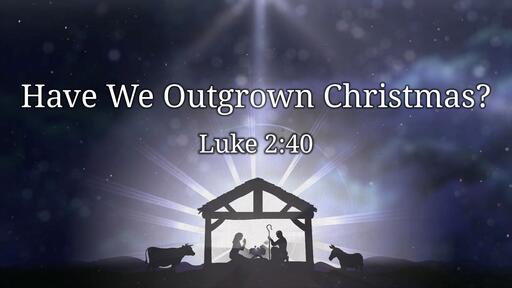
Have We Outgrown Christmas? - Dec. 21st, 2025

CJ Walker, DMin, ThD
Christmas 2021-2025 • Sermon • Submitted • Presented • 1:10:24
0 ratings
· 7 viewsLuke affirmed Jesus’ true, sinless humanity as He matured, strengthened, grew wise, and enjoyed divine favor. Because Jesus grew beyond the cradle, we must mature in strength, wisdom, and grace by God’s help.
Files
Notes
Transcript
Title: Have We Outgrown Christmas?
Text:
And the child grew, and waxed strong in spirit, filled with wisdom: and the grace of God was upon him.
Scripture Reading: Luke 2:40
Central Idea of the Text (CIT):
Luke affirmed Jesus’ true, sinless humanity as He matured, strengthened, grew wise, and enjoyed divine favor.
Sermonic Proposition:
Because Jesus grew beyond the cradle, we must mature in strength, wisdom, and grace by God’s help.
Statement of Purpose:
Objective: Devotional. I want my hearers to turn seasonal sentiment into sustained discipleship—taking specific, Spirit‑led steps this week to grow in spiritual strength, pursue wisdom, and live under God’s grace.
Introduction
Introduction
A young couple, proud to bring their firstborn child home from the hospital, placed the boy in a beautiful wooden cradle. Over the months he grew. The cradle that had once swallowed him could no longer contain him. He began to look like a giant in a baby bed. His parents kept the cradle as a symbol of the child’s birth, but the boy could not stay in the cradle forever. He outgrew it.
One cannot have Christmas without the cradle. Bethlehem matters. But Jesus did not stay in the manger long. Luke gives us a single, simple sentence that moves us beyond the stable and into the steady rhythms of sanctified growth: “And the child grew, and waxed strong in spirit, filled with wisdom: and the grace of God was upon him.” Tonight, part of our “Sounds of Christmas,” I want us to hear the quiet music of that verse. It calls us to outgrow a once‑a‑year, sentimental Christmas and to walk into a new year of steady growth—strength, wisdom, and grace. We’ll move from text to life the way we always do—observe the words, grasp the meaning, correlate with Scripture, and apply it with obedience, in line with our Wisdom House pillars.
[Read the Text Aloud – Luke 2:40, KJV]
“And the child grew, and waxed strong in spirit, filled with wisdom: and the grace of God was upon him.”
Transition: Luke takes us past the cradle. He shows us four realities that ought to mark every follower of Christ who has met the Child of Bethlehem.
I. We spend most of our lives outside the cradle.
I. We spend most of our lives outside the cradle.
Jesus’ growth was natural and normal. As a child, he grew in wisdom and stature. The Bible does not indicate that Jesus had any adult capacities as an infant or a child. He could have, but we have no such biblical authentication. Apparently, he went through the natural growth stages of child development.
Like Jesus, we too must be willing to grow. We should allow the church to nurture us. The Bible samples for us the voice of God as a correcting and stabilizing force. The lordship of Christ encourages us to focus our attention on Jesus. Knowing Christ allows us to come into a closer relationship with him. Yes, one spends most of life outside the cradle.
Explain:
Luke’s verb “grew” reflects steady, ordinary development—Jesus truly took on our humanity and matured through the natural stages of childhood. The same language appears for John the Baptist (Luke 1:80). The emphasis is not on precocious shortcuts but on patient progress. The term “child” (paidion) underscores His genuine boyhood. He did not merely appear human; He was human—yet without sin. Steady growth is God’s wise way.
Illustrate:
That cradle in the living room becomes a keepsake, not a cage. In the same way, Christmas mangers on mantles should remind us of Christ’s birth, not restrain us to a once‑a‑year spirituality. We honor the cradle best by refusing to live in it.
Apply:
Embrace the ordinary means of growth. Plan your first 30 days of 2026 in the Word and in prayer—set a time, a place, and a plan (Luke, Proverbs, and Psalms are a strong trio for January).
Parents and grandparents: normalize Scripture in the home. Read a few verses around the table; pray brief, specific prayers with your children; sing one stanza of a hymn at bedtime.
Church family: make corporate worship non‑negotiable. Growth is ordinary, not occasional.
Believer who feels “stuck”: growth rarely happens by leaps; it happens by faithful inches.
Transition: Life outside the cradle isn’t easy. It takes more than sentiment. It takes strength.
II. Survival outside the cradle requires strength.
II. Survival outside the cradle requires strength.
When Luke recorded that Jesus became strong, he indicated that such strength was given to him. In the same way, we must receive faith, courage, and strength from God. Look at the strength demonstrated by Christ.
Jesus exercised the power of his will and self-restraint. He measured the strength of a man by the power of his feelings he subdued, not by the power of those who subdued him. Jesus’ strength was not unbridled. It was directed and controlled by the will of God. In the same fashion, our lives should be controlled by God’s hand. We must achieve a balance.
Explain:
“Waxed strong” translates a verb Luke uses for robust, increasing strength; paired with “in spirit,” it points to moral and spiritual fortitude. Luke notes an ongoing, God‑given strengthening of Jesus’ inner life as He matured in real time. The grammar emphasizes process, not instant arrival.
Strength here is not swagger; it is holy steadiness—convictions anchored in the Father’s will, affections harnessed by truth, and appetites kept under righteous control. Think of the Lord’s own restraint and resolve: submitting to His parents (Luke 2:51), resisting temptation in the wilderness, enduring contradiction of sinners, and ultimately embracing the cross. True strength is controlled power.
Illustrate:
A steel bridge does not boast about its load; it quietly bears it because it was forged by fire and formed with integrity. So spiritual strength is forged by Scripture, prayer, obedience, and the Spirit’s deep work, long before the load arrives.
Apply:
Strengthen “the inner man.” Choose one habit this week that builds holy resolve—memorize one verse per day (start with Psalm 1 or Ephesians 3:16), fast from a distracting app for seven days, or add a 10‑minute prayer walk at lunch.
Identify one area that must be brought under Christ’s control—your tongue, your temper, your time, or your technology. Take one concrete step of obedience.
Ask a mature believer to check on your progress in 30 days. Accountability adds rebar to resolve.
Transition: Strength alone can become harsh. Godly strength must walk hand‑in‑hand with godly wisdom.
III. Strength must be complemented with wisdom.
III. Strength must be complemented with wisdom.
Jesus grew in wisdom. The New Testament teaches us that Christ was fully God and fully man. He grew in wisdom as a man. He did not simply acquire facts or obtain information. Paul warned young Timothy not to substitute mere facts for wisdom, “ever learning, and never able to come to the knowledge of the truth” (2 Tim. 3:7).
The student who studies only the night before an exam to earn a grade may pass but does not learn. In a world where random data passes for wisdom, we must learn that Jesus came to apply knowledge. People desperately need his wisdom today. “How much better is it to get wisdom than gold! and to get understanding rather to be chosen than silver!” (Proverbs 16:16). The world needs wisdom, not just information! We need today a sound wisdom for life built on the Judeo-Christian concept that God, not man, is the center of our universe.
Explain:
Luke’s phrase “filled with wisdom” uses a present participle—an ongoing filling that kept pace with His growth. Jesus, in His genuine humanity, learned, discerned, and applied God’s truth perfectly. This is not mere accumulation of facts; it is Spirit‑formed discernment leading to right choices at the right time for the right reasons. Luke’s later summary (Lk. 2:52) echoes this trajectory—growth in wisdom, stature, and favor “in the sight of” God and man.
Luke’s portrait also resonates with Isaiah’s promise of the Spirit’s wisdom upon Messiah (Isaiah 11:2). The motifs of wisdom, Spirit‑given favor, and divine filling correspond to Luke’s wording, identifying Jesus as the Spirit‑endowed Davidic King.
Illustrate:
Paul warned of data without discernment—“ever learning, and never able to come to the knowledge of the truth” (2 Tim 3:7). Imagine a student who crams the night before and forgets by Friday. He may pass an exam but fails at wisdom. Wisdom integrates truth into life.
Apply:
Ask a better question. Not merely, “Is this allowed?” but, “Is this wise?” (Prov 16:16; James 3).
Build a wisdom plan. Read one chapter of Proverbs each day this month. As a family, choose one proverb per night to discuss in two minutes: “What does it teach? How will we do it tomorrow?”
Pursue wise voices. Meet with a seasoned saint in our church; ask three questions: “What kept you faithful? What would you do again? What would you do differently?”
Guard your inputs. If you consume hours of random data, do not be surprised when discernment runs dry. Trade scrolling for Scripture.
Transition: Strength and wisdom are not self‑generated. There is a river running under this verse—a river called grace.
IV. God’s grace extends beyond the cradle.
IV. God’s grace extends beyond the cradle.
God’s gift came to Bethlehem two thousand years ago. God’s grace comes to our community also. We must grow beyond our simple views of life.
Explain:
“Grace” (charis) speaks of God’s favor resting upon Christ’s truly human life. Luke bookends this section with grace and favor (Lk. 2:40, 2:52). Grace is the atmosphere of Jesus’ growth and the means of ours. The commentaries rightly observe that this scene transitions from infancy to vocation: Jesus’ relationship with the Father governs His life, and that divine favor frames His obedience.
Grace is not permission; it is power. “The grace of God that bringeth salvation” also “teacheth us” to deny ungodliness and live soberly, righteously, and godly (Titus 2:11–12). Grace makes growth possible after Christmas lights come down.
Illustrate:
The late George Buttrick shared a story about his grandmother who was visiting the United States from Czechoslovakia. She tried to cross against a traffic light in New York City, and someone pulled her away from the path of an oncoming bus. After he composed himself, Buttrick rebuked her, “Do not walk against the light!” She responded, “But this is a free country!”That is the problem with too many people today. People feel they can do anything they want and get away with it. They cannot. Freedom never cancels reality; grace never negates holiness. God’s favor does not remove His wise boundaries; it empowers our joyful obedience.
Apply:
Receive grace for salvation. Christmas announces, “Unto you is born this day… a Saviour” (Luke 2:11). Turn to Christ—repent and believe the gospel.
Rely on grace for sanctification. “Grow in grace” (2 Pet 3:18). Confess what you cannot fix, ask for help you cannot manufacture, and walk in steps you can actually do—today.
Reflect grace to others. Is there a strained relationship? Extend undeserved kindness this week. “Freely ye have received, freely give” (Matt 10:8).
Transition: So—have we outgrown the cradle? Not by discarding it, but by letting it be our beginning point for a new year of growth in strength, wisdom, and grace.
Conclusion
Conclusion
Have you outgrown the cradle? You should have by now. Move beyond the ABCs of Christianity. Do not neglect the cradle, but let it become a beginning point for a new year to grow, become strong, be filled with wisdom, and accept God’s grace. Outgrow the cradle. Jesus did. You can too.
Recap:
The manger mattered, but Luke 2:40 moves us beyond the cradle. Jesus grew—so must we. He was strengthened in spirit—so must we be. He was filled with wisdom—so must we pursue. The grace of God was upon Him—so must we depend on grace.
God’s Action:
In His perfect humanity, the Lord Jesus lived under the Father’s favor, fulfilling righteousness for us and going from manger to cross to empty tomb. The same Savior who lay in a cradle now sits on a throne, ready to save and ready to strengthen. Grace has come near in a Person.
Call to Action:
One Strength Step: name one habit to start (or sin to forsake) this week. Tell a believing friend today.
One Wisdom Step: adopt a January plan—Proverbs daily; one meal‑time Scripture; one spiritual conversation.
One Grace Step: write one name and one gracious action you will take in the next 48 hours.
One Church Step: move from spectatorship to service—choose one ministry to explore in January.
Invitation
Friend, if you do not know Christ as Saviour, the cradle points to the cross. Jesus came to save sinners. Believe on the Lord Jesus Christ and thou shalt be saved (Acts 16:31). Turn from sin; trust His finished work—His sinless life, substitutionary death, and bodily resurrection. Tonight can be your spiritual birthday.
Believer, if you’ve been living in December sentiment, step into January discipleship. Have you outgrown the cradle? You should have by now. Do not neglect it—remember it—but let it be the beginning point for growth: become strong, be filled with wisdom, and walk in grace.
