Jonah 1.9-Jonah Identifies Himself to the Crew (Doctrinal Bible Church in Huntsville, Alabama)

Doctrinal Bible Church
Pastor-Teacher Bill Wenstrom
Sunday December 28, 2025
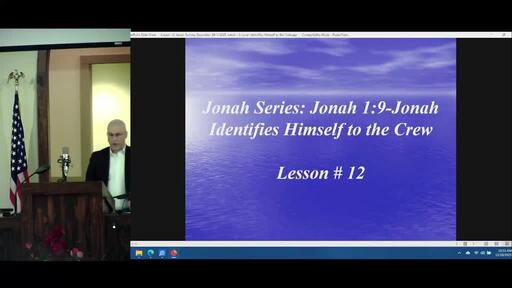
Jonah Series: Jonah 1:9-Jonah Identifies Himself to the Crew
Lesson # 12
Jonah 1:9 records Jonah responding to the crew’s interrogation of him by identifying himself as a Hebrew worshipper of the Lord God of heaven, who is the Creator of the sea and the dry land.
Jonah 1:1 The word of the Lord came to Jonah son of Amittai: 2 “Go to the great city of Nineveh and preach against it, because its wickedness has come up before me.” 3 But Jonah ran away from the Lord and headed for Tarshish. He went down to Joppa, where he found a ship bound for that port. After paying the fare, he went aboard and sailed for Tarshish to flee from the Lord. 4 Then the Lord sent a great wind on the sea, and such a violent storm arose that the ship threatened to break up. 5 All the sailors were afraid and each cried out to his own god. And they threw the cargo into the sea to lighten the ship. But Jonah had gone below deck, where he lay down and fell into a deep sleep. 6 The captain went to him and said, “How can you sleep? Get up and call on your god! Maybe he will take notice of us, and we will not perish.” 7 Then the sailors said to each other, “Come, let us cast lots to find out who is responsible for this calamity.” They cast lots and the lot fell on Jonah. 8 So they asked him, “Tell us, who is responsible for making all this trouble for us? What do you do? Where do you come from? What is your country? From what people are you?” 9 He answered, “I am a Hebrew and I worship the Lord, the God of heaven, who made the sea and the land.” (NIV84)
Jonah 1:9 is the first time in the narrative that we see Jonah speak to anyone whether to God or man.
“I am a Hebrew” is used by Jonah to describe himself as a legitimate and well-known descendant of Shem through Eber who was the progenitor of Abraham, Isaac and Jacob and the expression denotes Jonah’s nationality distinguishing the Israelites from the Gentiles (cf. Gen. 43:32; Ex. 1:15; 2:11; 21:2).
It was a term commonly used by the Israelites to describe themselves to foreigners like these sailors on this ship to Tarshish.
“I worship the Lord, the God of heaven, who made the sea and the land” expresses Jonah’s deep self-consciousness that he worshiped the Lord God of heaven, creator of the sea and dry land in contrast to those questioning him who were heathen idolaters and is expressing his national pride.
The verb yā∙rē(ʾ) (יָרֵא) means, “to have reverence and respect for, to worship” the Lord God expressing the fact that Jonah had “reverence” and “respect” for the Lord, or in other words, he “worshipped” Him.
Since Jonah is not worshipping the Lord by disobeying Him, his description of himself as a worshipper of the Lord God of heaven, creator of the sea and dry land expresses his national pride.
That Jonah describes himself as worshipping the Lord God of heaven is an implicit acknowledgement of his personal responsibility for the disaster that has come upon this ship to Tarshish.
Warren Wiersbe defines worship, “Worship is the believer’s response of all that they are –mind, emotions, will and body-to what God is and says and does. This response has its mystical side in subjective experience and its practical side in objective obedience to God’s revealed will. Worship is a loving response that’s balanced by the fear of the Lord, and it is a deepening response as the believer comes to know God better” (Real Worship, 26).
Psalm 95:6 “Come, let us worship and bow down, let us kneel before the LORD our Maker. 7 For He is our God, and we are the people of His pasture and the sheep of His hand.” (NASB95)
Worship is adoring contemplation of the Lord and is the act of paying honor and reverence to Him and affection for Him and flows from love and where there is little love, there is little worship.
It is the loving ascription of praise to the Lord in gratitude and appreciation for who and what He is, both in Himself and in His ways and in His work on the Cross for us and is the bowing of the soul and spirit in deep humility and reverence before the Lord.
Jonah is not demonstrating any reverence, awe or respect for the Lord at this time by disobeying Him.
The proper noun Yahweh (יהוה), “Lord” is the covenant-keeping personal name of God used in connection with man’s salvation and emphasizing God’s authority over Jonah and that he had a personal covenant relationship with God.
The word also reminds the reader of the “immanency” of God meaning that He involves Himself in and concerns Himself with and intervenes in the affairs of men and thus, it reminds the reader of the foolishness of Jonah in that he is attempting to flee from the presence of God who is transcendent of His creation and creatures.
It tells the reader that God is intervening in the life of Jonah and the crew.
The noun Elohim (אֱלֹהִים), “God” emphasizes the transcendent character of God and thus, the word emphasizes that Jonah’s God is transcendent of His creation and creatures and thus superior to the gods of the crew and the Gentiles.
The noun šā∙mǎ∙yim (שָׁמַיִם), “of heaven” speaks of the abode of God or the dwelling place of God, the location of His government with the implication that Jonah’s God was superior to their gods.
Like the noun Elohim (אֱלֹהִים), “God,” it speaks of Jonah’s God as transcendent and superior to the gods of the crew.
Therefore, the expression “God of heaven” emphasizes that Jonah’s God is transcendent and superior to the gods of the crew.
“Who made the sea and the land” emphasizes with the crew that Jonah’s God is the Lord of all creation and thus in control of the weather and the ultimate cause of this storm that has threaten those on board this ship bound for Tarshish.
To summarize, Jonah 1:9 records Jonah’s response to the crew’s interrogation of him recorded in verse 8.
In this verse, he identifies his God as the source of the storm and implicitly that he is responsible for the Lord causing this great storm to come against the ship and thus endangering the entire crew and its captain.
So Jonah’s description of himself in verse 9 coupled with his admission recorded in verse 10 that he was fleeing his commission from the Lord indicated to the crew that the disaster that presently engulfed the ship and threatened the lives of every one on board is the result of his disobedience to the Creator of the sea and dry land and thus, Jonah has admitted his guilt.
