There Was Famine in the Land - Ruth 1:1-5
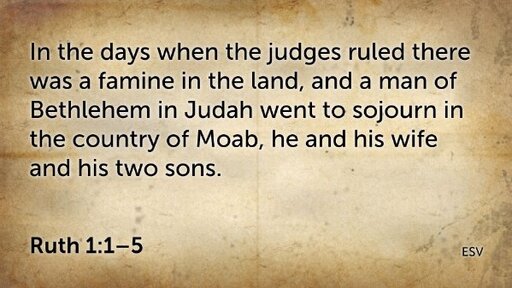

1. In the Day When the Judges Ruled v1-2
a. Famine v1
b. A Critical Decision v1
c. The Family v2
i. Bethlehem
ii. Tribe of Judah
iii. Moab
2. Tragedy v3-4
a. Death v3
The family is under great hardship. There is a famine in Israel, and so they go to sojourn in Moab and to live there under the authority of the pagan Moabites. Tragedy then strikes: Elimelech, the husband of Naomi, dies. Thus, matters are moving from bad to worse. Naomi is now a widow. Nevertheless not all is bleak, because she still has her two sons to care for her; she is not yet destitute.
b. Marriage v4
May we grasp the truth that God will use his people despite their sin. That, of course, does not give anyone a licence to sin, but it underscores the reality that God employs frail and weak vessels to proclaim his truth. God uses his people, despite their feebleness, debility and transgressions, for his glory and purposes.
This is what happens in the book of Ruth. As has already been suggested, the act of Elimelech to move his family to Moab because of a famine in Israel was not the right response to adversity. He should have trusted in the Lord’s provision and remained steadfast in the land of his inheritance. Now in verse 4 we see another errant action: Naomi’s two Hebrew sons marry Moabite women. How often biblical law demands that the Israelites should not intermarry with pagan peoples!
3. Increase in Adversity v5
Naomi’s situation is grave: she is now a widow with no sons to care for her. Certainly the Moabites would have no sense of responsibility for the widow of a sojourner; Naomi would have very few rights and privileges in that culture. So, on top of her grief and mourning, Naomi is facing destitution, poverty, and perhaps even enslavement
Difficult circumstances ought to lead a child of God into a period of self-examination. They ought to cause one to assess how one is living before God on this earth. The Puritan commentator Matthew Henry says in this regard, ‘When death comes into a family it ought to be improved [i.e. made good use of] for the reforming of what is amiss in the family.’ Such tragedy as Naomi is facing ought to lead to change, and it ought to bring into focus the things that are truly important. For Naomi, this change is about to take place.
