Faith that Prays

Notes
Transcript
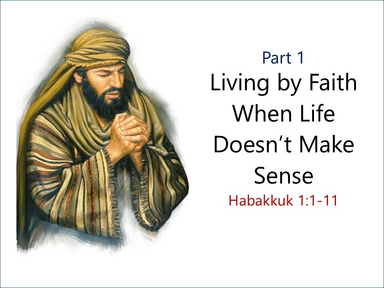
Living by Faith When Life Doesn’t Make Sense
Faith that Prays
Habakkuk 1:1-11
Why does God allow injustice to exist?
We turn on the news and watch oppressors rise without restraint. They redraw moral boundaries,
rewrite history, and wield power with seeming impunity. The innocent suffer. The vulnerable are
crushed. Entire peoples are marginalized, displaced, or threatened with erasure—socially,
politically, and sometimes violently. And through it all, heaven seems silent. This silence creates
deep friction in the human heart. Many struggle to reconcile the world they see with the God
they are told exists. If God is truly sovereign, loving, and just, why does injustice continue
unchecked? Why do the wicked prosper while the righteous suffer? Why do broken systems
persist for generations without accountability?
How can the same God who once caused the waters to rise in judgment, who unleashed
the plagues upon Egypt, who brought down Sodom and Gomorrah, now appear to allow the
injustices of our so-called modern society to go unanswered? This tension is born from a
collision between expectation and experience. We expect power to bring immediate
intervention,1 justice to arrive swiftly, and love to shield us from pain. Yet lived reality tells a
different story. Violence persists. Corruption flourishes. And prayers for deliverance can feel as
though they echo into an empty sky. That gap breeds confusion, disappointment, and—if left
unspoken—quiet resentment toward God. At its core, this struggle is not merely intellectual; it is
deeply relational. It is the ache of believing God can act, yet wondering why He does not. It can
feel like abandonment. It can feel like indifference. And Scripture does not ignore that feeling—
it gives voice to it.
Today, we turn to the minor prophet Habakkuk, a man who loved God deeply and yet
dared to pray honestly. Habakkuk wrestled with injustice in the face of divine silence. His lament
flowed from grief for his own people—Judah. Though sweeping reforms had taken place under
Josiah, reforms that removed idols, destroyed pagan shrines, and restored proper worship of the
LORD, they proved heartbreakingly short-lived. Before long, injustice, violence, and corruption
once again dominated daily life.
1
Eric Redmond, William Curtis, and Ken Fentress, Exalting Jesus in Jonah, Micah, Nahum, Habakkuk
(Nashville, TN: Holman Reference, 2016), 181–182.
1|P age
The book of Habakkuk is not a theological treatise—it is a conversation.2 It is the cry of
a faithful servant pleading with his Creator to act. It is a prophet’s prayer when obedience has not
produced righteousness, and reform has not produced repentance. Habakkuk teaches us that true
faith does not suppress hard questions—it brings them to God.
And that is where faith that prays begins.
Faith Cries out Honestly to God
Rather than suppressing his questions or disguising them in polite religious language,
Habakkuk brings his confusion directly to God. In Habakkuk 1:2–4, we hear what faith sounds
like when it cries out honestly—not with polished answers, but with raw lament. This is not
casual prayer; it is the anguished cry of a servant who loves God deeply and cannot reconcile
God’s holiness with the injustice he sees all around him.3 Listen to the emotion, the urgency, and
the reverence woven through his prayer to his Creator:
“How long, LORD, must I call for help,
but you do not listen?
Or cry out to you, “Violence!”
but you do not save?
Why do you make me look at injustice?
Why do you tolerate wrongdoing?
Destruction and violence are before me;
there is strife, and conflict abounds.
Therefore, the law is paralyzed,
and justice never prevails. The wicked hem in the righteous,
so that justice is perverted.”
- Habakkuk 1:2-4
2
Eric Redmond, William Curtis, and Ken Fentress, Exalting Jesus in Jonah, Micah, Nahum, Habakkuk
(Nashville, TN: Holman Reference, 2016), 181.
3
John Goldingay and Pamela J. Scalise, Minor Prophets II, ed. W. Ward Gasque, Robert L. Hubbard Jr.,
and Robert K. Johnston, Understanding the Bible Commentary Series (Grand Rapids, MI: Baker Books,
2012), 52.
2|P age
Habakkuk could have sought counsel from other godly voices or retreated into private
theological reflection, but instead he brings his burden straight to the LORD.4 He does not come
with accusations or uncontrolled anger, but with humble appeal—not demanding that God act
according to his timetable but pleading to understand why the God he trusts appears silent. This
is faith that prays honestly—faith that refuses to walk away, even when answers have not yet
come.
To understand why Habakkuk prayed this way, we must first understand what he was
seeing all around him. It seemed like only yesterday that Josiah, having heard the words of the
Book of the Law, tore his robes in repentance, cleansed the temple of foreign gods, smashed the
sacred stones and Asherah poles, and led Judah in renewing its covenant with the LORD (2
Kings 22–23). For a moment, the nation stood under the authority of God’s Word once again.
But that moment was painfully short-lived. Within a few years, the next two kings—
Jehoahaz and Jehoiakim—once again “did that which was evil in the sight of the LORD” (2
Kings 23:32, 37). The people no longer governed their lives by the teachings of the Torah, but by
the values of the surrounding nations.5 Instead, they returned to the worship of multiple gods,
while power shifted into the hands of the strong, the clever, and the corrupt. Justice was no
longer shaped by God’s law but by human advantage, often resulting in fraud, exploitation, and
violence against the weak and vulnerable within the community.6
Even the very leaders who were meant to protect God’s people had become agents of
destruction. As the prophet Jeremiah declared, “Woe be unto the pastors that destroy and scatter
the sheep of my pasture” (Jeremiah 23:1). It is out of this deep mixture of grief, frustration, and
covenant love that Habakkuk cries out to God. He watches his people rush headlong toward ruin,
and yet—despite the violence, despite the breakdown of justice, despite a law that has been
rendered powerless to restrain evil—Yahweh appears to tolerate injustice and remain silent.
While the names and circumstances may change, the problem of injustice remains—and
like Habakkuk, we must decide how we will come before God when we encounter it. Scripture
tells us that in the last days there will be wars and rumours of wars, famines, earthquakes, and a
growing tide of wickedness (Matthew 24:4–14), conditions reminiscent of the moral decay
Scripture associates with Sodom and Gomorrah. Jesus warned that as iniquity abounds, “the love
4
John Goldingay and Pamela J. Scalise, Minor Prophets II, ed. W. Ward Gasque, Robert L. Hubbard Jr.,
and Robert K. Johnston, Understanding the Bible Commentary Series (Grand Rapids, MI: Baker Books,
2012), 52.
5
John Goldingay and Pamela J. Scalise, Minor Prophets II, ed. W. Ward Gasque, Robert L. Hubbard Jr.,
and Robert K. Johnston, Understanding the Bible Commentary Series (Grand Rapids, MI: Baker Books,
2012), 55.
6
John Goldingay and Pamela J. Scalise, Minor Prophets II, ed. W. Ward Gasque, Robert L. Hubbard Jr.,
and Robert K. Johnston, Understanding the Bible Commentary Series (Grand Rapids, MI: Baker Books,
2012), 54.
3|P age
of many shall wax cold” (Matthew 24:12). We are living in a world where Christ is no longer
central, but increasingly treated as one voice among many—and in such a climate, frustration is
almost inevitable.
Yet Scripture calls us to be careful with how that frustration is expressed. Like
Habakkuk, when we cry out to God, we must do so not with anger, bitterness, or defiance, but
with humility—coming before our Creator as those who seek to understand His ways, which are
infinitely higher than our own (Isaiah 55:8–9). Our anguish over injustice does not give us
license to demand that the Potter explain Himself to the clay (Isaiah 45:9). Instead, faith bows in
reverence, trusting the wisdom of the hands that are shaping us. When we cry out to God, it
must be with reverence and godly fear, for “our God is a consuming fire” (Hebrews 12:28–29).
We do not approach Him with accusations that He is ignorant of evil, but as children who love
His ways and long to understand why—for now—He allows injustice to persist. This is faith that
prays honestly, humbly, and reverently, even when answers are delayed.
Faith Acknowledges God’s Sovereignty Even When Confused
When faith has poured out its honest questions, God responds—not by explaining
Himself, but by revealing His sovereignty. What follows is not a rebuke, but the LORD’s
response to a humble prayer. God lifts Habakkuk’s eyes beyond Judah and calls him to see that
He is already at work—though in a way the prophet never anticipated. Hear the word of the
LORD:
Look at the nations and watch and be utterly amazed.
For I am going to do something in your days
that you would not believe, even if you were told.
I am raising up the Babylonians,
that ruthless and impetuous people,
who sweep across the whole earth
to seize dwellings not their own.
They are a feared and dreaded people;
they are a law to themselves and promote their own honor.
- Habakkuk 1:5-7
4|P age
When Habakkuk cried out to God, he was likely pleading for divine intervention—grace for the
innocent, judgment for the wicked, and above all a return to repentance, that God’s people might
once again embrace the covenant of their LORD as they had briefly done in the days of Josiah.
But God tells the prophet that proof of His activity will not be found first within Judah, but on
the international stage.7 He is already at work—doing what is unimaginable and unthinkable.8
The LORD declares that He is raising up the Chaldeans, a nation described as “bitter and hasty,”
feared and dreaded, a people who recognize no authority beyond themselves. While Judah had
refused to fear the LORD, they would soon tremble before an instrument of His judgment. God’s
sovereignty had not failed; it was advancing. Yet His chosen means would leave Habakkuk
stunned—because God’s ways, though always just, are often far beyond what faith expects.
Faith that Trusts God’s Wisdom when His Methods are Hard to Accept
God’s answer in verses 5–7 was shocking enough, but what follows in verses 8–11
presses the tension even deeper, as the LORD now unfolds the full weight of the method He has
chosen. God does not soften the reality of what is coming; He describes it in sobering detail.
Hear the Word of the LORD:
Their horses are swifter than leopards, fiercer than wolves at dusk.
Their cavalry gallops headlong; their horsemen come from afar.
They fly like an eagle swooping to devour; they all come intent on violence.
Their hordes advance like a desert wind and gather prisoners like sand.
They mock kings and scoff at rulers.
They laugh at all fortified cities; by building earthen ramps they capture them.
Then they sweep past like the wind and go on—
guilty people, whose own strength is their god.”
-
Habakkuk 1:8-11
7
John Goldingay and Pamela J. Scalise, Minor Prophets II, ed. W. Ward Gasque, Robert L. Hubbard Jr.,
and Robert K. Johnston, Understanding the Bible Commentary Series (Grand Rapids, MI: Baker Books,
2012), 56.
8
Eric Redmond, William Curtis, and Ken Fentress, Exalting Jesus in Jonah, Micah, Nahum, Habakkuk
(Nashville, TN: Holman Reference, 2016), 188.
5|P age
The LORD declares that He is raising up a nation fierce and relentless, an instrument of
discipline unlike any Judah had known. They are swift, ruthless, and unstoppable in their
advance—sweeping through the land with devastating force, overwhelming defenses, and
showing no regard for kings or strongholds.9 Their confidence is absolute; their power is their
god. Yet their success will not come because they are righteous, nor because they are superior in
some ultimate sense, but because God has sovereignly appointed them as the rod of His
discipline.
This is what makes the revelation so troubling. Though the Chaldeans are guilty and
driven by pride, they will prevail—not by their own authority, but because the LORD has chosen
to use even a wicked nation to confront the covenant-breaking of His own people. God’s holiness
has not diminished, nor has His justice failed; rather, His wisdom is at work in a way that defies
human expectation. Habakkuk is forced to reckon with a hard truth: God’s methods may disturb
us deeply, yet His purposes remain perfectly just.
Habakkuk 1:5–7 reminds us that God is never idle, even when His ways unsettle and
confuse us. Too often, we want God to remove every affliction, silence every enemy, and smooth
our path with uninterrupted blessing. Yet our Lord assures us that the Father who knows us
perfectly will never give “a stone” when we ask for bread, or “a serpent” when we ask for a fish
(Matthew 7:9–10). God’s answers may not always feel gentle, but they are never cruel. If God
granted every plea for ease, how would our faith ever deepen? How would perseverance be
formed without trials? Scripture reminds us that testing produces steadfastness, and steadfastness
matures our faith, leaving us “perfect and entire, wanting nothing” (James 1:2–4). Without
hardship, we might never learn how deeply we need Him.
And if we drift into darkness—adopting the values and behaviors of the surrounding
world—how would we recognize our need for correction if God never intervened? Discipline,
though painful, is a mark of love. The LORD chastens His children “for our profit, that we might
be partakers of his holiness” (Hebrews 12:10). Scripture is uncomfortably clear: to be without
discipline is not freedom, but abandonment—evidence that one is “not sons” at all (Hebrews
12:8). Is that not a far greater tragedy than being shaken—yet shaped—by the mighty, loving
hand of God’s correction? Habakkuk teaches us that divine discipline, though frightening, is a
mercy—because it proves that God is still at work, still shaping His people, and still faithful to
His covenant.
Faith Moves us From Complaint to Continued Conversation
The writer of Hebrews reminds us that “faith is the substance of things hoped for, the
evidence of things not seen” (Hebrews 11:1, KJV). In frustration, defiance, or outright despair,
9
Eric Redmond, William Curtis, and Ken Fentress, Exalting Jesus in Jonah, Micah, Nahum, Habakkuk
(Nashville, TN: Holman Reference, 2016), 191.
6|P age
Habakkuk could have walked away from God. And truthfully, many believers do just that—
especially when faced with prolonged suffering or divine discipline. When God, who has the
power to change circumstances instantly, chooses not to do so, hearts can grow angry, prayers
can grow silent, and trust can slowly erode.
Habakkuk, however, does not turn away. Instead, he chooses to remain in prayer,
bringing his confusion before God to seek understanding rather than escape. He recognizes—
whether fully or not—that God’s ways are infinitely higher than our own, and that our spiritual
vision is often clouded by sin, pride, and self-seeking hearts. Because of this, we are frequently
unable to grasp why God responds to events in our lives as He does. Faith, then, is not required
when all the answers are clear—but precisely when they are not. Like Habakkuk, in the face of
uncertainty and confusion, we are called to cry out to God—not in defiance, not demanding that
He justify His actions, but in humble dependence, seeking to trust His wisdom even when
understanding is withheld.
Conclusion
Habakkuk’s story does not end with clarity, comfort, or control. It ends with something
far better—communion. The prophet is not given a timeline, nor is the injustice immediately
removed. Instead, Habakkuk is invited to live by faith in a God whose wisdom is higher, whose
purposes are sure, and whose presence is unwavering. The journey of this book teaches us that
faith does not deny confusion, nor does it pretend injustice is insignificant. Faith cries out
honestly. Faith bows humbly. Faith acknowledges God’s sovereignty even when it does not
understand His methods. And ultimately, faith chooses to stay in conversation with God rather
than walk away from Him.
We live in a world that feels increasingly familiar to Habakkuk’s—marked by injustice,
moral confusion, and spiritual indifference. Like him, we are tempted to demand answers, to
insist on immediate resolution, or to retreat into silence when God’s ways unsettle us. But
Habakkuk shows us a better way. He teaches us that faith is not having everything explained—it
is trusting the character of God when explanations are withheld. As we move forward, we are
called to do what Habakkuk learned to do: to stand watch, to wait, and to live by faith. Not a
passive faith, but a persevering one. Not a silent faith, but a praying one. Not a faith anchored in
outcomes, but a faith anchored in the unchanging nature of God Himself.
So, when injustice confuses you, pray. When God’s discipline unsettles you, trust.
When His methods disturb you, remember—He is still holy, still sovereign, and still good. And
like Habakkuk, may we remain before the LORD—not walking away in anger, but standing in
reverent awe—until faith gives way to sight, and justice, long awaited, is finally made complete.
Ultimately, God’s answer to injustice is not only a plan, but a Person—Jesus Christ, who entered
our suffering, bore our sin, and will one day bring perfect justice in righteousness.
“The just shall live by his faith.” (Habakkuk 2:4)
7|P age
