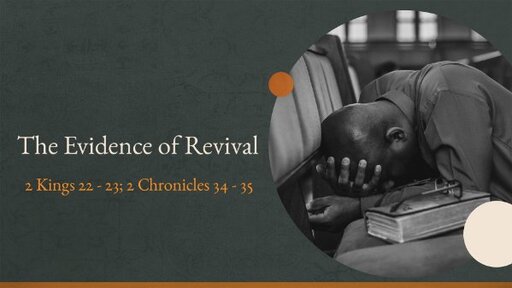
The Evidence of Revival

Sermon • Submitted • Presented • 36:29
0 ratings
· 5 viewsFiles
Notes
Transcript
Introduction: Revival—God’s Repeated Work Among His People
The history of the Christian faith is, at its heart, a history of revival.
Over and over again, God’s people burn brightly for Him
Yet over and over again they grow cold.
Through out scripture we see that when love cools and devotion fades, God’s people repent, seek His face, and the Lord graciously responds by sending revival.
Church history shows us this to:
In 1734, in a small Christian community called Herrnhut, God ignited a revival so powerful that it produced a missionary movement that sent over 300 missionaries throughout Europe and America.
In the 1700s and 1800s, America experienced multiple Great Awakenings that brought millions to saving faith in Jesus Christ—revivals that reshaped the moral and spiritual fabric of our nation.
During the American Civil War, in the fall of 1863, revival swept through both the Union Army of the Potomac and the Confederate Army of Northern Virginia. Prayer meetings filled army camps. Evangelistic services flourished. Historians estimate that nearly ten percent of all soldiers—over 250,000 men—were saved during that conflict.
In 1904, revival swept across Wales, resulting in over 100,000 conversions. Society was so transformed that bars and jails closed for lack of business.
And even today, God is still sending revival. Millions are coming to Christ in places like China, South Korea, and across Africa.
Revival is nothing new.
Wherever God has people, there has always been drift—and wherever there has been drift, God has been willing to send revival.
That brings us to our text.
In 2Kings 22-23 and 2Chron. 34-35 we find one of the greatest revivals of the Old Testament.
Israel had drifted far from the Lord.
Idolatry dominated the land.
Sin was normalized.
The Word of God was forgotten.
So, Judgment loomed.
But God, raised up a godly king named Josiah, whose passion for the Lord led an entire nation back to righteousness.
Lets read 2Chron 34:1-7 to give us a broad overview of what toke place
As we seek revival in our own church, we must ask an important question:
If God sends us a true revival, how will we recognize it?
This passage gives us the answer.
I. True Revival Involves Rededication
I. True Revival Involves Rededication
(2 Chron 34:8-21; 2Kings 22:8-13)
Revival begins with a return to God’s Word.
A. The Word of God Was Rediscovered
The temple had fallen into disrepair, and along with it, the Word of God had been neglected.
In fact, the Book of the Law had been lost amid religious activity and spiritual disorder.
When it was finally rediscovered and read, Josiah and the priests realized something devastating—they were living in violation of God’s commands, and His anger rested upon the nation.
When Josiah saw himself and Israel in the light of Scripture, he recognized how far they had drifted.
The Word of God convicted his heart, and he responded by rededicating himself to obedience.
Revival always begins when God’s people see themselves honestly through the lens of Scripture.
True revival will not happen until the people of God, get away from program schedules and get back to the preciouses book.
A. The Word of God Was Rediscovered
B. Devotion to the Word was Restored
One consistent mark of revival throughout history is a renewed hunger for God’s Word.
We claim to believe the Bible.
We defend it.
We declare it to be inspired, inerrant, authoritative—and it is all those things.
Yet far too often, the Bible remains unread, unstudied, and unapplied.
It is not enough to own a Bible.
We must be owned by the Bible.
If we say it is the standard, then it must govern our lives.
The Bible is God’s plumb line (Amos 7:7–9). Everything we believe, practice, and proclaim must align with it.
A. The Word of God Was Rediscovered
B. Devotion to the Word was Restored
C. The Bible was Returned as Final Authority
Scripture teaches us what to believe, how to worship, how to live, and how to walk with God (2 Timothy 3:16–17).
A genuine revival is marked by a return to Scripture as the final authority in faith and practice.
When revival comes, God’s people don’t argue with the Word—they submit to it.
II. True Revival Involves Repentance
II. True Revival Involves Repentance
(2 Kings 23:1–3)
Revival never stops with rediscovery—it moves toward repentance.
A. Repentance Was National and Personal
Josiah gathered the people and read the Word of God aloud.
Together, they entered into a covenant, committing themselves to obey the Lord.
Revival is never merely emotional—it is directional.
A. Repentance Was National and Personal
B. Repentance Is a Change That Produces Action
Biblically, repentance is more than sorrow.
It is a change of mind that results in a change of direction.
Repentance means we are sorry enough to stop going our way and start walking God’s way.
Being sorry you sinned is not repentance.
Turning from sin is repentance.
A. Repentance Was National and Personal
B. Repentance Is a Change That Produces Action
C. Repentance Is Essential
God does not change His Word.
He demands repentance from those who want fellowship with Him—and from those who want revival.
We deceive ourselves when we think we can cling to our ways and still enjoy God’s power and blessing.
Before there can be revival, there must be repentance.
Before there can be restoration, there must be honesty (1 John 1:9).
III. True Revival Involves A Removal
III. True Revival Involves A Removal
(2 Kings 23:4–20, 24)
True repentance always produces real change.
A. Josiah Led a Total Purge of Sin
The temple was cleansed of idols
Pagan worship centers were destroyed
Occult practices were removed
This was not partial reform—it was complete reformation.
Revival does not coexist with sin that is tolerated
A. Josiah Led a Total Purge of Sin
B. Removal Begins at Home
We may not be able to reform the nation, denominations, or other churches—but we can examine our own lives.
Personal holiness matters.
Church integrity matters.
Revival begins when God’s people remove what displeases Him.
A. Josiah Led a Total Purge of Sin
B. Removal Begins at Home
C. Revival Always Produces Holy Living
When revival comes:
Worship changes
Behavior changes
Desire changes
It is possible to believe right and behave right and still not be right—but genuine revival changes hearts, and changed hearts change lives.
IV. True Revival Involves A Remembrance
IV. True Revival Involves A Remembrance
(2 Kings 23:21–23)
A. Josiah Remembered the Passover
Israel had forgotten their redemption.
They forgot who they were and what God had done for them.
Forgetfulness led to idolatry.
So Josiah called them back to remembrance.
B. Revival Rekindles Gratitude and Passion
When God’s people remember what they were,
where they were headed,
and what Christ did for them (Ephesians 2:1–10),
love is rekindled and worship becomes alive again.
C. Jesus’ Prescription Still Works
The church at Ephesus was active—but cold.
Jesus’ solution was simple:
Remember. Repent. (Revelation 2:5)
Revival is God’s people falling in love with God all over again.
Conclusion
Conclusion
Here is what Josiah and Israel did:
They recognized their sin
They repented of their sin
They removed what dishonored God
They remembered who they were and what God had done
And God sent revival.
If we want revival, we must do the same.
This is a good moment to talk to the Lord about that desire.
