Jonah 1.11-12-Jonah Tells Ship's Crew To Throw Him Overboard (Doctrinal Bible Church in Huntsville, Alabama)

Doctrinal Bible Church
Pastor-Teacher Bill Wenstrom
Sunday January 4, 2025
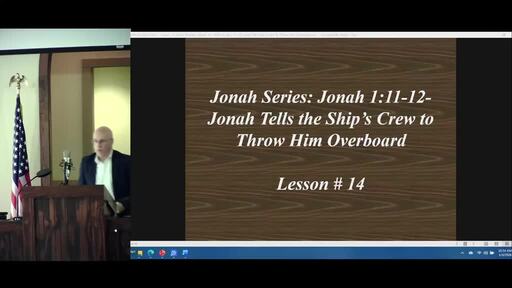
Jonah Series: Jonah 1:11-12-Jonah Tells the Ship’s Crew to Throw Him Overboard
Lesson # 14
Jonah 1:11-12 records the ship’s crew in desperation asking Jonah what they should do on behalf of him to make the sea calm and he responds by telling them to throw him overboard.
Jonah 1:1 The word of the Lord came to Jonah son of Amittai: 2 “Go to the great city of Nineveh and preach against it, because its wickedness has come up before me.” 3 But Jonah ran away from the Lord and headed for Tarshish. He went down to Joppa, where he found a ship bound for that port. After paying the fare, he went aboard and sailed for Tarshish to flee from the Lord. 4 Then the Lord sent a great wind on the sea, and such a violent storm arose that the ship threatened to break up. 5 All the sailors were afraid and each cried out to his own god. And they threw the cargo into the sea to lighten the ship. But Jonah had gone below deck, where he lay down and fell into a deep sleep. 6 The captain went to him and said, “How can you sleep? Get up and call on your god! Maybe he will take notice of us, and we will not perish.” 7 Then the sailors said to each other, “Come, let us cast lots to find out who is responsible for this calamity.” They cast lots and the lot fell on Jonah. 8 So they asked him, “Tell us, who is responsible for making all this trouble for us? What do you do? Where do you come from? What is your country? From what people are you?” 9 He answered, “I am a Hebrew and I worship the Lord, the God of heaven, who made the sea and the land.” 10 This terrified them and they asked, “What have you done?” (They knew he was running away from the Lord, because he had already told them so.) 11 The sea was getting rougher and rougher. So they asked him, “What should we do to you to make the sea calm down for us?” 12 “Pick me up and throw me into the sea,” he replied, “and it will become calm. I know that it is my fault that this great storm has come upon you.” (NIV84)
“What should we do to you?” indicates that the ship’s crew is asking Jonah what specific course of action they must take on behalf of him and for the benefit of him that will bring the great storm to an end.
Now that the crew knows that Jonah’s disobedience to his god was the cause of the great tempest that was pounding the ship and that his god caused this disaster, they ask him for a solution.
The pagan crew does not worship Yahweh like Jonah and they would have no clue as to what course of action they must take to appease his god.
Since Jonah worships Yahweh, only he would know what to do in this situation.
As Stuart quips, “Jonah is both the guilty party and the expert here.”
Now some contend that the crew is asking if there is something that they could do “to” Jonah in the form of punishment.
This is unlikely since verses 12-16 record the crew’s great anxiety in fulfilling Jonah’s request to throw him overboard thus indicating they had no desire to cause him any physical harm.
Rather the crew is asking what they could do “on behalf of” Jonah in the form of assisting him in presenting a suitable or acceptable sacrifice to Yahweh in order to appease Him and bring an end to the storm.
“The sea was getting rougher and rougher” gives the reason why the crew asked Jonah if there was any thing that they could do on behalf of him in the form of assisting him in finding or providing a suitable and acceptable sacrifice to Yahweh, which would bring an end to the storm.
“I know that it is my fault that this great storm has come upon you” Jonah’s deep self-consciousness of guilt that he alone was responsible for the great storm that was threatening the lives of everyone on the ship.
The verb yā∙rē(ʾ) means “to recognize” indicating that Jonah “recognized” that the dire circumstances that the ship and its crew and Jonah found themselves in were due to his disobedience to the Lord’s command to go to Nineveh and announce judgment against its inhabitants.
By no means should Jonah’s willingness to die be considered as gallant or virtuous since he repeatedly prays that God would kill him after going to Nineveh (See Jonah 4:3).
Rather, his willingness to die should be interpreted as a recognition of his guilt before God.
It is also clear that his willingness to die here is an attempt by him to avoid going to Nineveh since he again wishes to die after the Ninevites repented in response to his message of judgment against it.
He has no concern for the crew since he wants to die to avoid going to Nineveh.
He is willing to die so that he can get out of going to Nineveh.
He’d rather drown than become a missionary to Nineveh.
Jonah is in effect forcing God’s hand, which is of course impossible to do.
Again this is clearly indicated by Jonah 4:3 and also supported by the fact that he makes no attempt to pray for the end of the storm.
The prophet’s willingness to die implies that Jonah clearly understands and is fully aware that he is under discipline and that death is a just penalty that he deserves.
However, Jonah forgets that God will treat him like the Ninevites and relent from killing him if he repents.
The purpose for which the Lord brought a great storm against the ship carrying Jonah was to prompt the prophet to go and carry out his prophetic assignment.
The Lord does not want Jonah to die or the crew.
In fact, he uses the storm not only to get Jonah to obey him but also to save the crew and become worshipers of Himself.
Jonah 1:4-12 reveals that the heathen crew has more regard for their own lives and the life of Jonah as is demonstrated in verses 13-14.
However, the prophet of God, Jonah has no regard for his own life and the lives of those on board the ship with him.
Jonah is a terrible witness and ambassador for the Lord (cf. 1 Peter 2:11-12).
Jonah has no compassion for the pagans as demonstrated by his conduct on the ship and his refusal to go to Nineveh.
However, the heathen crew demonstrates compassion for Jonah.
They demonstrate they possess a moral conscience and Jonah reveals he has none.
The heathen crew has respect for Yahweh, “the Lord” but Jonah demonstrates no respect for Him.
Interestingly, Jonah does not jump into the ocean on his own but solicits the crew’s help.
Bob Deffinbaugh answers this question, he writes, “Why did Jonah not just jump into the sea? It seems as though the sailors had to act in obedience to God’s directive through Jonah. Casting him into the sea would surely have meant death to Jonah. Just as the Israelites had to be the instruments of the death of a sinner against God (cf. Lev. 24:10 16).” (The Prodigal Prophet: Jonah; page 5)
