Jonah 1.14-The Crew Urgently Requests That The Lord Spare Their Lives (Doctrinal Bible Church in Huntsville, Alabama)

Doctrinal Bible Church
Pastor-Teacher Bill Wenstrom
Sunday January 11, 2026
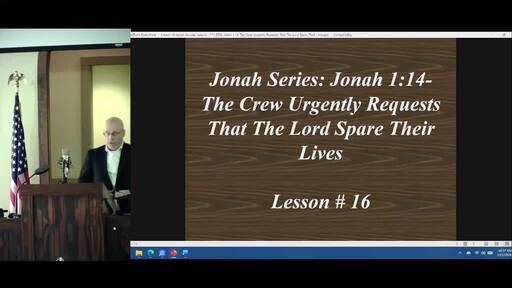
Jonah Series: Jonah 1:14-The Crew Urgently Requests That The Lord Spare Their Lives
Lesson # 16
Jonah 1:14 records the crew urgently requesting that the Lord spare their lives and not hold them accountable for Jonah’s death when they take his advice and throw him overboard.
Jonah 1:1 The word of the Lord came to Jonah son of Amittai: 2 “Go to the great city of Nineveh and preach against it, because its wickedness has come up before me.” 3 But Jonah ran away from the Lord and headed for Tarshish. He went down to Joppa, where he found a ship bound for that port. After paying the fare, he went aboard and sailed for Tarshish to flee from the Lord. 4 Then the Lord sent a great wind on the sea, and such a violent storm arose that the ship threatened to break up. 5 All the sailors were afraid and each cried out to his own god. And they threw the cargo into the sea to lighten the ship. But Jonah had gone below deck, where he lay down and fell into a deep sleep. 6 The captain went to him and said, “How can you sleep? Get up and call on your god! Maybe he will take notice of us, and we will not perish.” 7 Then the sailors said to each other, “Come, let us cast lots to find out who is responsible for this calamity.” They cast lots and the lot fell on Jonah. 8 So they asked him, “Tell us, who is responsible for making all this trouble for us? What do you do? Where do you come from? What is your country? From what people are you?” 9 He answered, “I am a Hebrew and I worship the Lord, the God of heaven, who made the sea and the land.” 10 This terrified them and they asked, “What have you done?” (They knew he was running away from the Lord, because he had already told them so.) 11 The sea was getting rougher and rougher. So they asked him, “What should we do to you to make the sea calm down for us?” 12 “Pick me up and throw me into the sea,” he replied, “and it will become calm. I know that it is my fault that this great storm has come upon you.” Instead, the men did their best to row back to land. But they could not, for the sea grew even wilder than before. 14 Then they cried to the Lord, “O Lord, please do not let us die for taking this man’s life. Do not hold us accountable for killing an innocent man, for you, O Lord, have done as you pleased.” (NIV84)
Jonah 1:14 presents the result of the crew being unable to row successfully to dry land and presents two prayer requests that the crew offered up to the Lord.
“They cried to the Lord” indicates that the entire crew had a personal relationship with God just like Jonah since unbelievers in the Old Testament never use this word Yahweh (יהוה), “the Lord” when addressing God, which is the covenant-keeping personal name of God used in connection with man’s salvation.
It emphasizes that the crew was now believers in Jonah’s God as demonstrated by their exercising faith in Him to deliver them from death and being held accountable for Jonah’s death.
It also reminds the reader of the “immanency” of God meaning that He involves Himself in and concerns Himself with and intervenes in the affairs of men.
Thus, it reminds the reader that the Lord is now going to intervene in the lives of the entire crew as a result of their faith in Him.
“Please do not let us die for taking this man’s life” emphasizes the crew’s desire to not die and be held accountable for taking Jonah’s advice and throwing him overboard to end the storm and expresses their urgency and the intensity of their prayer.
This first prayer request expresses the fact that the crew believes that the Lord intends to kill Jonah for his disobedience, which he has just admitted to them.
They are suffering because of Jonah’s sin against the Lord and they are begging that the Lord would not punish them along with Jonah.
The circumstances appear that the Lord was intending to kill them along with Jonah because the storm was growing increasingly worse.
This terrible adversity has led to their salvation, i.e. deliverance, not only from the storm and death but also eternal condemnation.
The irony is that the crew who knew nothing of the Lord prior to their experiencing this storm and meeting Jonah, are exercising faith in Him by petitioning Him to deliver them from death whereas Jonah does not pray.
This second request “do not hold us accountable for killing an innocent man” makes clear that the crew has decided at this point in the narrative to heed Jonah’s advice and throw him overboard.
However, it also reveals that they possess a moral conscience by respecting the sanctity of human life since it acknowledges that murder is a capital crime worthy of death.
This second request does not indicate that the crew thought Jonah was innocent or expresses their uncertainty that he was since Jonah already acknowledged to them he was guilty of running away from his commission from the Lord as noted in verse 10.
Also, indicating that this is the case is that they knew he was guilty since he admitted that the storm was because of him as noted in verse 12, his lot was chosen as noted in verse 7, and Jonah told them to throw him overboard as recorded in verse 12.
This second petition expresses the crew’s desire that the Lord would not hold them accountable for Jonah’s death and would not consider this act of throwing him overboard and drowning him as cold blooded murder and worthy of death.
They are in effect saying to the Lord with this request that by throwing Jonah overboard they are carrying out His will, which is indicated by the causal that follows this request, “for You, O Lord, have done as You have pleased.”
Further indicating this is that the Lord who controls the weather prevented them from reaching the shore as recorded in verse 13.
So the crew is caught between a rock and a hard place and a no win situation.
They are suffering because of Jonah’s bad decision and don’t want to die because of it, however they don’t want to be guilty of murder by taking Jonah’s advice and throwing him overboard, which according to Jonah would calm the stormy sea.
They wanted to live but not by committing murder and so consequently, they pray that by throwing Jonah overboard, they are doing the will of the Lord.
As far as the crew is concerned all the evidence pointed to the fact that the Lord wanted to execute Jonah for his disobedience.
First of all, the lot fell to Jonah and he admitted to fleeing from his commission from the Lord and then Jonah advised they throw him overboard and the Lord who controls the weather prevented them from reaching the shore.
Therefore, we have another irony, the crew, which did not know the Lord as Jonah did, was very concerned about doing the Lord’s will, whereas Jonah was not.
“For You, O Lord, have done as You have pleased” presents the reason why the crew made the previous request that the Lord would not judge them as guilty of murder because they take Jonah’s advice and throw him overboard and echoes other Old Testament passages (Isaiah 46:9-11; Psalm 13:5).
Psalm 115:3, “Our God is in heaven! He does whatever he pleases!” (NET Bible)
This causal clause at the end of Jonah 1:14 indicates that the crew’s act in throwing Jonah overboard is according to the Lord’s will or desire.
It also expresses the crew’s faith in the Lord in that they now recognize Him as superior to the idols they had formerly worshipped.
This clause is an expression not only of faith in the Lord but also is an expression of worship.
Undoubtedly, Jonah must have been rebuked by this expression of faith and worship in the Lord by the newly saved crew.
It taught Jonah that his God was the God of not only the Jews but also the Gentiles (Romans 3:29).
