Discipleship Path - Grow

Notes
Transcript
NOTE:
This is a manuscript, and not a transcript of this message. The actual presentation of the message differed from the manuscript through the leading of the Holy Spirit. Therefore, it is possible, and even likely that there is material in this manuscript that was not included in the live presentation and that there was additional material in the live presentation that is not included in this manuscript.
Engagement
A woman was driving her car when she pulled up behind another car that had stopped for a red light. When the light turned green, the man in that car was looking down at his phone and didn’t realize the light had changed. So the lady in the car let him know by honking her horn. But he didn’t budge so she honked her horn again.
She was getting really mad now, so she rolled down her window and began to yell, but apparently the man had his windows rolled up and his radio playing loudly and he didn’t hear her. But just as the light turned yellow, he looked up and took off just in time to zoom through the intersection, leaving the angry lady behind him to sit through another complete cycle. She was really fuming now, and she put her arm out and gave a certain gesture and yelled some choice words.
Apparently she hadn’t noticed the police officer right behind her and so she was quite surprised when he pulled his gun and commanded her to get out of the car with her hands up. The officer then cuffed her and put her in the back of his squad car while he checked her out on his computer. Finally after about 15 minutes, he opened up the door and let her go.
“Ma’am, I am very sorry for the misunderstanding. About the time I was watching you rant and rave I also noticed the “honk if you love Jesus” bumper sticker, the “In God We Trust” license plate and the chrome fish on the back of your vehicle and I naturally assumed you had stolen the car.
Tension
That story illustrates something that I think all of us struggle with at times. It’s not always easy for us to act in a way that is consistent with what we say we believe. Even the Apostle Paul wrote a whole chapter about that in his letter to the churches in Rome. This verse is a pretty good summary of everything he writes about in Romans chapter 7:
15 For I do not understand my own actions. For I do not do what I want, but I do the very thing I hate.
Anyone here relate to that? I sure do. And the fact is that as long as we live on this earth, we will continue to struggle with two things: making sure that our beliefs line up with truth and then making sure that our conduct is consistent with that truth. But the good news is that there are some things we can do that will help us with both of those things.
Truth
One of the reasons that we developed the discipleship path that we are talking about in this sermon series is to help us all develop right beliefs and then do what we can to make sure our actions are consistent with those beliefs.
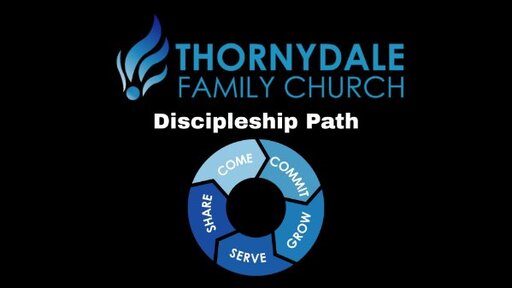
Just as a quick reminder, this path is a tool to both help us to evaluate where we are in our spiritual development and to help us determine the next steps we need to take to mature spiritually. So far we’ve addressed the first two steps in the process - Come and Commit.
Two weeks ago we talked about the need to Come when Jesus calls us. And last week we talked about the importance of making a commitment - especially a commitment to put our faith in Jesus alone, to baptism, and to church membership.
If you haven’t already figure it out today, we will cover the third step on the path - Grow. In a sense, this step really incorporates the other four steps on the path as well since the ultimate purpose is to help us grow spiritually. And the idea of growing spiritually is so broad that I’ll only be able to scratch the surface here today. But I am confident that if we all apply what we learn today, we can all benefit.
We’re going to look at two different passage this morning. The first one is found in 1 John chapter 2. There is so much in this chapter we could learn from but we’re going to focus on just 3 verses:
12 I am writing to you, little children, because your sins are forgiven for his name’s sake.
13 I am writing to you, fathers, because you know him who is from the beginning. I am writing to you, young men, because you have overcome the evil one. I write to you, children, because you know the Father.
14 I write to you, fathers, because you know him who is from the beginning. I write to you, young men, because you are strong, and the word of God abides in you, and you have overcome the evil one.
You will notice that John is addressing three, or possibly even four groups of people here: little children, children, young men, and fathers. While there are some differing views on exactly what John means here, I think it is safe to say that he is describing different levels of spiritual maturity. And he is also giving us some ways to measure who falls into each of those groups.
I’m not going to spend a lot of time here because while John does identify these groups and some defining characteristics, he doesn’t go into a lot of detail about how to grow from a little child to a father. And I think that’s what we all really want to know, right?
What I will say is that we do see there is a wide gap between spiritual children and spiritual fathers. Spiritual children, just know the basics. They understand that their sins are forgiven, but they don’t really have a firm grasp on who God is or His Word. And that’s exactly where all of us started didn’t we? We understood that we were sinners in need of God’s forgiveness and that the only way we could receive that was by putting our faith in Jesus alone.
Then hopefully at some point we mature into spiritual young men and women, and we begin to understand God and His Word more deeply, and that makes it possible for us to stand firm against Satan and his attacks.
And if we continue on the path of spiritual growth, we eventually become spiritual fathers and mothers who really begin to know God deeply. The word John uses for “know” is a word that means to come to know by experience and you’ll notice that the spiritual fathers and mothers know “him who is from the beginning”. John uses that phrase to indicate a much deeper understanding of God, not just knowing Him on a surface level.
Hopefully, all of us want to become spiritual fathers and mothers, but other than writing about abiding in God’s Word, John doesn’t give us a lot of “how to”. He doesn’t really explain how we grow from spiritual little children and become spiritual fathers and mothers. So we’re going to look at another passage that will provide us with some more practical guidance on how to do that.
Go ahead and turn in your Bibles to Philippians chapter 2 and follow along as I read beginning in verse 12:
12 Therefore, my beloved, as you have always obeyed, so now, not only as in my presence but much more in my absence, work out your own salvation with fear and trembling,
13 for it is God who works in you, both to will and to work for his good pleasure.
Here is the main idea we’re going to develop from this passage today:
Spiritual growth is a matter of training, not just trying
Spiritual growth is a matter of training, not just trying
That really shouldn’t be surprising statement because it is true in so many other areas of our life isn’t it?
Let’s say I decide that I want to bench press 225 pounds. There was a time when I actually was able to do that, but as I get older every time I go to the gym, they keep making the weights heavier, so that is no longer the case.
So I go to the gym and I do a couple warm up sets and then I put 225 pounds on the bar. And I try as hard as I can to lift that bar off the rack and lower it to my chest - that part isn’t too bad - and then try as hard as I can to raise it back up to the rack. That is when someone would have to call 911 as the bar crushes my chest.
However, if that was a high priority for me, I am confident that if I were to diligently train for that purpose for 4 or 5 months, there is a pretty good chance I would be able to do that again.
The same is true when it comes to spiritual growth. I can try as hard as I want, but without proper training, I will never mature as much as I’d like.
Before we talk about how to train in a way that we will grow spiritually I want to make sure we understand clearly what Paul is not saying here. In order to do that there are two truths that we need to hold in tension:
Salvation from start to finish is completely God’s work. Notice that Paul doesn’t write “work for your salvation”. Hopefully we have driven that point home enough that I don’t need to spend a lot more time on it today.
At the same time I have a responsibility to diligently develop that salvation. That is the idea we want to develop further this morning.
The verb “work out” is a single verb in Greek. It describes the process of bringing something to completion. In the first century it was used to describe working in a silver mine. The miners would enter the mine and “work it out” by bringing out the silver that was already there.
And, as you would expect this verb is an imperative or a command.
So essentially what Paul is saying here is, “Don’t stop half way. Keep on working until the gift of salvation that God has given you is brought to completion”. As we have observed before, we will never fully complete that task here on earth, but we are to keep training with that goal in mind.
Application
So exactly what does that look like in real life? How can we all make sure that we’re training in a way that will be effective in helping us grow spiritually so that both our beliefs and our conduct are consistent with who God is and what He wants for our lives? Let’s look at
FIVE KEY ELEMENTS OF EFFECTIVE SPIRITUAL TRAINING:
FIVE KEY ELEMENTS OF EFFECTIVE SPIRITUAL TRAINING:
Purpose
My earlier illustration of trying to bench press 225 pounds is not perfect here, but it might help. There will be days in my training where I might go backwards. I won’t be able to lift as much as I did during my last workout. So if my purpose is just to show off and make myself look good, there’s a good chance I’ll just give up. But if my purpose is something greater, like improving my health, I am much more likely to continue, understanding that even if I never reach my goal, the process itself will make me healthier.
As we have already mentioned, an important purpose for spiritual training is to develop right beliefs that are accompanied by right conduct. But at the end of verse 13 Paul points to an even greater purpose:
...for his [God’s] good pleasure...
The ultimate purpose of spiritual training and growth is for God’s pleasure. Will we benefit from spiritual training? Of course. But the primary reason we ought to engage in it is because we want to live our lives in a way that will both please God and bring Him glory.
There will be times in our spiritual journey where we will fail to grow like we should. And when those times come, if our only purpose is our own good, then it is very likely we will abandon our training program, at least for a time. But when God’s pleasure is our goal, it is much easier to repent and get right back to our training.
Power
Although we have the responsibility to “work out our salvation”, we don’t have the power to do that on our own. Lets look at verse 13 again:
13 for it is God who works in you, both to will and to work for his good pleasure.
The verb “works” here is a present tense verse. That means that God is still working in me right now to help me with the process of working out my salvation. He doesn’t just save me and then leave me to do that on my own. He is the one who is supplying the power that enables me to obey His command.
He is working in my life in two ways. I’ve always thought the NLT does a great job of capturing the meaning of this verse:
For God is working in you, giving you the desire and the power to do what pleases him.
First God gives me the desire to engage in the kind of spiritual training that will produce spiritual growth. Without that desire, I will find it really hard to persevere when things get difficult.
Second, God also gives me the power to actually carry that out. He will give me everything I need to make my spiritual training effective.
Unfortunately I think that the main reason many disciples of Jesus don’t grow like they should is because they try to do it on their own, without tapping in to the power that God wants to provide.
Plan
Most of us are probably familiar with the quote often attributed to Benjamin Franklin, although there is no solid evidence he ever said it:
If You Fail to Plan, You Are Planning to Fail
The command to “work out our salvation” implies that there is intentionality required. I’ll go back to my weight lifting illustration. If all I do is go to the gym once a week and watch others lift weights and listen to them tell me how to do it, I will never be able to lift more weight than I can right now. I have to develop a specific plan that includes how many days a week I will go to the gym and the specific exercises that I am going to do on each of those days.
I think you see what I’m getting at here. Just coming to church once a week and listening to a sermon - no matter how good it is - is not spiritual training. All of us need a plan that is tailored to where we are in our relationship with Jesus right now and which delineates the specific steps we are going to take to grow.
That doesn’t have to be complicated. In fact I’m going to suggest a very simple three step plan that is a great starting point for all of us.
Read the Bible on a systemic basis. Every Christian should have a plan to read through the entire Bible in a systemic manner. There are many ways to do that. Some of you are probably capable of reading through the entire Bible every year. Or you might want to join our church’s plan, which is taking two years to do that. Another possible approach is to read the Bible through chronologically. It really doesn’t matter what plan you use, but the key is to make sure you’re reading the entire Bible and not just your favorite parts.
Engage in Bible study with a small group. I’m convinced that one of the most important ways that Jesus provides the power for our spiritual growth is that He doesn’t leave us to do that on our own. He makes every disciple a part of His body, the church because He knows that effective spiritual growth requires us to engage with other believers on a regular basis. That’s why we provide multiple opportunities here at TFC for you to do this. If you haven’t already found a group to be involved in, let us know and we’ll help you get plugged in.
Make regular participation in corporate worship a priority. Notice that I didn’t just day “Come to church” but rather “participate” in corporate worship. There is a big difference.
We ought to do this primarily because it pleases God and gives Him glory, not because of what we are going to get out of it. But when we approach worship with that attitude, God often uses that time to help us grow.
Practice
I’ll be brief here because this principle is pretty obvious and simple.
The verb “work out” is a present tense command. And by now, most of us know that means it indicates continuing action. It could literally be translated “keep on working out”. The idea here is that this is not just something we do once. It’s not something we ever complete, at least in this lifetime. It is a process that requires constant practice.
Besides the fact that I’m getting older and the gym is making the weights heavier there is a good reason I can no longer life the amount of weight I once did. I started playing more pickleball and spending a lot less time at the gym. That’s not all bad as I’m still getting exercise and having fun doing that.
But when it comes to my spiritual training I need to make sure I don’t cut down that training in order to pursue things that are far less important. I’m reminded here of Paul’s words to Timothy:
8 for while bodily training is of some value, godliness is of value in every way, as it holds promise for the present life and also for the life to come.
Progress
As we saw at the beginning of the message, every church is full of people who are at all different levels of spiritual maturity. And no doubt here at TFC we have some spiritual children, some spiritual young men and women and some spiritual fathers and mothers.
When it comes to spiritual training, we need to avoid the tendency to compare ourselves to others. When we do that, one of two things usually happens.
On one end of the spectrum, pride sets in and I begin to think I’m really mature compared to everyone else so I don’t really need to keep on training since I’ve arrived.
At the other extreme I can look around and think “I could never be as smart, or as eloquent, or as generous as that person. So what’s the use in trying?” And so I just give up and quit.
What we need to realize is that for all of us spiritual growth is a process, not something we ever complete. And the goal is to make progress, not compared to others, but compared to where we were a year ago, or five years ago.
Action
We’ve seen this morning that...
Spiritual growth is a matter of training, not just trying
Spiritual growth is a matter of training, not just trying
I’ve done my best this morning to make this as practical as possible. So as we close, I want all of us to take a few moments to evaluate whether we are really training or just trying. Are we being intentional or just kind of going with the flow and hoping that spiritual growth will just happen.
So let me go back briefly to something I shared earlier and ask you three questions:
Do you have a plan to read through the entire Bible systematically? If so, congratulations! Just stick with it. If not, find a plan or go ahead and join our church reading plan right where we are.
Are you involved on a regular basis in a small group Bible study? That might be our Bible Roundtable on Sunday mornings after this worship service, or the Men’s Bible study on Monday mornings or the women’s Bible study on Wednesdays. Or it might even be another group outside of our church. Again, if you’re already doing that, keep it up. If not, will you find a study that you can be involved in regularly?
Are you make regular participation in corporate worship a priority? This doesn’t mean coming to church whenever it’s convenient. It means making corporate worship a priority. That’s becoming harder and harder in our culture that provides us with so many other things that can easily become more important. It also means coming with a heart that is ready to lift up the name of Jesus and let the Holy Spirit change me. Again, if you’re already doing that, keep it up. If you’re not, will you make that a priority in your life?
Inspiration
Can you imagine the growth that would occur right here at TFC - both individually and corporately - if all of us would take just those three steps to make sure that we are all training and not just trying? And can you imagine what God could do with a church that is growing like that? I’d sure like to find out. How about you?
