Come and See: Light Moving into Dark Places
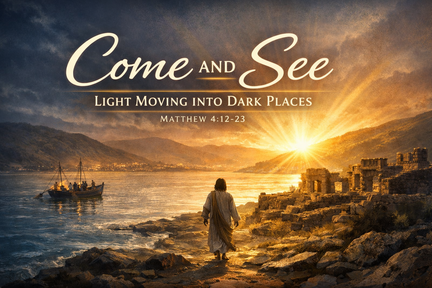

Sermon • Submitted • Presented • 23:28
0 ratings
· 12 viewsFiles
Notes
Transcript
12 Now when Jesus heard that John had been put in prison, He departed to Galilee.
13 And leaving Nazareth, He came and dwelt in Capernaum, which is by the sea, in the regions of Zebulun and Naphtali,
14 that it might be fulfilled which was spoken by Isaiah the prophet, saying:
15 “The land of Zebulun and the land of Naphtali, By the way of the sea, beyond the Jordan, Galilee of the Gentiles:
16 The people who sat in darkness have seen a great light, And upon those who sat in the region and shadow of death Light has dawned.”
17 From that time Jesus began to preach and to say, “Repent, for the kingdom of heaven is at hand.”
18 And Jesus, walking by the Sea of Galilee, saw two brothers, Simon called Peter, and Andrew his brother, casting a net into the sea; for they were fishermen.
19 Then He said to them, “Follow Me, and I will make you fishers of men.”
20 They immediately left their nets and followed Him.
21 Going on from there, He saw two other brothers, James the son of Zebedee, and John his brother, in the boat with Zebedee their father, mending their nets. He called them,
22 and immediately they left the boat and their father, and followed Him.
23 And Jesus went about all Galilee, teaching in their synagogues, preaching the gospel of the kingdom, and healing all kinds of sickness and all kinds of disease among the people.
Come and See: Light Moving into Dark Places
Come and See: Light Moving into Dark Places
We expect that when something important is about to happen—it’s going to happen in the right place.
Earth-shattering announcements are made in auditoriums.
Life-changing moments happen when everything else has finally died down.
If God is about to do something new—it won’t happen today.
The lights won’t come on until the crowds clear out and the coast is FINALLY quiet.
That’s what we expect light to do.
Light will come when the conditions are right for it.
But Jesus does not begin His ministry in any place we’d easily recognize as ideal.
There is no fanfare.
No palpable momentum.
No sense that the corner has finally been turned.
Quite the opposite.
Matthew tells us that Jesus launches His public life immediately after some really bad news hits the scene.
“When Jesus heard that John the Baptist had been arrested…”
John—the loud voice calling in the wilderness.
John—the one who had come to prepare the way of the Lord.
John—the one who we thought heralded God finally getting going.
Silenced.
And if YOU were the author—if this were your story—
THIS is where you’d put the pin in the map.
THIS is where you’d pause and go into hiding.
You’d wait for a CLEARer moment.
Jesus waits for no one.
But into what does Jesus go?
Not toward Jerusalem.
Not toward the Temple.
Not toward power or religious prestige—
…but toward Galilee.
Galilee!
The place that had a mixed reputation even among Jesus’ religious peers.
The place that some didn’t quite trust.
“The decadent northwest.” The land of political and spiritual compromise.
Matthew says something astonishing—not as commentary…but as fulfillment:
“The people who sat in darkness HAVE SEEN A GREAT LIGHT.”
Not the people who had it together.
Not the ready ones.
Not those who were watching and waiting for God to show up.
“The people who SAT IN DARKNESS…”
If that doesn’t pry open the question of what Epiphany is about—I don’t know what will:
What if God’s bright lights don’t wait for better days
But invade the places where hope is weakest?
Jesus does NOT launch His public career where you’d expect.
He comes into view—not at the center of Jewish life,
but on the outskirts…
not when the timing is right,
but when the timing is precarious.
And before He says a word…
before He recruits any followers…
before there is ANY SIGN of success—
MATTHEW tells us that “light” came to the people who were NOT looking.
Light Appears Where No One Is Looking
Light Appears Where No One Is Looking
12 Now when Jesus heard that John had been put in prison, He departed to Galilee.
13 And leaving Nazareth, He came and dwelt in Capernaum, which is by the sea, in the regions of Zebulun and Naphtali,
14 that it might be fulfilled which was spoken by Isaiah the prophet, saying:
15 “The land of Zebulun and the land of Naphtali, By the way of the sea, beyond the Jordan, Galilee of the Gentiles:
16 The people who sat in darkness have seen a great light, And upon those who sat in the region and shadow of death Light has dawned.”
Matthew is very deliberate in how he tells this story.
He doesn’t say, “Jesus began His ministry.”
He says, “When Jesus heard that John had been arrested…”
That detail matters.
Jesus steps into public ministry at a moment that feels like setback, not success.
The forerunner is silenced.
The momentum stalls.
The future looks uncertain.
And it’s right there—in the aftermath of disappointment—that Jesus moves.
Not backward.
Not into hiding.
Not into a holding pattern.
He moves into Galilee.
Matthew expects us to feel the tension of that choice.
Galilee wasn’t the obvious place for God to act decisively.
It wasn’t the center of worship.
It wasn’t the seat of authority.
It wasn’t even considered spiritually reliable.
Galilee was where boundaries blurred.
Where cultures mixed.
Where faith was practiced imperfectly and often under pressure.
In short, Galilee was not where anyone was watching for the light to appear.
And yet Matthew reaches back to Isaiah and says—this is exactly what God promised:
“The people who sat in darkness have seen a great light,
and for those who sat in the region and shadow of death,
light has dawned.”
Notice the language.
These are not people searching for the light.
They are not people preparing for it.
They are people sitting—stuck, weary, resigned.
Darkness here isn’t dramatic evil.
It’s long-term discouragement.
Political uncertainty.
Spiritual fatigue.
The kind of darkness that settles in when hope has been deferred long enough that you stop expecting change.
And Matthew dares to say: that is where the light dawns.
Not because the people are ready—
but because God is faithful.
This is an Epiphany truth we often miss:
God’s light does not wait for darkness to clear;
it shines precisely where darkness has lingered the longest.
Jesus does not begin by fixing systems or reclaiming institutions.
He begins by showing up—by relocating Himself into a place others had quietly written off.
Which means this point isn’t just about geography.
Galilee isn’t only a place on a map—it’s a pattern.
Galilee is wherever people assume God has stopped paying attention.
Galilee is where faith feels thin but life keeps going anyway.
Galilee is where expectations have quietly been lowered to avoid disappointment.
And Matthew is telling us: watch closely.
Because when God decides to reveal Himself,
He often chooses the places no one thinks to look.
And once the light has appeared—
once Jesus has stepped into the darkness rather than waiting for it to lift—
He opens His mouth and speaks.
Not with judgment.
Not with condemnation.
But with an invitation that reframes everything:
“Repent, for the kingdom of heaven has come near.”
That’s where the light begins to move.
Repentance Is an Invitation, Not a Threat
Repentance Is an Invitation, Not a Threat
Matthew 4:17 “17 From that time Jesus began to preach and to say, “Repent, for the kingdom of heaven is at hand.””
After the light appears—after Jesus deliberately places Himself in Galilee—Matthew tells us that Jesus finally speaks.
And His first public words matter.
“From that time Jesus began to proclaim,
‘Repent, for the kingdom of heaven has come near.’”
For many people, that word repent lands heavy.
It sounds like warning.
Like failure.
Like God pointing a finger and listing everything that’s gone wrong.
But Matthew will not let us hear repentance that way.
Because repentance comes after the light has already dawned.
It comes after Jesus has already moved toward the darkness.
It comes after God has drawn near.
In other words, repentance is not the condition for the kingdom—
it is the response to realizing the kingdom is closer than you thought.
The word Jesus uses means to change your mind—to reorient your life, to turn and see differently.
Repentance isn’t about groveling your way back to God.
It’s about realizing God is already standing closer than expected.
That’s why Jesus doesn’t say,
“Repent so that the kingdom might come.”
He says,
“Repent, because the kingdom has come near.”
This is crucial.
Jesus is not announcing a distant hope.
He is declaring a present reality.
God is not waiting on the other side of improvement.
God is not holding back until people get it right.
God has stepped into the neighborhood.
Repentance, then, is not a threat—it’s an invitation.
It’s the moment when someone realizes,
“If God is really this close, I may need to rethink the direction I’ve been heading.”
Or to put it simply:
Repentance is what happens when light reveals that there is another way to live.
That’s why repentance belongs so naturally in Epiphany.
Light doesn’t just illuminate what’s wrong—
it reveals what’s possible.
And when the light of the kingdom breaks into ordinary life, it asks a gentle but unsettling question:
If God is already near, what needs to turn in me?
Not out of fear.
Not out of shame.
But out of hope.
And then Jesus does something even more surprising.
He doesn’t stop with proclamation.
He doesn’t wait for people to come forward, sign on, or prove they’re ready.
He walks along the shore, looks at ordinary people in the middle of ordinary work, and says two simple words:
“Follow me.”
That’s where the light begins to move—
through everyday lives willing to step into its path.
Light Moves Through Ordinary Lives
Light Moves Through Ordinary Lives
Matthew 4:18–23 “18 And Jesus, walking by the Sea of Galilee, saw two brothers, Simon called Peter, and Andrew his brother, casting a net into the sea; for they were fishermen. 19 Then He said to them, “Follow Me, and I will make you fishers of men.” 20 They immediately left their nets and followed Him. 21 Going on from there, He saw two other brothers, James the son of Zebedee, and John his brother, in the boat with Zebedee their father, mending their nets. He called them, 22 and immediately they left the boat and their father, and followed Him. 23 And Jesus went about all Galilee, teaching in their synagogues, preaching the gospel of the kingdom, and healing all kinds of sickness and all kinds of disease among the people.”
After the light has appeared,
after the invitation to repentance has been spoken,
Jesus does something almost disarmingly simple.
He walks.
Not into a synagogue first.
Not into a palace.
Not into a strategy meeting.
He walks along the sea.
And what He finds there are not people searching for God—but people trying to make a living.
Fishermen mending nets.
Casting lines.
Doing the same work they did yesterday, and the day before that.
And Jesus doesn’t interrupt them with a lecture.
He doesn’t ask for credentials.
He doesn’t demand certainty or understanding.
He says,
“Follow me.”
Two words.
No footnotes.
And Matthew tells us something that should slow us down:
“Immediately they left their nets and followed Him.”
Not because they suddenly understood everything.
Not because life was suddenly clear.
But because the light that had moved into Galilee was now moving through them.
This is how the kingdom spreads in Matthew’s Gospel.
Not through people who have it all figured out—
but through people who are willing to respond before they’re fully ready.
Notice what Jesus does not say.
He does not say,
“Clean up your life first.”
“Resolve your doubts.”
“Finish what you’re doing and then come find me.”
He meets them in the middle of unfinished lives
and invites them to walk with Him anyway.
That’s important—because sometimes we imagine that following Jesus means escaping ordinary life.
But in Matthew’s telling, discipleship begins inside ordinary life.
Nets still wet.
Hands still tired.
Smelling like fish.
The light of the kingdom doesn’t hover above real life—it moves right through it.
And when Jesus says,
“I will make you fish for people,”
He’s not giving them a job description.
He’s giving them a promise.
Stay with me, and your life will become something more than you could have planned on your own.
This is where Epiphany quietly presses on us.
Because the question isn’t whether the light has come near.
Matthew has already answered that.
The question is whether we are willing to let that light move through us—
through our routines, our relationships, our ordinary faithfulness.
The kingdom advances not by dramatic moments alone,
but by everyday people who say yes
and start walking in the same direction as Jesus.
Jesus still walks the shoreline.
He still speaks into ordinary days.
And He still says, “Follow me.”
The light has come.
The kingdom is near.
The only question left is this:
Will we let the light stop with us—
or will we let it move?
Come and See: Light Moving into Dark Places
Come and See: Light Moving into Dark Places
Matthew doesn’t end this passage with applause, resolution, or certainty.
He ends it with movement.
Jesus keeps walking.
Teaching.
Healing.
Calling.
The light that dawned in Galilee doesn’t settle in one place—it keeps moving.
That may be the most Epiphany-shaped truth of all.
God’s light is not a spotlight meant to impress us.
It’s a lamp meant to guide us.
It doesn’t just reveal who Jesus is—it reveals where He is going.
And where does He go?
Into thin places.
Overlooked places.
Ordinary places.
Into lives that don’t yet feel holy enough, ready enough, or resolved enough.
Matthew shows us that Jesus does not wait for the darkness to lift.
He steps into it.
He does not demand perfection before calling people forward.
He invites them to walk with Him anyway.
Which means this story isn’t only about Galilee.
It’s about every place where hope has worn thin.
Every place where faith feels quiet instead of confident.
Every place where life is ordinary, unfinished, and still carrying yesterday’s weight.
The good news of Epiphany is not just that the light has come.
It’s that the light keeps coming.
It comes near.
It speaks gently.
And then it moves—through people willing to follow.
So maybe the invitation today isn’t to feel brighter or braver or more certain.
Maybe it’s simply this:
Come and see.
See where the light has already shown up.
See where God may already be nearer than you thought.
And then—one ordinary step at a time—
follow.
Because when we do,
the light doesn’t stop with us.
It moves.
