Unity at the Table - Feb. 1st, 2026
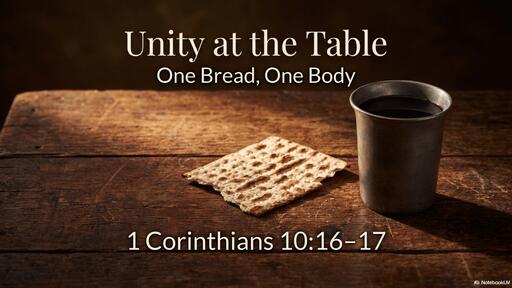

The Lord's Supper • Sermon • Submitted • Presented • 1:08:43
0 ratings
· 41 viewsThe Lord’s Supper calls us to live in unity, reflecting our oneness in Christ through fellowship and mutual love.
Files
Notes
Transcript
2025 Lord's Table Series - Sermon Brief 6
Title: Unity at the Table
Text: 1 Corinthians 10:16-17
Central Idea of the Text (CIT): Paul emphasized that participation in the Lord’s Supper signifies unity among believers as one body in Christ.
Proposition: The Lord’s Supper calls us to live in unity, reflecting our oneness in Christ through fellowship and mutual love.
Statement of Purpose:
Major Objective (MO): Ethical
Specific Objective (SO): I want my hearers to embrace the unity of the body of Christ and to actively cultivate fellowship and love within the church.
Outline
Introduction
Introduction
A. The Lord’s Table is a place where divisions should cease, and unity should prevail.
A. The Lord’s Table is a place where divisions should cease, and unity should prevail.
Divisions run deep in our world. People are split by politics, race, personality, and pride. Tragically, even churches are not immune to strife – longtime friends can stop speaking, families sit on opposite sides of the sanctuary, and petty disagreements fracture the fellowship. But the Lord’s Table is meant to be a place where those divisions cease, and unity prevails. When we gather to partake of the bread and the cup, all the labels and grudges should fade away. The ground is level at the foot of the cross, and around the Table of the Lord, we stand as one family.
B. Paul reminds us that partaking in the bread and cup signifies our shared identity as members of Christ’s body.
B. Paul reminds us that partaking in the bread and cup signifies our shared identity as members of Christ’s body.
The Apostle Paul wrote to a divided Corinthian church to remind them of this very truth. In 1 Corinthians 10:16–17, he emphasized that partaking in the bread and the cup is not an empty ritual – “The cup of blessing which we bless, is it not the communion of the blood of Christ? The bread which we break, is it not the communion of the body of Christ? For we being many are one bread, and one body: for we are all partakers of that one bread.” Here Paul stresses that participating in the Lord’s Supper signifies our common share in Christ’s sacrifice and our unity as members of His body.
16 The cup of blessing which we bless, is it not the communion of the blood of Christ? The bread which we break, is it not the communion of the body of Christ? 17 For we being many are one bread, and one body: for we are all partakers of that one bread.
C. Today, we will examine how the Lord’s Supper unites believers and challenges us to live in harmony.
C. Today, we will examine how the Lord’s Supper unites believers and challenges us to live in harmony.
In other words, what happens at the communion table is a picture of our oneness in Jesus. The message for us today is simple yet profound: The Lord’s Supper calls us to live in unity, reflecting our oneness in Christ through fellowship and mutual love. My prayer and purpose this evening is that each of us would embrace the unity we have in the body of Christ and actively cultivate that fellowship and love within our church. If we truly understand the Table’s meaning, it will change how we treat one another.
So today, let us walk through this passage and examine three facets of the unity symbolized and required by the Lord’s Supper: (1) the fellowship of the Table, (2) the unity of the Body, and (3) the call to live in unity.
I. The Fellowship of the Table (v. 16)
I. The Fellowship of the Table (v. 16)
A. Participation in the bread and cup symbolizes communion with Christ.
A. Participation in the bread and cup symbolizes communion with Christ.
1. The bread represents His body, broken for us (Matthew 26:26).
1. The bread represents His body, broken for us (Matthew 26:26).
Paul begins in verse 16 by highlighting the fellowship we share when we come to the Lord’s Table. He asks rhetorically, “The cup of blessing which we bless, is it not the communion of the blood of Christ? The bread which we break, is it not the communion of the body of Christ?” Here the word “communion” means fellowship, participation, sharing. When we drink from the cup of blessing, we are participating in the benefits of Christ’s blood shed for us. When we eat the broken bread, we are sharing in the sacrifice of Christ’s body given for us.
2. The cup represents His blood, shed for the remission of sins (Matthew 26:28).
2. The cup represents His blood, shed for the remission of sins (Matthew 26:28).
In the Last Supper, Jesus Himself took bread and broke it, telling His disciples, “Take, eat; this is My body” (Matthew 26:26), and of the cup He said, “This is My blood of the new testament, shed for many for the remission of sins” (Matthew 26:28). Thus, each time we bless the cup and break the bread in church, we enter into spiritual fellowship with our crucified and risen Lord. As Baptists, we understand the Lord’s Supper as an ordinance – a symbolic act of obedience and remembrance that Christ commanded. The bread and cup themselves do not confer grace or save us; rather, they represent Christ’s body and blood and point us back to His finished work on the cross. We remember His death and rejoice anew in the grace it signifies, embracing it afresh in our hearts by faith.
B. Our fellowship with Christ extends to our fellowship with one another.
B. Our fellowship with Christ extends to our fellowship with one another.
1. We are part of one body, united in faith and purpose.
1. We are part of one body, united in faith and purpose.
Yet this fellowship is not only vertical – between us and Christ – it is also horizontal among the believers. Paul implies that our communion with Christ extends to communion with each other. If I am in fellowship with Jesus, and you are in fellowship with Jesus, then we are in fellowship with one another by the very nature of being joined to the same Lord. The bread and cup bind us together as one family redeemed by one Savior. We who share in Christ’s body are now “one body” together. We cannot truly commune with our Lord while despising our brother. The Apostle John would later write, “If we love one another, God dwelleth in us, and His love is perfected in us” (1 John 4:12). In Christ we are spiritually interconnected – what blesses one blesses all, and what hurts one hurts all.
2. The Supper calls us to mutual care and support (Galatians 6:2).
2. The Supper calls us to mutual care and support (Galatians 6:2).
Therefore, the Lord’s Supper calls us to mutual care and support within the church. Galatians 6:2 exhorts us, “Bear ye one another’s burdens, and so fulfil the law of Christ.” If we are sitting at the Table together, we should be willing to carry one another’s burdens outside of the church walls too. Is someone in our fellowship hurting? Then we hurt with them and help them. Is someone rejoicing? We rejoice with them. Communion is not a private act of piety—it is a family meal of God’s people. Just as in a loving family no one goes hungry or unnoticed at dinnertime, so in Christ’s church we look out for each other’s needs when we “break bread” together.
Illustration: Picture a circle where all points on the circumference are drawn toward the center. As believers draw closer to Christ, they naturally draw closer to one another.
Picture a circle with a great center point. All around the edge of the circle are people standing far apart from each other. Now imagine each person taking a step toward the center. As they draw nearer to that center point, what happens to the distance between them? It shrinks. They grow closer to one another as they all approach the middle. Christ is the center. When each of us draws nearer to Jesus, we naturally draw nearer to everyone else who is coming to Him as well. The Lord’s Table is a vivid illustration of this truth: we gather around Christ, and in doing so we are drawn together in fellowship.
So, are we living out this fellowship of the Table? When you partake of communion, do you recognize that you are declaring oneness with your brothers and sisters? It ought to humble us and cause us to lay aside grudges or bitterness. If there is someone in the congregation you have been avoiding or refusing to forgive, remember that you both partake of the one bread. How can we hold the cup of forgiveness from Christ while withholding forgiveness from each other? Beloved, let the fellowship we profess at the Lord’s Table be real in our lives. As we come to the Table, let’s determine to be reconciled and in right relationship with one another, so that our worship is genuine. This is the fellowship of the Table.
Transition: Understanding the fellowship at the Table helps us appreciate the deeper unity it represents among believers.
(Transition: Understanding the sacred fellowship we share at the Lord’s Table helps us appreciate the deeper reality behind it – the unity that Christ has formed among all believers. Paul goes on to explain the unity of the body in the very next verse.)
II. The Unity of the Body (v. 17)
II. The Unity of the Body (v. 17)
A. Believers are one body because we share in the one bread.
A. Believers are one body because we share in the one bread.
1. The bread symbolizes our common identity in Christ.
1. The bread symbolizes our common identity in Christ.
In verse 17 Paul writes, “For we being many are one bread, and one body: for we are all partakers of that one bread.” Here the Apostle moves from our fellowship with Christ to the unity we have with each other. Notice the imagery: though we are “many” individuals, together we form “one bread” and thus “one body.” In the act of communion, many separate pieces of bread are often distributed, but they all come from one loaf (in Paul’s day, the church likely shared from one literal loaf as a powerful symbol of oneness).
2. The Supper reminds us of our unity despite diversity (Ephesians 4:4-6).
2. The Supper reminds us of our unity despite diversity (Ephesians 4:4-6).
That single loaf represents Jesus Christ Himself – the “Bread of Life” – of which every believer partakes equally. By sharing the one bread, we show that we, though many, are one body in Christ. There is one Savior, one Gospel, one Spirit who indwells us all. As Ephesians 4:4–6 declares, “There is one body, and one Spirit, … one Lord, one faith, one baptism, one God and Father of all.” All true Christians have this common foundation. Thus, unity is not something we manufacture – it is something given by God through our joint relationship to Christ.
B. Unity at the Table reflects God’s design for His church.
B. Unity at the Table reflects God’s design for His church.
1. Division and discord dishonor the Lord (1 Corinthians 11:18-22).
1. Division and discord dishonor the Lord (1 Corinthians 11:18-22).
This means that any division or strife in the church is a fundamental contradiction of who we are. When believers divide into factions, cherish bitterness, or elevate non-essential differences, we deny the very truth that the Lord’s Supper proclaims. The Corinthian church had fallen into such disunity. In the next chapter, Paul rebukes them because “when ye come together in the church, I hear that there be divisions among you” (1 Corinthians 11:18). Some were selfishly eating their own supper and shaming those who had nothing. Such behavior dishonored the Lord; they were eating the Lord’s Supper in an unworthy manner, not discerning the Lord’s body (1 Corinthians 11:22, 29). The “body” in that context can imply not only Christ’s physical body symbolized by the bread, but also the church as the body of Christ. They failed to recognize the sanctity of their unity. Beloved, division and discord grieve the Holy Spirit and mar the testimony of the church.
2. Harmony and love glorify Christ and testify to the world (John 13:35).
2. Harmony and love glorify Christ and testify to the world (John 13:35).
On the other hand, when we love one another and serve in harmony, Christ is glorified and the world takes notice. Jesus said, “By this shall all men know that ye are My disciples, if ye have love one to another” (John 13:35). Our unity is a powerful witness. It’s like a mosaic: individually, we are broken, different-shaped pieces, but Christ by His grace fits us together into a beautiful image that reflects His love. When the church, with all its diversity, stands together as one, it showcases the power of the Gospel to reconcile and transform lives. The Lord’s Table is meant to be a regular reminder of this truth. We who partake of one Saviour must live as one people.
Illustration: Imagine a symphony orchestra where each musician plays a different part, yet together they create a harmonious masterpiece. The church, united at the Table, displays the beauty of Christ’s body working together in love.
Imagine a grand symphony orchestra. Dozens of musicians come to the stage, each with a different instrument – violins, trumpets, drums, flutes. They begin to play, not as random noise, but under the direction of one conductor and one musical score. Though each instrument has a distinct sound and each musician a unique part to play, together they produce a harmonious masterpiece. If one section decided to play a different tune or tempo out of pride or discord, the music would collapse into chaos. But when all follow the conductor, unity is achieved in diversity. Similarly, in the church we have many members but we form one body (cf. Romans 12:4–5). Each person has different gifts and backgrounds, yet under Christ’s direction we blend into a harmonious whole. Unity is not uniformity – God isn’t making us all identical – but like an orchestra, our differences, submitted to Christ, enhance the symphony of church life.
So let’s ask: Are we in tune with one another? Or are we each trying to play our own song in pride? If there is discord, it’s time to yield to Christ’s baton and get back on the same rhythm of love and mission. Practically, this means we reject gossip, we refuse to form cliques or show favoritism, and we actively seek to include and honor all parts of Christ’s body. We strive to “be of the same mind one toward another” (Romans 12:16) and “endeavouring to keep the unity of the Spirit in the bond of peace” (Ephesians 4:3). Whenever we come to the communion table, it should prompt us to examine our hearts: Am I treating my fellow believers as fellow members of me – of my own body? Or have I allowed a rift to fester? The Lord’s Supper challenges us: if we are one body, then let there be no schism in the body (1 Corinthians 12:25). May we value each other as Christ values us, and work together so that the church, like a well-tuned orchestra, brings glory to God.
Transition: As we celebrate the unity of the body, we are called to live it out in our daily relationships within the church.
(Transition: We’ve seen that the Lord’s Table not only signifies our fellowship with Christ, but also the unity we have as His body. Finally, we must take these truths a step further. It is not enough to affirm unity during a communion service – we are called to live in unity day by day. In our third point, Paul’s teaching urges us toward a lifestyle that reflects the oneness we share.)
III. The Call to Live in Unity
III. The Call to Live in Unity
If the Lord’s Supper is a picture of our unity, then our lives should strive to match that picture. Having celebrated the fellowship of the Table and the unity of the body, we are now called to put unity into practice in our daily walk. This is where the rubber meets the road. What does it look like to “live in unity”? Scripture gives us clear direction:
A. Pursue peace and reconciliation within the church.
A. Pursue peace and reconciliation within the church.
1. Resolve conflicts and seek forgiveness (Matthew 5:23-24).
1. Resolve conflicts and seek forgiveness (Matthew 5:23-24).
First, we must pursue peace and reconciliation within the church. Unity is not maintained by accident; we have to work at it and sometimes fight our own flesh to preserve it. Ephesians 4:2–3 instructs us to act “with all lowliness and meekness, with longsuffering, forbearing one another in love; endeavoring to keep the unity of the Spirit in the bond of peace.” Such unity requires humility – a willingness to admit wrongs – and patience – a readiness to overlook minor offenses. Jesus taught that if you are about to offer your gift at the altar and remember that your brother has something against you, you should leave your gift and first be reconciled to your brother (Matthew 5:23–24).
2. Maintain the bond of peace through humility and patience (Ephesians 4:2-3).
2. Maintain the bond of peace through humility and patience (Ephesians 4:2-3).
In other words, make it right quickly. Don’t let pride or procrastination keep you from mending a broken relationship. Perhaps as you consider your own heart, the Holy Spirit brings to mind someone – even here in our congregation – from whom you are estranged. The call of Christ is to go to that person, seek forgiveness or offer it, and pursue peace. We cannot have genuine unity in the church if we refuse to reconcile with one another. The world is full of people who cut ties and walk away at the slightest offense, but we are called to a higher standard in Christ. “Blessed are the peacemakers,” Jesus said (Matthew 5:9). Unity thrives where peacemakers actively seek out and heal conflicts.
B. Celebrate diversity within the body of Christ.
B. Celebrate diversity within the body of Christ.
1. Value the unique gifts and perspectives of others (1 Corinthians 12:4-7).
1. Value the unique gifts and perspectives of others (1 Corinthians 12:4-7).
Second, we are called to celebrate diversity within the body of Christ. Unity does not mean we all think, look, or act exactly the same. It means we are joined in purpose and love even as we acknowledge our God-given differences. The church is enriched by a variety of gifts, personalities, ages, and backgrounds. The Apostle Paul explained that there are many members in one body, and all members do not have the same office or function (Romans 12:4). “So we, being many, are one body in Christ, and every one members one of another” (Romans 12:5). Each believer has a unique contribution to make. One may be a hand, another an eye, another a voice – but all belong to the same body (cf. 1 Corinthians 12:14–20).
2. Work together to fulfill the mission of the church (Romans 12:4-5).
2. Work together to fulfill the mission of the church (Romans 12:4-5).
Rather than allowing differences to divide, we should value each person’s gifts and perspective. “There are diversities of gifts, but the same Spirit … and the manifestation of the Spirit is given to every man to profit withal” (1 Corinthians 12:4, 7). This means God designed our differences for our good – to strengthen the whole church. So if a brother or sister has a different background or a different way of serving, we thank God for that difference. We learn from each other. We carry each other’s weaknesses and bolster each other’s strengths. In a very practical sense, unity means cooperation. We work together, as one, “striving together for the faith of the gospel” (Philippians 1:27), not competing against one another. No member should feel useless or unwanted; no member should act superior to the rest. Every part matters in Christ’s church.
C. Commit to mutual love and fellowship.
C. Commit to mutual love and fellowship.
1. Serve one another selflessly (Philippians 2:3-4).
1. Serve one another selflessly (Philippians 2:3-4).
Third, we must commit to mutual love and ongoing fellowship. Unity is sustained by love in action. It’s not a one-time truce, but a continual effort to care for each other’s souls. The New Testament is full of “one another” commands, teaching us how to live out unity: “Bear one another’s burdens” (Galatians 6:2), “in honour prefer one another” (Romans 12:10), “admonish one another” (Colossians 3:16), “serve one another” (Galatians 5:13), and “forgive one another, even as God for Christ’s sake hath forgiven you” (Ephesians 4:32).
2. Build each other up in faith (1 Thessalonians 5:11).
2. Build each other up in faith (1 Thessalonians 5:11).
One key summary is 1 Thessalonians 5:11: “Wherefore comfort yourselves together, and edify one another, even as also ye do.” That is, encourage each other and build each other up. Do you proactively seek to encourage your fellow church members? When someone is absent or struggling, do you reach out? Living in unity means we do not live in isolation. We show up for each other – in prayer, in practical help, and in shared life. Philippians 2:3–4 urges us, “Let nothing be done through strife or vainglory; but in lowliness of mind let each esteem other better than themselves. Look not every man on his own things, but every man also on the things of others.” This Christ-like humility values others highly and looks out for their interests. If every member of the church adopted that mindset, unity would flourish and conflicts would wither away. Love is the bond of perfectness (Colossians 3:14) that holds the church together.
Illustration: Think of a tapestry made of many different threads. Each thread adds to the beauty and strength of the whole, just as each believer’s contribution strengthens the unity of the church.
Think of a grand tapestry, woven together from many different threads. Some threads are gold, some are blue, some are red, some are humble brown. Each thread on its own may seem insignificant or plain, but when the weaver interlaces them according to his design, the end result is a magnificent work of art. The variety of colors and textures is precisely what makes the tapestry beautiful and strong. If one thread were missing or cut, the picture would be marred. In the same way, God is weaving His church together from all of us – different as we are – into a beautiful image of Christ. Each person’s presence and contribution strengthens the whole. “God hath set the members every one of them in the body, as it hath pleased Him” (1 Corinthians 12:18). We dare not despise or neglect one another, for we need each other. Unity is a gift to cherish and a duty to cultivate. Let us commit ourselves to that kind of love – a love that goes beyond Sunday morning, that reaches into each other’s lives with grace and truth. When we do, the church becomes like that tapestry: strong, radiant, and glorifying to the Maker.
Transition: As we partake in the Lord’s Supper, let us commit to living in unity, reflecting the oneness we share in Christ.
(Transition: As we prepare to conclude, let’s remember that the Lord’s Supper is not just a ritual but a responsibility. It calls us to respond by living out what it portrays. We have reflected on the fellowship of the Table, the unity of the body, and the call to live in unity. Now the question remains: How will we respond as we approach the Lord’s Table today?)
Conclusion
Conclusion
In light of God’s Word, each of us should take time to respond in three ways:
A. Reflect: Consider how your life reflects the unity of the body of Christ.
A. Reflect: Consider how your life reflects the unity of the body of Christ.
Reflect: Examine your heart and life in view of the unity of Christ’s body. “Let a man examine himself, and so let him eat of that bread, and drink of that cup” (1 Corinthians 11:28). Ask yourself, do I contribute to the unity of my church or hinder it? Is there prejudice, pride, or unforgiveness lurking in me? Reflect on how your attitudes and actions line up with the truth that we are one body. The Lord’s Table is a mirror—holding it up, we see whether we are truly loving our brothers and sisters as Christ has loved us. Take a moment to let the Holy Spirit search you.
B. Reconcile: Address any divisions or conflicts, seeking peace and forgiveness.
B. Reconcile: Address any divisions or conflicts, seeking peace and forgiveness.
Reconcile: If the Lord reveals any broken relationship or ill will toward a fellow believer, resolve to make it right immediately. “If thy brother hath ought against thee… first be reconciled to thy brother” (Matthew 5:23–24). Unity is preserved through peacemaking. It may mean offering a long overdue apology, or extending forgiveness even if it wasn’t asked for. It may mean bridging a gap with someone you’ve avoided. Don’t delay—go to your brother or sister even today. The beauty of the communion table is that it brings us together; we dare not come to the Table while willfully separated in heart. As much as lieth in you, live peaceably with all men (Romans 12:18). Let no personal quarrel or grudge remain unaddressed. Christ died to reconcile us to God and to one another—so seek out that reconciliation.
C. Rejoice: Celebrate the oneness we have in Christ as we partake in the Supper.
C. Rejoice: Celebrate the oneness we have in Christ as we partake in the Supper.
Rejoice: Finally, rejoice in the oneness we have in Christ. Communion is a celebration. We do it “in remembrance” of Jesus (1 Corinthians 11:24–25) – remembering not only His sacrifice, but also the glorious new community His sacrifice created. Give thanks that you belong – you are a member of the family of God, united with believers across the world and across the ages. There is a sweet joy knowing that no matter our differences, “we being many are one body in Christ.” Rejoice that the same grace that saved you has knit you together in love with all the saints. When you hold the cup of blessing, be grateful for the precious blood that bought people “out of every kindred, and tongue, and people, and nation” (Revelation 5:9) and made us one. When you break the bread, celebrate that we are members one of another, destined to share eternity together in perfect unity. Let a spirit of gratitude and joy fill your heart as we approach the Table, for God has made us one in His Son.
Beloved, “Behold, how good and how pleasant it is for brethren to dwell together in unity!” (Psalm 133:1). The Lord’s Supper beckons us to that good and pleasant place. It is a holy invitation to reflect on our hearts, to reconcile with one another, and to rejoice in the fellowship we share. As we come to the Table today, let’s not come out of habit or as isolated individuals, but as a loving, unified body of believers. Let’s remember Christ who made us one, and let’s commit ourselves to walk in unity and love beyond this Table – in our homes, in our friendships, in our ministries – every day. May the Lord Jesus, who prayed “that they all may be one” (John 17:21), grant us the grace to answer that prayer in our life together. And may the Holy Spirit bind us in peace and deep affection for one another.
Church, this is our calling. We are one loaf and one body. Let us guard that unity with all diligence. Let us show the world the love of Christ by the love we have for each other. And let us always find our common identity and strength at the foot of the cross and at the Table of our Lord.
Amen.
