Jonah 2.3-Jonah Acknowledges That Yahweh Was Responsible For His Being Thrown Into The Sea (Doctrinal Bible Church in Huntsville, Alabama)

Doctrinal Bible Church
Pastor-Teacher Bill Wenstrom
Sunday February 1, 2026
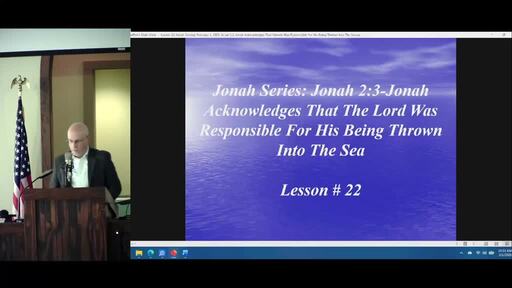
Jonah Series: Jonah 2:3-Jonah Acknowledges That The Lord Was Responsible For His Being Thrown Into The Sea
Lesson # 22
In Jonah 2:3, Jonah acknowledges in his prayer of thanksgiving that the Lord was responsible for his being thrown into the sea.
Then, he follows this up by beginning to recount his drowning experience.
Jonah 2:1 From inside the fish Jonah prayed to the Lord his God. 2 He said: “In my distress I called to the Lord, and he answered me. From the depths of the grave I called for help, and you listened to my cry. 3 You hurled me into the deep, into the very heart of the seas, and the currents swirled about me; all your waves and breakers swept over me. 4 I said, ‘I have been banished from your sight; yet I will look again toward your holy temple.’ 5 The engulfing waters threatened me, the deep surrounded me; seaweed was wrapped around my head. 6 To the roots of the mountains I sank down; the earth beneath barred me in forever. But you brought my life up from the pit, O Lord my God. 7 “When my life was ebbing away, I remembered you, Lord, and my prayer rose to you, to your holy temple. 8 “Those who cling to worthless idols forfeit the grace that could be theirs. 9 But I, with a song of thanksgiving, will sacrifice to you. What I have vowed I will make good. Salvation comes from the Lord.” 10 And the Lord commanded the fish, and it vomited Jonah onto dry land. (NIV84)
“You hurled me into the deep, into the very heart of the seas” emphasizes and affirms the events and circumstances that led to Jonah crying out to the Lord in prayer to deliver him from death.
“You hurled me” is the verb šā∙lǎḵ (שָׁלַךְ), which should be translated “to cast” since it is being used here in poetry.
Though it is used of the crew casting Jonah into the sea, the implied subject is Yahweh since Jonah is addressing Him in this prayer of thanksgiving.
The hiphil stem of the verb signifies causation, i.e. the causing of an event indicating that Yahweh “caused” Jonah to be cast into the Mediterranean Sea by the crew.
This does not contradict the statement in Jonah 1:15 where the crew in response to the command of Jonah (1:12), lifted up the prophet and threw him into the sea.
The storm was caused by Yahweh (1:4) and the only action that could bring the storm to an end was to throw Jonah overboard.
The prayer offered up by the crew to Yahweh recognizes that doing so was according to His will as recorded in Jonah 1:14.
The fact that the storm immediately came to a halt also indicates this was the Lord’s will.
Also, indicating that throwing Jonah overboard was the Lord’s will is that the crew does not perish and neither are they punished by the Lord for throwing Jonah overboard.
Therefore, Jonah 2:3 views the crew as the Lord’s instrument in carrying out this action against Jonah.
“Into the deep” speaks of “the ocean depths” or “the depths” of the sea, i.e., the very deep area of the Mediterranean Sea.
“Into the very heart of the seas” refers to the middle or midst of a thing, which in our context would be the Mediterranean.
This prepositional phrase indicates that Jonah is in a predicament from which he cannot possibly escape, apart from Yahweh’s aid.
“And the currents swirled about me” presents the result of the previous clause and thus indicates that “as a result of” the Lord causing the crew to cast Jonah into the ocean depths, into the midst of the seas, the ocean current engulfed him.
This result clause is Jonah’s first description of drowning in this song of thanksgiving.
We have the figure of asyndeton where there is no connective word between the previous result clause and the statement to follow.
This is done so that the reader will appreciate the gravity of the dire situation of drowning that Jonah experienced.
“All your waves and breakers” refers to the surging waves or turbulent waves from a stormy ocean with strong currents, white water and loud sounds associated with them (Dictionary of Biblical Languages with Semantic Domains: Hebrew (Old Testament).
This clause is Jonah’s second description of drowning in verse 3 and is taken verbatim from Psalm 42:7.
Not only is Jonah acknowledging God’s sovereignty over him and His providence but also that he is being disciplined by God, which expressed God’s love for Jonah.
Revelation 3:19, “Those whom I love, I reprove and discipline; therefore be zealous and repent.”
Proverbs 3:11-12, “My son, do not reject the discipline of the LORD or loathe His reproof, for whom the LORD loves He reproves, even as a father corrects the son in whom he delights.”
There are other Old Testament psalms that use the imagery of drowning to express experiencing great adversity (cf. Ps. 18:1-6; 88:7).
