The Rest We Refuse
Notes
Transcript
Happy Super Bowl Sunday to those of you who celebrate. Is anyone excited about the match up for tonight? Anyone hoping the Seahawks signed Marshawn Lynch for one day so he can run on the one yard line and finally score? All I know is that my the pitchers and catchers report for my Cubs in only 10 days. That is all that matters. Anyways, I am excited to be with you all continuing us on this journey that Dan started back in January. In case you do not know who I am, my name is Ryan Reed and I am the student pastor here at Fannin.
I once heard a story about a priest who was fond of riding his horse—too fond, it turned out, because he was always out riding when he should have been working in his parish. So, according to the story, he called his horse ‘Sabbatical’, so that when people asked where he was his wife could say, perfectly truthfully, that he was ‘on Sabbatical’.
If you have your Bibles I would like for you to turn to, or click on, Hebrews chapter 4. And before we get there, let’s have a little chat. We live in a culture that is tired…and proud of it. We admire people who are busy. We trust people who are productive. We celebrate people who are building something, growing something, accumulating something. And we rarely ask what it’s costing them, because exhaustion has become respectable. We say things like, “I’m just grinding.” “I’m in a busy season.” “I’ll slow down eventually.” And what we often mean is: My life only feels meaningful when I’m striving.
Over the last several weeks in this series, we’ve exposed false sources of meaning: ways people try to make their lives matter apart from God. Control. Success. Wealth. Legacy. A name. And intentionally, there’s been very little resolution. We’ve been left exposed. And that’s not accidental. Exposure is often the grace that comes before healing. This morning, Hebrews 4 confronts us with a sobering truth: You can be deeply religious, morally serious, biblically informed and still miss the rest that God offers. And the reason is not rebellion. It’s unbelief disguised as striving.
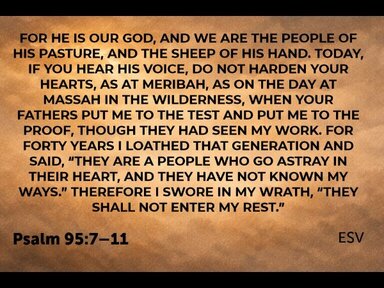
Before we get there, let me give you some context: Synagogues recite Psalm 95 every Friday night as part of the Kabbalat Shabbat service to welcome the Sabbath. The Sabbath liturgy selects this Psalm because it refers to God’s “rest,” which be understood as the Sabbath day, the day that God rested form creating the heavens and the earth. The Psalm concludes with a warning not to be hard-hearted like the generation of Moses that tested God in the wilderness and refused to enter the Promised Land. Psalm 95:7-11 reads like this
For he is our God, and we are the people of his pasture, and the sheep of his hand. Today, if you hear his voice, do not harden your hearts, as at Meribah, as on the day at Massah in the wilderness, when your fathers put me to the test and put me to the proof, though they had seen my work. For forty years I loathed that generation and said, “They are a people who go astray in their heart, and they have not known my ways.” Therefore I swore in my wrath, “They shall not enter my rest.”
I wanted to share this text with you because it is vital to understanding chapters 3 and 4 of Hebrews as it is quoted from several times. So now that we have read it, let’s dig in to our main text. Let’s read Hebrews 4:1–11
Therefore, while the promise of entering his rest still stands, let us fear lest any of you should seem to have failed to reach it. For good news came to us just as to them, but the message they heard did not benefit them, because they were not united by faith with those who listened. For we who have believed enter that rest, as he has said,
“As I swore in my wrath, ‘They shall not enter my rest,’ ” although his works were finished from the foundation of the world. For he has somewhere spoken of the seventh day in this way: “And God rested on the seventh day from all his works.” And again in this passage he said, “They shall not enter my rest.”
Since therefore it remains for some to enter it, and those who formerly received the good news failed to enter because of disobedience, again he appoints a certain day, “Today,” saying through David so long afterward, in the words already quoted, “Today, if you hear his voice, do not harden your hearts.”
For if Joshua had given them rest, God would not have spoken of another day later on. So then, there remains a Sabbath rest for the people of God, for whoever has entered God’s rest has also rested from his works as God did from his. Let us therefore strive to enter that rest, so that no one may fall by the same sort of disobedience.
I. A PROMISE STILL STANDS AND CAN STILL BE MISSED (v. 1)
I. A PROMISE STILL STANDS AND CAN STILL BE MISSED (v. 1)
“Therefore, while the promise of entering his rest still stands, let us fear lest any of you should seem to have failed to reach it.”
That word “therefore” matters. Chapter 4 is not starting a new thought. It’s continuing one. We just talked about the background of chapter 3 and how it reminded us of Israel in the wilderness. They were rescued from slavery. They saw miracles. They heard God’s voice. And yet, an entire generation died without entering the promised rest. And now Hebrews turns to us. That word “us” is important as well. It takes us out of the past from the word “therefore” and pulls us back into the present. But that phrase, “Therefore… let us fear.” is some pretty uncomfortable language, isn’t it? Not “let us celebrate.” Not “let us assume.” But “let us fear” or let us examine ourselves carefully. Because for these recipients of the book of Hebrews there is a real danger. They may fall short of entering into a rest that God is offering. It is possible that the faith of these Jewish believers will be tried because of the persecution they are experiencing at the time this epistle is written to them. Because of their present situation, they, too, might fall short of attaining all God wants them to attain in this life. The promise of rest is still available because it was never totally fulfilled. The promise of rest in the Old Testament was unfulfilled, but it was not withdrawn; it is available to those who want it now. The entire purpose of this letter to the Hebrews is to get the Jewish believers to enter the fullness of rest.
God has not withdrawn the offer. Rest is still available. But it is possible to come right up to the edge of it… and never enter. This warning here in Hebrews is not aimed at pagans. It’s aimed at church people. People who sing the songs… People who know the stories…People who assume that proximity equals possession. The danger is not that we openly reject God. The danger is that we quietly assume we’re fine. Simply hearing the message of the Gospel is insufficient for salvation. Even intellectually apprehending the Gospel message is not enough. The Israelites surely understood the promises and warnings God gave them, yet they did not rest on those promises. They disregarded the word of God and acted disobediently because they did not believe the word of God.
II. HEARING GOD WITHOUT TRUSTING GOD PROFITS NOTHING (v. 2)
II. HEARING GOD WITHOUT TRUSTING GOD PROFITS NOTHING (v. 2)
“For good news came to us just as to them, but the message they heard did not benefit them, because they were not united by faith with those who listened.”
Israel heard the good news. God promised them deliverance. God promised them a land. God promised His presence. But the Word they heard “did not benefit them.” Why? Because hearing is not the same as trusting. Faith is not merely agreeing with facts. Faith is resting the weight of your life on what God has said. Simply hearing the message of the Gospel is insufficient for salvation. Even intellectually apprehending the Gospel message is not enough. The Israelites surely understood the promises and warnings God gave them, yet they did not rest on those promises. They disregarded the word of God and acted disobediently because they did not believe the word of God. The only appropriate response to the Gospel is faith, and so because the generation in the wilderness did not have faith, they perished. Declared many times in Scripture, this fact invalidates completely the teaching of universalism that everyone is already saved by virtue of Christ’s death and that God will reveal that to them at the end, no matter how they lived.
Think about this: Israel heard God’s promises…but they lived as if the outcome still depended on them. They worried. They grumbled. They tried to control. They demanded signs. They feared scarcity. Twelve men came back from the Promised Land and gave a report. The Exodus Generation received a report from the twelve spies. The children of Israel made a wrong decision as a result of that report. The writer of Hebrews is addressing people in a similar situation. These Jewish believers have received a message from the Twelve Apostles. What will they do with this report? The emphasis is on the necessity of faith to attain spiritual blessings that come with salvation.
And the writer of Hebrews is holding up a mirror and asking us a dangerous question: Are we hearing God’s Word without ever letting it quiet our souls?
We listen to sermons. We read Scripture. We pray prayers. But then we go right back to living like everything depends on us. We believe God is sovereign—but act like we are. We believe God provides—but live like scarcity is king. We believe God is good—but never slow down long enough to trust Him. And the fruit of that kind of faithless hearing is exhaustion. So the implication for us is clear. Hearing must be accompanied by believing. The writer of Hebrews will get to that in Hebrews 11:6
And without faith it is impossible to please him, for whoever would draw near to God must believe that he exists and that he rewards those who seek him.
Without a personal response to the promise of salvation, no one may be saved.
But here’s the question we have to ask next: If faith is required… what exactly is faith doing? Is faith just agreeing with theology? Is faith just believing God exists? Is faith just trying harder to obey? Hebrews is about to show us something deeper.
Faith is not just believing God is real. Faith is believing God has already done what needed to be done. Because the opposite of faith is not always rebellion. Sometimes the opposite of faith is relentless striving.
And that’s where Hebrews takes us next. To the shocking idea that God’s rest is not just a gift He gives…It is the rest He Himself entered when His work was finished. So continue to follow along with me in verse 3 as we see that…
III. GOD’S REST IS GOD’S OWN REST (vv. 3–5)
III. GOD’S REST IS GOD’S OWN REST (vv. 3–5)
“For we who have believed enter that rest… as God said, ‘As I swore in my wrath, they shall not enter my rest,’ although his works were finished from the foundation of the world.”
Notice this: God’s rest is not something He created because He was tired. God rested because His work was finished. Genesis 2 tells us that God ceased working. Not because He lacked strength, but because nothing remained to be done. It was complete. Finished. His rest remains.
And Hebrews is telling us something profound: To enter God’s rest is to live as though the decisive work has already been accomplished. Israel couldn’t do that. They were always acting like God’s promises were fragile. Like the future depended on their effort. Like control was safer than trust. And we do the same thing.
We say we believe in grace, but live like our worth must be earned. We say we believe God is enough, but panic when productivity slows. We say we believe Christ has finished the work, but keep trying to finish ourselves. Rest is not primarily about stopping activity. Rest is about stopping self-reliance.
This a rest which believers of the first century (and today) can actually experience (v. 3). The statement, we who have believed, uses the past tense and it refers to the writer and the readers. Then the author switches to the present tense we … do [now] enter into that rest; we are presently entering into the spiritual rest.
Jesus had declared in Matthew 11:28 “Come to me, all who labor and are heavy laden, and I will give you rest.” That is the same promise of rest which the writer, in verse 1, has declared still stands. If believed, it requires a response, for though the promise is still valid, so is the threat that follows: Just as God has said, “As I swore in my wrath, they shall not enter my rest.” In Hebrews 4:11, he will point out that the final facet of the rest is still future. The point is that they have believed, and because they have believed, they have begun to enter this Creation Rest though the final facet of it is still future. These Jewish believers must continue to exercise faith to enjoy what this rest has to offer. The writer again quotes Psalm 95:11. He points out that the Wilderness Generation did not enter that rest even though God has possessed it since Creation. In Psalm 95, God, through the psalmist, announced the existence of a future rest: salvation rest. And the fact that the writer keeps quoting Psalm 95 shows us the urgency of entering God’s rest. When a biblical author repeatedly returns to the same issue, it is most likely because the hard-heartedness of sin-prone people requires the repetition. Only one thing can satisfy the restlessness of the human soul—the “rest” of God. And the only way we can access God’s rest is by faith in Jesus Christ, the One who secures God’s rest for believers through his death and resurrection. If we reject the promises of the gospel, then we will die in the wilderness. But if we trust in its promises and in the God who makes them, we will enter God’s rest. This is a message stubborn sinners need to hear over and over again.
Now here’s the danger for us. We hear about God’s rest and we immediately start attaching it to circumstances. “If I can just get out of this season…” “If I can just get financially secure…” “If I can just reach this goal…” “Then I’ll finally be at peace.”
But Hebrews won’t let us believe that lie. Because Israel reached the land. They crossed the river. They fought the battles. They stood in the promise. And many of them were still restless. Because the rest God offers has never been about where you are standing. It has always been about where you are trusting. And that’s why the writer now takes us to Joshua.
IV. THE REST WAS NEVER ABOUT THE LAND (vv. 6–8)
IV. THE REST WAS NEVER ABOUT THE LAND (vv. 6–8)
“Since therefore it remains for some to enter it… for if Joshua had given them rest, God would not have spoken of another day later on.” The argument is that certain ones were to enter this rest, but they failed. God still desired to fulfill His purpose and, therefore, He appointed another day when another invitation would be given. The hope of a future entrance into this rest was given by David, the author of Psalm 95, but this rest must be entered into by faith. Israel failed to enter this rest because of disobedience and unbelief. Nevertheless, the invitation to enter into God’s rest is now given: “it remains for some to enter into it.” God’s rest does not exist in vain; it was always meant to be shared by his people, and now that intention is fulfilled. For it is in this rest that God’s ultimate purpose for the creation finds its realization
As we have seen, Psalm 95 specifically focuses on Israel’s rebellion against God and against Moses in the wilderness—a rebellion that kept them from entering the promised land. Moses, however, did not lead the people into the promised land. His successor Joshua did that, which is why the author introduces him in verse 8. The author has already demonstrated that Christ is superior to the angels and Moses. Now he must demonstrate that Christ is superior to Joshua.
As the writer notes, even though Joshua led the people of Israel into Canaan, he did not lead them into God’s “rest.” Even in Canaan the people of Israel continued to rebel against God. When the people of Israel journeyed across the Jordan River into the land of Canaan, they did not journey into rest; they simply moved from one place to another. Thus Psalm 95, written by David long after the events of the conquest, still speaks of a Sabbath rest that remains for the people of God.
You can achieve goals and still be anxious. You can arrive and still be empty. The problem wasn’t geography. It was the heart.
And church, hear this gently but clearly: A bigger house will not quiet your soul. A better job will not give you peace. A respected name will not give you rest. If Joshua couldn’t give it, success won’t either. But
V. THERE REMAINS A SABBATH REST (v. 9)
V. THERE REMAINS A SABBATH REST (v. 9)
“So then, there remains a Sabbath rest for the people of God.” This is one of the most hope-filled verses in Hebrews. Here the author turns from creation rest to Sabbath rest. “There remains.” Despite failure. Despite unbelief. Despite generations who missed it. God has not closed the door. Sabbath rest is not merely a day off. It is a declaration of faith.
The term used here for rest is the Greek word sabbatismos. This is the only time it is used in the entire New Testament, found nowhere else in Greek literature and used sporadicly in other early Christian literature. In each case rest does not refer to the Sabbath Day but rather Sabbath observance or sabbath celebration. The emphasis was not on the cessation of daily activities but rather on an unhindered opportunity for the people of Israel to celebrate God’s life-sustaining presence among them. This is the ideal rest. It is provided by God. It is available today and the readers of Hebrews can attain it by faith. It means reaching a definite stage of attainment after satisfactorily fulfilling God’s purpose for their life. God finished His work and He entered into Sabbath Rest. Sabbath Rest is a type of spiritual maturity
Sabbath rest says:
God is God—and I am not.
The world does not depend on my constant motion.
My worth is not measured by output.
When we refuse rest, we are not just being busy—we are making a theological statement. We are saying, “If I stop, things fall apart.” And that is not humility. That is unbelief. So how do we enter this Sabbath rest?
VI. ENTERING REST MEANS CEASING FROM YOUR WORKS (v. 10)
VI. ENTERING REST MEANS CEASING FROM YOUR WORKS (v. 10)
“For whoever has entered God’s rest has also rested from his works as God did from his.” This does not mean laziness. It does not mean disengagement. It does not mean irresponsibility. It means ceasing from the works that try to justify us. Works that try to prove our value. Works that try to secure our identity. Works that try to give our lives meaning apart from God. And this is where the gospel comes into full view. Because the only way to truly rest is to believe Jesus when He says, “It is finished.”
Finished means:
You don’t have to earn God’s love.
You don’t have to prove your worth.
You don’t have to build a name to be secure.
Christ has done what you could never do. It means the believer ceased to rely on his own works and efforts, and by faith he trusted God to get him through the situation. This makes clear that truly keeping the sabbath is not observing a special day (that is but the shadow of the real sabbath), but sabbath keeping is achieved when the heart rests on the great promise of God to be working through a believer in the normal affairs of living. Because learning to function from a position of rest is the way to avoid burnout in ministry or any other labor. So let me encourage you to
VII. STRIVE TO ENTER REST (v. 11)
VII. STRIVE TO ENTER REST (v. 11)
“Let us therefore strive to enter that rest, so that no one may fall by the same sort of disobedience.”
Here is the great paradox of the Christian life. We strive—not by doing more—but by surrendering control. We fight—not against effort—but against unbelief. The real struggle is not slowing your schedule. The real struggle is trusting God enough to stop justifying yourself.
Some of us need to repent—not of scandalous sin—but of relentless striving. Of building meaning apart from God. Of believing rest will come after we’ve proven ourselves. And God’s invitation today is not, “Try harder.” It’s, “Trust Me.” Church, the writer of Hebrews keeps using one word over and over again: Today. Not when life slows down. Not when you finally get everything under control. Not when you feel more spiritual. Today.
Because the danger is not that God removes His offer of rest. The danger is that we keep postponing surrender. And I want to be very clear. This is not just about busyness. This is about where you are looking to prove that your life matters. Some of you are exhausted because you are trying to carry the weight of being your own provider, your own protector, your own savior, your own source of meaning. And Jesus is not standing over you saying, “Try harder.” He is standing with open hands saying, “Come to Me… and I will give you rest.”
Church, if Hebrews is right — and it is — then this isn’t just a theological idea. This changes how we live tomorrow morning. Because the question is not: Do you believe rest exists? The question is: Are you actually living from it? So how do we apply this?
Identify where you are still trying to be your own Savior
Most of us would never say out loud, “I don’t need God.” But we live like we don’t.
So here’s a diagnostic question you can take before the Lord this week: Where do I feel like everything depends on me?
Is it:
Your career?
Your parenting?
Your reputation?
Your finances?
Your ministry?
Your future?
Because wherever you feel like failure is unacceptable…Wherever you feel like slowing down feels dangerous…Wherever you feel like your value rises and falls with performance…That is probably where you are struggling to trust God.
And Hebrews would say: That is exactly where God is inviting you into His rest. The second thing to do is to
Repent. Not just of sinful actions, but of self-reliance
We usually think repentance means: “I did something bad.” But sometimes repentance means: “I’ve been trying to be what only Jesus can be.” Some of us need to repent of:
Needing to be impressive
Needing to be in control
Needing to be indispensable
Needing to prove we matter
Because hear me clearly: Jesus did not die so you could become your own savior with better morals. He died so you could finally stop trying to be one.
A third thing you can do is to
Practice Faith as rest and not just belief
Faith is not just: “I believe God exists.” Faith is: “I am going to live like God is trustworthy.” So what does that look like practically?
It might mean:
You stop tying your identity to productivity.
You actually practice Sabbath — even when it feels uncomfortable.
You stop trying to control outcomes you were never meant to control.
You obey God even when it feels risky.
You let yourself be limited — because you are not God.
Rest is not inactivity. Rest is active trust. And lastly
Remember: Rest is not found when life gets easier. It’s found when you trust Christ more
Some of you are waiting for a future season to finally breathe. “When things calm down…” “When I get through this season…” “When I get more secure…” But Hebrews says: Today. Rest is not waiting for you at the end of your success. Rest is waiting for you at the feet of Jesus. Stop refusing the rest and fully join Him in His rest.
So before we sing…Before we move on… I just want to give you space to respond to the Holy Spirit. Not to perform. Not to impress anyone. Not to manufacture emotion. Just to be honest before God. Because for some of you, the most spiritual thing you could do today… Is finally stop striving. So here’s what I want you to wrestle with this week: Where are you living like everything depends on you? And what would it look like — not emotionally, but practically —To trust Christ there?
Rest is not found in what you accomplish, but in what Christ has already finished. Let me just invite you, right where you are —If you’re comfortable, maybe just open your hands in your lap. Not as a show. Just as a posture of surrender. And maybe in your own heart, you just pray something simple like:
“God, I’m tired of trying to be enough.
I’m tired of trying to carry what only You can carry.
Teach me to trust You.
Teach me to rest in what Jesus has already done.”
And as we sing…
Or as we sit quietly…
Or as we pray…
Don’t rush this moment. Because there remains a rest for the people of God. And it is still offered…Today.
