Giving Up

0 ratings
· 16 viewsFiles
Notes
Transcript
Available
Countdown Video
Countdown Video
Thank you for joining Faith Vision Christian Ministries
Where We Walk by faith! Not by Sight
Faith Vision is a Christian church, based on the Word of God.
We are a training ground for all things Jesus Christ.
loving God, Loving People living by faith
Thank you for joining us today,
Please set everything aside as we come to God in Prayer this morning under the anointing and the Power of the Holy Spirit.
Faith Vision Family Please welcome each other online
Faith Vision Christian Ministries Announcements
Faith Vision Christian Ministries Announcements
Blessings and Thank you to those who are helping us stay current with Faith Vision’s Monthly Financial Obligations
Faith Vision is using donations for St Jude Children’s Hospital
2 Corinthians 9:7–8 (NKJV)
7. So let each one give as he purposes in his heart, not grudgingly or of necessity; for God loves a cheerful giver.
8. And God is able to make all grace abound toward you, that you, always having all sufficiency in all things, may have an abundance for every good work.
If you would like to Make a Tax deductible donation to the ministry: mail it to the Church address. (All donations go to Faith Vision Christian Ministries)
Please mail it to: 10950 Arrow Route, #3662 - Rancho Cucamonga, CA 91729
Faith Vision’s Zelle acount is: Pastordoc@faithvision.org
“A New” Complimentary “Faith Vision Daily Devotional” Printed copy is available
For the Cell-phone app, a link is available on our Faith Vision Facebook Page. This is one of the best ways to read and hear God's word each day.
Please “Follow” & “like” our Church page and leave Questions and comments
Faith Vision Christian Ministries is available on Facebook and YouTube.
Please don’t forget to subscribe to our YouTube Channel @ DocDewberry/streams
If you have a prayer request, or need to talk to someone confidentially, The Pastor is available
You can message the Pastor at PastorDoc@FaithVision.org
At the end of the teaching we will be taking prayer requests be taking prayer requests
Black History month
Black History month
Black history in the U.S. spans from the 16th-century Atlantic slave trade to modern-day contributions, highlighting the struggle for equality, civil rights, and cultural impact.
Key themes include slavery, the Civil War, the Great Migration, and the 1950s-60s Civil Rights Movement.
Civil Rights Movement:
Sportsmen’s ministry to you.This is my wayKey figures included Rosa Parks (bus boycott)
and Martin Luther King Jr., using nonviolent resistance to challenge segregation and secure voting rights.
Pepper and I had the privilege of being in the same elevator with her in downtown Los Angeles.
The Great Migration (1916–1970): Over 6 million Black Americans moved from the rural South to Northern, Midwestern, and Western cities to escape Jim Crow laws.
Next Sunday we will begin to introduce Influential Figures and Milestones as we celebrate Black History Month.
Add to your calendars*
Please join us each Thursday night at 7:00 pm. conference phone number. # (712) 451-0408 access code 8967910
Happy February Birthdays!
Happy February Birthdays!
(pause)
Mama Helen - 11
Kia - 13
Valerie - 17
Jonathan - 19
Angie - 24
pEppER: Let’s sing “Happy Birthday Everyone”
Scripture Reading by Lady Pepper
Scripture Reading by Lady Pepper
Thank you Lady Pepper for the announcements and the reading of God’s Word.
Welcome! to everyone especially those who are joining us for the first time.
My name is Pastor Doc, and I will be sharing the Word of God with you today.
Have your Bibles Ready and take notes
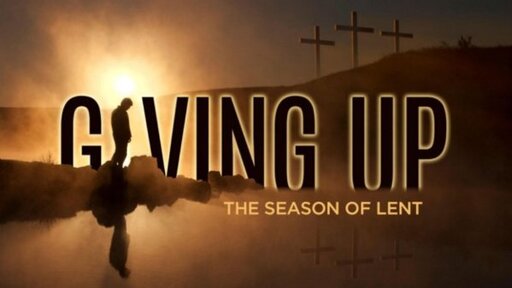
Video: Sermon Bumper -Giving Up
Title of the Message is
Title of the Message is
Giving Up
Giving Up
Big Idea:
Lent is an invitation to intentionally let go of what weighs us down so that we can follow Jesus with greater freedom and focus.
By laying aside both the distractions that slow us and the sin that entangles us, we learn to run the race of faith with perseverance and purpose.
This season is not about punishment or self-denial for its own sake, but about training our hearts to desire what truly gives life.
As we fix our eyes on Jesus, we discover that giving up lesser things makes room for deeper communion with God.
Prayer:
“God, we come to You carrying more than we were meant to carry.
In this season of Lent, give us the courage to lay down what weighs us down and the wisdom to let go of what distracts us from You.
Clear our hearts, fix our eyes on Jesus, and teach us to run the race with freedom and faith.”
Scripture: Hebrews 12:1–2, Matthew 6:21
Hebrews 12:1-2
Hebrews 12:1–2 develops a footrace metaphor, emphasizing perseverance through the fronted phrase “with endurance” before the main verb “let us run.”[1]
The passage calls believers to shed obstacles and pursue their faith journey with sustained effort.
The “cloud of witnesses” refers to the faithful figures from Hebrews 11, whose lives demonstrate faith for current believers to learn from—the focus is on what we observe in them, not on them observing us.
[1] Rather than passive spectators, these exemplars provide active instruction through their perseverance.
The “sin that easily surrounds us” functions as a technical term for apo-sta-sy—specifically, the pressure to abandon the Christian community and ultimately the faith itself, making this meaning particularly fitting within an exhortation to perseverance.
[2] Believers must “fix their gaze” on Jesus by deliberately looking away from distractions—their suffering, humiliation, and reasons to abandon faith—and redirect attention toward him.[2]
Jesus functions as both originator and finisher of faith, having completed the race himself and providing motivation for believers to continue.
[2] His endurance through the cross becomes the template for Christian perseverance.
Matthew 6:21 operates on a different plane but complements this theme. The verse states, “For where your treasure is, there your heart will be also,”
[3] establishing that our priorities reveal our deepest commitments.
Faithful giving demonstrates genuine trust in God; such offerings represent heart preparation for what God desires to accomplish in us.
[3] Both passages ultimately address the alignment of our focus—whether on Jesus and perseverance, or on treasures that compete for our devotion.
Introduction
Introduction
Lent is not a season of spiritual self-improvement or religious guilt.
It is not about proving our devotion by how much we can deny ourselves, nor is it about adding one more obligation to already crowded lives.
Lent is an invitation—a gracious call to slow down, to pay attention, and to ask an honest question: What am I carrying that God never asked me to carry?
Most of us don’t feel spiritually stagnant because we don’t love God.
We feel weary because our lives are full—full of noise, full of obligations, full of distractions, full of good things that quietly become heavy things.
Pastor -
Can you share some personal examples here of things that distract you?
Or things that you’ve had to learn to let go?
We live in a culture that tells us more is better, busier is normal, and full schedules mean full lives.
But Lent interrupts that narrative.
It reminds us that excess, even when it isn’t sinful, can still crowd out what matters most.
Sometimes the greatest threat to our spiritual lives isn’t rebellion—it’s accumulation.
That’s why the language of Hebrews 12 is so fitting for this season.
Scripture doesn’t picture the Christian life as standing still or endlessly managing burdens; it pictures us running.
And the writer assumes something important—if we’re going to run, there are things we must lay aside.
Lent becomes a season of intentional letting go, not as punishment, but as devotion.
We give up what weighs us down so that we can run free, focus fully, and fix our eyes on Jesus—the One who is not only the destination of our faith, but the strength that carries us there.
Main Teaching
Main Teaching
That’s why the writer of Hebrews doesn’t tell us to try harder or run faster.
He begins in chapter 12 by telling us to let go.
Before we are called to run the race set before us, we are invited to throw off everything that hinders—and that’s where Lent begins.
Read Hebrews 12:1-2
I. The Call to Let Go
I. The Call to Let Go
“Let us throw off everything that hinders…”
The writer of Hebrews begins this passage with an assumption that’s easy to miss if we’re not careful.
He doesn’t say, “If you are weighed down.” He says, “Let us throw off everything that hinders.”
In other words, he assumes that we are already carrying things that slow us down.
He assumes excess.
He assumes weight.
He assumes that if we’re going to run the race of faith, something is going to have to be laid aside.
And here’s what’s important for us to hear—especially in this season of Lent: not everything we are called to give up is sinful.
Some things are simply heavy.
Some things are good in themselves but burdensome when they take up too much space in our lives.
Some things start as gifts but slowly become distractions.
And Lent gives us permission to name those distractions., without shame and without defensiveness.
We live in a world that constantly encourages us to accumulate—more commitments, more noise, more possessions, more information, more opinions.
And over time, all of that accumulation begins to shape our hearts.
Jesus names this reality clearly when He says,
“Where your treasure is, there your heart will be also” (Matthew 6:21).
What we give our attention to, what we invest our energy in, what we prioritize—those things quietly form us.
They determine not just what we do, but what we desire.
That’s why Lent is such a necessary season.
It is a season of honest inventory.
It invites us to slow down long enough to ask a difficult but freeing question: What is actually helping me follow Jesus—and what is simply weighing me down?
What has my heart been chasing?
What has been filling my days but emptying my soul?
We see this tension play out in the story of Mary and Martha in Luke 10.
Martha is doing good things—important things—necessary things.
But Jesus lovingly says to her,
“You are worried and distracted by many things, but few things are needed—or indeed only one” (Luke 10:41–42).
Martha’s problem wasn’t sin; it was distraction.
Her heart was pulled in too many directions, and the weight of it robbed her of joy and presence with Jesus.
Lent invites us to hear that same gentle correction—not as condemnation, but as an invitation.
An invitation to stop confusing fullness with faithfulness.
An invitation to remember that more is not always better, and busy is not always holy.
Ecclesiastes captures this wisdom with surprising simplicity:
“Better one handful with rest than two handfuls with toil and chasing after the wind” (Ecclesiastes 4:6).
There is a way to live with less and experience more—more peace, more clarity, more attentiveness to God.
The call to let go is not about deprivation; it’s about freedom.
It’s about making space for what actually sustains us.
Hebrews tells us to throw off what hinders—not because God wants something from us, but because God wants something for us.
The race set before us is not meant to be run burdened, distracted, and exhausted.
Lent reminds us that sometimes the most faithful thing we can do is to lay something down so that we can run lighter, clearer, and closer to Christ.
II. The Weight vs. the Sin
II. The Weight vs. the Sin
“…and the sin that so easily entangles.”
After calling us to throw off everything that hinders, the writer of Hebrews becomes even more specific.
He names a second obstacle:
“the sin that so easily entangles.”
And by doing so, he helps us make an important distinction—there is a difference between weights and sin.
Both are dangerous to our spiritual lives, but they harm us in different ways.
Weights are often neutral things.
They aren’t evil on their own.
They become problematic when they take up too much space, too much attention, too much affection.
Weights slow us down.
They exhaust us.
They make the race harder than it needs to be.
Sin, on the other hand, doesn’t just slow us—it traps us. Sin entangles.
It wraps itself around our hearts and our habits until movement becomes difficult and freedom feels distant.
And Lent gives us the gift of discernment.
It invites us not only to ask, “Is this wrong?” but also, “Is this ruling me?”
The apostle Paul puts it this way in
1 Corinthians: “‘I have the right to do anything,’ you say—but not everything is beneficial… ‘I will not be mastered by anything’” (1 Corinthians 6:12).
That’s the heart of the question.
What has mastery over me?
What do I feel powerless to put down?
What quietly dictates my mood, my schedule, my attention?
Because here’s the truth: even good things become dangerous when they begin to master us.
And sin almost always begins subtly—not with dramatic rebellion, but with small compromises that slowly tighten their grip.
That’s why Hebrews describes sin as something that “so easily entangles.”
We don’t usually notice the cords wrapping around us until we try to move forward and realize how restricted we’ve become.
This is why Scripture repeatedly calls us to guard our hearts.
Proverbs 4:23 says,
“Above all else, guard your heart, for everything you do flows from it.”
New King James version -
Keep your heart with all diligence,
For out of it spring the issues of life.
Our behaviors don’t exist in isolation; they flow from the condition of our hearts.
What we tolerate, what we excuse, what we return to again and again—those things shape us.
Lent invites us to stop pretending we’re unaffected and start paying attention to what’s forming us.
And that kind of clarity requires honesty before God.
The prayer of Psalm 139 becomes especially fitting in this season:
“Search me, God, and know my heart… See if there is any offensive way in me, and lead me in the way everlasting” (Psalm 139:23–24).
This is not a fearful prayer—it’s a freeing one.
It’s an acknowledgment that we cannot always see clearly on our own, and that God’s loving examination leads us toward life, not shame.
Weights slow us.
Sin traps us.
And you cannot run well if you are tangled or overloaded.
Lent calls us to deal with both—not so that we can prove our discipline, but so that we can experience the freedom Christ desires for us.
This is the holy work of repentance and release: laying down what hinders and turning away from what entangles, so that the path ahead becomes clear once again.
III. Running with Intention
III. Running with Intention
“…and let us run with perseverance the race marked out for us.”
Once we’ve named what we need to let go of—and once we’ve begun to distinguish between the weights that slow us and the sin that entangles us—the writer of Hebrews finally tells us what to do next: run.
But not frantically.
Not aimlessly.
Not fueled by guilt or pressure.
We are called to run with perseverance the race that has been set before us.
That language matters, because it reminds us that the Christian life is not a sprint fueled by intensity; it is a long obedience shaped by faithfulness.
There are moments of passion and momentum, yes—but most of the race is run through consistency, endurance, and trust.
Lent teaches us that following Jesus is not about burning brighter for a moment, but about learning how to keep going without burning out.
Endurance requires intention.
It requires focus, rhythm, and restraint.
No runner trains by accident, and no runner improves by simply wanting it badly enough.
The apostle Paul uses this same imagery in 1 Corinthians when he writes,
“Do you not know that in a race all the runners run, but only one gets the prize? Run in such a way as to get the prize… I discipline my body and keep it under control” (1 Corinthians 9:24–27).
Paul isn’t talking about punishment—he’s talking about training.
About aligning his life with his purpose.
And that’s the heart of spiritual discipline.
It’s not about trying harder; it’s about training wisely.
It’s about shaping our lives around what leads us toward Christ rather than assuming we’ll drift there on our own.
What we give up during Lent should serve this purpose.
It should help us run lighter, clearer, freer—not more exhausted or discouraged.
Paul’s words to the Galatians offer both encouragement and warning:
“You were running a good race. Who cut in on you to keep you from obeying the truth?”(Galatians 5:7).
Sometimes we don’t stop running because we lose faith; we stop because we lose focus.
We get crowded out.
We get discouraged.
We get diverted by things that promise life but quietly pull us off course.
Lent is a season of recalibration—a chance to ask whether our daily rhythms are actually helping us move forward in faith.
And when the race feels long—when perseverance feels costly—Scripture reminds us where our strength comes from. *
“Those who hope in the Lord will renew their strength. They will run and not grow weary, they will walk and not be faint”
IV. Fixing Our Eyes on Jesus
IV. Fixing Our Eyes on Jesus
“Fixing our eyes on Jesus, the pioneer and perfecter of faith.”
After all the language about letting go, laying aside, and running with perseverance, the writer of Hebrews brings us to the most important question of all: Where are we looking?
Because giving up is never the goal.
Discipline is never the destination.
Even endurance is not the point.
Jesus is.
Hebrews tells us to fix our eyes on Jesus—not glance at Him occasionally, not look to Him only when we’re tired or overwhelmed, but to intentionally and continually center our attention on Him.
The imagery is one of focus and direction.
In a race, where you look determines where you go.
And in the life of faith, what captures our vision ultimately shapes our lives.
This is why Lent is not simply about removing things from our lives; it’s about reorienting our vision.
We let go of lesser things so that we can hold fast to what matters most.
We loosen our grip on what competes for our attention so that our hearts can more fully cling to Christ.
Lent shifts us from consumption to communion, from distraction to devotion.
The apostle Paul echoes this call in Colossians when he writes,
“Since, then, you have been raised with Christ, set your hearts on things above… Set your minds on things above, not on earthly things” (Colossians 3:1–3).
This isn’t an escape from the world; it’s a re-centering of our lives around the reality of Christ.
When our eyes are fixed on Him, everything else finds its proper place.
Jesus Himself describes this posture as abiding.
In John 15, He says,
“Remain in me, as I also remain in you… apart from me you can do nothing” (John 15:4–5).
Abiding is not frantic effort; it’s sustained attention.
It’s choosing, day after day, to stay connected to the source of life.
Lent gives us space to practice that connection—to slow down enough to notice where we’ve drifted and to return our gaze to the One who sustains us.
And perhaps no verse captures the heart of this longing better than Psalm 27:
“One thing I ask from the Lord, this only do I seek: that I may dwell in the house of the Lord all the days of my life, to gaze on the beauty of the Lord”(Psalm 27:4).
One thing.
Not many.
Not everything.
One focused desire—to be with God, to see Him clearly, to delight in His presence.
What we fix our eyes on determines the direction of our lives.
Lent invites us to choose, again and again, to look to Jesus—the pioneer who went before us, and the perfecter who faithfully carries us to the end.
When our eyes are fixed on Him, the race becomes clearer, the burdens lighter, and the journey filled with purpose.
Conclusion
Conclusion
Lent reminds us that the Christian life is not about carrying more, proving more, or striving harder.
It is about learning how to run well.
Hebrews 12 shows us the shape of that life: we let go of what hinders, we turn away from what entangles, we run with intention, and we fix our eyes on Jesus.
Each movement builds on the next, and all of them lead us toward the same goal—not a more disciplined life, but a more centered one.
We let go because we were never meant to carry everything.
We discern between weights and sin because freedom requires honesty.
We run with intention because faithfulness is formed through rhythm, not impulse.
And we fix our eyes on Jesus because He is both the beginning and the end of our faith—the One who calls us forward and sustains us along the way.
So as we move through this season of Lent, the invitation is not to do more, but to choose wisely.
To live with less noise, less distraction, less clutter—so that there is more space for God to shape us, guide us, and restore us.
Lent is not about what we give up for its own sake; it is about what we make room for.
And when we make room for Christ, we discover that the race before us becomes lighter, clearer, and filled with grace.
Three Practical Invitations for Lent
Three Practical Invitations for Lent
1. Identify one thing to lay down.
Not everything needs to go—but something might.
Ask yourself honestly: What is weighing me down spiritually?
Choose one practice, habit, or distraction to fast from—not to prove discipline, but to create space for God.
2. Replace, don’t just remove.
What you give up should be replaced with something that re-centers your heart.
Let fasting create room for prayer.
Let silence make space for Scripture.
Let less noise open your life to God’s presence.
3. Fix your eyes daily.
Choose one simple, repeatable way to turn your attention to Jesus each day—
morning prayer, a short Scripture reading, a moment of stillness.
The goal is not perfection, but consistency.
Over time, what you look at most will shape who you become.
Let’s pray together.
Let’s pray together.
Salvation:
Salvation:
The Word of God says in: John 3:16
For God so loved the world that He gave His only begotten Son, that whoever believes in Him should not perish but have everlasting life.
For “whoever calls on the name of the Lord shall be saved.”
If you’d would like to receive Jesus today, please pray this prayer with all of us:
Lord I believe that Jesus is the Son of God, and that He died On the cross for my sins and His resurrection from the dead gives me eternal life. I ask forgiveness of my sins, and I accept Jesus as my Lord and Savior. Amen.
Pastor Doc@FaithVision.org
Church Office: 909-922-8090
And I will send you a Bible & a Free Book on how to begin your first 21 steps with Jesus (show the book)
***Leave slide up until Pepper gets in position***
Pepper Praise Reports
Share your Praise Reports!
Prayer Requests
Martha & Family - (James Passing)
Patty and her family
Kenneth Sherman Alzheimer's and colon cancer
Pam’s daughter Ryan -
Let us Pray (P/P)
Praying for the 10-40 Window
Praying for the 10-40 Window
The "10/40 Window" refers to an area stretching from North Africa through the Middle East to East Asia.
!!!!!!!!Relocate Logos to original location for Pepper !!!!!!!!
!!!!!!!!Relocate Logos to original location for Pepper !!!!!!!!
This is Pastor Doc & Lady Pepper with:
Faith Vision Christian Ministries
Pepper Please Continue Reading
See you next Sunday @ 10:55 on Facebook Live!!
See you next Sunday @ 10:55 on Facebook Live!!
Those of you watching on YouTube,
don’t forget to subscribe!
www.youtube.com/@ DocDewberry/streams
www.youtube.com/@ DocDewberry/streams
Prayer Line - Thursday night at 7:00 pm. conference phone number. # (712) 451-0408 access code 896791
Pastor, please continue reading
Benediction Scripture
“Throw off everything that hinders and the sin that so easily entangles”
— Hebrews 12:1 —
Have a Great Week! Goodbye!
This is Pastor Doc and Lady Pepper signing off until next time we meet. Blessings to you all!
