Instruction for Gospel Workers

Notes
Transcript
Intro
Intro
We’ve been talking a lot in Matthew about Kingdom living. What does it look like be faithful to Jesus. We have spent a lot of time focused on inward heart decisions that affect who we are as people. But remember a long time ago, many sermons ago, about the idea of us being salt and light?
Matthew 5:14 “14 You are the light of the world. A city located on a hill cannot be hidden.”
We are going to et back to that idea today. We understand how we are to live, but what is our goal? What is our mission?
You may be asking yourself, what am i supposed to be doing? Is Christianity more than just reading the bible, praying, and coming to church? What else are we supposed to be doing?
Today, we see Jesus show us the need for Gospel work, he defines it, and tells us how to do it.
MAIN POINT: Because people need Jesus, faithful followers take on Gospel work.
And you may be asking, what is gospel work? Well, that is what we will be looking at this morning!
We want to understand hermeneutics here. We remember that all of the Bible is written for us, but not to us. What do i mean by this? When Judas is about to betray Jesus, and Jesus tells him “What you are about to do, do quickly.” Jesus isn’t telling us all to go and betray him quickly. We understand biblical literature in the context that it is written. And we certainly don’t want to miss that here in our story today.
We want to remember that Jesus is speaking to his twelve disciples here. But we also believe that all of scripture is profitable for our benefit and growth in righteousness. So this text, and Jesus’s words to these twelve people help us understand what our mission is today as followers of Jesus.
We also want to remember that Matthew is inspired by the Spirit of God to give us this section for our benifit. He is not randomly writing down historical data. God is having Matthew pen this section, so that we will live as faithful disciples.
I. The Necessity for Gospel Work v35-38
I. The Necessity for Gospel Work v35-38
First today, we want to understand the necessity for Gospel work. We see this in verses 35-38.
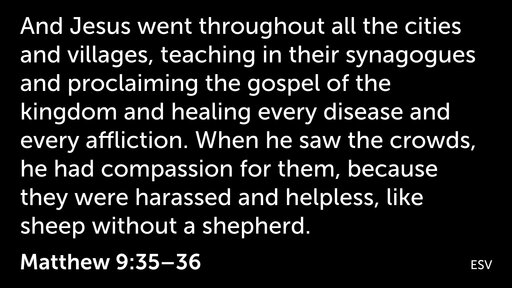
We see Jesus continuing the ministry and message that he has been focused on in the entire book. He is preaching the gospel of the kingdom.
Gospel is an interesting word for Matthew to use at this point. When we ask what is the gospel today, we say it is the death burial and resurrection of Jesus for our sins to fulfill the scripture after 1 Corinthians 15. But the message Jesus has been giving thus far has not been this.
Rather, the gospel is the good news that life with Jesus, abundant life being offered, is here now. The Gospel of Jesus’s kingdom, the kingdom of heaven that Jesus came to bring them in that moment is that he has come to fulfill and to be what we could not, in our place, and now, because of him, we can join him in living out what God has created us for. Living out our full potential as humans for the glory of God.
Jesus doesn’t just preach though, he is compassionately helping people also. Jesus isn’t just transferring knowledge and calling for obedience. He is loving people and helping them with physical needs.
We see in verse 36 that he sees the crowds, and has compassion on them. Not in response to what they do for Jesus. The crowds in Matthew are not fully committed disciples, they are still searching people. But because of where they are at, Jesus has compassion on them.
The description of how Jesus saw them is harassed and helpless. I believe that the correct way tot translate this is “because they had been harassed and bewildered.”
This was their current state. Helpless. Lost. Until Jesus came to them. They have no way to change their current condition, but Jesus knows exactly how to change their current condition. They are who he came for.
He says they are like sheep without a shepherd. This is a throwback to prophecy in the Old Testament. Think of
17 who will go out before them, and who will come in before them, and who will lead them out, and who will bring them in, so that the community of the Lord may not be like sheep that have no shepherd.”
Context here, Moses was the great leader for the people of Israel, then he sinned against God, so God was not going to allow him to lead the people into the promised land. When God tells him this, verse 17 is Moses’s response. We see Moses has a heart for the people. Who will take care of them? Who will keep them safe? Who will ensure that they find God and bring God to them? He knows he is unfit for the task.
The answer as the chapter continues is Joshua. Joshua in Hebrew means “cry out for help.” Joshua becomes the answer for the cry for help. He becomes the one they have been waiting for to bring them into rest and peace in God’s presence.
Do you see where this is going?
We’ve talked about typological fulfillment before. Typological fulfillment is greater and more complex then prophecy fulfillment.
We have this idea sometimes that prophecy is that “God said this would happen, look, then it happens.” But this is not what a vast majority of Biblical prophecy is, and especially prophecy about the messiah.
Biblical Typology is a narrative that becomes a symbol or picture prophecy. It is a prophetic allusion to something greater in the future. Jesus comes to be the better Adam, the better David, the better Abraham, the better everything.
Here, he is the better Joshua.
Just like Joshua, he came to lead the people in a way that without him, they would be hopeless. He came to lead them to life and peace with God.
A few other biblical prophets give this idea of sheep without a shepherd. But Jesus comes to bring comfort, peace, and lead us into the presence of God with his own life.
Realizing the great need of the people, Jesus tells his disciples that the harvest is plentiful, but the laborers are few.
Often times when Jesus uses harvest parables, they involve judgement. But not here. Here is having compassion realizing the great need, and needing more laborers to bring in the harvest.
Saffron is a good example of harvest that is quickly ripe. It is a very expensive spice, maybe more expensive than gold. And the reason for the great price is because of how hard it is to harvest. Saffron is three small red strands at the center of a these purple flower. You have to pick 12000 flowers to get one ounce of Saffron. There are not machines, these are done by dedicated and nimble fingers. An experienced harvester only gets one or two ounce per day. But the flowers only bloom for a couple of weeks and must be harvested quickly.
Jesus probably didn’t have Saffron in view, but the principle is the same. The harvest is ready now, but more people are needed to help with the harvest.
So Jesus gives the solution to this problem.
And we might expect it to be a call to gospel work. Go out there and get busy!
But look at what the first and correct response is. To pray.
Pray!
What kind of radical leader is Jesus? He doesn’t motivate and army and say “lets march boys, it’s time to fight!”
He tells them to pray.
Notice who the harvest belongs to. God. Pray to the Lord of the harvest. It belongs to God and God will be the one to harvest it and bring laborers.
No glory goes to us. The kingdom does not come because of us. It is God’s kingdom and we are joyful to be a part of his plan. We have nothing to boast in but the Lord.
Guess what? The harvest is great in Maine also. New England has cycled after Europe, going from Pagan, to Christian, to Anti Christian, to Post Christian, to Non-Christian. I have found that people are willing to talk about religion, Jesus, faith, the Bible. The people around us need the gospel. Will you pray that God would raise up people to reach them?
Guess what happenes when we pray? God will also stir up our hearts. This is a natural thing. Remember from chapter 5 when we pray for our enemies instead of hate them. If you pray for the people you hate long enough, God will take your hate and replace it with love for them.
A similar thing happens when we pray for the lost. When we pray for them, God works on our hearts to give us a greater love for them. Greater love than our fear of rejection. And guess what? Our love and compassion for people motivates us to become the laborers of the harvest. To take the gospel to the hopeless and bewildered people. Hopeless and lost because of sin. We have the truth. Will you start by praying for them?
II. The Persons for Gospel Work v1-4
II. The Persons for Gospel Work v1-4
Second today, we will want to see the persons for Gospel work. Look with me at chapter 10, verses 1-4.
In verse one, Jesus calls the 12, then gives them authority. We remember that Matthew is about Jesus’s authority, but here he is sharing his authority to accomplish what his authority was meant to accomplish.
Applicable for us is that Jesus has not called us to just come to church to be a part of his kingdom. He is giving us his authority to be the church. We look for opportunities to serve and minister to others.
And this is the second half of the response to what do we do about the lost and dying world? We pray yes, but Jesus has equipped us with his authority to go also.
We could take some time to look at this list of disciples. We could go into detail and do that. This is what we have been doing in our Men’s Study on Saturday Mornings. It’s been wonderful to see how we relate to the people God chose and the example they are for us. John Macaurther’s book “Twelve Ordinary Men” is one that is great and you should read and find comfort in the ordinary people God chose to accomplish his extraordinary mission.
I’ll point out a couple things in the list. Peter always comes first. And Matthew says he is first. Not first to convert, not first in the list, but first among equals. More on this when we get to chapter 16.
The first four names are always the first four names in these lists. Judas Iscariot always is last in the list and is left out in the list that happens in Acts for obvious reasons.
Notice again Matthews placement of himself. He calls out what God has saved him from, but just one of the ones who Jesus chose and delighted to serve in his mission. He inserts himself into the middle of this list. Just another person that Jesus calls to faithfully live out his life for Christ’s kingdom.
Also, look at the beginning of verse 2. “The names of the twelve apostles are these...” I believe this is another throw back to Numbers 1 where Moses is selecting 12 elders who he will begin something new with Israel. He gives them authority and commissions them. Jesus is doing that here with his 12. The number 12 is significant. We don’t know that they were from all 12 tribes, in fact, they couldn’t have been. But Jesus is showing them an alternative to the current Israel or the Israel of old.
Besides the first and the last name, Matthew doesn’t mention them again. What their are doing, their corporate goal, is far more important than their individual goals. This is a preamble for the church. We work together in the gospel to stay on mission.
We could get hung up and do a deep study on all of these names, but here is what i want us to see today. These are ordinary people. Fishermen, religious fanatics, the worst of sinners, political warriors. These are common people, and certainly not the best people. Jesus didn’t set out to choose the best society had to offer. He doesn’t choose the football quarter back or the most popular person in school. He didn’t choose the CEO or the one with a massive social media following.
He chooses ordinary people like you and like me to accomplish the extraordinary task of his mission.
Jesus doesn’t need outstanding people, he is calling us to be faithful people. This is an encouragement to you and I. We don’t have to be special or significant for Christ to choose us. He chooses us when we are nothing significant. Infact, the significance we have is found in the fact that he loved us and chose to make us his own and to use us for his purposes.
Jesus is looking for show-up people. Sometimes, people are chosen because of their high achievements or accomplishments. But Jesus doesn’t choose that crowd. He chooses the ones who will show up and be faithful.
And if you are struggling with the idea of not being faithful, He will help you. Lord, help my lack of faith.
God is calling all of us and has gifted all of us to bring people to him. Will you join me in this mission of faithfully bringing people to Jesus?
III. The Focus for Gospel Work v5-7
III. The Focus for Gospel Work v5-7
Third, we will see the Focus for Gospel work. We see this in verses 5-7.
Then we see Jesus send them out. This is where we can quickly write this information off. But we can also see the heart of Jesus in his instruction for them. The focus he wants them to have.
We see the focus on geography here. Certainly we know that gentiles were already coming to Jesus. And he doesn’t reject them. And Jesus has gone to gentile regions at this point. But the focus is Israel.
What you can see on this Map is the Region Jesus wanted them to focus on. He didn’t want them to go north or east to the gentiles, or south to the Samaritans. He didn’t want them to make their way to Jerusalem. He wanted to focus on the lost sheep in Israel where they were at.
There is two aspects here.
First, Jesus is fulfilling Messianic prophecy. The focus starts with Israel and fulfiling God’s original plan. Remember that God chose Israel to be a light to the nations. But they messed it all up. So Jesus is going to fuflill what they could not, through them. He comes to be the king and priest, and then restores Israel to be a kingdom of Priests and be a light to the nation. A kingdom of Priests that we are all now a part of. What do priests do? Bring God to people and people to God. This is what we do not, and what Jesus started with them.
After Jesus’s death and resurrection, the gospel would explode from Israel to fulfill the scriptures.
It was time in this moment to turn the light not to the outward darkness around people, but inwardly to Israel who was supposed to have the light. The ones who though they had God, needed to be invited into the kingdom of God. Instead of focusing on everyone else, they needed to focus on themselves.
But before the explosion of the gospel that would eventually win the Roman empire, we see Jesus’s focus for them is where they are at. He doesn’t want them to go to the gentile region of the north, or the Samaritan region of the south. He wants them to share the gospel right where they are at.
They may have remembered the great success Jesus had in Samaria, or the gospel work that happened with Jesus battling Demons in the gentile region. They might think that this important message that Jesus had should go strait to Jerusalem where it will be most impactful, but Jesus tells them to stay where they are at.
We can sometimes think to ourselves “ah! If only i was in this location, or had a different job, or different community, i could share the gospel more!”
How many of us have often missed the simple solution right in front of us? You have an appliance that isn’t working, you mess with it, jiggle the cord, determine you are going to have to throw it out. You go to the store to get a new one. Bring it home. And as you go to plug it in, you realize, the GFCI has been tripped. The solution was one quick button press that cost you nothing. Go back and return the new appliance, dig the thought to be broken appliance out of the trash, and look, it words just fine. The solution was in front of you the whole time.
The solution to gospel work is not far from you. You don’t need to craft some dramatic plan. God may be laying on some of your hearts vocational missional work, but for most of us, God has you exactly where he wants you to share the gospel with the people around you.
Your placement in your life is exactly where God wants you to be faithful and share the love of Christ with others. You can invite your neighbors over for dinner. Invite lost family members to church. Bring up what impacted you on Sunday at church, a song, or the sermon, with your coworkers on monday morning rather than talk about superbowl. When a friend is telling you about a problem they have in life, offer to pray with them or for them.
Parents, the greatest gospel work you can do is right in front of you everyday in the Chidlren that God has given you to bring the light of Christ too. You get the opportunity to put on display kingdom living to them daily.
Grandparents, what if your time with grandkids included moments of asking them questions about the world, where it came from, what they think of Jesus. Maybe getting them some Christian books and reading with them.
Guess what message Jesus wants you to take to your family, your friends, your grandchildren, your children, your parents, your co workers your neighbors. The Gospel.
We see this in verse 7. They are to be preaching that the Kingdom of heaven is here because of Jesus.
Jesus doesn’t want you to change the message. He doesn’t want you to alter it. He doesn’t need to to preach something new. He doesn’t need you to become a cultural warrior. He isn’t asking you to speak on politics. He isn’t asking you to be the most knowledgeable theologeon. He wants us to speak the same message he did. Life in the kingdom is being offered to everyone who has faith in Jesus. Invite people to true life with Jesus.
IV. The Motives of Gospel Work v8-10
IV. The Motives of Gospel Work v8-10
Fourth, the motives of Gospel work. We see this in verses 8-10.
Jesus is telling them that the ministry they are to be doing is meant to be without pay.
We don’t do gospel work for what we receive out of it. This would be the wrong motivation.
Jesus reminds that what we recieved, life with Jesus, we didn’t receive because we earned it. It was a free gift of grace given to us. So this free gift of God’s love that we share with the world, we do not seek to profit from it.
This ministry is an extension of Jesus’s ministry.
We are thankful for the many foodbanks around. This would be like someone getting free food from the food bank, then opening a farmers stand in front of their house and selling to food they were given for a profit. We would have such a problem. This doesn’t show thankfulness, this doesn’t show the same kindness you were shown. Instead, maybe you help others get the food that they need.
Similarly, Jesus isn’t looking for us to prophet from sharing the gospel with others, and serving others in love.
Don’t acquire gold, silver, or copper. Don’t keep adding to your belt bank. And for us today, we all have jobs where we earn money. But you might ask yourself, what is primarily important? This is what Jesus wants his disciples to be asking themselves and how we apply this principle to our lives.
Don’t get caught up in the materialism and the pursuit of wealth. Our mission as followers of Jesus is the Gospel. Remember from the sermon on the mount, stop storing up treasure on earth, it all goes away anyway!
So am i saying we shouldn’t work hard to get promoted and get raises or find a higher paying job? No! But what is my purpose? Am I pursuing wealth for myself or for the sake of the kingdom? Do I want more money so that I can live in more comfort and ease and not have to worry?
It’s not wrong for us to want comfort, but what is our highest priority? Is it Jesus’s kingdom or is it our own? When we get a promotion at work, are we thinking of the position, or are we thinking of the greater gospel influence we can have?
When we get a pay increase, are we primarily thinking of ourselves, or are we thinking of how we can serve others, be generous to those around us, and give to further the kingdom through our church?
Verse 10 shows us an aspect of trust. Jesus tells them not to pack extra. They were supposed to depend on God for their needs. Again, Jesus is not looking for the financially stable, he is looking for those who will lean on him for dependence.
Are we willing to trust God with what he has given to us freely? If God is our employer, we have no doubts we will be taken care of. Do we trust him to meet our needs with what we are given? We we entrust him with what he has given us in our giving?
Let us be a people who are consumed and focused on the task Jesus has called us to.
V. The Worthiness of Gospel Work v11-12
V. The Worthiness of Gospel Work v11-12
Fifth, we see the Worthiness of Gospel Work. We see this in verses 11-12.
Lets read this,
11 Whenever you enter a town or village, find out who is worthy there and stay with them until you leave. 12 As you enter the house, greet those within it.
This is a tricky section.
How do we know who is worthy?
Again, this is a message of how the disciples, and by extension us, are meant to do Gospel work.
We don’t choose people based on outward appearance. Remember the disciples Jesus chose? Not based on their status or accomplishments.
Remember when God chose David? He goes through a bunch of brothers. 7 of them. They would have been great by the outward appearance. But remember what God tells Samuel? He doesn’t look at the outward appearance like men do, he looks at the heart. He determines David, this scrappy ruddy young character to be the nations greatest leader. Why? Because God counted him as worthy.
We don’t do gospel work to who we think are going to accept it most, or who are the most honorable. We do gospel work with those who God would count as worthy. And remember who he counted worthy? The disciples. You and me.
There is an aspect of staying here in verse 11. Other traveling people at the time of Jesus would go house to house, maybe looking for a better opportunity, a better position, a better life situation. Jesus doesn’t want us jumping from flashy shiny thing to the next flashy shiny thing. Jesus is looking for faithful people who show up where he has put them to be faithful servants of the gospel.
There is an aspect here of not waiting around doing nothing, and also an aspect of being faithful at what God has called us to. Not looking for what suits our needs best or what we think is worthy, but what God has deemed as worthy.
Who has Jesus deemed as worthy? In need of the gospel? Who has he commissioned us for? The hopeless and the bewildered.
VI. The Rejection of Gospel Work v13-15
VI. The Rejection of Gospel Work v13-15
Last today, we see the Rejection of Gospel Work in verse 15.
When we think about peace, this is the message we are bringing. Peace from the tormoil of our sin. Peace for this life and the one to come. look at this prophetic passage:
7 How delightful it is to see approaching over the mountains the feet of a messenger who announces peace, a messenger who brings good news, who announces deliverance, who says to Zion, “Your God reigns!”
This is the message we are proclaiming. God is on reigning, eternally, and also in our hearts. We invite others into this life as well. But some will reject it. What does it mean to allow the peace to come back to you?
Maybe like an uncashed check. You are presenting them with life, but if they are unwilling to use it, it goes to waste and stays with you.
This is not a taking back of the peace of God you have offered to them. This isn’t them loosing peace. It is a rejection of peace. They have chosen to reject what was freely being offered to them.
In verse 14, Jesus says to shake the dust off your feet from that place. This is not you pronouncing judgement on them. This is an acknoledgement that they want to stay in the filth of their own sin so God’s judgement is upon them. We want to ensure the Gospel message is not wasted as we keep spreading it to others who will accept it. The ones who God has counted as worthy.
We will talk about this more next week, but sometimes we take rejection like a sign that we are doing the wrong thing. When we face opposition, we might recluse and stop sharing the gospel. But here, Jesus is telling us that when we face rejection and opposition, we are doing the gospel work he has called us to. Not everyone will accept it.
The response however is not to stop, but to move on.
Verse 15 is troubling. Jesus says Matthew 10:15 “15 I tell you the truth, it will be more bearable for the region of Sodom and Gomorrah on the day of judgment than for that town!”
I’m telling you the truth, or verily, or pay attention.
Rejecting Jesus’s message is worse than what Sodom and Gomorrah did. Jews would have had this idea of True evil in their minds, and we still do today. It’s a phrase that even is used in secular culture.
Our teens in Leadville started using this as a verb. To “Sodom and gamorrah” something was to completely annihilate them.
Sodom and Gomorrah are characters of sin and judgement. They are synonomous of the worst kind of sin. Extreme depravity against God’s ways. But to reject Jesus is even worse than that.
To Reject the message we bring of Jesus, to reject his peace, is to reject HIM. To reject the message we bring is to accept final judgement.
And there is more to this than just judgement. This is also a claim to who he is. If the punishment of those who reject Jesus’s followers is worse that the most famous sin story in the history, then how great must Jesus be?
The message of Jesus is so important. What will are we doing with it?
Beyond the Walls (Grace and Growth)
Beyond the Walls (Grace and Growth)
There is a call her to those who do not know Jesus in the room. We must first realize that we are all hopeless and bewildered by our sin. We are lost wandering in this life without a shepherd. However, there is a great shepherd to came to show us the way. Through his death and resurrection, he has given us life by taking our sin and punishment. We can now follow him in his grace. Will you accept him today or accept the his judgement to come?
To those of us following Jesus. Guess what, God wants to use you. You might think to yourself, that you are weak, that you are incapable, you are unqualified, maybe you are better off warming the bench.
You are exactly who Jesus has called for Gospel work. Jesus wants the light of his gospel to shine through you. And you being meek and humble lets Christ make much of his strength in our weakness as we depend on him, the Lord of the harvest. Jesus wants you to faithfully show up and share the gospel around you. Right now, i pray God is putting someone on your heart that needs to hear the gospel from you.
Don’t just come to church, be the church and fulfill the mission of God where he has called you.
Also, I want us to think about today deeply. What is our purpose on earth? Have we become distracted with pursuing the wrong stuff? Do we work for our own glory? Do we make money for our own gain? Do we have relationships simply for fun? Or are all of things things furthering the kingdom of God as we tell others about he good news of Jesus? Do we use our resources that God has entrusted to us to further the kingdom of God? Do we use the positions where God has placed us in a way that we share the gospel with others?
Let’s respond to the text together today.
Father, realizing the great need, we pray that you would raise up laborers for your kingdom.
Jesus, give us a heart for the lost like you.
Spirit, give us boldness to the task of Gospel work.
