Division and Rewards

Notes
Transcript
Intro
Intro
The book of Matthew is about Jesus the messiah, and realizing his kingdom.
You might think of a the book of Matthew like a great coloring page that we have been given. We have the black outline for the picture in Chapter one verse one, and we spend the rest of the book filling it in with color. And what are we filling in with color? What it means to be a disciple. We certainly see that in the passage before us today. We know we want to follow Jesus, but our passage today shows us in more detail about what it practically looks like to follow Jesus, and also, why we should follow Jesus.
Some have said we are going through this gospel a bit slow, not today! We are taking on a larger chunk of verses.
Main Point: Because of who God is, we pursue the mission of Jesus over everything else.
I. Don’t Fear v26-31
I. Don’t Fear v26-31
First today, we see don’t fear. Disciples of Jesus reject fear. We see this is verses 26-31. Jesus is going to give us three reasons not to fear.
But we see in verse 26 what we are specifically not supposed to be fearing. Have no fear of them.
Who are the them?
From our time together last week, and the previous section of Matthew, we would know that this is those who oppose Christianity.
We talked about opposition around the world, where Christians are imprisoned, falsely accused, tortured, and killed for their faith. And the world has been this way since the time of Jesus. If you want to know more specifics about persecution currently going on in the world, you can tap the circle in front of you and tap on the second link which will take you to persecution.com and hear details, facts, and stories about brothers and sisters currently living this opposition in very real ways.
But we also talked about how here in America, we don’t have the same persecution, but there is certainly opposition to the gospel of Jesus. Kids in schools in Maine being told to hate Christians. Kids in schools being sent to detention for holding to Biblical Christianity. People who reject us or distance themselves from us when they find out we are a Christian. Many us are looked at as silly, talked about as one of “those.” Maybe even mocked for your Christian beliefs.
We talked last week about how through opposition, Jesus wants us to continue to be faithful and bold in our gospel witness.
The placement of Jesus discourse on opposition is not random. We will see a slow move in the book of Matthew, even beginning in the next chapter with Jesus facing greater and greater opposition to who he is and the message that he brings. Jesus is foretelling the opposition, then about to live it out as an example.
But he gives us this instruction here today not to fear.
And here, he is reminding us not to fear them. Three reasons why.
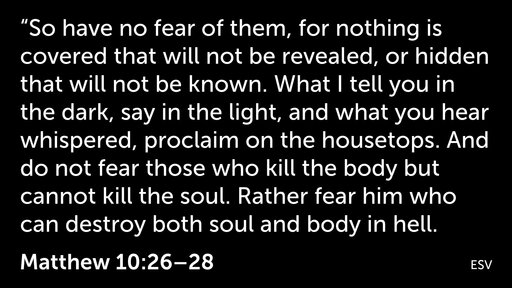
A. Truth will Emerge v26-27
A. Truth will Emerge v26-27
The first reason Jesus tells us not to fear them is that truth will emerge.
Along with a reason not to fear, this comes as a great encouragement to those who are being opposed because of our Christianity and witness for Christ. That whatever is hidden is being revealed.
We want to be careful to understand this in context.
We might be tempted to think this is some sort of judgement, that whatever is done to us in the dark will be revealed in judgement.
So we might be tempted to think Jesus is saying that the mockery we take for the gospel will be rewarded someday. And this is true, that everything done in the dark and light will be revealed and judged. The judge of all the earth will do right. Paul in 1 Corinthians reminds us that even the secret things we do, even the motives of our hearts, God will judge.
We are reminded in passages like Romans 12 that we are not to take vengeance for ourselves with the reason that God will repay all evil, including the evils done against us.
In revelation we see the saints in heaven crying out to God asking for the blood of the martyrs to be avenged. And the rest of the book we see God judging those who are against him and his people.
We could look at multiple places in scripture that teach this idea that Everything done by every person will be evaluated by God someday, and that God will avenge the ones who have wronged his people. But i don’t believe this is what Jesus is teaching us in verse 26.
In context, we remember that Jesus is commissioning us to proclaim his good news, and there will be opposition. So why not fear them and continue presenting the gospel is the question at hand?
Because what is hidden from them now, or them trying to hide the truth, or suppress the truth, or not believe Christ’s truth, will be made known to them someday.
Someday, the universal world, everyone who is living and all who have ever lived will realize that Jesus is who he claimed to be. Every knee will bow and every tongue will confess that He is Lord. And will be judged for how the accepted that truth in this life on earth.
The point is that the truth of the gospel will be someday revealed. So it is wise for us to proclaim it now to people around us before it is too late. So we do it through opposition. Better for people to realize it now before it is too late.
This idea continues in verse 27. What Jesus has said to them, they will bring it to greater light as they tell even more people. It will continue to grow.
B. They have limited power v28
B. They have limited power v28
The second reason we have not to fear is that the opposition has limited power. We see this in verse 28. Don’t fear the one who can kill the body, but the one who can ultimately destroy body and soul.
We sometimes think that the devil is the one who has power to judge, and that the devil is punishing people in hell. This is just untrue. Nor should God’s people be afraid of him.
The word hell here is Gehenna, which was a place where jewish trash from Jerusalem would be burned, but it ended up being a larger idea in Jewish literature. The physical place of Gehenna in Israel was a symbol of God punishing and destroying all that is evil and wicked in the world.
There is a movement today called Annihilationism which says that all people who reject Jesus cease to exist into eternity. Kirk Cameron has been a recent proponent of this idea, along with the theologian John Stott.
Without doing an extensive biblical theology today, we would say that anyone who does not believe in Jesus as Lord and Savior will experience God’s judgement in an eternal, conscious, torment. Matthew would fill us in a few chapters later with Jesus’s words concerning those who thought they belonged to Jesus but did not.
46 And these will go away into eternal punishment, but the righteous into eternal life.”
There is only two destinies for humans. Either eternal life, or eternal punishment.
But for our context, we want to consider what it means for us to continue sharing the gospel in opposition here in America. We might say, don’t fear the one who can destroy our mental health with their negativity and rejection, but respect the one who is responsible for our whole being.
We know that though others may make us feel rejected, discouraged, down, they ultimately have no control on our being.
And even if they were to kill us as it happens in other countries were persecution is more prevalent, our souls are safe in the hands of the father.
In contrast, they ought to fear the one who has authority over their whole being. The one who will ultimately send them their body and soul to hell for rejecting the Gospel, and rejecting the proclaimers of the gospel.
So what is the take away?
The ones who oppose the gospel message in our lives, we don’t treat with obstinance or distain. We don’t look at them and say “you will get what you have coming for you.” “God will deal with your soul!”
No! Knowing that God will punish their whole being eternally is a good reason to continue sharing the gospel with them, even if it means laying down part of our physical life, for what can only be regained in eternal life.
Jesus is exhorting us to stop valuing what people can do to us, because we are eternally secure, and start valuing the gospel of Jesus reaching the hearts of people around us.
We compassionately continue to love and share the grace of Jesus with them even in difficultly because nothing they do to us can outdue what we know is coming for them.
C. God’s providential care v29-31
C. God’s providential care v29-31
Third reason to not fear opposition is because of God’s providential care. We see this in verses 29-31.
There seems to be this odd interjection that Jesus has of the sparrows and hairs on heads. But this is not random, this is inline with how Jesus has already been teaching.
Don’t fear, because God is caring for you even when it might be hard to see.
Sparrows were of the least expensive things you could get at the market at Jesus’s time. Not valued. They were less than a half hour’s worth of wages. But what we don’t value, even the life of a sparrow, God values. And if God cares about the sparrow falling to the ground, certainly he cares for us.
We might think that God only cares about the big stuff. When we see God caring for the smallest insignificant part of creation, we can know and be reassured that he also cares for us.
He even cares about the hairs on our head.
Many of you have met our dog. Our dog has more hair than anyone. But between the dog and many girls in our house, hair is a never ending storyline in our house. It doesn’t matter how much Erika cleans, the storyline of the hair will never be subdued.
The hair we loose, the hair left on a brush or a comb that we quickly discard and forget, God cares even for that. God cares far more about us that even we care about us.
This caring for hairs on head idea is several places in the Bible. When you are opposed, when you are worried, God cares more for the impossible and your anxiousness than you do.
Notice the sparrow is falling to the ground in the context that people might oppose us and take our physical life. We remember from the sermon on the mount that a reason to not be anxious is that we will outlast the birds. Not in this life, but for all of eternity in the next.
Nothing happens to us without God’s care and providence. What do I mean by providence?
Providence is is the governing power of God that oversees his creation and works out his plans for it.
When people oppose us in the gospel work we do, God is not suppressed, he is not frustrated throwing up his hands saying “now what am i going to do?!?” He is bringing about his plans for his glory and our good, even through difficulty, even through opposition.
God being in control over the universe does not mean we get a free-pass on suffering, but that nothing happens without our father willing it. I don’t have to be afraid because I know God is using what i might be afraid of to bring him glory.
Martin and Gracia Burnham were everyday people. Ordinary people who chose to bring the gospel to the Philippines. The went through New Tribes Mission. They were examples of grace and servanthood to the Filipino people. On their 18th anniversary, they were kidnapped by a Muslim terrorist group of rebels. They were held hostage for more than a year. When the Filipino military group attempted a rescue, Gracia was wonded, and Martin was killed.
During their captivity, they shared food, and the gospel, and showed kindness even through the suffering. When back home, Gracia wanted everyone to know one thing. That God was good to them every single day of their captivity. They fixed there eyes on Jesus and loved serving him.
Before his death, Martin said, “I’m not called to be a missionary, I’m called to serve Christ.”
They knew their Lord was taking care of them and that their eternal life was secure, no matter the opposition they faced.
Remember that Jesus is inviting us into his kingdom. Part of living and accepting Jesus is not living in anxiety and fear. Part of submitting to Jesus is realizing that God will take care of us.
Let me say this as an sidenote. If you are here today, and struggling through anxiety. I would encourage you to go back and listen to the sermon where we reflected on Jesus’s words about being anxious in general. The sermon was called “Anxiety is for the birds.” 10 reasons Jesus gives for not being anxious.
But for today, Our primary concern as disciples of Jesus is not avoiding fear and anxiety, but boldly proclaiming the Gospel.
II. Acknowledge Jesus v32-33
II. Acknowledge Jesus v32-33
Then in verse 32-33, We see acknowledging Jesus. We as disciples acknowledge Jesus.
In light of Jesus’s reassurance through our fears, he asks us the question. “Will we acknowledge him before others?” Will we represent him?
This is meant to be a strong warning for us. And we should be asking ourselves, what will we do? Will a fear of people keep us from being faithful to Jesus?
We have seen this portrayed in the Olympics the last few weeks. Our kids loved watching the Olympics. Leland was all about the hockey, and Avenleigh loved some figure skating. There are Americans athletes who chose to represent America and American trained athletes who chose to represent other countries. Two of the most iconic pictures from the Olympics are Alysa Liu being wrapped in an American flag winning a gold metal for figure skating that America went 24 years without. And how does that make us in America feel? Glad that she is representing us. We will claim her as ours! And then another Iconic picture is Jack Hughes, winning the golden goal for the USA Hockey team that America went without for 46 years. We watched at as a family last Sunday while we were sick, into overtime, and this young 21 year old who had his two teeth knocked out earlier in the game scores and incredible goal. Right after they get him off the ice, blood dripping down his face, a huge smile, he says “"I love the USA. I'm so proud to be an American today.” And we say yes! We will claim that guy as ours. He represents us!
Similarly, Jesus is saying that if we represent him before others, he will represent us before his father. If we want to be aligned with him, he will claim us as his own. If we reject him, he isn’t twisting our arm to stay with him. Go and represent what you want to represent, but you won’t be claimed by Jesus.
Jesus’s acknowledgement of you take the place of judgement against you.
Acknowledging Jesus is a necessary criteria for being a disciple of Jesus.
John Calvin points out that this acknowledgement will look different for different people.
What do i mean by this? If i see one individual in our congregation witnessing to every person they meet constantly, always, and I think to myself, I can’t keep up with that! Am I supposed to live up to that standard?
No. I don’t need to feel guilty that I am not being like them. I don’t judge myself against that person, i ask myself the question Jesus said. Do I make known to others that I follow Jesus?
God isn’t saving us to be cookie-cutter Christians. He doesn’t want us all to look the same. Our gospel witness will vary in boldness, fluency, wisdom, sensitivity, and frequency.
But in some way, shape, of form, all of us will be public with our faith if we follow Jesus.
Practically, when we know the Spirit is tugging on our hearts to talk to someone about Jesus, and we have the immediate worry of what they will think of us, will we let that keep us back from acknowledge?
And know that God gives grace for our inability. If you didn’t share the gospel once when you though maybe you should have, you aren’t living in constant fear that God will now reject you. Jesus is talking about a pattern of acknowledging him before people.
Think about Peter who we will see later in Chapter 26. He is an object lesson for us in God’s grace. Temporary lapses under pressure like Peter who did not acknowledge Jesus are different than a settled course of acknowledging Jesus or denying Jesus.
We don’t have to work out of fear, we can work in obedience and thankfulness that Jesus has already acknowledged us by saving us.
III. Recognize the Gospel v34-36
III. Recognize the Gospel v34-36
Next, let’s look at recognizing the gospel in verses 34-36.
This section is a bit off putting, and it is meant to be.
Matthew 10:34 “34 “Do not think that I have come to bring peace to the earth. I have not come to bring peace but a sword!”
Wait what? I thought Jesus was the prince of peace, i thought he came to be peace on earth, isn’t that what we celebrate at Christmas time?
Jesus isn’t coming to bring a literal sword, but this is a metaphor for conflict and suffering.
The prophets like Isaiah and Zechariah expect the messiah to bring peace. And Luke 2:14 tells us that Jesus’s birth is peace for people among whom God is pleased. Jesus presents himself later in book of Matthew as the bringer of peace. He has been telling his disciples even in this section, look at verse 13, to bring the message of peace to others. So why does he say no peace here?
This is a reminder that the work Jesus is doing is peace making, not peace keeping. Peace making is an essential part of the good life Jesus is offering. Remember Matthew 5:9 “9 “Blessed are the peacemakers, for they will be called the children of God.”
But the way to peace is not avoiding conflict, but sometimes engaging in contraversy.
The peace that Jesus came to bring is not an absence of strive, it is peace that overcomes sin and brings the salvation of God.
In verse 35 we see father and son, mother and daughter, even the best and most respected relationships in society being disregarded.
The Gulag Archipelago gives us insight into this verse lived out in the Soviet Union under Stalin. Soviets turned family members on each other. Children against parents, and parents against children for their militant atheism and crush of Christianity. Close family members would turn their Christian family members over to the state to be sent to death camps. The family members, including children who turned over parents, were celebrated and praised as national heros for elevating the state above ones religious affiliation.
Jesus says in verse 36 that a persons enemies will be those of his own household. Jesus is not saying that family enmity is a virtue or universal experience of all disciples. But it is a matter of what do we prioritize? Loyalty to Jesus and his mission must come first. Even if it means strong family ties have been strained or loosened, or in some cases, broken.
I don’t think any of you in this room fear being turned over to the hostile government and be sent to prison camps to die, but I know that some of you do have strained family relationships because of your Christian witness. You have chosen your relationship with your king over every relationship that makes sense on earth.
Jesus wants you to know that he sees the conflict and does not take it lightly. Jesus also experienced being misunderstood by his family.
IV. Elevate Jesus v37-39
IV. Elevate Jesus v37-39
Next, disciples of Jesus elevate Jesus above all. Elevate Jesus?
In verses 37-39, we see elevating Jesus in three ways. Over Family, over values, and over our own life.
A. Over Family
A. Over Family
We’ve already been discussing verse 37 in light of family relationships. Jesus is not saying that we are not to love our family members, but that our love for him must be elevated above all else.
Jesus assumes we will have love for family members. But he should not be pushed to the background.
What about us this last week? Did we put Jesus on the backburner?
Practically, who am i making decisions for? Am i prioritizing family with my decisions during the week, or am I prioritizing Jesus and his kingdom? If Jesus assessed my own actions this last week, did I elevate him above others in my life?
B. Over Values
B. Over Values
In verse 38, we see this idea of carrying our cross.
This is something that is so popular in secular culture. But something that often gets misunderstood and misquoted.
I’ve heard from so many people “this is just my cross to bear.”
This saying of Jesus would have sent chills down the spines of the disciples. They would have not viewed the cross with the same eyes that we do today. It was a shameful and social disgrace.
People would be made to carry their own cross to their death. Taking on all of the shame that was associated with the cross. Publicly claiming and owning death of the cross as your own.
First humiliation, then death.
What does it actually mean to take your cross and follow Jesus?
Bearing your cross does not mean putting up with an awkward or tragic situation in one’s life. Rather, it means painfully dying to self, killing the desire for what you think is important in your life.
The things you thought were important, the parts of you that you thought were important, as loss for the kingdom of Jesus.
Beyond just family, what thinks do you hold dear that are keeping you from Jesus?
C. Over Life
C. Over Life
Then in verse 39, we see the idea of reward and judgement in elevating Jesus even over our own life.
Matthew 10:39 “39 Whoever finds his life will lose it, and whoever loses his life because of me will find it.”
Life is being offered to us. If we are willing to give up ourselves and submit our lives to Jesus.
This is the opposite of what the world teaches. The world encourages us to find ourselves. Pursue yourself interest. Seek yourself and what you need. But Jesus says the opposite. Throw it away!
This is the great paradox.
Our faith in Jesus, willingness to give up physical life, ends up being what preserves your eternal life.
Discipleship is not a matter of life and death, it is far more serious than that. Discipleship is a matter of what is your destiny beyond this life.
This is a promise of Jesus. That whether it is self-denial or martyrdom, you will find life. Jesus will grant you life.
But if you find your life now, if you continue seeking your best interest over Jesus, ultimately, you will lose your life.
What things are we holding onto so tightly and unwilling to give up in order to follow Jesus? What do we value?
In light of this passage, I’m not saying that you need to give up physical things to pursue Jesus. Maybe some of us in the room do. But for in light of this passage, are you willing to give up acceptance, maintaining peace, and status quo relationships in order to proclaim the gospel of Jesus?
Embarrassing Reward v40-42
Embarrassing Reward v40-42
Last today, embrace the reward. We see this in the last three verses of chapter 10.
In this section, Jesus has been a bit dark, maybe glum, but he is going to wrap up with hope.
We could sum up this section with simply saying, to accept Jesus’s disciples is to accept Jesus.
Prophets and righteous people are the ones who are speaking on God’s behalf and living out his ways. We are speaking to God’s message and sharing it with others even in opposition just like the prophets.
Remember in Matthew 5 when Jesus says blessed are the persecuted, for such they did to the prophets? Jesus is equating us to the prophets who have God before.
Righteousness is not so much speaking about our ethical uprightness, we know that any righteousness we have is only because of Jesus. But this righteousness is about an active life conformed to the law of God. We accept Jesus’s message that God rules and algin ourselves to God’s kingdom.
We see this at the end of chapter 5 when Jesus says to live out his teachings is to live more righteous then the Pharisees.
Receiving a prophet or righteous person presupposes that the individual knows that the person is righteous in Christ, or a prophet of Christ. By receiving a messenger of Jesus, people receiving and accept Jesus. The person who is open to the message we bring receives Christ, his word, his ways, and his gospel.
Jesus seems to be wrapping up this section to remind us that in all the opposition, some will receive Christ.
The little ones mentioned in verse 42 are all of us. The target of the worlds hostility. Insignificant people by the worlds standard, but love by God and used by God to bring the reward of Christ to those who receive his message from us.
Beyond the Walls (Grace and Growth)
Beyond the Walls (Grace and Growth)
To you here who hear the gospel today. The gospel is the good news of Jesus. There was talk in this passage of being worthy. We all realize that non of us are worthy. Only Jesus could be worthy and live perfectly to God’s standard. We have all sinned and fall short of God’s glory. We know that the scriptures teach that the penalty for our sins is hell, eternal punishment. But by accepting Jesus, we receive his worth before God. He takes our sin, shame, judgement, to the cross. He died on behalf of our sin. He rose to give us new life with him. He took the judgement meant for me so that I can now live for God, free from sin.
If you want to know more, please come and talk to us today.
To the church today, Will we be bold this week in our gospel witness?
Guess what, God doesn’t need any of us to share the gospel. Remember he said he doesn’t need us, he can make the rocks cry out for him if he wanted to. But yet...he chooses to use us. We get to be about this unfolding plan of redemption.
When I used to share the gospel, I used to worry myself sick that I didn’t say the right thing, I should have said this, i wish i would have remembered this verse. What if I sent that person to hell because I didn’t communicate well?!?
My motivation for sharing the gospel used to be rescuing people from hell. It would give me such anxiety and fear. But guess what? Us witnessing doesn’t make people get saved, but it is an issue of being obedient to Jesus.
Remember who the Lord of the harvest is that we pray to? Not us, we are just the laborers.
This is what the passage today is pushing us towards. It isn’t talking about the lost going to hell being the motivation for us to share the gospel. Instead, we share the gospel in peace knowing God is the one doing the saving. We consider it a privilege this week to be obedient in what he has called us to.
Let’s bow our heads and respond to the text together.
Father, raise up labors for your harvest, and start the work in my heart.
Jesus, help me to love the lost compassionately like you.
Spirit, help my will to be less about me, and more submitted to you.
