Alignment After Revelation (2)
Notes
Transcript
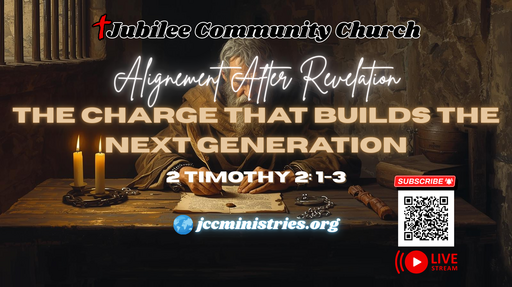
The Charge That Builds the Next Generation
The Charge That Builds the Next Generation
Text: 2 Timothy 2:1–3
1 Thou therefore, my son, be strong in the grace that is in Christ Jesus. 2 And the things that thou hast heard of me among many witnesses, the same commit thou to faithful men, who shall be able to teach others also. 3 Thou therefore endure hardness, as a good soldier of Jesus Christ.
Introduction
Introduction
Second Timothy represents the final words of the apostle Paul. He is not writing from a place of comfort but from a Roman prison cell. Chains are on his wrists, execution is approaching, and the man who once traveled the world preaching Christ now writes by lamplight, knowing his time is short.
But Paul is not focused on his death. He is focused on what comes after him.
His concern is not survival. His concern is succession.
In front of him is the future of the church, and that future is a young pastor named Timothy. Timothy had traveled with Paul for years. He had watched him preach in synagogues, endure persecution, cast out devils, and establish churches across the Roman world.
Now the baton is being passed.
Second Timothy chapter 2 is not simply advice. It is a charge. It is the transfer of responsibility from one generation of leadership to the next.
The question is not simply what Paul told Timothy.
The real question is: what did Timothy do with what he received?
The Strength That Comes From Grace
The Strength That Comes From Grace
Scripture: 2 Timothy 2:1
Thou therefore, my son, be strong in the grace that is in Christ Jesus.
Paul does not tell Timothy to be strong in personality, influence, or popularity. He tells him to be strong in grace.
The word “strong” carries the idea of being empowered or strengthened from an outside source. Paul is telling Timothy that ministry cannot be sustained by human ability. The strength must come from Christ Himself.
Timothy would need that strength. History tells us Timothy eventually became a leader in the church at Ephesus. Ephesus was not an easy place to pastor. It was filled with pagan worship, false teachers, and spiritual warfare.
Timothy would face opposition, discouragement, and pressure. Yet the strength Paul spoke about was not emotional strength. It was spiritual empowerment through the grace of Christ.
What Timothy received from Paul was not simply teaching.
He received spiritual formation.
And Timothy carried that same strength into the churches he led.
The Truth That Must Be Passed Forward
The Truth That Must Be Passed Forward
Scripture: 2 Timothy 2:2
And the things that thou hast heard of me among many witnesses, the same commit thou to faithful men, who shall be able to teach others also.
This verse describes one of the most powerful principles in the New Testament: generational transmission of truth.
Paul gives Timothy a clear pattern.
Paul taught Timothy.
Timothy must teach faithful men.
Those faithful men must teach others.
Four generations of spiritual leadership appear in one verse.
The word “commit” means to entrust something valuable like a deposit placed in safe keeping. Paul is saying the gospel is a treasure that must be guarded and passed forward without corruption.
Timothy understood this responsibility.
Church history records that Timothy helped establish leadership structures in the early churches and trained believers to guard the teachings of the apostles. The instructions Paul gave Timothy became the pattern for how churches developed leaders.
The church did not grow through personalities.
It grew through faithful transmission of truth.
The Endurance Required to Carry the Message
The Endurance Required to Carry the Message
Scripture: 2 Timothy 2:3–4
Thou therefore endure hardness, as a good soldier of Jesus Christ.
No man that warreth entangleth himself with the affairs of this life; that he may please him who hath chosen him to be a soldier.
Paul shifts to the language of warfare. The Christian life is not described as comfort but as conflict.
The word “endure” means to suffer hardship without abandoning the assignment.
Paul knew Timothy would face pressure. False teachers were already infiltrating churches. Cultural hostility toward the gospel was increasing. The Roman Empire would soon begin intense persecution of Christians.
Timothy had to understand something: following Christ requires endurance.
Paul reminds him that a soldier cannot allow himself to become entangled in civilian distractions. The mission must remain the priority.
Timothy lived this out.
Ancient church tradition records that Timothy eventually faced violent opposition while confronting pagan worship in Ephesus. Rather than remain silent, he continued standing for truth even when it brought persecution.
The instruction Paul gave him was not theoretical.
Timothy walked it out.
The Discipline of a Faithful Servant
The Discipline of a Faithful Servant
Scripture: 2 Timothy 2:15
Study to shew thyself approved unto God, a workman that needeth not to be ashamed, rightly dividing the word of truth.
Paul tells Timothy to become a workman of Scripture.
The phrase “rightly dividing” means cutting a straight path. It describes careful handling of truth without distortion.
Timothy would face teachers who twisted doctrine and confused believers. The only way to confront error was through accurate understanding of the Word.
Timothy followed this instruction by guarding apostolic doctrine in the churches he served. His leadership helped preserve the teachings that would later become the foundation of the New Testament church.
The survival of the gospel message required faithful teachers who would not compromise truth.
Timothy became one of those teachers.
Becoming a Vessel Fit for the Master
Becoming a Vessel Fit for the Master
Scripture: 2 Timothy 2:20–21
But in a great house there are not only vessels of gold and of silver, but also of wood and of earth…
If a man therefore purge himself from these, he shall be a vessel unto honour, sanctified, and meet for the master’s use.
Paul explains that usefulness to God is connected to purity.
The issue is not whether someone is inside the house. The issue is what kind of vessel they become.
Some vessels are honorable. Others are common.
Paul tells Timothy that separation from corruption prepares a person for greater use in God’s kingdom.
Timothy understood this.
His life was marked by faithfulness, integrity, and devotion to Christ. Paul even testified earlier in Philippians 2:20 that he had no one like Timothy who genuinely cared for the churches.
Timothy became the very vessel Paul described.
Application
Application
Second Timothy chapter 2 reminds us that every believer eventually stands where Timothy stood.
At some point we receive instruction, truth, and spiritual investment from someone before us.
The question becomes what we will do with what we have received.
Paul did not invest in Timothy so Timothy could simply hold knowledge.
He invested in Timothy so Timothy could build the next generation.
Faith must be passed forward. Truth must be preserved. The work must continue beyond one lifetime.
Every generation receives the gospel from the one before it.
Every generation must decide whether it will faithfully carry that truth to the next.
Conclusion
Conclusion
The church does not suffer from a lack of information.
It suffers from a lack of faithful carriers.
Paul’s final concern was not buildings, programs, or reputation. His concern was that truth would continue after he was gone.
Timothy answered that call.
The question for this generation is the same.
Will we become vessels fit for the Master’s use?
Will we endure hardship for the gospel?
Will we pass truth to those who come after us?
The future of the church has always depended on those willing to receive the charge and carry it forward.
Closing Quote
“The church is always one generation away from extinction if the truth is not passed faithfully to the next.”-Charles Spurgeon
“The church is always one generation away from extinction if the truth is not passed faithfully to the next.”-Charles Spurgeon
