Tell Me Without Telling Me You're the Messiah

Notes
Transcript
Intro
Intro
As we come to the text today, we are asking the question, Are you really him?
This is the question that John asks in our text today. And truly, many of us ask the question also. When things are not going well in our life, through difficulty and challenges, we really wonder, “Is Jesus really reigning? Is he really the Messiah? Does he really have authority?”
One of my favorite people from church history is the Baptist Missionary Hero Adonirim Judson. He would pioneer missions from America as the first White person from America to take the gospel to a foreign country, who had never heard the name of Jesus. He went to Burma, which is now Mymar. He traveled by boat to a place that he had almost no knowledge of, except that people needed the gospel. He and his wife land and begin ministry. He serves for years without seeing a single convert. He labored to give one of the greatest gifts, a bible in their language so they could read the Word of God themselves. He, his wife, and his child suffered all kinds of diseased that they had never experienced before. He would be sent to prison for looking like a white person. He did nothing wrong. He did no evil. He would be in deplorable conditions in a prison for almost two years. He was in a single unventilated room with 100 other prisoners. Every night he would be strung up with a pole going through his legs to hold up his feet shackels so only his shoulders and head would touch the ground. They would be forced to run naked in the heat of the day. When he was finally released, he would reunited with his wife, only to see her die shortly after their reuniting. Then his only daughter of 2 years would die. Adonirim Judson would loose his entire family only 6 months after having been relieased from his suffering in prison.
He would build a hut in the solitude of the tiger infested jungle. He would dig a whole, a grave, next to his hut. He would sit in it for hours at a time. Contemplating death and decay. He famously said at this time “God is to me the great unknown. I believe him, but i find him not.”
Certainly at this time, he questioned Jesus. Are you really him? Have I been living for the right one? Is all of this for nothing? This is not what I expected.
We can feel like this too. The difficulties we face in life, we might say “Are you really there Jesus? It doesn’t feel like it.”
This is text before us today. Here is the main point i want us to see.
MAIN POINT: Because Jesus is who he says he is, we follow him even when he is not the Messiah we want.
I. Viewing Jesus through Doubt v1-6
I. Viewing Jesus through Doubt v1-6
First today, we see viewing Jesus through doubt.
Look at verse one with me. Matthew is moving the text along. New scene. We don’t see the disciples going out to fulfill the mission Jesus just gave them. We don’t have a report back. We have this next dialoged that takes place.
The Holy Spirit inspiring Matthew the author is concerned with the readers understanding the principles of the disciples mission. He wants us to know what it looks like to follow Jesus, and skips some of the narrative elements.
The next two chapters are going to be people responding in various ways to Jesus’s message.
This verse is really the turn in the book. Where people have now heard Jesus, seen Jesus, and are turning on Jesus. And it is even beginning with his own cousin, John the baptizer, who I will refer to as John for the rest of our time together today.
This is not my work, but i wanted to share it to give an overview and the pattern Matthew gives us of the next two chapters.
I. First collection (11:2–30)
1. Unbelief: John the Baptist (11:2–19)
2. Unbelief: the towns of Galilee (11:20–24)
3. Belief: “Come unto me” (11:25–30)
II. Second collection (12:1–21)
1. Unbelief: Sabbath controversy (12:1–8)
2. Unbelief: Sabbath controversy (12:9–14)
3. Belief: “the hope of the Gentiles” (12:15–21)
III. Third collection (12:22–50)
1. Unbelief: the unforgivable sin (12:22–37)
2. Unbelief: an evil generation (12:38–45)
3. Belief: Jesus’ true family (12:46–50)
This we are only governing the first Unbelief, then next week, we will do both the second unbelief and the first belief to do the rest of the chapter.
When we get to verse 2, we might ask why John is in prison? Matthew doesn’t tell us yet. We will find out later that it’s his views on marriage that get him into prison. We’ll get to that in chapter 14.
We’ve already seen the disciples of John be skeptical of Jesus’s practices. Remember they come to Jesus like the Pharisees to question Jesus and his practices? They don’t understand why he doesn’t fast.
The deeds that John hears while in prison would have been the miracles of Jesus, as well as his teachings. So the sermon on the mount, and the last few chapters that Jesus dialogues.
What odd here, is that Matthew introduces Jesus in this chapter as the Messiah. He has been doing the work of messiah which we will see in a moment. The next time we will see Jesus addressed this way is in chapter 16 and Peter’s claim.
Matthew has not been declaring who Jesus is, but showing us who Jesus is. He announced it in verse one, but he has spent 10 chapters making a case for Jesus being the messiah. And now that he has done that, we get to someone questioning the very thing that the previous chapters were meant to display. Is Jesus really the one, or should we keep waiting?
This is John question. Remember that John is not the guy looking for something flashy and new like others who initially want to follow Jesus and then fall away. John has devoted his life to announcing Jesus to be the one. He declared Jesus to be the lamb of God who takes away the sins of the world. Remember in chapter three, he considers himself unworthy to baptize Jesus. But experiences the voice coming from heaven declaring Jesus to be the long awaited “Son of God” and receiving the Holy Spirit.
John as been preaching of the stronger and greater one to come, and pointed to Jesus as that one. He had put all of his eggs in the one basket of Jesus being the messiah.
But now, look at where John is at. He’s in prison. And probably not a prison of great conditions as someone who is hated. He is in the palace prison of the one who hates him for denouncing his lifestyle as displeasing to God.
If Jesus is the Messiah, why doesn’t he bust John out of Prison? If he has all authority, why isn’t he taking authority so John can continue his ministry? Why isn’t Jesus judging the ones who put John in prison? I thought he was going to come and judge all of the evils?
What kind of messiah just preaches and heals? What kind of Messiah lets his own cousin, who bore Jesus’s name, rot in prison?
We might be quick to mock john and say “oh you of little faith!” But the reality is, we have all been here. There has been times, or maybe that time is right now in your life, when you are thinking to yourself. “Am I really meant to follow Jesus?”
Jesus, do you see what I’m going through? How can you claim to have authority and then see the chaos in my life? How can you be claiming to reign and then let me go through what I'm going through right now?
This isn’t the messiah John expected. Wasn’t the messiah supposed to be ruling and reigning? Didn’t the Messiah claim great authority? Wasn’t he going to judge all the evils?
He is working through the doubt here. He is looking for confirmation that his life has not been wasted. That the one who he has held up as the Savior of the World is going to save him.
And while the delayed kingdom and his imprisonment are certainly contributing to John’s doubt, Jesus is going to tell him to focus on the Old Testament fulfillment, not promise of judgement or a political messiah.
We see Jesus’s response start in verse four.
To John messengers, he tells them to go back, and tell John what you hear and see.
Interestingly, Jesus doesn’t say “Yes John, I’m the Messiah, quite your doubting. Suck it up butter cup.”
No, Jesus tells him, look at what is happening. But he tells the messenger to tell John something specific. John had already heard the deeds Jesus did, and is wondering, is this what the messiah is supposed to do? “Jesus, I was hoping for a little more fire and brimestone, maybe for this prison guard.” But Jesus tells him you know the deeds, now think about the old testament prophecy.
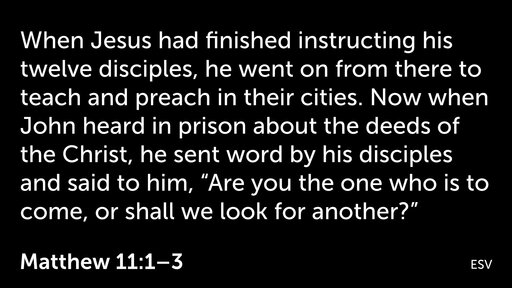
Rather than say “Yes John, i’m the one.” He says Matthew 11:5 “5 The blind see, the lame walk, lepers are cleansed, the deaf hear, the dead are raised, and the poor have good news proclaimed to them.”
Jesus never answers questions very directly. He always is pointing us to deeper and richer meaning. He wants us to think for ourselves.
There are videos that go around online saying “tell me you’re single without telling me your single” or “tell me your married without telling me your married.” One of the most recent ones i saw was a guy with the words across the screen saying “tell me you’re married without telling me your married.” and the rest of the video just shows him wanting to go to bed, but having to clear the mass amount of unnecessary pillows off his bed in order to climb in. Yes, I chose my words wisely and said “Unnecessary.”
Jesus is telling John “I’m going to tell you in the Messiah without telling you im the Messiah.
He wants John to consider the Old Testament. Places all over Isaiah that prophecy of the Messiah doing the things Jesus has accomplished in verse 5. Jesus is pulling together not just one Isaiah prophecy, but many Isaiah prophecies to show he is the one.
If your curious, this Isaiah 26:19, 25:5-6, 29:18, 35:5-6, 42:18, and Isaiah 61:1. Jesus is saying he is the one John has been waiting for and proclaiming. Visible activity confirms the scriptural prophetic blueprint of the Messiah.
Jesus comes to be the compassionate Emmanuel, God with us. God is visiting his people just as he promised.
He expects John to pick up on the evidence, though slow to believe.
John probably could have answered this question himself from the Old Testament. But Jesus takes the time to compassionately answer John, and not just give a quick answer, but carefully helping him realize that God very God is manifested now with humans.
And then we get to verse 6. This little beatitude. “Blessed is the one who is not offended by me.” What and odd thing for Jesus to end with. I’m going to start ending all my conversations this way.
Remember the end of John when Jesus tells the disciples that they believe him because they have seen him, but blessed is the one who believes even though he doesn’t see Jesus.
Unlike the beatitudes in chapter 5 of the sermon on the mount, this one is singular, pointed at an individual decision rather than collective living.
This simple beatitude assumes that the hearer has listened, and maybe begun the journey to follow Jesus, but now needs to avoid stumbling on their way to him.
Choosing Jesus is not something that your parents do for you, or that your spouse does, or your pastor does for you. Choosing Jesus is a personal decision for you to make.
This is also a weird thing for Jesus to say. His message, from the sermon on the mount to the last few chapters, his message has been so offensive! But blessed is the one who isn’t offended.
John is the prototype of many who will find it hard to follow and accept Jesus and what it means for him to be the Messiah in our lives.
This may be a quick allusion to Isaiah 8:13-14 where Isaiah commands his hears to accept the authority of the Lord and not be stumbled by it. The passage says that many in Israel will stumble by the authority and allegiance we have to Jesus.
This is Jesus reminding John that accepting the Messiah is not easy, it’s actually hard for us. To realize, admit that He is who he says he is, and then to submit to him.
He is telling John that rather than focus on what we don’t have, focus on what we have right now in the presence of salvation.
It is not sinful and wicked for us to long for or wish things in our lives were different. We don’t want to have sickness, we don’t want to be in this place of searching for a home. We don’t want to be in the place of being rejected. Maybe we simply want it to be the end times and Jesus to take us out of here. But right now, in this moment, rest in the fact that Jesus has come to heal, to make alive, to bring comfort to us.
Rather than longing for a different circumstance, or Jesus to do something different, we accept who Jesus is right now for us in this moment. He has saved our souls and restored us to God.
We also want to be careful with how we communicate to people on this point.
It’s good to communicate compassion and sympothize with people, but we don’t want to in empathy, play God or apologize for God.
We don’t twist the message of Christ or make him easier to swallow, we accept the reality that suffering is part of God’s plan, but he is with us in the suffering.
The other side of that is not promising that God will make everything better in the here and now. John’s life never got better. Jesus suffered continually in rejection, and eventually a slow and painful death.
We don’t promise people that their lives will get better, and communicate what God does not. But we encourage people not to continue following Jesus because he will make our lives easy and do whatever we want, but because he is the Messiah, the one who brought God to us.
We want to be careful not to interpret Jesus and our relationship to him in our present circumstances. We align our understanding of our circumstances with what the Word of God tells us about Jesus, and who we are in light of him.
We aren’t going to get critical, or bitter, or angry at Christ for the things we go through. We may question him, but we don’t bail on Jesus when it is hard.
Blessed is the one who is not offended by me.
II. Grasping Hard Truths v7-15
II. Grasping Hard Truths v7-15
Next, we grasp hard truths. We are going to soak a bit in verses 7-15.
So the messengers leave, and then Jesus turns to the crowds to defend John and use his doubt, and Jesus’s encouragement, as a teaching point for the crowds.
The problem of John’s doubt was big enough that Jesus needed to address it more publicly. He turns to the crowds.
John has been a man of the people. People loved him and sought him out. The Pharisees are even afraid of him.
Jesus tells the people “what did you go to the wilderness for? It wasn’t for the shaken reeds right?”
You didn’t go to the dessert to look at plants right? I have lived in the desert, not the right place to go look for vegetation.
I lived in Arizona for a while, and then the Mojave dessert of California for a time. And people would say “itsn’t the desert just beautiful?” And I would just not hold back any punches and say a hard “no.” Just crushing peoples realities. Pretty if you like the one color of brown.
Then another illustration in verse 8.
They didn’t go to see a softly clothed man with a easy message that everyone would accept.
This is a funny ironic reference because now John is in a royal palace or the kings house, even though he is a prisoner.
But there is more to what Jesus is saying here also.
You didn’t go to John to hear a message that was quickly swayed like a reed to what you wanted to hear right? John was going to speak hard truths, not tell you what you want to hear, and then follow Jesus.
There is a generation today who are fed up with easy wishy washy progressive Jesus. They want to know the hard truths of who Jesus is and how we follow him. They are hungry for the Word of God and what it says to us.
Like this generation, the people in John’s day liked him and sought him out because he was willing to stand firm in truth and not go with what society wanted.
But it’s also his stubbornness that lands him in prison.
Jesus in a way is defending John. Reminding them that through his doubt, he is not fickle or soft, or passive. Jesus is reminding them of who John really is.
In a way, Jesus is fulfilling the last chapter. Remember when he said “acknowledge me before people and I will acknowledge you to my father?” We know that John has spent his life acknowledging who Jesus is, and now, Jesus is going to defend him to the crowd.
Some think that Jesus is giving a slight comment about Herod Antipas who has imprisoned John. He was supposed to be a great king. And Jesus says, you know who i stand with? The guy in his prison.
Verse 9 reminds us that He was not just a prophet, he was more than a prophet. Because he doesn’t just prophecy, he fulfills what the other prophets said. He is a prophet and fulfills prophecy by prophesying as the one who prepares the way of Jesus.
John is the hinge, or the transition between the promise and the fulfillment.
John is the March in Maine. We have known in January and February that Summer is coming, though hard to believe when the temperature some weeks was single digits every day. But March is the transition, melting the snow, showing us the reality of the situation that Warm Weather is quickly upon us.
John is the transition from Old to New Testament, from promise of the Messiah to the Messiah. Promise of the Kingdom here.
John was a questionable objectional character, and would prepare the way for the even more radical and offensive person of Jesus.
Jesus continues with his defense of John in verse 11 calling him the greatest man to ever live. He elevates John rather than speak ill of his doubt.
And we might say “better than Abraham? Better than Moses? Better than David?”
Jesus says the greatest person ever born. The GOAT as the kids on the street say these days.
Jesus says even though John was the greatest, even the least person in the kingdom of heaven is greater than him.
This is a dynamic shift that happens in this new Kingdom that Jesus is bringing. We should embrace and celebrate the grace we find in this verse.
John proclaimed and told people about the message of a Messiah he hoped for, but didn’t even know in reality. A messiah he knew was promised.
But guess what? We get to proclaim the messiah who we have already experienced and know personally. We are greatest, greater than all the prophets of old, because we get to proclaim the name of Jesus to the lost around us in a way that the prophets of old could have only wished to get to do!
Think about Moses, and Abraham, and Issac, and David, coming up to us in the eternal kingdom and saying “What was it like to know and tell people about Jesus?”
“What was it like to have the perminant Spirit of God in our life?
What was it like to BE the temple of God with your own body?”
So we should do it! We have a message far greater than John because we KNOW Jesus! So we should share it!
The days of John are behind, the kingdom is here now, we are invited right now to join Jesus’s kingdom.
Then we get to verse 12. This verse is very hard to translate. I learned about some of the most challenging verses to translate. Proverbs 26:10, and this one. What is this verse saying?
In greek literature, these terms suffering violence, forceful people are almost always forceful and violent and evil intended.
Some might want to soften this verse and say you have to fight hard to get into Jesus’s kingdom, but we know Jesus’s kingdom is more about accepting than taking.
Jesus isn’t saying we should enter the kingdom through violence if we have to. We do not believe in a Gospel of works to save us, we believe that we accept the free gift of God’s grace being offered to us.
People have been violently trying to take the kingdom of God by themselves. Trying to take it in ways that they want.
Wanting politics that they want, material success, a gospel of their own good news., seeking their own best life now, instead of seeking Jesus and what he is offering.
You might consider the zealots at Jesus’s time and before Jesus’s time desiring to take back Israel by violence rather than submission to God. Jesus is reminding John that he is coming in a different way than these violent grabs.
We see this also in verse 14. If we are willing to accept it. Not take it. Not work for it. Not try to earn it or be worthy of it, because we are not. But rather, we accept what is being offered to us.
To accept John is to accept Jesus. If you think John has come as the spirit of Elijah to prepare the way of the Lord, then Jesus is that Lord that John was preparing the way for.
Jesus secured the kingdom for us, not through violence, but by accepting the violence done to him. He took on all human violence and sin. He took on our judgement and guilt for all of the evils we have done. He took it to the cross for us. So that we could be freed from the violence and the evil of our sin. He took that on to secure the kingdom, and then offer it to us in grace and peace.
One thing that i love in this text is that John is called the greatest. The guy who is in prison, Jesus is going to say is great in his kingdom.
This is wonderful news for us. We look at famous people like John, or the prophets of old, or even modern day speakers, and we say “look how great they are.” But to us, Jesus is saying that the least is the greatest in his kingdom. The ones who think they aren’t enough, the ones who think they could never be like that guy or that girl, the ones who question if they are any use to Jesus, Jesus looks at us and says “Yes, those are the ones who I will use in my kingdom. Give me the least in society.”
To us who follow him, Jesus says we are greater than that. You might not feel like much, you might feel stuck in life. Like you are accomplishing very little for the kingdom of God. You might feel like your gospel witness is small.
But if you who are willing to accept Jesus and the Messiah and Lord of your life, he declares you to be great.
Though you think your work is small, he declares you to be great in his kingdom.
He will declare you as his own.
III. Accepting the Irregular Jesus v16-20
III. Accepting the Irregular Jesus v16-20
Last today, we see accepting the Irregular Jesus. Lets look at verses 16-20.
Jesus ends this discussion with a pointed parable of children playing in the marketplace.
These children are acting Childish. Childish because they did not get what they wanted.
The children wanted someone who would dance to their flute playing and weep with their mourning.
We sometimes have to remind our kids “play and include everyone, not everything has to be your way.” We have one particular kid who love to dominate and have everything their way. And if you don’t play it there way, there will be no playing.
They wanted someone to play their game the way that they want it to be played. But neither John nor Jesus did.
Jesus’s issue with the crowd is that they are too worried about their own game than God’s game.
John was not the prophetic forrunner they wanted him to be, and Jesus was not the messiah they thought he should be.
Verse 18, John was a pretty righteous guy, and they opposed him. John was known for being a separatist, defiant, divergent, rebel. Someone who denied himself of common things.
And Jesus was the opposite. He was a man of the people. So much so that people called him a drunk and glutton. We know he was not, but this was slanderously spoken of him for being in settings with sinners. He compassionately spent time with people.
But Either way, John being divergent, or Jesus being with people, the crowd were going to complain about it.
Then we see this final comment that wisdom is justified by her deeds.
If we are honest, It is easier for us to whine and complain than submit to Jesus’s rule.
We might not like who Jesus is, or what he calls us to be. We might have complaints about some things in the Bible. And it’s easier for us to be upset than to believe and accept who he is, even though it is not what we want or expected.
Jesus’s teaching is not meant to be debated and argued over at a philosophical level. It is meant to be lived out and “proved” to be right. This is wisdom lived out.
Are we ready to set aside our complaints, and the ways we don’t like what Jesus has called us to, and to live out his wisdom with our lives?
Beyond the Walls (Grace and Growth)
Beyond the Walls (Grace and Growth)
If you are here today, and have yet to accept Jesus as your Lord and Savior, today can be the day that you leave your sins, and trust him with your life. I would invite you to come and talk to us more about this after the service.
Maybe you are like John today. Maybe Jesus is not who you thought he would be. Maybe it is harder to follow Jesus than you thought. Maybe your Christian life is not what you thought it would be.
In what ways is he not what we expect or want? In what ways do we need to accept him as the messiah and Lord of our lives?
Maybe you are suffering through family relationships, work situations, financial struggles, friendship struggles, physical ailments, and you are left questioning if Jesus is really there.
Jesus is calling you today to pick up the torch and continue following him.
We should consider it a great privilege, even greater than John the Baptist, to be a part of the kingdom of God and get to serve him.
Those of you doubting and questioning today, you will not be shunned or made to feel guilty here. We welcome the questions and doubt because we know that is exactly where Jesus works. We have a Q and A coming up at the end of this month for just such a thing as questions.
And not just the Q and A. Bring your questions and your doubts all the time! God has give us the body of Christ to help us and encourage us together as we walk through following him. Don’t due it alone. Come and talk to others. Bear one another's burdens.
Adonirum Judson who we started with, get up out of his own dug grave, and accept his task in following Jesus. Accept Jesus for who he is, Messiah and Lord, and continue his work to the burmese people. What seemed like a small man, the least, trampled on, made insignificant, through the awful trials of his life. God would use in mighty ways. He wouldn’t see it in his lifetime, but his goal was to accept Jesus, follow him faithfully, and make much of Jesus. Today, 2 million baptists in Maymar can tie their faith back to God using the least of these, Adonirum Judson, to faithfully be a servant of Christ.
How will he use our faithfulness as we follow the Messiah through difficulty in our life?
Let us take a moment to respond to the text together.
Father, give us understanding for the trials you put us through.
Jesus, help me to believe in you even through the difficulty of my life
Spirit, help me to continually be faithful and not fall away.
