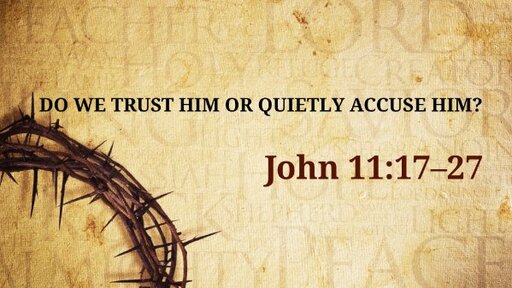
Do We Trust Him or Quietly Accuse Him?

Notes
Transcript
Now when Jesus came, he found that Lazarus had already been in the tomb four days. Bethany was near Jerusalem, about two miles off, and many of the Jews had come to Martha and Mary to console them concerning their brother.
So when Martha heard that Jesus was coming, she went and met him, but Mary remained seated in the house. Martha said to Jesus, “Lord, if you had been here, my brother would not have died. But even now I know that whatever you ask from God, God will give you.”
Jesus said to her, “Your brother will rise again.” Martha said to him, “I know that he will rise again in the resurrection on the last day.” Jesus said to her, “I am the resurrection and the life. Whoever believes in me, though he die, yet shall he live,
and everyone who lives and believes in me shall never die. Do you believe this?” She said to him, “Yes, Lord; I believe that you are the Christ, the Son of God, who is coming into the world.”
As we continue through John chapter 11, we step into one of the most emotionally powerful moments in the entire Gospel. This event takes place only about six days before the crucifixion of Jesus Christ. The tension surrounding Jesus has been building for months, and this miracle will become one of the final moments that pushes the religious leaders to fully commit themselves to putting Him to death. But the story does not begin with the conflict of religious leaders. It begins with something far more personal and painfully familiar to all of us. It begins with a crisis.
As you may remember from Gill’s sermon last week, Mary and Martha send word to Jesus that their brother Lazarus, one of Jesus’ closest friends and followers, is dying.
Gill pointed out how God’s timing can greatly differ from ours. Jesus gets word about Lazarus’ condition and everyone is expecting him to hightail it to him, but Jesus responds by saying they are staying where they are for a couple more days.
Think about that, this was not just an acquaintance or someone from the crowd. Lazarus was someone Jesus loved deeply. The sisters believed without question that if Jesus came, He could heal their brother. Yet before Jesus arrives, Lazarus dies.
That immediately forces us to confront one of the most sobering realities of life in this fallen world. Death is a crisis. Death is the story of humanity ever since sin entered the world.
Scripture tells us that death is not a natural friend of humanity but an enemy that entered the world through sin.
Paul writes in 1 Corinthians 15:26
The last enemy to be destroyed is death.
Death is the great intruder into God’s good creation, the unavoidable reminder that something in this world is deeply broken. Every funeral, every grave, every tear shed at the loss of someone we love reminds us that the world we live in is not the world God originally created. Death is the echo of the fall, and the Bible never pretends otherwise.
But the good news of the gospel is that Jesus Christ came to defeat that enemy once and for all.
By the time Jesus finally arrives in Bethany of Judea, Lazarus has already been in the tomb for four days. John intentionally highlights that detail because it matters. After four days there can be no misunderstanding. Lazarus is not barely alive. This is not a mistake. He is undeniably dead.
In the culture of that time, many believed the spirit lingered near the body for about three days, but by the fourth day there was no hope left. The situation had moved completely beyond human repair.
The delay also allowed many mourners from Jerusalem to gather around Mary and Martha. Their house was now full of grieving people. That means when Jesus acts, there will be no shortage of witnesses to what happens next.
None of this timing is accidental. Jesus did not arrive late because He could not get there sooner. He arrived exactly when He intended to arrive.
Before Jesus even reaches the house, Martha hears that He is coming and immediately goes out to meet Him. What she says when she reaches Him reveals both the heartbreak in her heart and the faith she still carries. She looks at Jesus and says,
Martha said to Jesus, “Lord, if you had been here, my brother would not have died.
You can hear the pain in those words. Martha had a plan. She sent word to Jesus because she believed He could heal Lazarus. In her mind the situation was simple. If Jesus had come when she called for Him, her brother would still be alive. But now, from her perspective, Jesus has arrived four days too late.
Yet beneath her disappointment is something deeply revealing. Her statement actually shows how much confidence she has in Jesus. She was absolutely convinced that if Jesus had been there, Lazarus would have been healed. And then she adds something remarkable in the next sentence.
She says,
But even now I know that whatever you ask from God, God will give you.”
In other words, Martha is saying something like this: “I don’t understand why you didn’t come sooner. I don’t know what you could possibly do now that my brother has been dead for four days. But I still believe you can do whatever you want.”
What we see in Martha at this moment is struggling faith. It is not polished or perfectly confident, but it is real. And the truth is, struggling faith is often very normal when death is involved. Death has a way of shaking us in ways few other things can.
When we stand face to face with it, when we watch someone we love slip away, when grief settles into the room and there are no easy answers, faith doesn’t always come out in neat and confident statements. Sometimes faith sounds like Martha’s words—“Lord, if you had been here.” It’s faith, but it’s faith wrestling with pain.
And that is because death is rarely smooth or tidy for the people who are left to witness it Like Mary and Martha just had. Heck if you’ve seen the obituaries in our little community just this past week, you know what I mean. A sweet fifteen-year-old boy and a forty-year-old man reached a place where they saw no hope left and took their own lives. Those kinds of losses shake a community. They leave families with questions that echo long after the moment has passed.
Death often arrives with heartbreak, confusion, and wounds that don’t heal quickly. The reality is that death, in most cases, is not the peaceful picture we sometimes imagine. It is often harsh. It can be vile. It can be grotesque. And the experience of witnessing it has a way of changing us forever.
I know that reality personally. I was raised by my grandparents, and when my grandpa passed away our whole family was there with him in his room at the care center. On the surface it sounds like a peaceful picture. Surrounded by the people who loved him most, gathered around his bed in those final moments. But the reality of what happened in that room was far from peaceful.
My grandpa was bleeding internally, and the doctors told us there was nothing they could do to stop it. They explained that once the blood filled past his lungs he would essentially drown in his own blood. Hearing that was one thing. Watching it unfold was something entirely different.
As the oldest man in the room, when it started happening and he began choking and coughing blood from his mouth and nose, instinct just took over. I felt like it was my responsibility to step in and hold him, to cover him as best I could so that the last image burned into the minds of my grandma, my mom, my aunts, and my cousins wouldn’t be that moment.
The sounds of it, the sight of it, the weight of what was happening in that room, those things never really leave you. Moments like that change you.
And when you’ve experienced something like that, you begin to understand why faith sometimes sounds like Martha’s faith. Faith that still runs toward Jesus, but faith that carries the weight of grief. Faith that believes He is able, but still wonders why the pain had to unfold the way it did.
And if we are honest, many believers know exactly what that feels like. We believe Jesus has power. We trust Him deeply. Yet when life does not unfold the way we expected, we wrestle with His timing.
In moments of loss or disappointment, the heart begins to ask quiet questions. “Lord, why didn’t you stop this? Why didn’t you intervene sooner? Why didn’t you come when I called?” Martha is not rejecting Jesus, but she is wrestling with the same tension that every believer eventually faces when God’s timing does not match our expectations.
Jesus responds to Martha with a simple statement that carries enormous meaning. He tells her,
Jesus said to her, “Your brother will rise again.”
Martha hears that statement and immediately answers with good theology. She says,
Martha said to him, “I know that he will rise again in the resurrection on the last day.”
Martha understands the Old Testament promises about the resurrection. This was not a new concept to her. From a young age she likely knew passages like,
For I know that my Redeemer lives, and at the last he will stand upon the earth. And after my skin has been thus destroyed, yet in my flesh I shall see God,
Martha affirms this truth. She believes that one day God will raise the dead. She believes that the grave will not have the final word. Her theology is sound.
But there is an important lesson here for all of us. There is a profound difference between knowing the truth of God’s Word and experiencing the power of that truth in our lives. Martha believes in the resurrection someday in the distant future, but she has no expectation that resurrection power could meet her in the present moment. Her faith is real, but it is limited by what she believes is possible right now.
Sometimes our faith can become something we acknowledge as important but rarely put to use in real life.
It reminds me of something many people around here would understand. Imagine someone who owns a really good hunting rifle, one that’s been passed down through generations.
It’s well-built, reliable, and capable of doing exactly what it was designed to do. But instead of ever taking it into the mountains, it just sits locked away in a safe year after year.
Everyone in the family knows it’s valuable. They respect it, talk about its history, maybe even show it off from time to time. But when hunting season comes around, it never actually gets used.
In the same way, faith can become something we respect and talk about without ever truly leaning on it when life gets difficult.
We know the truths of Scripture. We can say the right things about God, about hope, about resurrection. But when the crisis hits, when grief shows up at our door or life throws something at us we didn’t expect, those truths can remain tucked away like that rifle in the safe instead of being the very thing we take hold of and rely on.
A person can know the right answers, recite the right verses, and affirm the right doctrines while still living as though those truths have little impact on their everyday experience.
That reality can be true for someone who only attends church once a year, and it can also be true for someone who sits in church every week, attends Bible studies, and knows Scripture well. It is one thing to know the answers; it is another thing entirely to experience the transforming power of the truths we confess.
Real faith isn’t just something we admire from a distance. It’s not just the knowledge we gain and retain. It’s something we bring into the moments when life gets heavy. It’s trusting the truth of who Jesus is when we’re standing in the middle of circumstances that make no sense at all.
I had a good friend call me this week and share some very deep, dark struggles with me, and he asked me if I did blessings. I explained that I know different churches have different ideas of what those blessings look like some use oils and stuff, I told him the only thing I really know is that we get together and cry our to God for help in this situation.
Because it’s not the process or the substance we use in the blessing that I have faith in, but the faith in the One who hears are prayer that makes all the difference.
And those moments always lead us to ask ourselves the most important question like the one we’ll see here as we see Jesus respond to Martha’s heavy heart with one of the most profound declarations in all of Scripture. He says to her,
Jesus said to her, “I am the resurrection and the life. Whoever believes in me, though he die, yet shall he live, and everyone who lives and believes in me shall never die. Do you believe this?”
This statement is the fifth of the famous “I AM” declarations in the Gospel of John, and with these words Jesus is making an unmistakable claim about His identity.
Notice carefully what Jesus does not say. He does not say, “I have the power to resurrect people,” or “I am able to give life.” Instead, He makes a far greater claim. He says, “I am the resurrection and the life.”
In other words, resurrection is not merely an event that will take place at the end of time. Resurrection is found in a person, and that person is standing right in front of Martha. Life is not merely something Jesus distributes to others. Life exists in Him because He Himself is the source of life.
This truth sets Jesus apart from every other person who has ever lived.
You and I possess life, but it is fragile and temporary. It can be taken from us at any moment. Jesus, however, does not simply possess life. He is life itself.
Later He will willingly lay down His life on the cross, but when He rises again it will prove that death itself has no authority over Him. Death cannot defeat the one who is the very source of life.
The miracle that is about to happen with Lazarus is not only about Lazarus. Throughout the Gospel of John, the miracles of Jesus function as signs that reveal deeper spiritual realities.
For example, in John chapter 5 Jesus heals a man who has been paralyzed for years. The man cannot move himself toward healing, he’s paralyzed. In the same way, spiritually speaking, humanity is unable to move toward God unless God moves first.
In John chapter 9 Jesus gives sight to a man who was born blind. The man cannot find Jesus because he cannot see Him, but Jesus finds him and opens his eyes. That miracle illustrates the spiritual blindness that exists in every human heart until God opens our eyes to the truth.
Here in John chapter 11, the picture becomes even more sobering. Lazarus is not sick. He is not struggling or weak. He is dead. He is a corpse wrapped in burial cloths and sealed inside a tomb.
Scripture uses this image to help us understand our spiritual condition apart from Christ.
Ezekiel once described sinners as a valley full of dry bones, bones that were completely lifeless and scattered across the ground. They were not injured bones or sick bones; they were dead bones. What those bones needed was not encouragement or advice. What they needed was the voice of God speaking life into them.
Thus says the Lord God to these bones: Behold, I will cause breath to enter you, and you shall live. And I will lay sinews upon you, and will cause flesh to come upon you, and cover you with skin, and put breath in you, and you shall live, and you shall know that I am the Lord.”
That is why the message of the gospel is so radical. The Bible does not teach that people simply need moral improvement or a fresh start. The Bible teaches that we need resurrection. We do not need spiritual spring cleaning; we need a new heart.
The same voice that will soon call Lazarus out of the tomb is the voice that still speaks life today through the Word of God.
Jesus Himself said in John 6:63
It is the Spirit who gives life; the flesh is no help at all. The words that I have spoken to you are spirit and life.
The Word of God carries the power to awaken those who are spiritually dead.
Because of this, the power of the church has never been found in our fleshly works, behavior modification, clever programs, impressive strategies, or charismatic personalities. The true power that changes hearts and transforms lives is the Word of God proclaimed and the Son of God revealed.
Only the voice of Christ can bring spiritual life to those who are dead in sin.
Yet Jesus’ promise in this passage extends beyond the present moment and points to the future hope of every believer. Scripture teaches that the bodies we currently live in are temporary. The apostle Paul describes them in 2 Corinthians 5 as tents, temporary shelters meant for a short stay. A tent is not a permanent home. It is something used while passing through.
In the same way, our earthly bodies are temporary. But those who believe in Christ are promised something far greater. One day Jesus will raise His people and give them glorified bodies that will never experience sickness, pain, or death again.
He will wipe away every tear, undo the sorrow of this broken world, and make all things new. The hope of the Christian life is not that we will float through eternity as disembodied spirits. The hope is resurrection life in a restored creation where death itself has been defeated.
After revealing these truths, Jesus asks Martha a question that reaches far beyond the moment they are standing in. He asks, “Do you believe this?”
That question echoes through every generation and reaches every heart that hears the gospel.
It is not a question about whether we believe Jesus can solve a problem or perform a miracle. It is a question about whether we believe who He truly is.
No one else can answer that question for us. Our parents cannot answer it for us, and our spouses cannot answer it for us. Our church attendance record cannot answer it for us. Each person must respond personally to the question Jesus asks: Do you believe this?
Martha responds with a beautiful confession of faith. She says,
She said to him, “Yes, Lord; I believe that you are the Christ, the Son of God, who is coming into the world.”
Martha does not yet fully understand what Jesus is about to do, but she anchors her faith in the most important truth of all: the identity of Jesus. She recognizes that He is the promised Messiah, the Son of God sent into the world to rescue His people from death.
This is where real faith always begins. Faith does not begin with perfect understanding or flawless people.
Faith begins with trusting the person of Jesus Christ. Scripture makes it clear that salvation is not earned by human effort. Jesus has already accomplished everything necessary for our salvation. Romans 10:9 tells us that if we confess with our mouths that Jesus is Lord and believe in our hearts that God raised Him from the dead, we will be saved.
Even for those who feel their faith is weak, there is great comfort in remembering that we are not saved by the strength of our faith but by the strength of our Savior. Faith is simply the instrument through which we trust Him. The power of salvation rests not in our ability to believe perfectly but in the One we believe in.
And so the question Jesus asked Martha is the same question He places before every one of us today.
Do we believe that He truly is the resurrection and the life?
Do we trust Him even when His timing confuses us?
Do we trust Him when circumstances feel beyond repair and hope seems buried beneath the weight of grief?
Because sometimes, Jesus allows situations to reach what feels like the fourth day, the moment when hope appears completely gone and the stone seems permanently sealed.
Yet it is often in those very moments that He reveals most clearly who He truly is. The story of Lazarus reminds us that Jesus is never late. He is always working according to a greater purpose, revealing His glory and demonstrating that He alone holds the power over life and death.
Amen? Amen!
Let’s Pray.
