Jonah 3.9-The Basis for the Decree Was to Cause God to Change His Mind

Doctrinal Bible Church
Pastor-Teacher Bill Wenstrom
Sunday March 22, 2026
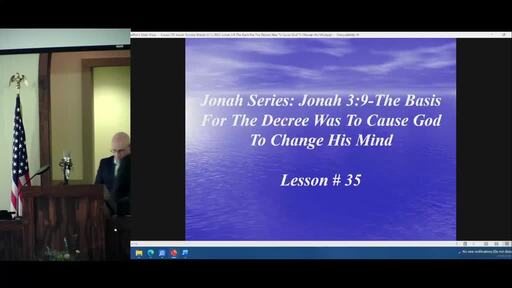
Jonah Series: Jonah 3:9-The Basis For The Decree Was To Cause God To Change His Mind
Lesson # 35
Jonah 3:9 records the king of Nineveh revealing the basis for the decree, namely to cause God to change His mind and relent from destroying Nineveh, thus sparing the lives of the Ninevites.
Jonah 3:1 Then the word of the Lord came to Jonah a second time: 2 “Go to the great city of Nineveh and proclaim to it the message I give you.” 3 Jonah obeyed the word of the Lord and went to Nineveh. Now Nineveh was a very important city—a visit required three days. 4 On the first day, Jonah started into the city. He proclaimed: “Forty more days and Nineveh will be overturned.” 5 The Ninevites believed God. They declared a fast, and all of them, from the greatest to the least, put on sackcloth. 6 When the news reached the king of Nineveh, he rose from his throne, took off his royal robes, covered himself with sackcloth and sat down in the dust. 7 Then he issued a proclamation in Nineveh: “By the decree of the king and his nobles: Do not let any man or beast, herd or flock, taste anything; do not let them eat or drink. 8 But let man and beast be covered with sackcloth. Let everyone call urgently on God. Let them give up their evil ways and their violence. 9 Who knows? God may yet relent and with compassion turn from his fierce anger so that we will not perish.” 10 When God saw what they did and how they turned from their evil ways, he had compassion and did not bring upon them the destruction he had threatened. (NIV84)
“Who knows?” is a rhetorical question that expresses the king’s hope that God would change His mind and relent from overturning Nineveh.
In Jonah 3:4, we noted that this verse is a temporal clause that tells the reader that the Lord would overturn Nineveh at the end of forty days.
This verse records an announcement of judgment that was conditional rather than an unconditional and obviously implies to the Ninevites that the Lord wants them to repent since He could have destroyed them immediately without warning.
The forty days leaves room open for repentance.
This is also indicated by the fact that in Jonah 3:4, the verb hā∙p̄ǎḵ (הָפַךְ), “will be overturned” is ambiguous since it can signify “judgment, a turning upside down, a reversal, a change, a deposing of royalty, or a change of heart.”
Therefore, Jonah’s message from the Lord can be interpreted by the Ninevites as “at the end of the forty days Nineveh will be destroyed” or “at the end of the forty days Nineveh will have a change of heart.”
The Lord didn’t need forty days to muster up the power and resources to destroy the city since He could do it immediately.
So the Lord told Jonah that Nineveh would be changed, turned upside down but whether for good or evil, he did not know and neither did the Ninevites.
The Ninevites response to the message would determine the city’s destiny.
If God had intended to wipe out Nineveh, what reason was there for Him to tell the Ninevites about it, and then send Jonah to inform the people of Nineveh of His intention.
God tells of judgment in advance so as to afford an opportunity for men to repent.
The Lord’s desire was not to destroy the city of Nineveh but rather His will was to forgive them and show mercy to them even though they rebelled against Him.
Jonah knew this about the Lord and did not like it.
So the rhetorical question in Jonah 3:9 expresses the king’s hope that God would change His mind and relent from overturning Nineveh at the end of forty days.
This announcement of judgment against Nineveh was conditional.
Therefore, God changed His mind in the sense that He did not act on this announcement as a result of observing the king and his subjects humbling themselves before Him by fasting and clothing themselves in sackcloth and crying out to Him for mercy and forgiveness.
It also acknowledges that God who is holy would be justified in overturning their city for the wicked conduct towards others.
“God” is the masculine plural form of the noun ʾělō∙hîm (אֱלֹהִים), which emphasizes the transcendent character of God and in particular His attributes of omnipotence, sovereignty and love.
The narrator uses ělō∙hîm rather than Yahweh since he wants to emphasize that the Ninevites who were Gentiles were not members of the covenant nation of Israel.
It is also used to emphasize that Yahweh is God, the only true God.
“Turn” is the verb šûḇ (שׁוּב), which means “to turn,” i.e. “to change one’s mind about taking a certain course of action, to abandon the decision to take a certain course of action.”
Here it is used of God changing His mind about overturning Nineveh at the end of forty days as a result of seeing the Ninevites fasting and putting on sackcloth and crying out to Him for mercy and forgiveness.
In other words, it refers to Him abandoning His decision to overturn Nineveh at the end of forty days as a result of seeing the Ninevites fasting and putting on sackcloth and crying out to Him for mercy and forgiveness.
This verb refers to God’s mind or thinking whereas the verb nā∙ḥǎm (נָחַם) speaks of God acting upon what He is thinking.
This verb is used in an anthropopathic sense meaning that the human characteristic of changing one’s mind is ascribed to God even though He doesn’t change His mind.
This figure is used by the writer in order to convey the Lord’s decision to not overturn Nineveh at the end of forty days in terms that the reader can understand.
“Relent” is the verb nā∙ḥǎm (נָחַם), which means “to relent” in the sense of ceasing from taking a particular course of action, usually with emphasis upon a gracious act.
Here the word is used of course with God as its subject.
Therefore, the verb refers to God graciously not acting upon His decision to overturn Nineveh at the end of forty days as a result of seeing their actions as recorded in verses 6-8.
“Turn” is the šûḇ (שׁוּב), which is again used of God but this time it is used of Him abandoning His decision to overturn Nineveh at the end of forty days and means “to turn from” or “hold back” and is used again in anthropopathic sense of God “turning” from exercising His anger or “holding back” from exercising His anger.
God does not get angry as humans.
This word is language of accommodation so that the reader can understand from the human perspective the seriousness of the situation in Nineveh and God’s displeasure with the Ninevites.
“His fierce anger” denotes the intensity of God’s anger or righteous indignation towards Nineveh.
The righteous indignation is based upon concern for the holiness of God whereas the latter is emotional, selfish, self-centered, vindictive and intent on harming another.
God’s righteous indignation is the legitimate anger towards evil and sin since both are contrary to His holiness or perfect character and nature.
To summarize, Jonah 3:9 reveals the basis for the decree issued to the Ninevites by its king and his nobles and the rhetorical question “who knows?” expresses the king of Nineveh’s hope that God would change His mind and relent from destroying Nineveh at the end of forty days.
The statement “God may yet relent” refers to God abandoning His decision to overturn Nineveh at the end of forty days as a result of seeing the Ninevites fasting and putting on sackcloth and crying out to Him for mercy and forgiveness.
It refers to God graciously not acting upon His decision to overturn Nineveh at the end of forty days as a result of the Ninevites fasting and clothing themselves in sackcloth and crying out to Him for mercy and forgiveness.
“Turn from his fierce anger” refers to God refraining from exercising His righteous indignation.
So in Jonah 3:9 the king of Nineveh is expressing the hope that God would have mercy on his city and forgive them of their sins.
He is acknowledging that the God of Israel, Jonah’s God, Yahweh is sovereign over him and his city.