Just Come!

A Consuming Fire • Sermon • Submitted • Presented • 55:34
0 ratings
· 5 viewsThe journey to the cross and to resurrection is a heart-searching, soul-cleansing journey. It can be a painful journey, like it was for Jesus. Yet, because of Jesus, it can also be a healing, renewing, redemptive journey. Fire can destroy, or it can refine. On this first Sunday of Lent, we respond to the invitation of GOD to join Him in His rest.
Files
Notes
Transcript
Handout
Greeting
Good morning! My name is Joel Cossins, and I’m the pastor here at Libby COTN. I’d like to welcome all of our guests here today, especially to those of you checking us out online. Hello! If you’ve not yet visited us in person, I look forward to the day we can welcome you to our fellowship. You should know when you visit, you will most likely be invited to stay after, as we have a potluck every Sunday after the service—unless otherwise noted. So, come hungry for an encounter with JESUS and bring your appetite for food, as well!
Announce text: Psalm 95
Key Text: Psalm 95
Review
Thank you to all of you who were able to come to the Ash Wednesday service, and thank you for the feedback. It was a special time, and as I said then, I really believe it was a pivotal moment for us—and I believe this season of Lent is a pivotal season for us in the midst of what I believe the LORD is calling a season of change.
Testimony
Excitement
Ash Wed & Lenten season—what GOD did, is doing, will do in and through us during this journey
Smoothly—then shift
hell breaks loose (multiple people)
little wonder, this is a pivotal moment
at some point, realization this was the way it would be
experienced before—not fun, not pleasant
much prefer feeling the fire of HS
shaking, pruning, burning > purification
GOD is breaking loose some things in this body to prepare for something greater on the way through and on the other side of this season
testimony to GOD’s timing (tie-togethers, as Linda has made famous amongst us)
Remember last Sunday?
skipping ahead to fasting thinking it was about sticking with group of religious practices for concluding that portion
realizing only after that Lent started the following Wednesday
Lent a season of prayer & fasting
then unction of HS to call us to a corporate fast during the Lenten season
Well, last Wednesday, it was more of the same
Curriculum for the season
From the opening invocation—praying that the spiritual practices of our inner lives would lead us to think and act differently in our outer lives
In fact last line of prayer echoes what GOD spoke last Sunday, “May our fasting done in secret lead us to Christlike love in public.”
So, from the opening invocation to the Gospel reading right before the sermon (Matthew 6:1-6, 16-21)
and the main passage for the sermon itself (Isaiah 58)
quick summary?
One giant tie-together
Never knew any of that prior to beginning of this week when preparing for the service on Wednesday
For those who weren’t able to be there, you missed out on a special moment, but you’re still just as much a part of this as we journey through the Lenten season together. So, here’s what was missed or a review of what was covered depending on your perspective.
The Ash Wednesday service was liturgical worship—meaning a structured service that was filled with interspersed Scripture readings, hymns & modern worship songs, responsive readings, prayers, a short sermon (if there is such a thing), imposition of ashes (I’ll explain that more in a minute), and communion. I provided handouts for the service with excerpts from our devotional book that I thought would be useful for the start of this season—including more examples of alternative forms of fasting.
Speaking of fasting, how is your fast going? Remember: the call is for all of us to fast in some way & to seek GOD on the transformation HE wants to bring to our three areas of focus: individuals & families, our church body, our community. We’re all in this together.
SIDE NOTE: Linda collected the unused handouts to pass out to her Sunday School class. If you would like a copy, please see Linda or me after the service, and we will see that you get one.
We briefly discussed the meaning of Ash Wednesday:
Ash Wednesday is a day of repentance and reflection on which we contemplate our mortality and our dependence on God that leads us into a season of fasting. Here’s an excerpt from our devotional that describes the journey through the Lenten season:
The word “Lent” comes from an Old English word meaning “spring.” Images of new growth and new beginnings are appropriate for this season. The journey will take forty days of soul searching. While forty isn’t a magic number, it does refer to significant periods of journeying in the Bible: Jesus’s forty days in the wilderness or Moses’s forty days on Mount Sinai, for example. For us today, forty days offers time to set new habits and rhythms. The forty days in Lent do not count the Sundays because Sundays are for worship and celebration. Some long-accepted practices have helped many Christians in their Lenten observances throughout history. We do not direct these practices ourselves; instead, throughout the entire season of Lent, we respond to God’s nudging in order to journey and be formed in the ways that God wants from us. Some of the historic practices of the church through the season of Lent include fasting, confession and repentance, praying in solitude, and service to others.
Ash Wednesday includes a special moment—the imposition of ashes. This might be new to some, so I want to explain what that is. The term imposition carries several meanings that sound heavy, but this spiritual rite (r-i-t-e) in the church, at its core, simply denotes the act of putting something onto another. The ritual’s primary observable action is exactly that: the minister or priest imposes the ash onto the forehead. While “imposition” can imply an unwanted demand, in the liturgical context it is inviting believers to a deeper awareness.
The imposition of ashes on Ash Wednesday symbolizes mortality, repentance, and the beginning of a season of spiritual renewal. Christianity often frames repentance as taking on a spiritual burden: acknowledging sin, embracing humility, and committing to change. The “burden” is meant to be lightened by grace, turning the weight into hope for renewal. The ashes embody that burden, not as a punitive load (punishment) but as a reminder that we need GOD’s mercy. The ashes, typically made by burning the palm branches from the previous year’s Palm Sunday, serve as a powerful reminder of human fragility and the need for humility before God. The words spoken during the ritual—"Remember that you are dust, and to dust you shall return"—echo Genesis 3:19, grounding believers in the reality of death and the transient (only in place for a time) nature of life. This act is not meant to inspire shame but to awaken a call to repentance and faith, acknowledging that all people are sinners in need of God’s mercy. The cross drawn in ashes on the forehead also affirms a Christian’s identity as a follower of Jesus, marking the start of Lent—a 40-day journey of fasting, prayer, and alms-giving leading to Easter. Far from being a gloomy gesture, the ashes point toward hope and resurrection, reminding believers that from dust, God can bring new life.
This is what I believe Ash Wednesday was for us—a catalyst for new life. In fact, I heard HS quote a verse I included in the service and do so again now:
19 Behold, I am doing a new thing; now it springs forth, do you not perceive it? I will make a way in the wilderness and rivers in the desert.
We closed out the service by reading a devotional and listening to a hymn about the cross.
Read “Take Up Your Cross” from Experiencing GOD devotional
What is your cross? Are you walking in GOD’s will for your life this morning?
May the fasting we do this Lenten season—the minor discomfort it might bring—produce in us a Christlike love that leads to transformation of the heart, soul, mind, and strength in us and in those around us.
pause for transition to today’s message
Have you ever felt out of place somewhere? Maybe you were in a new location with a lot of new people, so you were not sure how to act, and you felt like you were the odd one out. Or maybe you badly misread the dress code, so you showed up overdressed or under-dressed. Or maybe you were in a new position of authority or leadership and felt woefully unqualified.
When you’re in a situation like that, you can’t help but wonder if anyone can tell how uncomfortable you feel. You can’t help but think everyone is staring at you and wondering what you of all people are doing there. Everyone else belongs, but you are an imposter.
In Psalm 95 we find an incredible description of God—and, somehow, we of all people are invited into this incredible God’s presence.
Announce text again: Psalm 95
Scripture Reading
Scripture Reading
1 Come, let us sing for joy to the Lord; let us shout aloud to the Rock of our salvation.
2 Let us come before him with thanksgiving and extol him with music and song.
3 For the Lord is the great God, the great King above all gods.
4 In his hand are the depths of the earth, and the mountain peaks belong to him.
5 The sea is his, for he made it, and his hands formed the dry land.
6 Come, let us bow down in worship, let us kneel before the Lord our Maker;
7 for he is our God and we are the people of his pasture, the flock under his care. Today, if only you would hear his voice,
8 “Do not harden your hearts as you did at Meribah, as you did that day at Massah in the wilderness,
9 where your ancestors tested me; they tried me, though they had seen what I did.
10 For forty years I was angry with that generation; I said, ‘They are a people whose hearts go astray, and they have not known my ways.’
11 So I declared on oath in my anger, ‘They shall never enter my rest.’ ”
Introduction
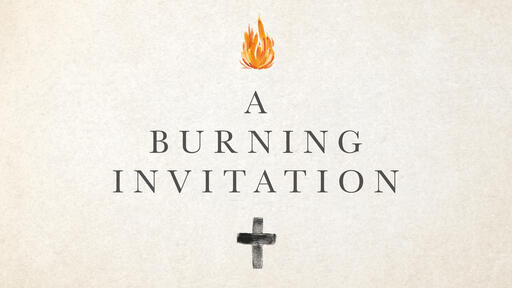
The title of our message this morning is A Burning Invitation.
Psalm 95 presents a heartfelt appeal for worship, emphasizing both celebration and caution as it invites us to acknowledge God's power and mercy while reminding us of the importance of listening to His voice and not hardening our hearts.
Big Idea: Worship is an active engagement that requires both joy and a vigilant heart, calling us not only to celebrate God’s majesty but to continually seek His presence and guidance in our lives.
In this passage, we discover that genuine worship not only involves celebrating God’s goodness but also requires a posture of humility and responsiveness to His guidance and word, urging those who will listen to avoid spiritual complacency.
There are four observances in our text this morning that we will be looking at. The first observance we will look at is:
GRACE IN THE TEXT
GRACE IN THE TEXT
The God of the universe invites us to come into God’s rest.
In vv.4-5, we have this vivid description of the God of the universe:
4 In his hand are the depths of the earth, and the mountain peaks belong to him.
5 The sea is his, for he made it, and his hands formed the dry land.
This is a God of great majesty and glory and worth! This is the great King!
If you want to talk about being out of place in a situation, talk about humanity in the presence of our Creator.
God is a God of whirlwinds (see Job 38) whose robe hem is so big that it fills an entire temple (see Isaiah 6).
We, on the other hand, were made from dust, and someday to dust we shall return.
We remembered this reality of our mortality and our humility on Ash Wednesday.
You can’t be more underdressed or unqualified than a human is before the Creator.
Yet we are also “the people of God’s pasture, the flock under God’s care” (v. 7).
Psalm 95 invites us three separate times in three different ways to come and worship:
There are three different verb forms used to extend the invitation.
Verse 1: Lĕkŭ from hălak (haw-lack), which means “go” or “walk”
Verse 2: Qādam (pr. ka-dam), which means “meet” or “go before”p
Verse 6: Bô (pr. bow[& arrow]), which means “go in” or “enter in”
Come. Come. Come.
Come and worship.
Come into his presence, woefully underdressed and ill prepared though you may be. God stills invites.
While there is a celebratory aspect of worship reflected in the text that sets the tone for awakening our hearts to God's presence and majesty, there is a sudden transition which leads us to the second observance in our passage this morning:
TROUBLE IN THE TEXT
TROUBLE IN THE TEXT
The Israelites were hard of heart.
This invitation in Psalm 95 was given to the Israelites, and they should’ve known the value of the invitation.
God rescued them out of slavery in Egypt and defeated the mighty Egyptian army.
They experienced the miraculous gift of manna and quail as they wandered in the desert wilderness.
Yet in Exodus 17, they went to Moses, demanding water, and began to quarrel with him.
3 But the people were thirsty for water there, and they grumbled against Moses. They said, “Why did you bring us up out of Egypt to make us and our children and livestock die of thirst?”
Although Exodus 17 is the specific situation referenced in Psalm 95:8–9, it is far from the only time that the Israelites grumbled and made ungrateful demands of God.
They repeatedly said it would’ve been better to die enslaved in Egypt than to journey in the wilderness with God.
Have you ever grumbled at GOD in the wilderness seasons of your life? Have you ever focused on the difficulty of a situation—perhaps a perceived lack—instead of focusing on GOD’s provision—all the ways GOD has provided for you?
While we often look at and talk about Israel’s unfaithfulness, we don’t often recognize the “log” in our own eye. This is the third observance from our text.
TROUBLE IN THE WORLD
TROUBLE IN THE WORLD
We are like the Israelites in that we often do not trust God for the journey.
In Lent, we have begun our own journey with God through the wilderness.
The forty days that we observe Lent echo the forty years the Israelites spent in the wilderness and the forty days Jesus spent in the wilderness, when he was tempted by the devil.
The wilderness is not a fun, easy location.
In some ways, the Israelites were absolutely right to be worried about the practical realities of food and drink and of safety from other nations.
They were a relatively small group journeying through a desert with seemingly no destination and no tangible protection.
When we’re experiencing the wilderness, it’s easy to romanticize the past, no matter how bad the past was. When they were hungry and thirsty in the wilderness, the Israelites didn’t remember the back-breaking, punishing hours of work the Egyptians forced upon them. They only remembered having enough to eat and drink when they were hungry and thirsty. It was easy for them to begin to think that maybe they were better off in Egypt rather than out there, alone, in the wilderness.
Except that they were not journeying alone. They were in the presence of the living God.
They had a pillar of cloud by day and a pillar of fire by night to guide them (see Exodus 13:21–22).
Deployment to Saudi
Desert Rose
- hot, dry, arrid
- sunburned
- thirsty
- why am i doing this?
- hard work
- dig deep enough
- something beautiful reveals itself
Something beautiful can be found in the wilderness seasons when we dig deep with the FATHER.
God’s invitation to the children of Israel to be in HIS Presence and rest was still relevant in the wilderness—which leads us to the fourth and final observance from our text.
GRACE IN THE WORLD
GRACE IN THE WORLD
God still calls. Will we listen and come?
God’s invitation to rest in God’s presence is still relevant for us in our journey in the wilderness too.
The wilderness is not easy. Lent is not an easy journey. After all, our destination is the cross.
And during these forty days we will be asked to examine ourselves, even the things we would like to keep hidden.
We will be forced to slow down, to reckon with our sin and with the brokenness of the world around us.
We will be faced with calls for repentance.
We will end up at the cross, where we will be forced to realize that our own voices have cried out, “Crucify him!”
No, it is not an easy journey. But praise be to God that we do not go alone. The invitation to come into God’s presence still stands. And God’s presence still goes with us even in the wilderness.
If only we will enter into it.
If only we will trust God for the journey and humble ourselves to listen.
If only we would train ourselves to hear and recognize God’s voice.
So, pj … What’s the point?
Conclusion
Conclusion
As we conclude this message on "A Burning Invitation" from Psalm 95, let us remember that the majestic Creator—whose hands hold the depths of the earth and the mountain peaks—invites us, dust-formed and often feeling unqualified, into His rest. For those who have felt out of place, like an imposter in a crowd or overdressed for the occasion, envision this: accepting God's call means stepping into His presence with joy, bowing in humility, and finding belonging as sheep under His care. No longer outsiders, we become part of His flock, guided by the pillar of His light through life's wilderness.
As a church body during Lent, we embrace this invitation through prayer and fasting—journeying together in the wilderness like Israel and Jesus, softening our hearts to hear His voice. May we respond today: celebrate His majesty with shouts of praise, recognize Him as King above all, kneel in worship as His people, and heed the warning against hardened hearts. Trust God for the journey; He still calls us to enter His rest.
Closing prayer & Introspection for Communion
Let us pray: Heavenly Father, thank You for Your burning invitation. Soften our hearts, draw us near, and lead us into Your rest. In Jesus' name, Amen.
invite ushers for communion & read devotional
Communion
24 and when He had given thanks, He broke it and said, “This is My body, which is for you; do this in remembrance of Me.”
25 In the same way He took the cup also after supper, saying, “This cup is the new covenant in My blood; do this, as often as you drink it, in remembrance of Me.”
Benediction
24 The Lord bless you, and keep you;
25 The Lord make His face shine on you, And be gracious to you;
26 The Lord lift up His countenance on you, And give you peace.’
27 “So whenever they use my name to bless the Israelites, I will bless them.”
So, receive and go with the blessings of YAHWEH!
