Easter He is Risen

Notes
Transcript
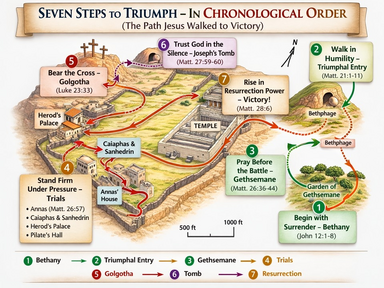
Seven Steps to Triumph
Rev. Derek Geldart
Easter / John 12:1-8; Luke 10:38-42; Matthew 21:1-11; Zechariah 9:9; Matthew 26:36-44; Luke 22:41-44; Matthew 26-27; Isaiah 53:7; Luke 23:33; Luke 9:23; Matthew 27:59-60; Matthew 28:1-6
Today, I want to take you on a journey-one that is familiar, and yet one we must never allow to become ordinary. It is a journey we must not only remember-but one we must live. Because if we are not careful, If we are not careful, Easter becomes a moment we celebrate instead of a reality that transforms us. A season of new clothes, chocolate bunnies, and tradition, or perhaps one of the few times in a year someone steps into a church. But Easter was never meant to be reduced to a moment; it was meant to be a life-altering reality.
The word "triumph" is defined as joy or satisfaction resulting from a great victory or achievement, and when we think of triumph, we often picture success, comfort, and everything going right [1]. Yet Easter confronts that way of thinking, because the path to Christ's triumph did not look like victory at all. It began with a call, "Repent: for the kingdom of heaven is at hand" (Matthew 4:17), and it led to a mission, "The Son of man came... to give his life a ransom for many" (Mark 10:45). Today, I want to walk that path with you-what Scripture calls the Passion Week-from Bethany, through Gethsemane, into the courts of injustice, up to Golgotha, and finally to the empty tomb. And here is what I want you to see: The triumph of Easter is this: what looked like defeat was actually God's greatest victory. But this is not just history; this is an invitation-an invitation to step into God's grand story of redemption, not merely to observe the cross, but to participate in it. For the Bible tells us, "We are buried with him by baptism into death... that we also should walk in newness of life" (Romans 6:4). So, my prayer today is that by the end of this journey, we will not simply understand Easter more clearly, but that we will see ourselves as recipients of His grace and, by faith, join in the death and resurrection of our Lord.
Begin with Surrender - Bethany
Listen carefully to how John begins the story of Passion Week, because in it we find the first step to triumph-a step that does not look like victory at all. It was six days before the Passover when Jesus came to Bethany to dine with Lazarus, Martha, and Mary (John 12:1-3). Yet beneath the surface of this quiet evening was a rising storm. In the previous chapter, the religious leaders had already conspired together to put Jesus to death (John 11:53), and now even Lazarus-a living testimony to Christ's power-was marked for death as well (John 12:10). The Passover was approaching, and the true Lamb who would take away the sins of the world was not an animal on an altar, but the very Son of God seated at that table. In that moment, Mary did something extraordinary. She took a pound of costly perfume-worth nearly a year's wages [2]-and anointed Jesus' feet, then wiped them with her hair (John 12:3). This was no ordinary act of devotion; it was an act of surrender, humility, and costly love. Perfume like this was often used for burial, and without fully realizing it, Mary was preparing the body of Christ for the cross that was soon to come. While Judas objected, cloaking greed in false spirituality (John 12:6), Jesus affirmed her sacrifice, saying, "Leave her alone... it was intended that she should save this perfume for the day of my burial" (John 12:7-8).
The most meaningful gifts are not measured by what they are worth-but by what they cost us [3]. This forces us to ask: how will we respond to the sacrifice of Christ? Will we remain indifferent, like the lukewarm church of Laodicea (Revelation 3:15-16), or will we, like Judas, appear devoted while our hearts remain far from Him? Or will we see Him for who He truly is-the eternal Son of God who emptied Himself (Philippians 2:5-7) and came to give His life as a ransom for many (Mark 10:45)-and respond with humble, wholehearted surrender? If Easter teaches us anything, it is this: triumph begins not with gaining, but with giving; not with exaltation, but with surrender. And so, as we begin this journey, we must first confess that too often we treat Him as ordinary, offering Him little more than words, when He is worthy of our whole lives.
Walk in Humility - The Triumphal Entry
The second step to triumph comes as Jesus arrives in Jerusalem-and it is a step marked not by power, but by humility. For three years, Jesus had been calling disciples, preaching the truth, teaching with authority, and healing the sick. Yet throughout much of His ministry, He had restrained public declaration of His identity. But now, the appointed time-set before the foundation of the world-had come (1 Peter 1:18-20). As He approached the Mount of Olives, Jesus sent His disciples ahead with specific instructions: they were to go into a nearby village and bring back a donkey and a colt, saying simply, "The Lord hath need of them" (Matthew 21:3). This was no random detail-it was the fulfillment of prophecy, spoken centuries earlier:
Zechariah 9:9 NIV
Rejoice greatly, Daughter Zion!
Shout, Daughter Jerusalem!
See, your king comes to you,
righteous and victorious,
lowly and riding on a donkey,
on a colt, the foal of a donkey.
The disciples obeyed, bringing the animals and placing their cloaks upon them, and Jesus sat upon this humble seat (Matthew 21:6-7). As He entered the city, a great crowd gathered. They spread their cloaks on the road and cut branches from the trees, laying them before Him, crying out:
Matthew 21:9 NIV
"Hosanna to the Son of David!"
"Blessed is he who comes in the name of the Lord!"
"Hosanna in the highest heaven!"
Matthew tells us that the whole city was stirred, asking, "Who is this?" (Matthew 21:10)
And that question still echoes today.
If you had been there that day, would you have laid your cloak on the road? To lay down your cloak was to offer honor, submission, and allegiance to a king. Yet this King did not come like the rulers of this world. Earthly kings rode on war horses, clothed in splendor and power-but Jesus came riding on a donkey, a symbol of peace and servanthood. He came not to conquer Rome, but to conquer a far greater enemy-sin, death, and Satan himself. What looked like weakness was power under control. What looked like humility was the very pathway to victory. This is the second step to triumph: humble surrender to the King. The people welcomed Him with their voices, but many would soon reject Him with their hearts. And we must ask ourselves the same question: do we truly honor Him as King, or do we simply admire Him from a distance? Because Jesus did not come to fit into our expectations-He came to rule over our lives. And His triumphal entry reminds us that true victory is not found in asserting ourselves, but in bowing before the One who is both righteous and victorious (Zechariah 9:9).
Pray Before the Battle - Gethsemane
The next step to triumph is found in a place of deep anguish-the Garden of Gethsemane-where victory is first won in prayerful surrender before it is revealed at the cross. Nowhere else in the Gospel accounts do we see Jesus more pressed down, more burdened, and more vulnerable in His humanity [4]. In Matthew 26:36-46, we are told that Jesus took Peter, James, and John with Him into a place called Gethsemane, and He said unto them:
Matthew 26:38-39 NIV
Then he said to them, "My soul is overwhelmed with sorrow to the point of death. Stay here and keep watch with me." Going a little farther, he fell with his face to the ground and prayed, "My Father, if it is possible, may this cup be taken from me. Yet not as I will, but as you will."
Jesus knew that before the foundation of the world, mankind would fall into sin and stand guilty before a holy God (Romans 3:23; 6:23). He knew that the cup before Him was not merely physical suffering, but the full weight of God's wrath against sin-that He would stand in our place as our propitiation [5]. And yet, in that moment of overwhelming sorrow, He did not turn away-He submitted. After He prayed, we are told that an angel appeared from heaven strengthening Him (Luke 22:43), preparing Him for what lay ahead: betrayal, injustice, suffering, and the cross. When Jesus returned, He found His disciples asleep and said:
Matthew 26:41 NIV
"Watch and pray so that you will not fall into temptation. The spirit is willing, but the flesh is weak."
He prayed a second and third time and then told His disciples the time had come for the betrayer was on route.
There are profound lessons for us in the Garden of Gethsemane. First, we are called to a life of continual prayer: "Pray without ceasing" (1 Thessalonians 5:17) and "praying always with all prayer and supplication in the Spirit" (Ephesians 6:18). What a privilege it is that we can come before the Creator of the universe, for we are invited to:
Hebrews 4:16 NIV
Let us then approach God's throne of grace with confidence, so that we may receive mercy and find grace to help us in our time of need.
But we must come as Jesus did-with humility, reverence, and surrender-crying out to our Father, "Abba" (Mark 14:36). Prayer is not about getting God to follow us-it is about surrendering until we are ready to follow Him. Jesus knew the cross was unavoidable for our salvation, but the weight of divine wrath was beyond human comprehension-so He prayed, and He was strengthened. And here is the final lesson: when we truly pray, we must be ready to rise and obey. Jesus did not remain in the garden-He got up and walked toward the cross. In the same way, prayer is not the end of the journey; it is the preparation for obedience. This is the step to triumph: not escaping the will of God, but surrendering to it-and finding strength to walk it out.
Stand Firm Under Pressure - The Trials
The next step to triumph is seen in steadfast obedience under pressure-as Jesus is betrayed, arrested, and brought before unjust courts. While He was still speaking with His disciples in the garden, Judas arrived with a great multitude sent from the chief priests and elders (Matthew 26:47). With a kiss-a sign meant for love-he sealed the betrayal of the Son of God (Matthew 26:48-49). And yet, Jesus did not resist. He willingly gave Himself into their hands. They sought false witnesses to condemn Him, but found none-until Jesus, under oath, declared the truth of who He is:
Matthew 26:64 NIV
"You have said so," Jesus replied. "But I say to all of you: From now on you will see the Son of Man sitting at the right hand of the Mighty One and coming on the clouds of heaven."
Unable to execute Him under their own authority, they delivered Him to the Romans. And there, before Pilate, we see something remarkable. Though falsely accused, though surrounded by lies and hatred, Jesus answered nothing:
Matthew 27:12-14 NIV
When he was accused by the chief priests and the elders, he gave no answer. Then Pilate asked him, "Don't you hear the testimony they are bringing against you?" But Jesus made no reply, not even to a single charge-to the great amazement of the governor.
This was not weakness-this was strength restrained for the sake of salvation (Isaiah 53:7). Through every moment of mockery and cruelty, Jesus remained fixed on His mission. The soldiers stripped Him, clothed Him in a scarlet robe, pressed a crown of thorns upon His head, mocked Him in false worship, and struck Him again and again (Matthew 27:27-30). The crowds reviled Him, the religious leaders ridiculed Him-yet He did not turn back.
It is one thing to know the will of God-but it is another thing entirely to obey it when it costs everything. Jesus knew that the only way for humanity to be reconciled to the Father was through His atoning death on the cross. And yet, in His darkest hour, He was abandoned on every side. Betrayed by Judas, condemned by the religious leaders, rejected by the Gentile court, denied by Peter (Matthew 26:69-75), and forsaken by all but one disciple at the cross. And if we are honest, we know this struggle well. For within every believer there is a battle:
Galatians 5:17 NIV
For the flesh desires what is contrary to the Spirit, and the Spirit what is contrary to the flesh. They are in conflict with each other, so that you are not to do whatever you want.
We often find, like Paul, that we do not do what we ought. We lack the strength, the courage, the endurance to walk fully in obedience. But here is the hope: God does not call us to walk this path in our own strength. He is able:
Ephesians 3:20 NIV
Now to him who is able to do immeasurably more than all we ask or imagine, according to his power that is at work within us,
And so, if we will stand firm in faith-seeking Him, trusting Him, and depending on Him-He will strengthen us to endure whatever lies ahead. The path of obedience is not easy, but it is the path of triumph. Just as Christ stood firm through betrayal, injustice, and suffering, so too can we walk through trials and persecution with steadfast faith-knowing that obedience to God always leads to His greater purpose.
Bear the Cross - Golgotha
The fifth step to triumph was the cross. The whole assembly rose from the Sanhedrin and brought Jesus before Pilate, and as they stood before the Roman governor, their accusations revealed both their desperation and their blindness: "We have found this man subverting our nation. He opposes payment of taxes to Caesar and claims to be Messiah, a king" (Luke 23:2). Yet even Pilate, a pagan ruler, could see what they refused to acknowledge-there was no basis for a charge against Him. Hoping to avoid condemning an innocent man, Pilate sent Him to Herod, but there too Jesus stood in silence (Luke 23:9), fulfilling the image of the suffering servant who would not open His mouth. Still, the cries of the crowd grew louder-"Crucify Him! Crucify Him!"-until Pilate, though convinced of His innocence, surrendered Jesus to their will (Luke 23:24).
What followed was not merely injustice-it was humiliation beyond measure. The soldiers stripped Him, clothed Him in a scarlet robe, pressed a crown of thorns upon His head, mocked Him as king, spat on Him, and struck Him again and again (Matthew 27:27-31). Weak from the brutality of the beatings, He could no longer carry His cross, and Simon of Cyrene was compelled to bear it for Him (Matthew 27:32). At Golgotha, they nailed Him to the cross and placed above His head the charge meant to mock, yet proclaiming eternal truth: "This is Jesus, the King of the Jews" (Matthew 27:37). From noon until three in the afternoon, darkness fell over the land-a creation groaning under the weight of its Creator's suffering. And then came the cry that echoes through history: "My God, my God, why have you forsaken me?" (Matthew 27:46). In that moment, Christ bore the full weight of sin, the separation we deserved, so that we might be brought near. When He gave up His spirit, the veil of the temple was torn in two, the earth shook, rocks split, and even the dead were raised (Matthew 27:51-53). And a Roman centurion, standing beneath the cross, declared what all must come to see: "Surely He was the Son of God" (Matthew 27:54).
Easter calls us not only to remember this sacrifice, but to respond to it. Jesus Himself said we must "deny ourselves and take up our cross daily" (Luke 9:23). The tearing of the temple curtain declared that the barrier between God and man had been removed-access was now open through the blood of Christ. The sinless Lamb of God gave His life as a ransom for many, so that our sins might be forgiven and we might be brought into the family of God. As Jesus proclaimed, "I am the way and the truth and the life. No one comes to the Father except through me" (John 14:6). But this truth demands a response. Scripture reminds us that we reap what we sow (Galatians 6:7-10). To follow Christ is to sow seeds of righteousness-to give our time, our gifts, our resources, and ultimately our lives for His glory. And yet, just as Christ was rejected, so too the message of the cross will be resisted by those who love darkness rather than light (John 3:19-20). Still, we are called to stand as His ambassadors (2 Corinthians 5:20), living lives marked by the same sacrificial love displayed at Calvary. That means loving not only those who are easy to love, but even our enemies (Matthew 5:44), remembering always that Christ "died once for all" (Hebrews 10:10).
So let us surrender the life we cannot keep, to gain the life we can never lose. May we follow the Savior who turned the darkest moment in history into the greatest triumph the world has ever known.
Trust God in Silence - The Tomb
The sixth step to triumph can be found in the tomb of silence. Matthew tells us that as evening approached a rich man from Arimathea, named Joseph who was a disciple of Jesus, went to Pilate and asked if the body of the Lord to be released to him. Pilate gave the order and Joseph took His body and wrapped it in a linen cloth and placed it in his own tomb that he had cut out of the rock. He rolled a big stone in front of the entrance of the tomb and went away (Matthew 27:57-61). The next day the Pharisees went to Pilate and out of fear someone might steal Jesus' body and proclaim Him risen got a Roman seal and guards to seal the tomb (Matthew 27:62-66). The corrupt leaders broke the Sabbath to make arrangements for the tomb to be sealed. This violated Jewish law, which prohibited work on the Sabbath. The irony is striking, those who accused Jesus of being a deceiver and who would later emphasize their own legal scrupulosity were willing to transgress Sabbath law to prevent what they feared-the disciples stealing the body and claiming resurrection.
Sometimes triumph is hidden in God's silence-and nowhere is that more powerfully seen than in the tomb of Christ. After the cross, everything appeared finished. The crowds had dispersed, the disciples were scattered, and the body of Jesus lay lifeless in a borrowed grave. Heaven seemed silent. No miracles, no voices, no visible movement of God. From a human perspective, it looked like defeat had won. Yet what felt like silence was not God's absence-it was God at work. Scripture reminds us that God often works in ways we cannot immediately see or understand. The silence of the tomb was not the end of the story, but the space between promise and fulfillment. Though no words were spoken, God was not inactive. The victory had already been secured at the cross when Christ declared, "It is finished" (John 19:30), and in that quiet darkness, God was preparing the greatest triumph in history-the resurrection. What looked like stillness was actually sovereignty. What felt like abandonment was actually accomplishment.
For believers, this truth speaks directly into our own lives. There are seasons when God seems silent-when prayers go unanswered, when circumstances do not change, when we cannot see His hand at work. But the tomb reminds us that silence does not mean defeat. It does not mean God has stopped working. Often, His greatest victories are being prepared in the quiet places we least understand. As the psalmist declares, "Be still, and know that I am God" (Psalm 46:10).
Rise in Resurrection Power - Victory
But the story does not end at the tomb-because the tomb could not hold Him. The final step to triumph is this: Christ is risen from the grave! At the dawn of the first day of the week, Mary Magdalene and the other Mary went to the tomb, expecting to mourn-but instead, they encountered victory. A violent earthquake shook the ground, and an angel of the Lord descended, rolled back the stone, and sat upon it (Matthew 28:1-2). The guards, hardened soldiers, trembled in terror and became like dead men (Matthew 28:4). Then the angel spoke words that still echo through history:
Matthew 28:5-6 NIV
The angel said to the women, "Do not be afraid, for I know that you are looking for Jesus, who was crucified. He is not here; he has risen, just as he said. Come and see the place where he lay.
This was no theft-this was victory over the grave. Death had been defeated. The grave had been conquered. And as the women ran with hearts full of awe and joy to tell the disciples, Jesus Himself met them on the way. They fell at His feet and worshipped Him-not a memory, not a spirit-but the risen, living Savior.
From the garden to the cross, from silence to resurrection, this is the gospel. Jesus did not suffer by accident-He suffered on purpose. He bore our sin, our shame, and our separation so that we might receive His forgiveness, His righteousness, and His life. And because He lives, everything changes. Sin no longer has the final word. Death is no longer the end. Hope is no longer uncertain. The grave is empty-and that means grace is available. The question is no longer, 'Did He rise?'-the question is, 'Will we respond?' Will we surrender? Will we follow? Will we live in the power of the risen Christ?
Sources Cited
[1] Catherine Soanes and Angus Stevenson, eds., Concise Oxford English Dictionary (Oxford: Oxford University Press, 2004).
[2] Matt Carter and Josh Wredberg, Exalting Jesus in John (Nashville, TN: Holman Reference, 2017), 240.
[3] Matt Carter and Josh Wredberg, Exalting Jesus in John (Nashville, TN: Holman Reference, 2017), 242.
[4] James Montgomery Boice, The Gospel of Matthew (Grand Rapids, MI: Baker Books, 2001), 566.
[5] David Platt, Exalting Jesus in Matthew, ed. Daniel L. Akin, David Platt, and Tony Merida, Christ-Centered Exposition Commentary (Nashville, TN: Holman Reference, 2013), 350.
Page . Exported from Logos Bible Study, 9:13 AM April 4, 2026.
