The Believer Practicing God's Love is Experiencing Fellowship with God (Doctrinal Bible Church in Huntsville, Alabama)

Doctrinal Bible Church
Pastor-Teacher Bill Wenstrom
Wednesday April 1, 2026
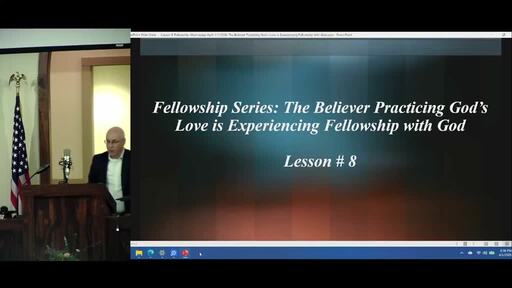
Fellowship Series: The Believer Practicing God’s Love is Experiencing Fellowship with God
Lesson # 8
If the believer is going to experience fellowship with God, they must exercise or demonstrate the love of God in their lives.
The believer who exercises God’s love toward their fellow human being is experiencing fellowship with God.
If they are loving their fellow believer as Jesus Christ has loved them and is loving them, then, they are experiencing fellowship with God.
If they are not exercising the love of God in their lives, then, they are not experiencing fellowship with God and this is an eternal spiritual truth.
The Bible teaches that God as to His nature, is love.
1 John 4:7 Dear friends, let us love one another, for love comes from God. Everyone who loves has been born of God and knows God. 8 Whoever does not love does not know God, because God is love. (NIV84)
“Knows” in verse 7 and “know” in verse 8 are translating the verb ginōskō (γινώσκω), which means, “to know experientially.”
To experience means, “to personally encounter, observe or undergo something through a process, to have knowledge or practical wisdom gained from what one has observed, encountered or undergone,” and implies being affected by what one meets.
In verse 7, the verb means “to know experientially” God the Father in the sense of personally encountering Him through the process of learning and obeying His will as this will is revealed in the pages of Scripture and in prayer by God the Holy Spirit.
It also involves being affected by this encounter with the Father resulting in the gaining of practical spiritual wisdom and more of the character of Christ.
However, in verse 8, the verb is emphatically negated by the emphatic negative adverb ou (οὔ), which expresses a negation which is absolute and not subject to conditions or exceptions and speaks of something that is not subject to dispute or challenge.
Therefore, the verb ginōskō (γινώσκω) and the emphatic negative adverb ou (οὔ) are expressing the idea of a believer “never knowing experientially” God the Father because they disobey the Lord’s command in John 13:34 to love one another as He loves them.
1 John 4:7 Beloved, let each one of us continue to divinely love one another because this love is a characteristic originating from God (the Father). Consequently, the one who at any time does divinely love has been fathered by God (the Father) and as a result they know God (the Father) experientially. 8 The one who at any time does not practice divine-love never enters into knowing God (the Father) experientially because God (the Father) is divine-love. (Pastor’s translation)
The fact that we are beneficiaries of God’s divine-love before justification and objects of His personal love after justification will serve to encourage us when we go through adversity in life and also serves to challenge us to advance to maturity and execute the plan of God.
The believer who comprehends and acknowledges and accepts by faith that they are the object of God’s love will receive the capacity to love others, even the obnoxious.
It is only when the believer realizes and accepts by faith the extent to which God loves them that they can in turn love like God and this gives the believer the capacity to love others as God has loved the human race.
God commands the believer to love his fellow believer and fellow human being.
John 13:34 “A new commandment I give to you, that you self-sacrificially love one another, even as I have self-sacrificially loved you, that you also love one another. By this all men will know that you are My disciples, if you have self-sacrificially love for one another.” (Pastor’s translation)
John 15:12 “This is my commandment, that you self-sacrificially love one another, just as I self-sacrificially loved you.” (Pastor’s translation)
The love of God has many characteristics: (1) Loyal (John 21:7, 15-16, 20; Rom. 8:35, 39; Eph. 5:28) (2) Self-sacrificial (John 3:16; 15:13; Gal. 2:20). (3) Eternal (John 17:26). (4) Kind (1 Cor. 13:4). (5) Not self-centered (bragging, jealous) (1 Cor. 13:4). (6) Immutable (Rm. 8:39). (7) Unconditional (Rm. 8:35, 39). (8) Faithful (Rm. 8:35, 39). (9) Compassionate (1 John 3:16-17). (10) Merciful (1 John 3:16-17). (11) Righteous and Just (Rm. 13:8-10). (12) Thoughtful and Considerate (Rm. 13:8-10). (13) Truthful or Honest (1 Cor. 13:6). (14) Long-suffering (1 Cor. 13:4). (15) Enduring (1 Cor. 13:7). (16) Confident in the Future (1 Cor. 13:7). (17) Forgiving (Eph. 4:32-5:2). (18) Tolerant (Eph. 4:2). (19) Giving (John 3:16; Gal. 2:20). (20) Encourages Others (1 Thess. 4:18; 5:11). (21) Prays for Others (Jam. 5:16). (22) Considers Others More Important Than Self (Phlp. 2:3). (23) Considerate Others (Phlp. 4:10-18). (24) Shares Another’s Burden in Adversity (Gal. 6:2). (25) Delights in Being Obedient to God (John 14:23-24). (26) Reciprocates (Phlp. 1:3-7). (27) Sincere (1 Pet. 1:22).
The believer who obeys the Lord demonstrates their love for the Lord.
If they love the Lord they will obey Him.
John 14:15 If you love Me, you will keep My commandments. (NASB95)