Sundays in the Psalms (33)

Notes
Transcript
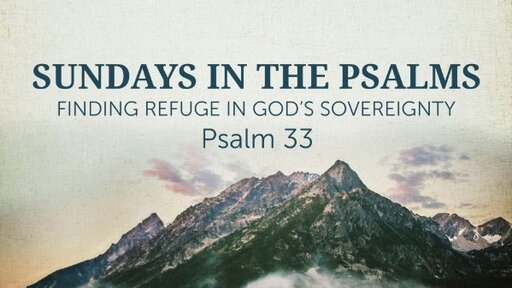
Finding Refuge in God's Sovereignty
Bible Passage: Psalm 33
This psalm reassures us that in times of trouble or uncertainty, we have a safe refuge in God. By our actions and reactions to things can share this message of security with those who fear the unpredictable nature of the world, promoting a sense of peace and unwavering hope.
This Psalm foreshadows Christ as our refuge and ultimate source of salvation.
Just as God protected and guided His people in the Old Testament, Jesus provides a secure foundation for believers today, fulfilling God's promise of unwavering presence and guidance for those who trust in Him.
Understanding God’s sovereignty should inspire us to embrace His peace and security in every aspect of our lives, allowing us to confront challenges with confidence and joy.
I. The Call to Rejoice
I. The Call to Rejoice
Psalm 33:1-3
Verse 1 – “Rejoice… for praise is comely”
“Comely” means fitting, beautiful, or appropriate.
Praise is not optional decoration—it is the proper response of the “righteous” (those aligned with God’s covenant and ways).
Joy is directed “in the LORD”, not merely in circumstances.
Verse 2 - Lets us know that rejoicing in the things of God should include musical instruments.
Verse 3 – “A new song… play skilfully”
“New song” points to fresh expressions of praise in response to God’s ongoing works.
“Play skilfully” suggests that excellence in worship matters—devotion includes effort and ability, not carelessness.
“With a loud noise” reinforces the earlier theme: worship is bold, audible, and celebratory, not merely internal.
These verses frame worship as:
Joyful (rejoicing, loud expression)
Fitting (appropriate for the righteous)
Skillful (intentional and excellent)
Renewed (continually fresh, not stagnant)
Together, these three verses establish the psalm’s trajectory:
that all people should give praise to God, since we were created and blessed to do so.
They set the tone for the rest of Psalm 33, which explains why such praise is warranted—God’s power, righteousness, and sovereign rule.
II. The Causes to Rejoice
II. The Causes to Rejoice
Psalm 33:4–19
a. God’s Word is All-Powerful (vv. 4–9)
God’s Word is not merely informative—it is creative, authoritative, and unstoppable.
David begins by establishing the
i. The character of His Word:
— it is morally perfect, never flawed, never mistaken.
“For the word of the Lord is right”
— everything God does is consistent with His Word.
“All His works are done in truth”
This means God never contradicts Himself. What He says and what He does always align perfectly.
Then the psalmist shifts from the character of the Word to the
ii. The power of the Word:
“By the word of the Lord were the heavens made”
“He spake, and it was done; He commanded, and it stood fast”
Creation itself is the greatest demonstration of God’s power. He did not struggle, strive, or labor—He simply spoke. Out of nothing, everything came into existence. Light, oceans, stars, life—all obeyed His voice instantly.
This reveals something profound:
God’s Word does not depend on circumstances
The same voice that formed galaxies is the voice that speaks into our lives today through Scripture.
His Word still carries authority, still accomplishes His purposes, and never returns void.
David also emphasizes God’s control over chaos:
“He gathereth the waters of the sea together as an heap”
“He layeth up the depth in storehouses”
To ancient readers, the sea represented disorder and danger.
Yet God restrains it effortlessly.
What seems uncontrollable to us is completely governed by Him.
Because of this what should be our response:
“Let all the earth fear the Lord”
“Let all the inhabitants of the world stand in awe of Him”
This is not fear of terror, but reverent awe—a recognition that God is infinitely powerful, completely trustworthy, and utterly sovereign.
Application
If His Word created the world, it is powerful enough to:
Sustain you when you feel weak
Guide you when you feel lost
Correct you when you go astray
Transform you when change feels impossible
Too often, we treat God’s Word as advice instead of authority. But Psalm 33 reminds us—it is not just something to read, it is something to rely on.
The power of your rejoicing is directly connected to your confidence in God’s Word.
If His Word is sure, then your hope can be sure.
If His Word stands firm, then your joy can stand firm.
a. God’s Word is All-Powerful (vv. 4–9)
b. God’s Will is All-Ruling (vv. 10–11)
After establishing the power of God’s Word, the psalmist now turns to the certainty of God’s will.
“The Lord bringeth the counsel of the heathen to nought”
“He maketh the devices of the people of none effect”
No matter how organized, powerful, or widespread human plans may be, they are ultimately limited and temporary.
God has the final say.
Nations may strategize, leaders may plan, and cultures may shift—but none of it can override the purposes of God.
This is a sobering truth: What man builds without God will not stand.
But then comes a powerful contrast:
“The counsel of the Lord standeth forever, the thoughts of His heart to all generations”
Unlike human plans that change with time, God’s purposes are:
Unchanging – they do not shift with circumstances
Unstoppable – they cannot be overthrown
Unending - they extend across all generations
God is not reacting to history—He is directing it.
This passage reminds us that God is never surprised, never caught off guard, and never forced to adjust His plans.
Everything unfolds under His sovereign authority.
Even when the world feels chaotic, nothing is out of control—it is simply out of our control, not His.
Application
When life doesn’t go according to your plans, it doesn’t mean nothing is working—it means God is working something greater.
When doors close, His purpose still stands
When plans fail, His will remains firm
When the future feels uncertain, His counsel is already settled
You can rejoice because God’s plan is not fragile—it is forever.
a. God’s Word is All-Powerful (vv. 4–9)
b. God’s Will is All-Ruling (vv. 10–11)
c. God’s Eyes are All-Seeing (vv. 12–19)
The psalmist now brings the truth even closer—not only is God powerful and sovereign, but He is also personally attentive.
God is not distant from His creation—He is deeply aware of it.
i. He Watches All Things (vv. 12–14)
“The Lord looketh from heaven; He beholdeth all the sons of men”
“From the place of His habitation He looketh upon all the inhabitants of the earth”
God sees everything.
Every person, every situation, every detail is fully visible to Him.
This means:
No one is overlooked
No situation is hidden
No moment is unnoticed
God’s vision is complete and constant.
i. He Watches All Things (vv. 12–14)
ii. He Weighs All Things (vv. 15–17)
“He fashioneth their hearts alike; He considereth all their works”
God doesn’t just see actions—He examines hearts.
He understands motives, intentions, and thoughts at the deepest level.
David corrects a common misconception:
“There is no king saved by the multitude of an host”
“A mighty man is not delivered by much strength”
“An horse is a vain thing for safety”
Earthly strength gives a false sense of security. What looks powerful to us is often powerless apart from God.
God measures things differently than we do.
We value strength—God values trust
We admire power—God examines the heart
We depend on resources—God looks for reliance on Him
i. He Watches All Things (vv. 12–14)
ii. He Weighs All Things (vv. 15–17)
iii. He Witnesses All Things (vv. 18–19)
“Behold, the eye of the Lord is upon them that fear Him, upon them that hope in His mercy”
While God sees all people, He gives special attention to those who:
Fear Him (reverence Him)
Hope in His mercy (trust Him)
And what does He do for them?
“To deliver their soul from death”
“To keep them alive in famine”
God doesn’t just observe—He intervenes.
He protects, provides, and preserves His people, even in the hardest conditions.
Application
You are never outside of God’s sight or beyond His care.
When you feel forgotten—He sees you
When you feel uncertain—He understands
When you feel vulnerable—He is watching over you
When you put all three truths together:
His Word is powerful
His Will is unshakable
His Eyes are attentive
You realize that You have every reason to rejoice.
Rejoicing is not based on circumstances—it is based on the unchanging nature of God.
III. The Choice to Rejoice
III. The Choice to Rejoice
Psalm 33:20–22
After reflecting on who God is, the psalmist moves from truth to response—a deliberate decision to trust.
This section calls us to rest fully in God’s steadfast love.
It also points forward to the ultimate refuge found in Christ, where believers find peace, confidence, and joy.
a. The Patience in the Choice
“Our soul waiteth…”
This is not casual waiting—it is the posture of the soul.
It speaks of deep, inward dependence.
The psalmist is not merely passing time; he is placing his expectation fully on God.
Waiting on God requires trust and endurance.
It means choosing faith over anxiety.
Waiting is not about God being slow—it is about God being purposeful.
He is working in ways we cannot always see.
Faith says, “Even if I don’t see it yet, I trust that God is at work.”
Application: Waiting is not inactivity—it is confident expectation.
a. The Patience in the Choice
b. The Protection in the Choice
“He is our help and our shield”
Here the psalmist shifts from waiting to confidence.
God is described in two powerful ways:
Help – He actively comes alongside us to strengthen and sustain
Shield – He stands between us and harm as our defender
This means God is both present in our need and protective in our vulnerability.
A shield does not remove the battle—it protects you in the battle.
God does not promise a life without difficulty, but He does promise His presence and protection through it.
a. The Patience in the Choice
b. The Protection in the Choice
c. The Pleasure in the Choice
“For our heart shall rejoice”
Now we see the result of trust—joy.
Notice the progression:
Waiting → Trusting → Rejoicing
Joy is not commanded here—it emerges naturally from confidence in God.
This joy is not dependent on circumstances.
It is rooted in the unchanging character of God.
The heart rejoices not because everything is going right, but because God is still right.
True joy is not the absence of trouble—it is the presence of trust.
a. The Patience in the Choice
b. The Protection in the Choice
c. The Pleasure in the Choice
d. The Proclamation in the Choice
The psalm concludes with a powerful declaration of hope.
“according as we hope in thee”
He is saying..
“Regardless of the situation, I will hope in God.”
Choosing to trust God is more than a personal decision—it is a public proclamation that:
His mercy is new every morning
His plans are better than ours
His leadership is worth following
Hope here is not wishful thinking—it is confident assurance in God’s character and promises.
And this hope is not hidden—it is visible.
Trusting God is never silent.
It speaks through:
Your attitude in difficulty
Your peace in uncertainty
Your confidence when others are afraid
Your life becomes a testimony of where your hope truly lies.
Your life becomes a message: God is trustworthy.
When you choose hope, others notice
When you remain steady, others are encouraged
When you trust God, others see His faithfulness
David closes with a heartfelt prayer:
“Let thy mercy, O Lord, be upon us, according as we hope in thee”
This ties everything together:
Our waiting is anchored in hope
Our confidence is grounded in His character
Our joy flows from trusting Him\
Our lives proclaim His faithfulness
Conclusion
Conclusion
As David brings this psalm to an end, he leaves us with more than a truth—he leaves us with a decision.
We have seen the call to rejoice…
We have examined the causes to rejoice…
Now we are confronted with the choice to rejoice.
Because if God’s Word is truly all-powerful…
If His will is truly all-ruling…
If His eyes are truly all-seeing…
Then the question is not “Do I have a reason to rejoice?”
The question is… “Will I choose to?”
David answers that question clearly:
“Regardless of the situation, I will hope in God.”
That is not based on feelings.
That is not dependent on circumstances.
That is a settled conviction based on who God is!!
“Let thy mercy, O Lord, be upon us, according as we hope in thee.”
In other words:
“God, I am placing my full weight on You—now let Your mercy meet me there.”
So when life feels uncertain… choose to wait.
When you feel vulnerable… choose to trust.
When circumstances don’t change… choose to rejoice.
Because rejoicing is not pretending everything is okay—
It is declaring that God is still in control.
When your hope is in God, your joy has a foundation that circumstances cannot shake.
