Jonah 4.7-God Sends a Worm to Attack the Plant So That It Dried Up (Doctrinal Bible Church in Huntsville, Alabama)

Doctrinal Bible Church
Pastor-Teacher Bill Wenstrom
Sunday April 26, 2026
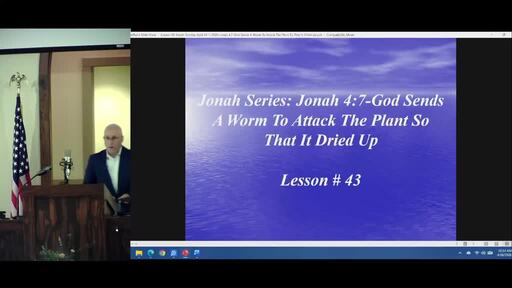
Jonah Series: Jonah 4:7-God Sends A Worm To Attack The Plant So That It Dried Up
Lesson # 43
Jonah 4:7 records God sending a worm to attack the plant so that it dried up.
Jonah 4:1 But Jonah was greatly displeased and became angry. 2 He prayed to the Lord, “O Lord, is this not what I said when I was still at home? That is why I was so quick to flee to Tarshish. I knew that you are a gracious and compassionate God, slow to anger and abounding in love, a God who relents from sending calamity. 3 Now, O Lord, take away my life, for it is better for me to die than to live.” 4 But the Lord replied, “Have you any right to be angry?” 5 Jonah went out and sat down at a place east of the city. There he made himself a shelter, sat in its shade and waited to see what would happen to the city. 6 Then the Lord God provided a vine and made it grow up over Jonah to give shade for his head to ease his discomfort, and Jonah was very happy about the vine. 7 But at dawn the next day God provided a worm, which chewed the vine so that it withered. 8 When the sun rose, God provided a scorching east wind, and the sun blazed on Jonah’s head so that he grew faint. He wanted to die, and said, “It would be better for me to die than to live.” 9 But God said to Jonah, “Do you have a right to be angry about the vine?” “I do,” he said. “I am angry enough to die.” 10 But the Lord said, “You have been concerned about this vine, though you did not tend it or make it grow. It sprang up overnight and died overnight. 11 But Nineveh has more than a hundred and twenty thousand people who cannot tell their right hand from their left, and many cattle as well. Should I not be concerned about that great city?” (NIV84)
“But at dawn the next day God provided a worm” is presenting a contrast between God providing this plant for Jonah with His taking it away from Jonah.
The noun ʾělō∙hîm emphasizes the transcendent character of God and in particular His attributes of omnipotence, sovereignty and love.
The word emphasizes with the reader that the sending of the worm to attack and kill this plant expresses the Lord’s sovereign control over His creation and His omnipotence over creation as well as His love for Jonah.
By taking this plant away from Jonah, He is teaching Jonah about His grace policy.
The noun ʾělō∙hîm also pertains to the fact that the Lord is Jonah’s deliverer in the sense that by killing this plant with the worm in order to teach Jonah about His grace policy towards the Ninevites, He is delivering Jonah from his evil, self-righteous attitude towards the Ninevites.
The Lord wanted to deliver Jonah from his uncompassionate attitude toward these people.
The verb mā∙nā(h) means “to commission” in the sense that the Lord appointed or assigned a worm for the specific purpose or task of attacking the plant so as to kill it and it emphasizes with the reader the Lord’s sovereign control over His creation and His omnipotence over creation.
The noun tô∙lē∙ʿā(h) is a general term for any several species of creeping invertebrate, which consumes organic matter.
This term, which is translated by the NIV84 as “worm” is translated various ways since the particular species of crawling invertebrate is uncertain and it may refer to the black caterpillar that is plentiful in the region around Nineveh and worms can strip a plant of its foliage in a single night.
“At dawn the next day” is referring to the daybreak or just prior to sunrise or in other words the early time of the morning when the first rays of light are seen in the eastern horizon.
In our context, it marks the particular point in time when the worm that God commissioned attacked the plant in order to kill it.
“Chewed the vine” is composed of the verb nā∙ḵā(h) (נָכָה) and the object marker ʾēṯ (אֵת) (oath) and the noun qî∙qāy∙wōn (קִיקָיוֹן), “a plant.”
This clause emphasizes to the reader the purpose of this worm.
The verb nā∙ḵā(h) means “to attack” and is used of the worm attacking the plant so that as a result it died.
The New American Commentary, “The destructive effect of worms on many types of vegetation is well known. The cutworm can easily destroy the stem of a plant and can do so almost immediately.” (The New American Commentary: Amos, Obadiah, Jonah; page 279)
“So that it withered” is a result clause that indicates that the plant withered as a result of the worm attacking it.
The verb yā∙ḇēš means “to dry up, to be withered” or in other words, to be in a state of relatively little or no moisture and it emphasizes God’s sovereignty over creation in that He can cause this plant to die by means of this worm.
It expresses the fact that God is disciplining Jonah by causing this worm to attack the plant so that its leaves die since this word communicates the idea of judgment.
Jonah 4:7 contains another irony in that this plant, which caused Jonah to be extremely delighted was destroyed by God whereas the Ninevites who the prophet hated and caused him misery, were not destroyed.
By killing this plant, the Lord was attempting to deliver Jonah from his evil attitude towards His grace policy with regards to the Ninevites, which is indicated by the dialogue in verses 7-11 where the Lord is teaching Jonah about His grace policy.
In verse 7, by killing this plant with the worm, God is treating Jonah the way the prophet wished that God had treated the Ninevites.
Again, Jonah loves when God treats him in grace but not the Ninevites.
Jonah was undeserving like the Ninevites, yet he thinks that God was wrong to extend grace to them.
This is due again to his self-righteousness in that he is comparing himself to the Ninevites and concluding that he is better than them, however, if he compared himself and the Ninevites to God’s perfect holy standards, he would have to conclude that he is no better than the Ninevites.
Consequently, if he acknowledged this fact, he would have no problem with God treating the Ninevites in grace since he too was undeserving of being delivered from death and had been the beneficiary of God’s grace.