A Good Citizen

Notes
Transcript
Ugh, the government, am I right?
Depending on your views of the government that may conjure up a variety of thoughts for you. Maybe for some of us, they are less… holy(?) thoughts than for others!
Today we are talking about Paul’s teaching around how followers of Jesus must live as citizens of a country. If we can just do the super quick fly-over review of our time in Romans so far, we have learned about the power of the gospel, what we have been saved from - words like fear and slavery have been significant.
And when Paul reveals the fullness of the gospel we see that we are not only saved from fear and slavery, but we are saved for something entirely new and different. Starting in chapter 12, we came to those key verses that changed the entire direction of the book of Romans.
Therefore, brothers and sisters, in view of the mercies of God, I urge you to present your bodies as a living sacrifice, holy and pleasing to God; this is your true worship. Do not be conformed to this age, but be transformed by the renewing of your mind, so that you may discern what is the good, pleasing, and perfect will of God.
From that point on, everything that we have talked about and will talk about are about application. If we have chosen to believe the gospel, how should we live?
As we dig into what the Bible says about the government, I want to be very clear that I firmly believe that the only politics that belong in the pulpit are the politics of Jesus. In fact, Paul tells us in another of his letters that our citizenship belongs to another place… Phil 3:20. However, we are born in a place with citizenship in that place. So, we need to learn how citizens of a heavenly kingdom should navigate being temporary residents of an earthly kingdom.
Our citizenship is in heaven, and we eagerly wait for a Savior from there, the Lord Jesus Christ.
Many Christians use different verses and passages to justify what they believe, but unfortunately most of them are looking to proof-text their beliefs. By this I mean, they come to the text to justify what they already believe. If they can find one verse or even one part of a verse, they think they can back up what they believe.
This has ALWAYS BEEN and will most likely ALWAY BE a problem. When we come to the Bible, for whatever reason, it MUST be without agenda or conviction, looking to be formed by Scripture, not forming it to our likeness. There are two words that scholars use for the different approaches - eisegesis is when I have an agenda, and I come to the Bible looking to defend/justify or explain my agenda. Exegesis is when I come to the Bible and my agenda is only to let it tell me what my agenda should be. Eisegesis has led to all kinds of theological problems, resulting in way too many churches that stand for nothing and affirm anything. I’m sure I have told you before, used properly, eisegesis can make the Bible say almost anything you want it to!
As I was thinking about the politics of Jesus, I was reminded of the Apostles that he chose. Matthew, for example, was a tax collector. A servant of the state who by his participation implicitly accepted what was. On the other hand you have the Zealot named Simon. The Zealots resisted Roman rule and often did so violently. Imagine some of the fireside chats that they had once everyone had left for the day!
The two extremes were united in the calling of Jesus. If you have trusted the gospel and are working to faithfully follow Jesus, it doesn’t matter whether you are slightly off of the centre or others would consider you extreme, our politics are nothing in Christ. Could you imagine if Paul (Gal 3:28) said that in Christ there is no more Jew or Greek, slave or free, male or female, but if you are conservative or progressive, there’s nothing we can do about that?
There is no Jew or Greek, slave or free, male and female; since you are all one in Christ Jesus.
If there was room in those closest to Jesus for a variety of opinions, then there is room in the great cloud of witnesses to which followers of Jesus, past, present and future, belong. The unity that we are invited to experience in Jesus transcends anything that could be used to divide us. Knowing there would be a variety of opinions, Paul decided to remind us of the call to love one another - even in the context of politics. If there is one way to boil down the core of Jesus’ politics, it is simply this: Jn 15:12.
“This is my command: Love one another as I have loved you.
We demonstrate love for one another by following the ways of the sheep in Matthew 25 who fed the hungry, give drink to the thirsty, took in the stranger, clothed the naked, cared for the sick and visited those in prison.
I don’t know how many times I have said this in my recent memory whether in a sermon, or when I’m reading the Bible with others or even when I’m reading by myself - I have said this a lot - the verse and chapter divisions aren’t always helpful and once again, this is the case.
Some people will look at our passage for today, which is the beginning of a new chapter in Romans, and they will lift if out of its greater context, this happens way too often. But you need to look at where it belongs in Romans. The immediate context is quite interesting because in Romans 12:18, Paul says…
If possible, as far as it depends on you, live at peace with everyone.
And that isn’t all, in the verses following today’s passage, he continues on saying Romans 13:8
Do not owe anyone anything, except to love one another, for the one who loves another has fulfilled the law.
In fact, these seven verses, if they are removed from the context of love, become a weapon, when they are intended as a hypothetical situation. As we have already seen, love for one another must be THE defining charateristic of a disciple of Jesus. Unfortunately, that is not always the case and it is often because people lift a verse out of context and weaponize it.
Paul is saying that if you recognize that you need the gospel, you should look different than the world. Last week, Kyle took us through the second part of chapter 12 with this comprehensive list of ways that followers of Jesus should be different and then look at his final thought in chapter 12…
Do not be conquered by evil, but conquer evil with good.
This passage has more to do with unity between believers than it does with politics - although, the political context is important. As far as teaching gows, Paul basically only reiterates what the Bible says elsewhere.
May the name of God be praised forever and ever… he removes kings and establishes kings.
Compare that with Romans 13:1
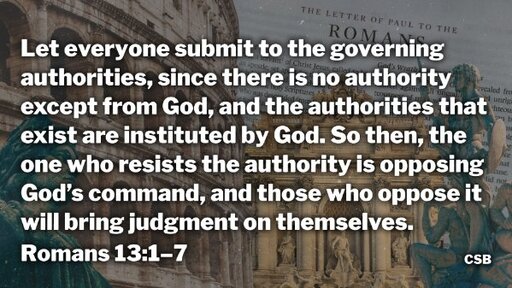
Let everyone submit to the governing authorities, since there is no authority except from God, and the authorities that exist are instituted by God.
Or
“Well then,” he told them, “give to Caesar the things that are Caesar’s, and to God the things that are God’s.”
Compared with
Pay your obligations to everyone: taxes to those you owe taxes, tolls to those you owe tolls, respect to those you owe respect, and honor to those you owe honor.
None of this instruction is new. What makes it new and very important is that it is placed in the context of a longer conversation around love as a display of true worship to God for his mercy towards us in Jesus.
Paul doesn’t care where you fall on the spectrum of left and right, what he cares about is that you love each other wherever we land on that spectrum. Do not be conquered by evil! What is evil? Vengeance, pride, discord, anger, hypocrisy. If you have been paying any attention for the last year these are the exact things that politics have sown in everyone - believers and unbelievers alike. Saying something simple like “I’m right and you’re wrong,” would be a nice way of disagreeing these days.
Debates tend to turn into full fledged arguments and they quickly devolve into, “how can you believe that?” With the implication being that you are either too dumb or ignorant to agree with the other person - who is, of course, right!
Paul’s solution is not to try correct anyone’s political beliefs, it is, ‘who cares about your political beliefs?’ Everyone - and he is being specific to believers here - needs to submit to the authorities by conquering evil with good. What is good? Blessing one another, rejoicing with one another, mourning with one another, living in harmony with one another, showing humility to one another. And ultimately, we submit to the authorities because God put them there! He say…
the one who resists the authority is opposing God’s command, and those who oppose it will bring judgment on themselves.
Again, taken within the whole counsel of Scripture, Paul is not saying to blindly obey - especially when it comes to matters of sin and conscience. When historical tyrants like Stalin, Hitler or Pol Pot were in power, Paul’s counsel would not have been ‘just go along everything that they said,’ but, again, going back to chapter 12…
If possible, as far as it depends on you, live at peace with everyone.
We are not responsible for the choices that the government makes. We will not be held responsible for whatever atrocities other people might commit, we will be held responsible for the way that we obeyed what we could and more importantly, as much as we can do so, lived at peace with our fellow Jesus followers.
Just because this could be a lingering question - how should a disciple of Jesus respond in the face of wanton disregard for the poor, the immigrant and others, or as some historical examples have shown, much worse? Hold on tight, because in the Psalms there is a big one. Psalm 82:3-4
Defend the weak and the fatherless; uphold the cause of the poor and the oppressed. Rescue the weak and the needy; deliver them from the hand of
the wicked.
We need to find a way to care about the people that Jesus cared about. Some of you might remember who Jesus cares about in Matthew 25 - the least of these. And here the Psalmist tells us specifically. We need to operate out of love for Jesus that extends to love for and care for others.
Why does it matter so much how we treat one another? Because the world is an absolute free for all! Peter explains this very well in one of his letters, saying, 1 Peter 2:13-17
Submit to every human authority because of the Lord, whether to the emperor as the supreme authority or to governors as those sent out by him to punish those who do what is evil and to praise those who do what is good. For it is God’s will that you silence the ignorance of foolish people by doing good. Submit as free people, not using your freedom as a cover-up for evil, but as God’s slaves. Honor everyone. Love the brothers and sisters. Fear God. Honor the emperor.
In case you’re wondering, the political situation at the time of Paul and Peter was much worse than it is today and in the coming years it would get much worse for them. All the licentiousness and sin that is rampant today is not unique to our time, and the government was actively persecuting Christians. Not many years before, the emperor Claudius, had expelled all the Jews from Rome because of a dispute among them over Jesus. At this point, some had now returned, but they had returned to a very volatile situation. Yet, both Paul and Peter called followers of Jesus to radical submission to the tyrannical government because when we do good - even in the face of persecution - it speaks to the genuineness of our faith.
People notice our faithful obedience to the Lord - not by the ways that we parade our freedom - but by the ways that we submit even though we are free.
As Peter said 1 Pet 2:17
Honor everyone. Love the brothers and sisters. Fear God. Honor the emperor.
Back in Romans 12, rulers, Paul says in verse 3, are not a terror to good conduct. This is a very important line in the middle of the passage. I want to highlight two words that are very significant - terror and conduct. The Greek word that we translate terror, in this placement and verb sense means deterrant. We may not let rulers deter us from good conduct.
But to complete the picture we also want to understand what the word conduct means. The Greek word for conduct, paired with the word, ‘good’ and used in the context of followers of Jesus, literally means deliberate actions performed with conscious alignment to the authority and character of Jesus.
So, while we are expected to obey the authorities as an act of worship to Jesus, we must be more devoted to submitting to the authority of and pursuing the character of Jesus. The government doesn’t get to legislate morality.
Are you picking up the force of this passage? As we pursue a life that increasingly displays our love for Jesus, sacrificing our lives as an act of worship to him. We must submit to the authorities, not because they are perfect or even trying to be godly, but because God put them there. However, we don’t take our moral cues from the government, we get those from Jesus. Look to the way Jesus treated the outcasts and poor, the hurting and broken.
If the government treats people badly, we must still treat them well in the name of Jesus. When you see people in the world with damaged relationships that stem from political disagreements, we can step in and show them a new way to live.
Let me wrap up with this. Earlier this week I got a text from someone in the church - I won’t expose you, don’t worry! They said, I don’t know who to shoot first, the guy who wrote the first 9 chapters of 1 Chronicles or the guy who included them in the church reading plan. If you are following along, you know exactly what that means.
Because the 1 Chronicles readings have been so impractical, in our morning devotions time, we have been spending our time in the John passages this week. I actually had to come back and do this ending again after reading John 17 on Friday. We often refer to this as Jesus’s High Priestly Prayer. In it, he intercedes for his immediate followers, those with him in the moment, and then he prays for us. He prays
I pray not only for these, but also for those who believe in me through their word. May they all be one, as you, Father, are in me and I am in you. May they also be in us, so that the world may believe you sent me.
Jesus didn’t pray for our health, wealth and happiness. He prayed for the unity of the future church. He prayed that we would be one.
Jesus doesn’t care about your political views. He cares that you submit to him above all else. He cares that we love, serve, and honour one another. He cares that as far as it depends on us that we live at peace with everyone. He cares that we demonstrate peace by submitting to the authorities in whatever way we can. He cares that we feed, give water to, care for and love the stranger.
That’s a big ask. But Jesus prayed for us, that in our unity the world would see him and the Father. Then in Acts 2, he sent his Spirit to empower us to do it. This matters to our individual lives, this matters to the corporate life of Sunshine Ridge and the big C Church, and it matters to people who don’t yet know Jesus.
May followers of Jesus - and Sunshine Ridge specifically - never be politically left or right. May we never NEED to be correct. Rather, in our daily pursuit of Jesus, may we live as citizens of better kingdom who pursue not power, but influence. Who don’t legislate morality, but demonstrate it. And ultimately, through our connection to Jesus, may we be the men and women who love one another so deeply that whatever issues divide the world would be unimportant in the light of the love he has for us.
