Jonah 4.10-11-The Lord Rebukes Jonah for Showing More Concern for the Plant Than the Ninevites (Doctrinal Bible Church in Huntsville, Alabama)

Doctrinal Bible Church
Pastor-Teacher Bill Wenstrom
Sunday May 3, 2026
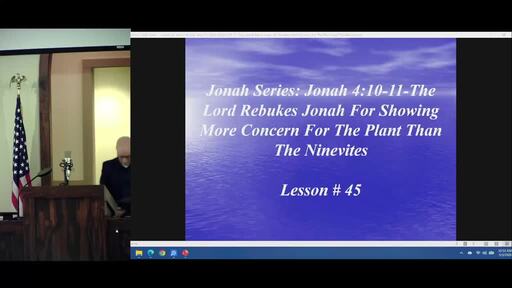
Jonah Series: Jonah 4:10-11-The Lord Rebukes Jonah For Showing More Concern For The Plant Than The Ninevites
Lesson # 45
In Jonah 4:10-11, the Lord rebukes Jonah for showing more concern about the plant than the Ninevites.
Jonah 4:1 But Jonah was greatly displeased and became angry. 2 He prayed to the Lord, “O Lord, is this not what I said when I was still at home? That is why I was so quick to flee to Tarshish. I knew that you are a gracious and compassionate God, slow to anger and abounding in love, a God who relents from sending calamity. 3 Now, O Lord, take away my life, for it is better for me to die than to live.” 4 But the Lord replied, “Have you any right to be angry?” 5 Jonah went out and sat down at a place east of the city. There he made himself a shelter, sat in its shade and waited to see what would happen to the city. 6 Then the Lord God provided a vine and made it grow up over Jonah to give shade for his head to ease his discomfort, and Jonah was very happy about the vine. 7 But at dawn the next day God provided a worm, which chewed the vine so that it withered. 8 When the sun rose, God provided a scorching east wind, and the sun blazed on Jonah’s head so that he grew faint. He wanted to die, and said, “It would be better for me to die than to live.” 9 But God said to Jonah, “Do you have a right to be angry about the vine?” “I do,” he said. “I am angry enough to die.” 10 But the Lord said, “You have been concerned about this vine, though you did not tend it or make it grow. It sprang up overnight and died overnight. 11 But Nineveh has more than a hundred and twenty thousand people who cannot tell their right hand from their left, and many cattle as well. Should I not be concerned about that great city?” (NIV84)
This verse stands in direct contrast with Jonah’s reply to God’s question that appears in verse 9.
Therefore, the contrast is between Jonah’s justification for being angry over God’s decision to kill the plant and spare the Ninevites and God’s response in verses 10-11 in which the Lord declares that the prophet is not justified for being angry about the plant and His decision to spare the Ninevites.
“You have been concerned about this vine” reveals that God is affirming that Jonah had concern for the plant.
“Though you did not tend it” indicates that Jonah by no means put forth considerable effort and energy in cultivating or tending the plant.
“Or make it grow” indicates that Jonah by no means caused the plant to grow bigger.
“It sprang up overnight” refers to the fact that the plant became mature in a time period of overnight and “and died overnight” refers to the death of the plant.
In Jonah 4:10, the Lord is attempting to teach Jonah that he is totally unjustified in his anger concerning His decision to kill the plant with a worm and more importantly spare the lives of the Ninevites.
The Lord rebukes Jonah for his unjustified anger about the death of the plant by telling Jonah that he by no means worked for it and by no means did he cause it to grow.
The plant came into existence in one night and died the very next night.
Yet, Jonah was angry though he had absolutely nothing to do with the life and death of the plant.
The prophet wanted to die over a plant whose entire lifespan was one day even though he had no right or claims upon the plant since it was God’s creation and He had every right to end its existence since He is the sovereign Creator.
The plant was a gift of God’s grace, which Jonah therefore, did not merit or deserve.
The Lord wants Jonah to understand that he has no business questioning or complaining about His decision to destroy the plant since Jonah has no merit with Him, nor did he create the plant.
This question in verse 11 is an a fortiori argument from lesser to greater and the lesser is Jonah’s concern about the little plant whereas the greater is the Lord’s concern for the people of Nineveh.
“Should I not be concerned about that great city?” is affirming the Lord’s concern for the Ninevites.
“The great city” refers to the enormous population of the greater Nineveh area.
“In which there are more than 120,000 persons” affirms the existence of 120,000 persons in the city of Nineveh and its surrounding districts.
“Who cannot tell their right hand from their left” refers to the fact that Nineveh had 120,000 children who could not distinguish between what is right from what is wrong.
It by no means indicates that the Ninevites were morally innocent or not accountable for their actions since the Ninevites themselves acknowledge their guilt in Jonah 3:5 and 8.
It also does not express the fact that the Ninevites were ignorant of God since creation manifests the fact that there is a God.
Also, the inherent law that is basically the Ten Commandments resides in the soul of every human being without exception according to Romans 2:14-15.
The fact that they expressed their guilt before God and had nothing in writing from
God like the Jews demonstrates that they were by no means ignorant of God’s law.
The interpretation would indicate that the population of the greater Nineveh area would have been 600,000.
Such a number of children would suggest a population in the greater Nineveh area of 600,000.
Archaeology does not substantiate this number if Nineveh refers only to the city proper.
However, if one holds this view, as this writer that Nineveh refers to the city proper and its surrounding districts, then this population estimate is possible.
The mention of domestic animals further emphasizes the stupidity and irrationality of Jonah’s position.
The Lord had the first word in the book of Jonah and He has the last.
Since the Lord poses a rhetorical question to Jonah, we would expect that the final word would belong to Jonah.
However, this is not the case.
There are several reasons for the silence.
First of all, Jonah didn’t respond because he finally understood what God was telling him.
Another reason why Jonah does not respond to the Lord’s rhetorical question is that this question presents the message of the book.
Also, another reason for Jonah’s silence is that it confronts the reader as to their response.
It makes the reader reflect upon his attitude as to whether or not he holds the Lord’s viewpoint toward the human race or Jonah’s.
The silence to the Lord’s question invites a response by the reader.
In Jonah 4:10-11, the Lord makes His point with Jonah that He is sovereign, His policy with all the nations and not just Israel, is grace.
